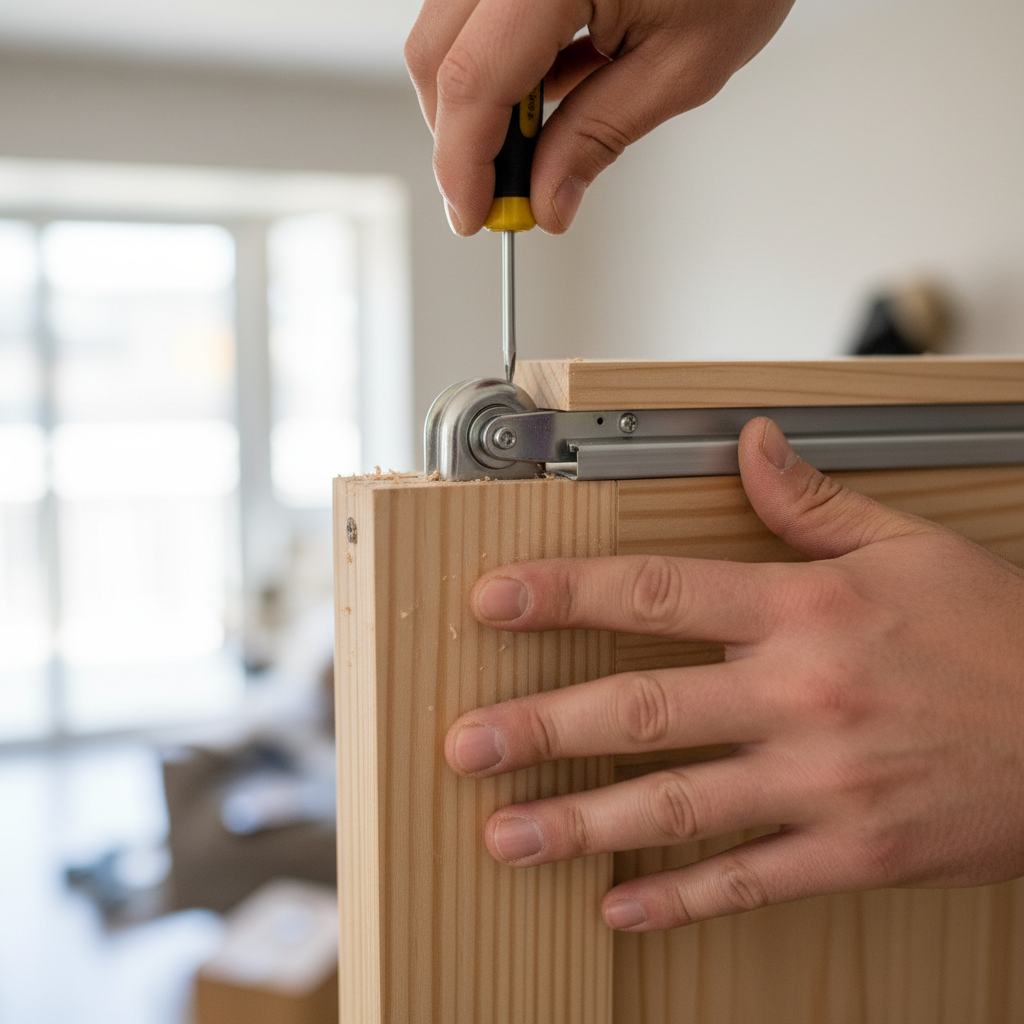
- Worn-Out Rollers: This is the number one cause. The plastic or nylon wheels crack, develop flat spots, or break from age and use. The axles can also bend or seize, preventing the wheel from turning.
- Bent or Damaged Track: If the overhead track is bent downwards, even slightly, it creates a low spot where a roller can easily jump out. Dents or debris inside the track can also cause a roller to catch and derail.
- Missing or Broken Floor Guide: Without the floor guide to keep the bottom of the door stable, the door can swing wildly, putting sideways stress on the rollers and causing them to pop out of the track.
- Improper Installation: If the track was not installed level, the door will constantly want to roll to the low side. This constant momentum can contribute to derailments, especially if the door is stopped abruptly.
- Objects in the Track: Small objects, from fallen clothing hangers to pet toys or accumulated debris, can obstruct a roller, causing it to jump the track.
General remodeling · Renovation planning
| Project category | General remodeling |
|---|---|
| Problem type | Renovation planning |
| Trade required | General contracting |
| Urgency | Planned project |
| Safety risk | Low safety risk |
| DIY suitability | Pro recommended |
| Cost category | Major investment |
| Typical timeline | Design and permitting often 2–4 months before work starts |
| Contractor type | General contractor |
Repair option
Phase the work and fix the building envelope first.
Replacement option
Full renovation with permits, design, and a general contractor.
Common causes
- Space no longer fits how the household lives
- Resale preparation
- Deferred maintenance stacking up
Relevant tools:project cost estimatorcompare quoteshome improvement material prices
Published May 2, 2026Last updated August 17, 2026
Tools & materials you'll need
Affiliate linksAs an Amazon Associate FixlyGuide earns from qualifying purchases — at no extra cost to you. Prices and availability are accurate as of publication and subject to change.
Quick Answer
Your sliding closet door most likely keeps falling off its track due to worn-out or broken roller hardware, not the door itself. Over time, the plastic wheels on the rollers crack and the axles seize, causing the door to jump the track instead of gliding smoothly. Replacing the entire set of roller hardware is the only permanent solution.
The Problem
It’s a familiar, frustrating routine. You slide your closet door open, and with a jarring lurch, one side drops down, the door scraping uselessly against the frame. You sigh, lift the heavy door back into its metal track, and it works—for a little while. But soon, whether it's a day or a week later, it happens again. The closet door falls off track, seemingly at random. You might blame the house settling, the kids being too rough, or just bad luck. Many homeowners assume this is just something they have to live with, repeatedly wrestling the door back into place.
The reality is that simply popping the roller back into the track is like putting a bandage on a broken arm. You've addressed the immediate symptom but completely ignored the underlying cause. A properly functioning sliding door system is designed to be robust and should operate smoothly for years without derailing. When a closet door falls off track repeatedly, it's a clear sign that a critical component in the system has failed. Ignoring it not only causes daily frustration but can also lead to further damage to the door, the track, and even your flooring as the heavy door scrapes and bangs against surfaces it was never meant to touch. This isn't a random annoyance; it's a mechanical failure with a specific, and thankfully, fixable cause.
How It Works
A sliding bypass closet door system operates on a simple but clever principle of guided suspension. All the weight of the doors rests on a set of rollers that ride inside a metal track mounted to the header above the door opening. This is the single most important part of the entire system. Each door typically has two roller assemblies screwed into its top edge. These rollers consist of a small wheel (often nylon or plastic) on an axle, which is attached to a mounting bracket. Crucially, these brackets are often J-shaped or have a height adjustment screw, allowing for precise vertical positioning of the door.
This top-hung design is inherently stable. As you slide the door, the wheels roll along the inner channel of the track. To prevent the bottom of the doors from flapping back and forth, a small floor guide is installed. This guide can be a simple C-shaped bracket that the bottom edge of both doors slides through, or it might be a set of small L-shaped brackets that create a channel. The guide doesn't bear any weight; its sole job is to keep the doors aligned vertically as they move.
When new, the rollers glide effortlessly. The wheels are perfectly round, the axles spin freely, and the weight is distributed evenly. Over thousands of open-and-close cycles, however, these small plastic and metal parts wear down. The plastic wheels can develop flat spots, crack, or break apart entirely. The axles, often just simple rivets, can bend or seize up with dust and lack of lubrication. When a wheel stops spinning and starts dragging, or when it breaks, it creates a point of high friction. Instead of rolling smoothly, the roller assembly "trips" and, with the momentum of the door, hops up and out of the track. This is the moment of derailment. The reason your closet door falls off track isn’t a mystery; it’s the predictable failure of these small, hard-working components.
Step-by-Step Fix
This guide covers the full replacement of the track and roller hardware, which is the definitive fix for a door that repeatedly falls off track.
1. Remove the Doors — To get the doors off, you typically need to slide them to the center of the opening, then swing the bottom of the door out towards you. Once the bottom is clear of the floor guide, you can lift the entire door up and out, compressing the spring-loaded rollers or maneuvering the J-hooks out of the track. Be aware that closet doors, especially solid-core ones, can be heavy and awkward. It's often helpful to have a second person assist you.
2. Inspect the Old Track and Rollers — With the doors off, take a close look at the hardware. Spin the wheels on the rollers. Do they spin freely, or are they seized and gritty? Look for cracks or chunks missing from the plastic wheels. Now, look at the metal track. Is it bent, dented, or warped anywhere? A common failure point is a slight downward bend in the middle, which can cause the rollers to hop out.
3. Pry Off the Old Track — If the track is damaged or you're replacing all the hardware as a kit, the old track must be removed. Use a pry bar and a small block of wood (to protect your wall) to gently pry the track away from the door header. It's usually held in by a few nails or screws. Work from one end to the other, applying steady pressure.
4. Measure and Cut the New Track — Use a tape measure to determine the required length for your new track; it should be identical to the old one. Mark the cut line on the new aluminum or steel track with a permanent marker. Place the track on a stable surface and use a hacksaw with a fine-toothed blade (at least 24 TPI) to make a clean, straight cut. Smooth any burrs from the cut end with a metal file.
5. Drill Pilot Holes in the New Track — Your new track may not come with pre-drilled mounting holes that line up with your wall studs or solid header. Hold the new track up in place and use a pencil to mark where you need to drill. A good rule of thumb is to have a screw every 16-24 inches. Take the track down and drill pilot holes using a bit sized for your mounting screws. Drilling on the ground is much safer and more accurate than trying to drill overhead.
6. Install the New Track — Position the new track against the header, ensuring it's level. Use a 4-foot level to check it; a track that isn't level will cause the door to roll open or closed on its own. Drive your mounting screws into the pilot holes, securing the track firmly to the header. Do not overtighten, as this can warp a thin aluminum track and impede roller movement.
7. Replace the Rollers on the Door — With the door lying on a flat, protected surface (like a pair of sawhorses or a carpeted floor), use a screwdriver to remove the old roller assemblies from the top edge. Position the new rollers in the same location and screw them in. Most new hardware kits come with multiple roller options; choose the one that matches your old hardware (e.g., J-hook vs. top-mount, axle distance).
8. Install the New Floor Guide — The hardware kit will include a new floor guide. The most common type is a small C-shaped plastic bracket. Position it directly underneath the center of the track. The doors will slide through it. Screw it into the floor, ensuring it doesn't obstruct the path of the doors but keeps them from swinging.
9. Hang the First Door — This is usually the back door. Hook the new rollers into the back channel of the new track. This can take some maneuvering. You may need to angle the door significantly, hook the rollers in, and then let the bottom swing down into place. Ensure both rollers are securely seated in the track.
10. Hang the Second Door and Test — Hang the front door in the front channel of the track. Once both doors are up, slide them back and forth. They should glide smoothly and quietly. Check that they overlap correctly in the center and don't scrape against each other. The movement should feel almost effortless compared to the old, worn-out hardware.
11. Adjust Roller Height — Most modern roller hardware allows for fine-tuning the door's height. Use a screwdriver or a small wrench to turn the adjustment screw on the roller bracket. This will raise or lower that corner of the door. Adjust each corner until there is an even, minimal gap (about 1/4 inch) between the bottom of the doors and the floor, and the doors hang perfectly plumb.
Common Causes
Understanding why a closet door falls off track helps in preventing future issues. The causes are almost always related to the hardware system.
- Worn-Out Rollers: This is the number one cause. The plastic or nylon wheels crack, develop flat spots, or break from age and use. The axles can also bend or seize, preventing the wheel from turning.
- Bent or Damaged Track: If the overhead track is bent downwards, even slightly, it creates a low spot where a roller can easily jump out. Dents or debris inside the track can also cause a roller to catch and derail.
- Missing or Broken Floor Guide: Without the floor guide to keep the bottom of the door stable, the door can swing wildly, putting sideways stress on the rollers and causing them to pop out of the track.
- Improper Installation: If the track was not installed level, the door will constantly want to roll to the low side. This constant momentum can contribute to derailments, especially if the door is stopped abruptly.
- House Settling: While often blamed, this is a less common culprit. Significant settling can cause the door frame to go out of square, putting the entire system in a bind. This is usually accompanied by other signs, like cracks in the drywall around the frame.
- Objects in the Track: Small objects, from fallen clothing hangers to pet toys or accumulated debris, can obstruct a roller, causing it to jump the track.
Common Mistakes
Avoid these common pitfalls when diagnosing and fixing your sliding closet door.
- Only Replacing One Roller: If one roller has failed, the others are not far behind. They have all been subjected to the same number of cycles and stress. Always replace all roller assemblies on both doors at the same time.
- Re-using the Old Track: While you can sometimes get away with this, if the old track shows any signs of bending, warping, or denting, it's a false economy not to replace it. A new track is inexpensive and ensures a perfectly smooth surface for your new rollers.
- Ignoring the Floor Guide: Many people forget to install the new floor guide or think it's unnecessary. It is a critical component that prevents the door from swinging and derailing.
- Over-tightening Track Screws: Cranking down on the mounting screws, especially with a powerful drill, can warp an aluminum track, creating tight spots that impede the rollers.
- Not Cleaning the Area: Before installing the new track, thoroughly clean the header and the top of the doors. Dust and debris can interfere with a clean installation.
- Guessing at Adjustments: Don't just eyeball the door height. Use a level to ensure the doors are plumb (perfectly vertical) and that the gap at the bottom is consistent. This ensures the door's weight is distributed evenly on the rollers.
Cost & Time Breakdown
This project is highly achievable for a DIYer. A professional handyman can also complete the job quickly.
| Task | DIY Cost | Pro Cost (incl. labor) | Time |
|---|---|---|---|
| Hardware & Track Replacement | $30 - $70 | $180 - $300 | 1.5 - 3 hours |
| Roller Hardware Only | $20 - $50 | $150 - $250 | 1 - 2 hours |
| Track Straightening (if possible) | $0 | $100 - $150 | 0.5 - 1 hour |
| Door Adjustment Only | $0 | $75 - $125 | 15 - 30 minutes |
Pro costs assume a handyman rate of $75-$125/hour. Costs can vary by region.
Tips & Prevention
Keep your closet doors gliding smoothly for years to come with these simple maintenance tips.
- Clean the Track Regularly: About twice a year, use a vacuum cleaner with a brush attachment to clean out any dust, hair, and debris from the upper track.
- Lubricate the Rollers: After cleaning, apply a small amount of silicone-based spray lubricant to the roller axles. Avoid oil-based lubricants like WD-40, which can attract dust and gum up the mechanism.
- Check for Level: Periodically, check that your doors are still hanging level. If you notice they are starting to scrape or a gap has appeared, adjust the rollers before it becomes a bigger problem.
- Don't Slam the Doors: Avoid sliding the doors forcefully into the ends of the track. This impact can stress the rollers and brackets, leading to premature failure.
- Inspect the Floor Guide: Make sure the floor guide remains securely fastened and free of obstructions. A loose or broken guide is a common reason a closet door falls off track.
- Listen for Problems: If you start to hear a grinding, scraping, or squeaking noise, it’s an early warning sign that a roller is beginning to fail. Investigate it before it leads to a full derailment.
When to Call a Professional
While replacing closet door hardware is a manageable DIY project for most, there are situations where calling a professional handyman or carpenter is the smarter choice. If you discover the header above the door opening is sagging, not level, or shows signs of structural damage (like large drywall cracks), this is a job for a pro. They need to assess if there's a larger structural issue causing the door frame to shift. Additionally, if you have very heavy, custom-made, or mirrored doors, the weight and fragility can make them extremely difficult and dangerous for one person to handle. A professional will have the right equipment and experience to manage them safely. Finally, if you simply don't have the time, tools, or confidence to tackle the job, a handyman can typically complete a full hardware and track replacement in just a couple of hours, saving you the frustration and ensuring a perfect, long-lasting result. When your attempts to fix a closet door that falls off track fail, a pro is your best bet.
Related Articles
Keep troubleshooting with these hand-picked guides from FixlyGuide:
- Is Your House Breathing? Why Doors Stick Shut in Summer — Don't just muscle that sticking door shut. It's a sign of a house-wide issue. Learn the surprising reason your doors swell in summer and th…
- The 3 Hidden Reasons Your Door Won't Latch (And the Easy Fixes) — Discover the surprising reasons your interior door isn't latching and how to quickly diagnose and fix the issue with simple tools.
- The 5-Minute Trick to Fix a Window That Won't Stay Open (No Tools Needed!) — Discover the surprisingly simple reasons why your window keeps sliding shut and how to fix it in minutes, often without any tools.
- The Hidden Cause of Squeaky Hardwood Floors & The Real Fix — That persistent squeak from your hardwood floors isn't just an annoyance; it's a sign of movement. We'll uncover the hidden causes, from hu…
- That Peeling Paint? Your Bathroom Has a Moisture Secret — Discover the hidden causes behind your peeling bathroom ceiling paint. We reveal why moisture is the main culprit and provide a permanent f…
- The Hidden Reason Your Ceiling Fan Wobbles (And 3 Cheap Fixes) — A wobbling ceiling fan isn’t just annoying; it can be a sign of imbalance or loose connections that are simple to fix with the right approa…
What should this project cost?
Enter your project details for a realistic cost range before you call anyone.
Cost depends heavily on which system turns out to be the source.
- Regional adjustment
- National average
- Labor share (typical)
- ~$1,620
- Quotes to collect
- 3 written estimates
Educational estimate based on national averages — not a binding quote. Always confirm with written local estimates.
Recommended for DIYers & woodworkers
Sponsored
The Top 20 Tools for Workshops of Any Budget
No stationary machines or power tools required — plus 3 fundamental tools that can't be bought at any price.
Get the free guide
Ted's Woodworking — The #1 Woodworking Resource
Detailed instructions, dimensioned drawings, materials & cutting lists, and 3D schematics for every skill level.
See the plansSponsored: links above are affiliate links. FixlyGuide may earn a commission on qualifying purchases — at no extra cost to you.
Frequently asked questions
Can I just replace the wheels on my closet door rollers?+
Generally, no. The wheels are typically attached to the axles with pressed rivets and are not designed to be replaced separately. For a reliable and long-lasting repair, you should always replace the entire roller assembly (the wheel, axle, and bracket).
My closet door doesn't have a bottom track, is that normal?+
Yes, it's completely normal and very common. Most sliding bypass doors are top-hung, meaning all the weight is on the top track. They use a small floor 'guide' instead of a full track to simply keep the bottoms of the doors from swinging, not to support weight.
How do I know what size closet door hardware to buy?+
The best way is to remove one of your old rollers and take it with you to the hardware store. Pay attention to the wheel diameter and the style of the mounting bracket (e.g., J-hook, top-mount, offset). Most hardware replacement kits are fairly universal and come with multiple bracket options to fit most doors.
The gap under my closet door is uneven. How do I fix that?+
An uneven gap is fixed by adjusting the roller height. Most modern roller brackets have an adjustment screw. By turning this screw, you can raise or lower that specific corner of the door. Adjust each roller until the door is plumb (use a level) and the gap is even along the floor.
Discussion
Loading comments…