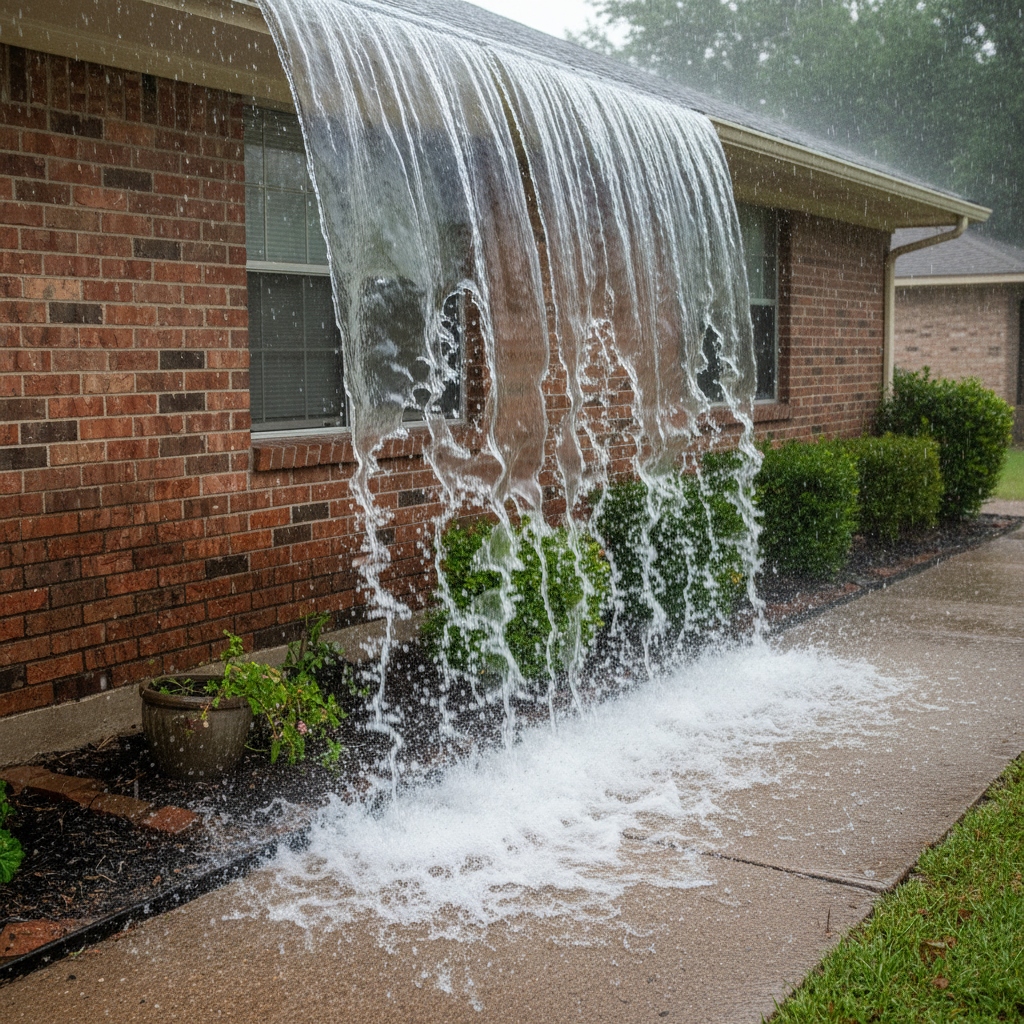
- Undersized 5-inch Gutters: The most frequent cause, incapable of handling the water volume from a large roof in a typical DFW downpour.
- Insufficient Downspouts: Long runs of over 40 feet with only one downspout create a traffic jam for rainwater.
- Standard 2x3" Downspouts: These act as a bottleneck, preventing water from exiting the gutter channel quickly enough during intense rain.
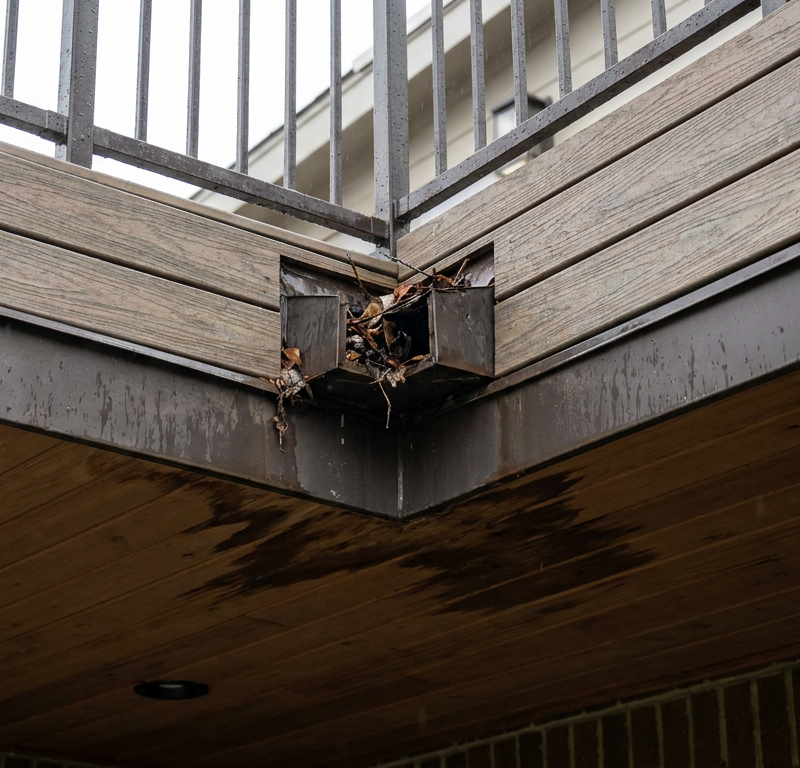
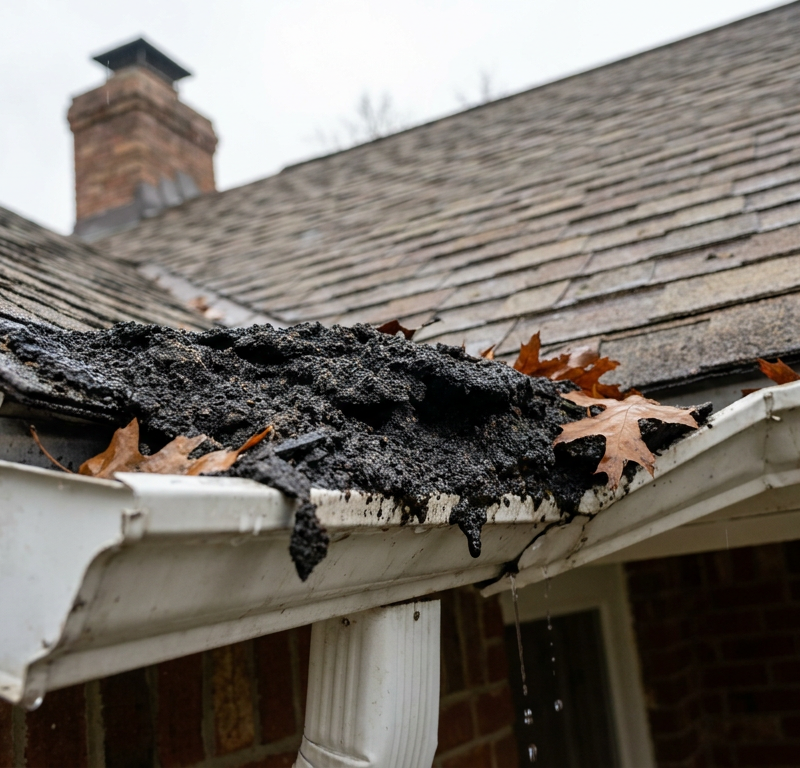
- Clogs and Debris: A thick layer of shingle granules, pine needles, and decomposing leaves forms a dam, preventing any water from reaching the downspout.
- Improper Gutter Slope: Due to fascia shifting on expansive clay soil or poor installation, gutters become level or, worse, back-sloped away from the downspout.
Roofing · Aging roof
| Project category | Roofing |
|---|---|
| Problem type | Aging roof |
| Trade required | Roofing |
| Urgency | Planned project |
| Safety risk | Low safety risk |
| DIY suitability | Pro recommended |
| Cost category | High cost |
| Typical timeline | Plan 4–12 weeks ahead for scheduling and material lead time |
| Contractor type | Licensed roofing contractor |
Repair option
Maintenance repairs to buy a season or two while you budget.
Replacement option
Planned replacement, which is almost always cheaper than a leak-driven emergency.
Common causes
- Normal weathering past the shingle service life
- Poor attic ventilation cooking the shingles from below
- Repeated repairs on the same slopes
Relevant tools:repair or replace roofproject cost estimatorhome improvement material prices
Published June 12, 2026Last updated August 17, 2026
Tools & materials you'll need
Affiliate links- AmazonGutter Sealant
As an Amazon Associate FixlyGuide earns from qualifying purchases — at no extra cost to you. Prices and availability are accurate as of publication and subject to change.
Quick Answer
Arlington gutters primarily overflow because they are undersized for the city's intense, high-volume downpours. The standard 5-inch K-style gutters installed on many homes lack the capacity to handle the 'gully-washer' storms common in DFW, leading to water damage. The professional solution is often upgrading to larger 6-inch gutters and oversized 3x4-inch downspouts.
The Problem
You've seen it happen. The sky over Arlington turns a menacing shade of gray, the tornado sirens wail their weekly test, but this time it's for real. The rain starts—not as a drizzle, but as a torrential sheet of water. You're safe and dry inside, but you look out the window and see a cascade of water pouring over the edge of your gutters, hammering the flowerbeds below into a muddy soup. That's not just rain; that's your home's first line of defense against water intrusion being completely and utterly overwhelmed.
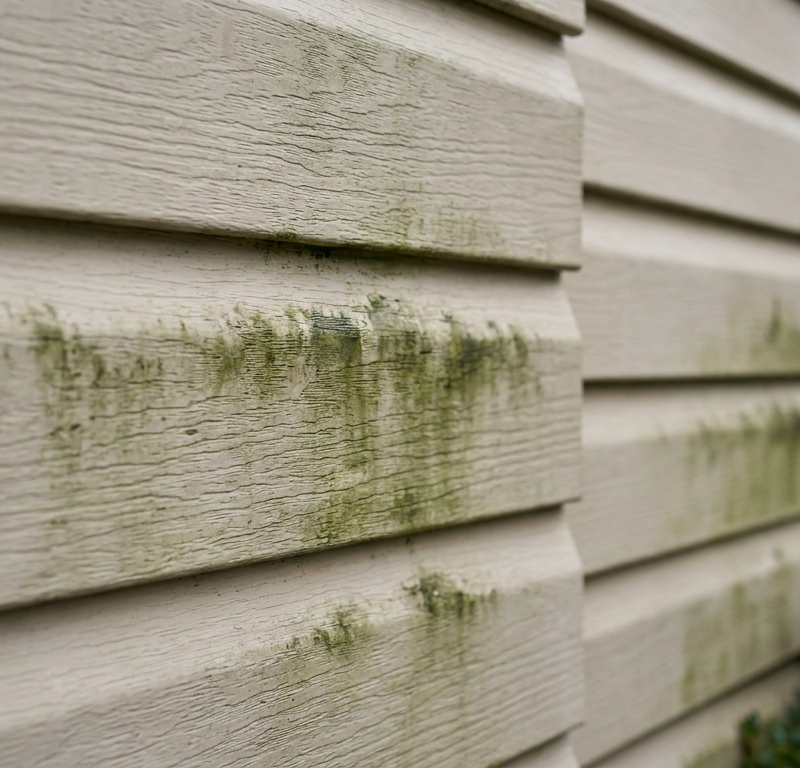
This scene is alarmingly common across North Texas, from Arlington to Plano. A 2-inch downpour, often falling in less than an hour, is a stress test that most residential gutter systems fail spectacularly. The water isn't just flooding your petunias. It's soaking the wooden fascia board the gutter is attached to, initiating a slow, insidious process of rot. It's sheeting down your brick or siding, looking for any crack or crevice to penetrate. Most critically, it's pooling directly against your foundation. In a region famous for its expansive clay soil, this concentrated water load is a primary contributor to soil heave and settlement, which can lead to foundation cracks, sticking doors, and costly structural repairs down the line.
What homeowners often mistake for a simple clog is frequently a more fundamental issue: a system design flaw. The 5-inch K-style gutters that have been the builder-grade standard for decades are simply not engineered to handle the volume and velocity of water that a DFW storm throws at a typical North Texas roof.
How It Works
To understand why your gutters are failing, you have to think like a water management engineer. Your roof is a massive, non-absorbent basin. Its sole job is to collect every drop of rain and deliver it to a single, narrow channel: the gutter. The performance of that system hinges on physics, climate, and engineering.
First, consider the sheer volume of water. The average Arlington home has a roof surface area of around 2,400 square feet. A 2-inch rainfall event doesn't sound like much, but across that surface, it amounts to an astonishing 2,992 gallons of water. Imagine nearly sixty 50-gallon barrels of water being dumped on your roof in an hour. Your gutter system is expected to catch, channel, and control every last drop.
The DFW climate is the key variable here. We don't get gentle, misty English drizzles; we get convective thunderstorms that form in the hot, humid air and unleash staggering amounts of water in short bursts. This intensity is the crucial factor. A gutter system might handle 3,000 gallons over 12 hours, but it will be completely swamped by the same amount delivered in 60 minutes.
This is where gutter sizing becomes critical. The standard 5-inch "K-style" gutter (named for its shape resembling the letter K) can hold approximately 1.2 gallons of water per linear foot. A 6-inch gutter, just one inch wider, can hold around 2.0 gallons per linear foot—that's a 66% increase in capacity. For the sprawling rooflines of many DFW homes, that extra capacity is not a luxury; it's a necessity.
But even a 6-inch gutter is useless if the water can't get out. This brings us to the downspout, the drainpipe of the system. The standard companion to a 5-inch gutter is a 2x3-inch rectangular downspout. The Achilles' heel of the entire system. Upgrading to a 6-inch gutter but keeping the 2x3 downspouts is like upgrading your car's engine but keeping bicycle tires—you haven't solved the real bottleneck. The professional standard for DFW is the oversized 3x4-inch downspout. Its opening is significantly larger, allowing it to evacuate water from the gutter much faster, preventing the backup and overflow during a gully-washer.
Finally, the expansive clay soil of North Texas adds another layer of jeopardy. When dry during our brutal 100°F summers, the soil shrinks and pulls away from foundations. When a gutter overflow event suddenly saturates the ground, the clay swells with incredible force. This constant cycle of shrink-swell is what causes the vast majority of foundation problems in Arlington and the surrounding Metroplex.
Step-by-Step Fix
Before you can fix the problem, you need to diagnose your specific situation. This guide will walk you through assessing your current gutter system.
SAFETY WARNING: Working on a ladder is inherently dangerous. If your home is two stories, if the roof has a steep pitch (anything you can't comfortably walk on), or if you are not 100% confident on a ladder, STOP and call a professional. Never work on a wet roof or use a ladder near power lines.
-
Safety First: Ladder and Height Precautions — Start with a sturdy, properly-sized extension ladder. Use a ladder stabilizer (a "standoff") at the top to brace it against the roof, not the gutter itself. This prevents damage and improves stability. For any single-story work, a safety harness is a wise investment.
-
Assess Your Current Gutter Size — From your ladder, use a tape measure to measure the width of the gutter opening from the back (fascia side) to the front lip. If it measures around 5 inches, you have standard builder-grade gutters. If it's 6 inches, you already have the larger size, and your problem may lie elsewhere (clogs, slope, or downspout issues).
-
Check Your Downspout Dimensions — Now, measure the outlets. Look at the rectangular downspouts where they meet the ground. Are they roughly 2 inches by 3 inches, or are they a noticeably larger 3 inches by 4 inches? A 2x3 downspout on a 6-inch gutter is a red flag for a bottleneck.
-
Inspect for Clogs and Debris — Put on work gloves. Scoop out any debris from a section of gutter near a downspout. Common DFW culprits include a thick paste of shingle grit, oak tree tassels and leaves, and "helicopters" from maple trees. A dense clog is the most common and simplest cause of overflow. Pay special attention to the downspout opening; this is where debris funnels and often gets stuck.
-
Examine Gutter Pitch (Slope) — Gutters are not installed perfectly level. They must have a slight slope—or "pitch"—towards the downspout to encourage water flow. The correct pitch is subtle: about 1/4 inch of drop for every 10 feet of gutter. You can check this with a 4-foot level. Place the level in the bottom of a clean gutter. If the bubble is centered, you have a problem. It should be slightly off-center, indicating a slope toward the downspout.
-
Calculate Your Roof's Drainage Load — Pace off the section of roof that feeds a single downspout. For example, a 50-foot section of gutter fed by a 20-foot roof slope is 1,000 square feet. In a 2-inch rain, that's 1,246 gallons of water headed for one downspout. This mental math helps illustrate why undersized systems get overwhelmed.
-
Count Your Downspouts — Look at the runs of gutter. As a general rule, there should be at least one downspout for every 40 feet of guttering. Long runs of 50, 60, or even 70 feet serviced by a single downspout are a guaranteed recipe for overflow in a DFW storm.
-
Evaluate Splash Guards for Valleys — Roof valleys concentrate an enormous amount of water into one spot. If you see water overshooting the gutter at an inside corner, a simple piece of angled aluminum called a "splash guard" or "diverter" can be installed to manage the torrent.
-
Plan the Upgrade to 6-Inch Gutters — Based on your assessment, if you have 5-inch gutters, a large roof surface, and experience overflow, the definitive solution is an upgrade to a seamless 6-inch K-style system.
-
Specify 3x4-Inch Downspouts — When getting quotes, ensure that the contractor is explicitly including 3x4-inch downspouts. Do not let them talk you into reusing your old 2x3s. This is the single most important part of the upgrade.
-
Consider Gutter Guards — Gutter guards can be a good addition, but they are not a magic bullet. In DFW, the fine debris and heavy rainfall can sometimes cause water to "sheet" over the top of certain guard designs, recreating the overflow problem. Opt for a high-quality system that is screwed in, not tucked under the shingles, and be prepared for occasional maintenance.
Common Causes
- Undersized 5-inch Gutters: The most frequent cause, incapable of handling the water volume from a large roof in a typical DFW downpour.
- Insufficient Downspouts: Long runs of over 40 feet with only one downspout create a traffic jam for rainwater.
- Standard 2x3" Downspouts: These act as a bottleneck, preventing water from exiting the gutter channel quickly enough during intense rain.
- Clogs and Debris: A thick layer of shingle granules, pine needles, and decomposing leaves forms a dam, preventing any water from reaching the downspout.
- Improper Gutter Slope: Due to fascia shifting on expansive clay soil or poor installation, gutters become level or, worse, back-sloped away from the downspout.
- Extreme Rainfall Intensity: A storm that drops 2-3 inches of rain in under an hour exceeds the design specifications for most standard residential systems.
Common Mistakes
- Ignoring the Overflow: Homeowners assume a waterfalling gutter is normal in a heavy storm. It is not; it is a sign of system failure.
- Replacing a Failed 5-Inch System with Another 5-Inch System: This simply resets the clock on the problem, it doesn't solve it.
- Upgrading to 6-Inch Gutters but Reusing 2x3 Downspouts: A critical and common error that negates much of the benefit of the larger gutter.
- Installing Cheap DIY Gutter Guards: Many flat or mesh guards accumulate debris on top and cause water to skip right over the gutter entirely.
- Not Addressing Fascia Rot: Simply placing a new gutter over rotted wood is a temporary fix. The fascia must be replaced for the new gutters to be secured properly.
- Hiring a General Handyman for a Gutter-Specific Job: Gutter installation, especially seamless systems, requires specialized equipment and knowledge of proper pitching and sealing techniques.
Cost & Time Breakdown
Here's a realistic look at the costs and time involved for a typical 2,000 sq. ft. home in the Arlington area (~180 linear feet of gutters).
| Task | DIY Cost | Pro Cost | Time |
|---|---|---|---|
| Gutter Cleaning & Flushing | $20 (scoop, gloves) | $150 - $300 | 2-4 hours |
| Minor Slope Repair / Re-hanging a Section | $50 (sealant, hardware) | $200 - $400 | 2-3 hours |
| Install Splash Guards at Valleys | $30 (guards, sealant) | $100 - $200 | 1 hour |
| Replace One 10ft Leaking Section (DIY Sectional) | $40 (10ft section, connectors) | $250+ | 2 hours |
| Full System Upgrade to 6" Seamless Gutters & 3x4 Downspouts | N/A (Requires pro equipment) | $2,500 - $4,500+ ($14-$25/ft) | 1-2 Days |
Tips & Prevention
- Clean Gutters Twice a Year: In Arlington, the best times are late spring (after oak tassels and helicopters fall) and late fall (after leaves are down).
- Flush with a Hose: After cleaning, run water from a hose down the gutter to ensure the slope is working and the downspouts are clear.
- Use Oversized Splash Blocks: At the bottom of your downspouts, use large concrete or plastic splash blocks to direct the torrent of water at least 3-5 feet away from your foundation.
- Check Your Soil Grade: The ground around your foundation should slope away from the house—a minimum of 6 inches over 10 feet is recommended.
- Don't Tuck Gutter Guards Under Shingles: This can void your roof warranty and create a path for water to get under the shingles. Opt for systems that attach to the gutter or fascia.
- During Re-Roofing, Address the Gutters: A re-roof is the perfect time to have your gutters detached, your fascia inspected and painted, and the gutters re-installed with proper slope.
When to Call a Professional
While a handy homeowner can tackle cleaning and minor repairs on a single-story home, many situations warrant a professional call immediately. Your safety and the integrity of your home are paramount.
Call a qualified gutter company or roofer if:
- The work involves a two-story or three-story home. The risk of a fall is too great.
- Your roof has a steep pitch (generally a 6:12 slope or higher), making it unsafe to work from the roof or a ladder.
- You discover the wood fascia board behind the gutter is soft, spongy, or visibly rotten. This requires replacement before a new gutter can be securely installed.
- You are opting for the full upgrade to a 6-inch seamless system. This is not a DIY project as it requires a specialized machine, mounted on a truck, that forms the continuous gutter onsite.
- You see signs of foundation issues like cracks in the brickwork or interior drywall, or doors that have become difficult to close. This indicates the water management problem may have already caused structural damage.
Should you do this yourself?
Answer five quick questions before you start. Safety outranks savings every time.
Your experience with work like this
How high do you have to work?
Does the job involve any of these?
Will it need a permit?
Specialty tools
Free and instant. Educational guidance only — not a quote, inspection, or professional diagnosis.
What should this project cost?
Enter your project details for a realistic cost range before you call anyone.
Spot repairs commonly run $400–$1,800; full replacement typically $9,000–$18,000 for an average home.
- Regional adjustment
- National average
- Labor share (typical)
- ~$2,948
- Quotes to collect
- 3 written estimates
Educational estimate based on national averages — not a binding quote. Always confirm with written local estimates.
Fixly Project Decision Box
- DIY difficulty
- Professional Recommended
- Estimated time
- Inspection 1–2 hours · repairs 1–3 days
- Cost level
- High
Main tools / materials
- Binoculars for a ground-level look
- Flashlight for attic checks
- Moisture meter
- Roofing cement (temporary patch only)
When to stop and call a pro
- Active leak near lights, fans, or any wiring
- Sagging, bulging, or water-filled ceiling
- Steep, wet, or two-story roof — do not climb it
- Storm or hail damage you plan to claim on insurance
Need professional help?
Free roof assessment first — no phone calls until you ask for them.
Get Local Roofing HelpDecide what your roof needs
Two minutes of questions turns "something is wrong up there" into a clear next step.
- Repair or replace your roof?Answer 10 questions about age, leaks, and damage to get a clear next step.Open
- Compare contractor quotesScore up to four bids on price, warranty, licensing, and timeline.Open
- Get local estimatesSend one request and compare written estimates from vetted pros.Open
Free, no signup required. Estimates are educational guidance, not a quote or an inspection.
Get the print-ready PDF of this guide
A clean, ad-free, printable version you can keep on your phone or pin to the workshop wall. Free with a FixlyGuide account.
- Print-optimized layout
- Tools, materials & every step included
- Saved to your account
Frequently asked questions
Can I just add more downspouts to my 5-inch gutters?+
While adding downspouts can help, it's often a partial fix. If the 5-inch gutter itself is filled to capacity during a downpour, the bottleneck is overall volume, not just the outlet. For many Arlington homes with large roofs, upgrading to 6-inch gutters is the more effective long-term solution.
Are expensive gutter guards worth it in Arlington?+
It depends. High-end, professionally installed systems can be effective. However, cheaper DIY guards can sometimes worsen overflow in heavy rain by creating a 'shelf' for water to ski right over. In Arlington, with fine debris like oak tassels and shingle grit, no system is truly 'no maintenance,' so weigh the high cost against the need for occasional check-ups.
How do I know if I have fascia rot?+
From a safe position, you can gently poke the wood fascia board behind the gutter with a screwdriver. If the wood is soft, spongy, or crumbles, it's a clear sign of rot. You may also see peeling paint or dark water stains on the wood. All rot must be replaced before installing new gutters.
Will my homeowner's insurance cover a gutter upgrade?+
Typically, no. Insurance policies cover damage from sudden and accidental events, like a tree falling on your gutters. They do not cover preventative upgrades or failures due to age, wear and tear, or undersized design. However, they may cover the *damage* caused by the overflowing gutters, such as rotted fascia or interior water damage, depending on your policy.
Discussion
Loading comments…