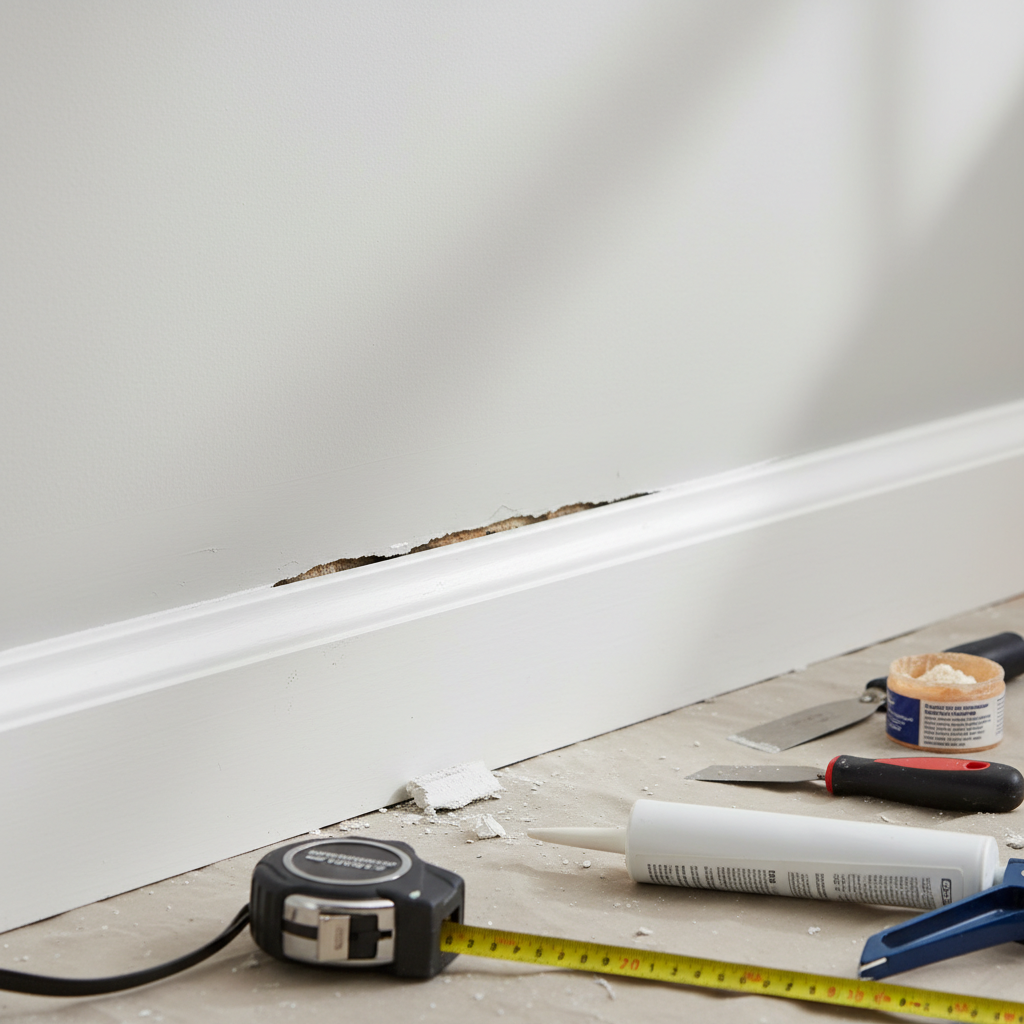
- Forgetting to Clean. Applying new caulk over dust, debris, or peeling old caulk is a recipe for failure. The new bead won't adhere properly and will peel away, leaving you back where you started.
- Applying Too Much Caulk. More is not better. An overly large bead of caulk is difficult to smooth, creates a mess, and results in a wide, amateurish-looking joint. Start with a small opening in your tube.
- Nailing Only Into Drywall. If you need to re-secure the board, a nail into drywall has almost no holding power. You must use a stud finder and anchor the baseboard to the solid wood framing.
- Painting Caulk Too Soon. Paint applied to uncured caulk can slow the curing process and is prone to cracking and crazing as the caulk shrinks underneath. Respect the cure time on the label.
General remodeling · Renovation planning
| Project category | General remodeling |
|---|---|
| Problem type | Renovation planning |
| Trade required | General contracting |
| Urgency | Planned project |
| Safety risk | Low safety risk |
| DIY suitability | Pro recommended |
| Cost category | Major investment |
| Typical timeline | Design and permitting often 2–4 months before work starts |
| Contractor type | General contractor |
Repair option
Phase the work and fix the building envelope first.
Replacement option
Full renovation with permits, design, and a general contractor.
Common causes
- Space no longer fits how the household lives
- Resale preparation
- Deferred maintenance stacking up
Relevant tools:project cost estimatorcompare quoteshome improvement material prices
Published May 5, 2026Last updated August 17, 2026
Tools & materials you'll need
Affiliate links- AmazonCaulk Gun1 · A dripless model is worth the extra cost.
- AmazonUtility Knife1 · For cutting the caulk tube tip and cleaning old caulk.
- AmazonPutty Knife1 · A flexible 1.5-inch knife is best.
- AmazonStud Finder1 · Critical if you need to re-secure a loose baseboard.
- AmazonHammer and Nail Set or Finish Nailer1 · For securing loose trim to studs.
- AmazonFlexible Siliconized Acrylic Latex Caulk1 tube · Ensure it is labeled 'paintable'.
- AmazonPainter's Tape1 roll · 1-inch or 1.5-inch width is ideal.
- AmazonShop Towels or Paper Towels1 roll
- AmazonWood Filler1 small tub · Only needed if you are filling new nail holes.
- AmazonFine-Grit Sandpaper (220-grit)1 sheet
As an Amazon Associate FixlyGuide earns from qualifying purchases — at no extra cost to you. Prices and availability are accurate as of publication and subject to change.
Quick Answer
The unsightly gap between your baseboard and wall is usually not a sign of a major structural problem. It's typically caused by the natural shrinking and swelling of wood trim due to seasonal humidity changes, a common framing phenomenon called "truss uplift" during dry winter months, or an installation that didn't account for wall imperfections. The most effective and durable fix is to fill the gap with a high-quality, flexible, and paintable siliconized acrylic latex caulk. For larger or persistent gaps, you may need to first re-secure the baseboard to the wall studs before caulking.
The Problem
You walk into a room and it just looks… unfinished. Your eyes are drawn to a dark, distracting line running along the floor. It’s the dreaded gap where your baseboard pulls away from the wall. This common issue makes a clean, polished room look sloppy. Aesthetically, it breaks the clean transition from wall to floor, making crisp paint lines look jagged and untidy.
Beyond just looks, this gap can be a practical nuisance. It’s a perfect trap for dust, dirt, pet hair, and crumbs, making it impossible to truly get your floors clean. In some cases, it can create small drafts, subtly affecting your home's energy efficiency. It can even become a tiny highway for insects like ants or spiders to travel between rooms or from within the walls. While usually a cosmetic issue, this separation can sometimes hint at underlying problems like excessive humidity shifts, improper home construction, or, in rare cases, foundation movement. Ignoring it doesn’t just leave your home looking perpetually incomplete; it leaves a channel for dust and pests that’s best sealed for good.
How It Works
To understand why your baseboard pulls away from the wall, you need to know that your house is not a static object. It subtly moves, breathes, and reacts to its environment. The primary culprit behind most baseboard gaps is the seasonal expansion and contraction of building materials. Wood is a "hygroscopic" material, meaning it absorbs and releases moisture from the air. During humid summers, wood swells. In the dry air of winter (especially with forced-air heating), it releases moisture and shrinks. This constant, subtle movement puts stress on joints, and the seam between your wood baseboard and drywall is a prime victim.
A second, very common cause, particularly for gaps that appear in winter and close in summer, is called "truss uplift." Most modern homes use roof trusses. The bottom chord of the truss, which forms your top-floor ceiling joists, is buried in heavy insulation. The top chords are in the cold, dry attic space. In winter, the top chords lose moisture and shrink, while the bottom chord stays warmer and more stable in the insulated space. This differential causes the truss to arch upward, slightly lifting the interior partition walls with it. Since your floor system doesn’t move, the wall drywall gets pulled up, creating a gap between it and the baseboard, which is attached to the wall near the floor.
Finally, the gap may stem from the original installation. If a wall isn’t perfectly straight and plumb (and few are), and the installer simply nailed the straight baseboard against it without scribing it to the wall’s contours, gaps are inevitable. Similarly, if they missed the wall studs and nailed only into the soft drywall, the trim will never be secure and will easily pull away.
Step-by-Step Fix
This guide provides the definitive method for achieving a seamless, durable fix that accounts for minor seasonal movement. For gaps wider than 1/4 inch, see the "When to Call a Pro" section.
Safety Note: If your home was built before 1978, your paint may contain lead. Before sanding or scraping, test the paint for lead. If positive, consult a certified lead abatement professional.
-
Assess the Gap and Clean the Area. First, inspect the gap. If it's less than 1/4 inch wide, it's a perfect candidate for caulking. If it’s wider, or if the board feels very loose, you may need to add some nails first (see step 5). Prepare the area by vacuuming all dust and debris from the gap and the surrounding floor. Then, use a damp cloth to wipe down the top of the baseboard and the adjacent wall to ensure they are free of grime and dust. A clean surface is critical for proper caulk adhesion.
-
Scrape Away Old Caulk or Paint. Use a painter's 5-in-1 tool or a sharp utility knife to carefully scrape out any old, cracked caulk or flaking paint from the joint. You want to start with a clean, uniform channel. A fresh start prevents lumpy results.
-
(For Loose Boards) Locate Wall Studs. If the baseboard is noticeably loose, you'll need to secure it tightly. Use an electronic stud finder to locate the wall studs behind the drywall. They are typically spaced 16 inches on-center. Mark their location lightly with a pencil on the wall just above the trim.
-
(For Loose Boards) Secure the Baseboard. Drive 2-inch finishing nails through the baseboard into the marked wall studs. If using a hammer, use a nail set to sink the nail head about 1/16 inch below the wood surface to create a small dimple. This prevents the hammer from marring the trim. A pneumatic finish nailer makes this job much faster and cleaner.
-
Fill Nail Holes. Apply a small dab of paintable wood filler to each nail hole you created. Press it in with a putty knife, scraping away the excess so it’s flush with the baseboard surface. Allow the filler to dry completely according to the manufacturer's instructions (usually 30-60 minutes).
-
Sand the Filler Smooth. Once dry, lightly sand the filled nail holes with fine-grit sandpaper (220-grit is ideal) until they are perfectly smooth to the touch. Wipe away any sanding dust with a clean, dry cloth.
-
Apply Painter's Tape. For an impeccably clean caulk line, apply painter's tape. Place one strip on the wall, about 1/8 inch above the baseboard, and another on the top edge of the baseboard itself, leaving the gap exposed. This step is optional but highly recommended for beginners.
-
Cut and Load the Caulk Tube. Cut the tip of your caulk tube at a 45-degree angle, creating a small opening (about 1/8 inch). It's better to start small; you can always make it bigger. Puncture the inner seal with a long nail or the wire on your caulk gun. Load the tube into the caulk gun.
-
Apply a Continuous Bead of Caulk. Place the tip of the caulk tube firmly into the corner where the wall meets the trim. Apply steady pressure to the caulk gun trigger and move at a consistent speed, laying a smooth, continuous "bead" of caulk to fill the gap.
-
Smooth the Caulk Bead. This is the key to a professional look. Immediately after applying the caulk, dip your finger in water and run it lightly along the bead, pressing the caulk into the gap and smoothing the transition. Wipe the excess caulk that collects on your finger onto a paper towel. Alternatively, use a caulk finishing tool.
-
Remove the Painter's Tape. While the caulk is still wet, carefully pull the painter's tape off at a 45-degree angle away from the freshly caulked joint. This will leave a perfectly straight, clean edge.
-
Cure, Prime, and Paint. Let the caulk cure for the time specified by the manufacturer (this can range from 1 to 24 hours). Once cured, you can paint it to match your trim or wall color for a flawless, invisible repair.
Common Causes
Understanding the root cause of the baseboard gap can help you prevent it elsewhere in your home.
- Seasonal Humidity Swings: This is the number one cause. Wood trim acts like a sponge. In the high humidity of summer, it absorbs moisture and expands. In the dry air of a heated winter home, it releases that moisture and contracts, pulling away from the non-wood drywall and creating a gap.
- Truss Uplift: As detailed earlier, this architectural phenomenon occurs in winter. The roof trusses arch upwards in response to temperature and moisture differentials, lifting the center of the ceiling and taking attached interior walls along for the ride. This physically pulls the wallboard up from the floor, opening a gap above the baseboard.
- Improper Nailing: For trim to be secure, it must be nailed into the solid wood studs behind the drywall. Installers in a hurry may use nails that are too short or may miss the studs entirely, fastening the baseboard only to the soft drywall. Over time, the trim will inevitably work itself loose.
- No Construction Adhesive: While not always required, a bead of construction adhesive applied to the back of the baseboard during installation provides a much stronger, more permanent bond to the wall, helping to resist movement.
- Lumber Drying and House Settling: In new construction (the first 1-3 years), the wooden frame of the house is still curing and losing its initial moisture content. This shrinking can cause trim to separate. Similarly, a new foundation will undergo minor settling, which can shift walls and create gaps.
- Wavy or Uneven Walls: No wall is perfectly flat. A rigid piece of trim installed against a bowed wall will have gaps. A skilled carpenter will "scribe" the trim—tracing the wall's contour onto the wood and cutting it for a perfect fit—but this step is often skipped.
Common Mistakes
Avoid these pitfalls to ensure your baseboard gap fix looks professional and lasts for years.
- Using the Wrong Caulk. Never use pure silicone caulk, as it is not paintable and will leave you with a shiny, discolored line. Also, avoid cheap, rigid painter's caulk, which will quickly crack and fail when the seasonal gap reappears. Always choose a quality product labeled "flexible," "elastomeric," or "siliconized acrylic."
- Forgetting to Clean. Applying new caulk over dust, debris, or peeling old caulk is a recipe for failure. The new bead won't adhere properly and will peel away, leaving you back where you started.
- Applying Too Much Caulk. More is not better. An overly large bead of caulk is difficult to smooth, creates a mess, and results in a wide, amateurish-looking joint. Start with a small opening in your tube.
- Nailing Only Into Drywall. If you need to re-secure the board, a nail into drywall has almost no holding power. You must use a stud finder and anchor the baseboard to the solid wood framing.
- Painting Caulk Too Soon. Paint applied to uncured caulk can slow the curing process and is prone to cracking and crazing as the caulk shrinks underneath. Respect the cure time on the label.
- Ignoring a Serious Gap. If your gap is wider than 1/4 inch and growing, or if you also have sticking doors, cracked windows, or sloping floors, do not simply caulk it. These are signs of a potential foundation issue that requires professional evaluation.
Cost & Time Breakdown
Here’s what to expect for a cosmetic fix for a typical 12x12 foot room.
| Item / Task | DIY Cost | Professional Cost | Notes |
|---|---|---|---|
| Materials | |||
| Pro-Grade Flexible Caulk | $8 - $15 | Included | One tube covers 30-50 linear feet. |
| Wood Filler & Sandpaper | $10 - $20 | Included | For filling nail holes if re-securing. |
| Painter's Tape | $5 - $8 | Included | Optional but recommended for clean lines. |
| Labor | |||
| Handyman/Painter Labor | $0 | $75 - $150 / hour | Professionals typically have a 2-4 hour minimum charge. |
| Total Project | $23 - $43 | $150 - $450 | Pro cost is higher due to minimum charges but ensures a perfect result. |
Tips & Prevention
Keep your trim looking tight and professional with these preventative measures.
- Manage Indoor Humidity. The best way to prevent wood movement is to control its environment. Use a humidifier during dry winter months and a dehumidifier during humid summer months to keep your indoor relative humidity between 35% and 55%.
- Choose High-Quality Caulk. When fixing or installing new, don't skimp on caulk. Spend a few extra dollars on a top-tier brand of siliconized acrylic latex caulk. Its superior flexibility will allow it to stretch and compress with seasonal movement without cracking.
- Use Adhesive During Installation. When installing new baseboards, apply a wavy bead of construction adhesive to the back of the trim before nailing it. This creates a powerful bond with the drywall, minimizing separation.
- Acclimate New Trim. If you're installing new wood trim, let it sit inside your house for at least 48-72 hours before installation. This allows the wood's moisture content to equalize with your home's environment, preventing shrinking or swelling after it's on the wall.
- Scribe to Fit. For a truly professional installation on an uneven wall, learn to scribe your baseboards. This involves using a compass to trace the wall's exact profile onto the board, which you then cut for a perfect, gap-free fit that needs minimal caulk.
When to Call a Professional
While caulking a baseboard gap is a great DIY project, some situations warrant a professional eye. You should call for help if you encounter a gap that is consistently wider than 1/4 inch, especially if it appears to be actively growing over time. This could indicate a more significant issue than simple wood shrinkage.
Look for other related symptoms in your home: are doors or windows in the same area suddenly sticking or hard to open? Do you see long, diagonal drywall cracks radiating from window or door corners? Are the floors noticeably sloped? These signs, combined with a large trim gap, may point to foundation settling or other structural movement. In this case, don't call a painter; call a structural engineer or a reputable foundation repair company for an inspection. They can determine the root cause and recommend the appropriate, and sometimes significant, repairs.
Even for cosmetic fixes, if you don't own the necessary tools or don't feel confident in achieving a clean result, a professional painter or handyman can usually complete the job for a few rooms in just a couple of hours, delivering a flawless finish.
General Safety Note: Always prioritize safety. While this project is low-risk, any major work involving your home's structure—including significant roof, electrical panel, or gas line modifications—should always be left to licensed and insured professionals.
Related Articles
Keep troubleshooting with these hand-picked guides from FixlyGuide:
- Your Squeaky Floor's Secret: It's Not the Wood, It's the Gap — Tired of that persistent floor squeak? Discover the hidden causes of noisy floorboards and learn several easy, DIY methods to silence them…
- Why Your Hardwood Floors Have Gaps in Winter (And When to Worry) — Seeing gaps in your hardwood floors this winter? It's likely caused by low indoor humidity making the wood shrink. Learn what's normal, how…
- The Hidden Cause of Squeaky Hardwood Floors & The Real Fix — That persistent squeak from your hardwood floors isn't just an annoyance; it's a sign of movement. We'll uncover the hidden causes, from hu…
- That Crooked Crown Molding? Your Ceiling Is Lying — Discover the surprising reason your perfectly level crown molding still looks crooked. It's not your installation—it's an optical illusion…
- That ONE Reason Your Closet Door Keeps Derailing — Stop just putting your sliding closet door back on the track. We reveal the hidden—and surprisingly simple—hardware issue that causes 90% o…
- The #1 Deck Sealing Mistake Most Homeowners Make (And How to Fix It) — Many homeowners make a critical error when sealing their decks, leading to premature wear and damage. Learn how to properly reseal your woo…
Should you do this yourself?
Answer five quick questions before you start. Safety outranks savings every time.
Your experience with work like this
How high do you have to work?
Does the job involve any of these?
Will it need a permit?
Specialty tools
Free and instant. Educational guidance only — not a quote, inspection, or professional diagnosis.
What should this project cost?
Enter your project details for a realistic cost range before you call anyone.
Cost depends heavily on which system turns out to be the source.
- Regional adjustment
- National average
- Labor share (typical)
- ~$1,620
- Quotes to collect
- 3 written estimates
Educational estimate based on national averages — not a binding quote. Always confirm with written local estimates.
Before you start
Check the difficulty, permits, and safety risk — then decide whether to call a pro.
- Estimate this projectGet a cost range for your scope and ZIP before you call anyone.Open
- Get local estimatesSend one request and compare written estimates from vetted pros.Open
Free, no signup required. Estimates are educational guidance, not a quote or an inspection.
Get the print-ready PDF of this guide
A clean, ad-free, printable version you can keep on your phone or pin to the workshop wall. Free with a FixlyGuide account.
- Print-optimized layout
- Tools, materials & every step included
- Saved to your account
Recommended for DIYers & woodworkers
Sponsored
The Top 20 Tools for Workshops of Any Budget
No stationary machines or power tools required — plus 3 fundamental tools that can't be bought at any price.
Get the free guide
Ted's Woodworking — The #1 Woodworking Resource
Detailed instructions, dimensioned drawings, materials & cutting lists, and 3D schematics for every skill level.
See the plansSponsored: links above are affiliate links. FixlyGuide may earn a commission on qualifying purchases — at no extra cost to you.
Frequently asked questions
What is the absolute best caulk for baseboard gaps?+
The best choice is a high-quality, paintable siliconized acrylic latex caulk. Look for labels that mention 'flexible,' 'crack-proof,' or 'elastomeric.' These products are designed to stretch and compress as your house moves with seasonal changes, preventing the gap from re-opening.
Why does the baseboard gap get bigger in the winter and smaller in the summer?+
This classic seasonal change is due to two factors. First, the air in your home is much drier in the winter, which causes the wood baseboard to lose moisture and physically shrink. Second, a phenomenon called 'truss uplift' can cause the roof framing to bow upwards in the cold, lifting the walls slightly away from the floor, increasing the gap.
Can I just paint over the gap instead of caulking it?+
No, this is not a good idea. Paint is not designed to fill gaps and has very little flexibility. It will not bridge the gap, and as the house shifts seasonally, the paint will crack and flake almost immediately, making the problem look even worse.
My gap is almost 1/2 inch wide. Is that normal?+
A gap of 1/2 inch is larger than normal and should not be fixed with caulk alone. While it could be due to a very uneven wall, it can also be a red flag for foundation settling. It's best to have a professional handyman or a structural engineer assess the situation to rule out any significant structural issues before attempting a cosmetic repair.
Discussion
Loading comments…