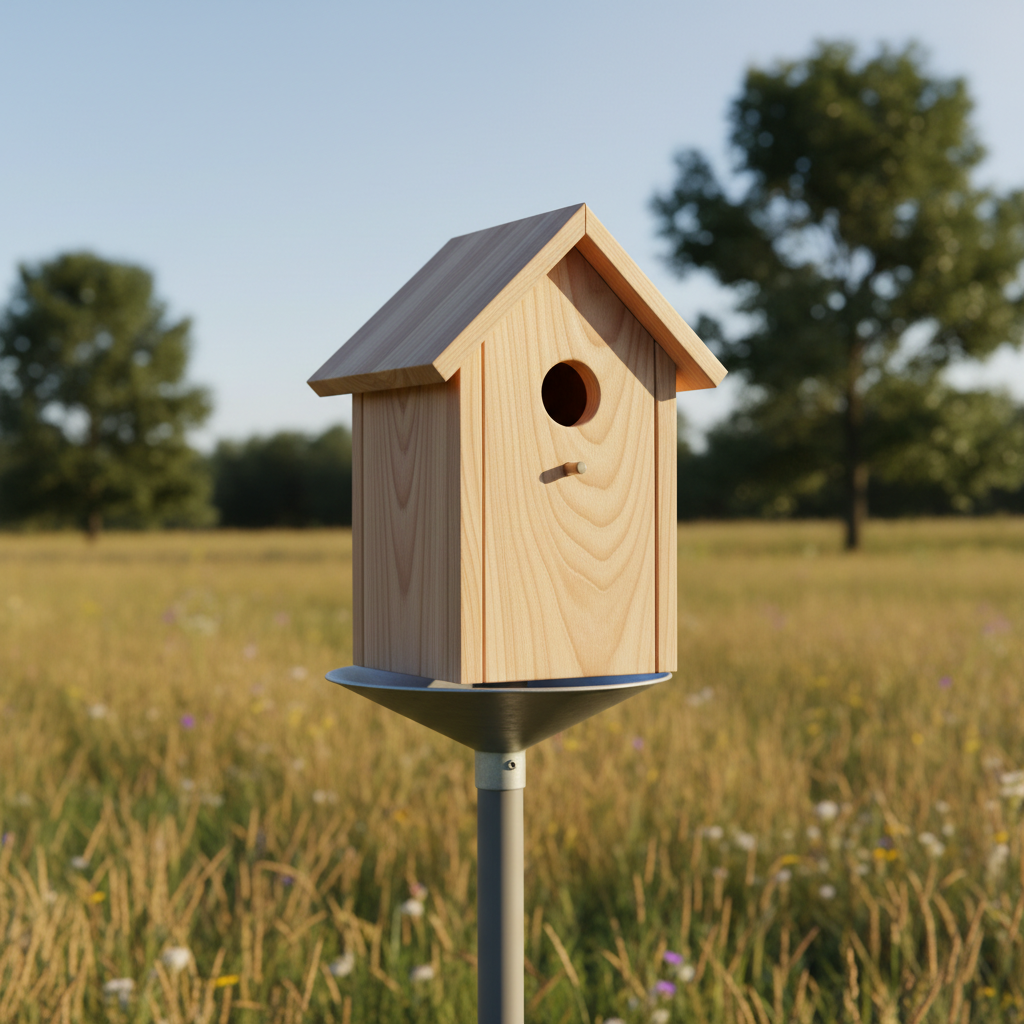
- Sides (2): 9 inches long (with a mitered top edge)
- Floor: 4x4 inches (you'll rip the 1x6 down for this)
- If this doesn't work: Double-check your measuring tape for accuracy. Small errors can lead to ill-fitting pieces.
Published May 10, 2026Last updated August 17, 2026
Tools & materials you'll need
Affiliate linksAs an Amazon Associate FixlyGuide earns from qualifying purchases — at no extra cost to you. Prices and availability are accurate as of publication and subject to change.
Quick Answer
Building a bluebird house from a single cedar board is an accessible and rewarding DIY project that creates a safe nesting site. The key is precise cuts and assembly to meet bluebird-specific dimensions for entrance hole size, floor area, and ventilation, ensuring a haven free from predators.
The Problem
Many homeowners want to attract the vibrant beauty of bluebirds to their yards, but off-the-shelf birdhouses are often poorly designed, overpriced, or made from unsuitable materials. Generic birdhouses may have entrance holes that are too large, inviting competitor birds or predators, or lack proper ventilation and drainage, creating an unhealthy environment for nestlings. Without a properly constructed bluebird house, these desirable birds may bypass your yard, or worse, struggle to fledge their young due to poor housing conditions. The challenge is constructing a durable, predator-resistant, and climate-controlled home that specifically caters to bluebirds' needs, all while keeping the project budget-friendly and achievable for the average DIYer.
How It Works
Bluebirds are particular about their nesting sites. They prefer open woodlands and fields with scattered trees, making suburban backyards potential havens if suitable housing is provided. A bluebird house is designed to mimic a natural cavity – like an old woodpecker hole – that offers protection from the elements and predators. The dimensions are critical: typically, a 1 ½-inch diameter entrance hole is used for Eastern Bluebirds, placed 6 inches above the floor. This size is small enough to deter larger birds like starlings, but large enough for a bluebird. The inside floor dimension is usually 4x4 inches, providing adequate space for a nest and brood. Drainage holes in the floor prevent water accumulation, while ventilation gaps near the top prevent overheating. The material choice is also important; cedar is often preferred for its natural resistance to rot and insects, its insulation properties, and its longevity. A hinged side or front panel is crucial for easy monitoring and cleaning, which should be done after each brood fledges or at least once a year. Mounting height and location are also part of the "system" – bluebird houses should be mounted on a pole 5–7 feet off the ground in a relatively open area, facing away from prevailing winds, to maximize their appeal and safety.
Step-by-Step Fix
-
Gather Your Materials and Prepare for Safety – Before starting any woodworking project, collect all your tools and materials. Ensure you have proper safety gear, including eye protection, hearing protection, and gloves. Work in a well-lit and well-ventilated area.
- Safety Note: Always wear safety glasses when operating power tools. Use push sticks when cutting small pieces on a table saw to keep your hands clear of the blade.
-
Measure and Mark Your Cedar Board – Lay out your single 1x6 cedar board. You will need six pieces: a front, back, two sides, a floor, and a roof. Refer to a detailed cut list to mark your measurements accurately. Precision here ensures a tight fit and a sturdy birdhouse. For Eastern Bluebirds, common dimensions are:
- Front: 9 inches long
- Back: 11 inches long
- Sides (2): 9 inches long (with a mitered top edge)
- Floor: 4x4 inches (you'll rip the 1x6 down for this)
- Roof: 7.5 inches long
- If this doesn't work: Double-check your measuring tape for accuracy. Small errors can lead to ill-fitting pieces.
-
Make Your Cuts – Carefully cut each marked piece using a miter saw or circular saw. For the sides, you'll need to cut a 15-degree angle on one end for the roof slope. The floor piece will need to be ripped down to 4 inches in width on a table saw. Take your time to ensure straight, clean cuts.
- Tools: Miter saw, table saw (for ripping the floor), measuring tape, pencil.
-
Drill the Entrance Hole – On the front piece, locate the center point for the entrance hole, typically 6 inches from the bottom edge. Use a 1 ½-inch hole saw to drill the entrance hole. Smooth any rough edges with sandpaper.
- Tip: Practice on a scrap piece of wood first to get a clean cut.
-
Add Ventilation and Drainage Holes – On the side pieces, drill two small ½-inch ventilation holes near the top, just below where the roof will sit. On the floor piece, drill four ¼-inch drainage holes, one in each corner, to prevent water buildup.
- Why this matters: Proper air circulation prevents overheating, and drainage keeps the nest dry and healthy.
-
Assemble the Sides and Front/Back – Begin assembling the house. Attach one side piece to the front piece using 1 ½-inch deck screws and waterproof wood glue. Ensure the edges are flush. Repeat with the other side piece. Then, attach the back piece to the assembled sides.
- Fasteners: Use screws, not nails, for superior holding power and longevity, especially with cedar.
-
Attach the Floor – Slide the floor piece into the bottom opening. Secure it from the outside of the front, back, and side pieces using screws. Ensure it's flush with the bottom edges of the house.
- Important consideration: Some designs allow for a removable floor for cleaning, but for a sturdy, long-lasting house, a fixed floor is often preferred, with a hinged side for access.
-
Hinge One Side for Cleaning – Instead of permanently attaching one side or the front, consider using screws on one edge and a small hinge on the opposite edge for easy access. This allows you to open the box for annual cleaning without dismantling it. Alternatively, attach the roof with a single screw on one side and a hook and eye latch on the other.
- Functionality: Regular cleaning is vital for bluebird health and encouraging multiple broods.
-
Attach the Roof – Place the roof piece on top, ensuring it overhangs the front and sides to offer protection from rain. Secure it with screws into the top edges of the front, back, and side pieces. Predrill pilot holes to prevent splitting the cedar.
- Protection: A good overhang is crucial for protecting the entrance hole and ventilation from rain.
-
Mount Your Bluebird House – Choose a suitable mounting location. Bluebirds prefer open, rural areas with scattered trees. Mount the house on a smooth metal pole (to deter predators) 5–7 feet high, facing generally east or southeast to protect from prevailing winds and receive morning sun. Attach a predator guard to the pole below the box.
- Safety for bluebirds: Predator guards are essential to prevent snakes, raccoons, and cats from reaching the nest.
Common Causes
- Lack of suitable nesting sites: Bluebirds are cavity nesters, and natural cavities are increasingly scarce due to habitat loss and competition from other species. Providing a well-designed house is often the primary reason for their presence in your yard.
- Incorrect house dimensions: An entrance hole that is too large (e.g., 1 ¾ inches or more) invites competition from larger, more aggressive birds like starlings. An interior space that is too small can lead to overcrowding and unhealthy conditions for nestlings.
- Poor material choice: Softwoods like pine can rot quickly and offer less insulation. Untreated wood can leach chemicals into the nesting environment. Cedar provides natural resistance and durability.
- Predator access: Raccoons, snakes, and even domestic cats can easily access poorly protected birdhouses, leading to nest failure. Missing or inadequate predator guards are a common problem.
- Improper ventilation and drainage: Without ventilation holes, the interior can become dangerously hot. Lack of proper drainage leads to wet nests, which can foster disease and hypothermia in young birds.
- Infrequent cleaning: Old nests can harbor parasites and diseases, and adult bluebirds are less likely to reuse an uncleaned house. Failing to clean after each brood is a common oversight.
Common Mistakes
- Using a perch: Bluebirds do not need perches; they can cling to the entrance hole. Perches actually provide a convenient landing spot for predators, making it easier for them to access the nest. Skip the perch!
- Painting or staining the interior: Never paint or stain the inside of a bluebird house. The fumes can be toxic to the birds, and the chemicals can leach into the wood, harming nestlings. Only raw, untreated wood should be used for the interior surfaces.
- Mounting too low or on a tree: Mounting a bluebird house directly on a tree makes it easy for climbing predators. Mounting too low (below 4 feet) also increases predator risk. Always use a smooth pole with a predator guard.
- Incorrect entrance hole size: A hole larger than 1 ½ inches for Eastern Bluebirds (or 1 9/16 inches for Western/Mountain) will allow starlings to enter, which are highly aggressive and can destroy bluebird nests and eggs.
- Forgetting ventilation and drainage: Without these crucial features, the house can become a death trap due to overheating or constantly wet nesting material. These are non-negotiable design elements.
- Not installing a predator baffle: A house without a predator baffle on the pole is an open invitation for raccoons and snakes. This is one of the most critical elements for nesting success.
Cost & Time Breakdown
| Task | DIY Cost | Pro Cost | Time |
|---|---|---|---|
| Cedar Board (1x6 x 6ft) | $15–$25 | N/A | N/A |
| Fasteners & Glue | $5–$10 | N/A | N/A |
| Hole Saw & Drill Bits | $15–$30 | N/A | N/A |
| Assembly | $0 | N/A | 1–2 hours |
| Mounting Pole | $20–$40 | N/A | N/A |
| Predator Guard | $10–$20 | N/A | N/A |
| Total | $65–$125 | $300+ (custom) | 1.5–2.5 hours |
Tips & Prevention
- Annual Cleaning: Clean out old nests in late winter or early spring before nesting season, and after each brood fledges. Remove parasites and debris to provide a healthy environment for the next family.
- Monitor Routinely: Check your bluebird house weekly during nesting season for signs of activity, predation, or pest issues (e.g., wasps). Do this quickly and quietly to avoid disturbing the birds.
- Add Multiple Houses: If you have enough space (at least 100 yards between houses), consider installing two houses. Bluebirds are territorial with their own species but will sometimes tolerate other cavity nesters like tree swallows in a nearby house.
- Plant Native Species: Provide natural food sources by planting native berry-producing shrubs and trees, and maintain an insect-friendly garden. This will further attract bluebirds to your yard.
- Avoid Pesticides: Bluebirds primarily eat insects, especially during nesting season. Eliminating pesticides from your yard ensures a healthy and abundant food supply for them and their young.
- Consider a Trail: If you want to attract multiple bluebird families, establish a "bluebird trail" by placing several houses in suitable habitat, spaced adequately apart.
When to Call a Professional
While building a bluebird house is a DIY-friendly project, there are no specific scenarios that warrant calling a professional carpenter to build one. The core challenge is in understanding bluebird behavior and habitat, not advanced carpentry. However, if you are uncomfortable with power tools, lack the necessary equipment, or simply prefer to have a ready-made solution, you could commission a local artisan or woodworker. Be sure to provide them with the specific dimensions and design requirements for bluebirds, as many general birdhouses are not suitable. If you're having trouble attracting bluebirds after installing a proper house, a local ornithological society or a wildlife specialist might offer advice on habitat modification or predator issues.
Related Articles
Keep troubleshooting with these hand-picked guides from FixlyGuide:
- The Single Cedar Board Secret to Attracting Bluebirds to Your Yard — Discover how to construct an ideal bluebird nesting box using just one cedar board, providing a safe and inviting habitat for these cherish…
- The Single Cedar Board Secret to Attracting Bluebirds This Spring — Discover how a single cedar board can be transformed into a welcoming home for bluebirds, enriching your yard with their vibrant presence a…
- The 4 Critical Dimensions of a Bluebird House (Most DIY Plans Miss One) — Discover the precise measurements and often-overlooked design elements essential for building a bluebird house that truly attracts nesting…
- 7 Hidden Equity Drains Costing You Thousands Annually — Your home is an asset, but silent problems like minor leaks, poor insulation, and deferred maintenance can drain its value. Discover the se…
- Is a Wall-Mounted Pressure Washer Right for Your Garage? The Unvarnished Truth — Discover if a wall-mounted pressure washer is the right cleaning solution for your home, offering a powerful and space-saving alternative t…
- The 4-Inch Drywall Hole Fix: Why Most DIY Patches Fail (And How to Do It Right) — Don't let a small drywall hole become a recurring nightmare – discover the secret to a seamless, lasting repair that disappears into your w…
Should you do this yourself?
Answer five quick questions before you start. Safety outranks savings every time.
Your experience with work like this
How high do you have to work?
Does the job involve any of these?
Will it need a permit?
Specialty tools
Free and instant. Educational guidance only — not a quote, inspection, or professional diagnosis.
What should this project cost?
Enter your project details for a realistic cost range before you call anyone.
Cost depends heavily on which system turns out to be the source.
- Regional adjustment
- National average
- Labor share (typical)
- ~$1,620
- Quotes to collect
- 3 written estimates
Educational estimate based on national averages — not a binding quote. Always confirm with written local estimates.
Before you start
Check the difficulty, permits, and safety risk — then decide whether to call a pro.
- Estimate this projectGet a cost range for your scope and ZIP before you call anyone.Open
- Get local estimatesSend one request and compare written estimates from vetted pros.Open
Free, no signup required. Estimates are educational guidance, not a quote or an inspection.
Get the print-ready PDF of this guide
A clean, ad-free, printable version you can keep on your phone or pin to the workshop wall. Free with a FixlyGuide account.
- Print-optimized layout
- Tools, materials & every step included
- Saved to your account
This article was independently written by FixlyGuide based on the source topic.
Frequently asked questions
What size entrance hole is best for a bluebird house?+
For Eastern Bluebirds, a 1 ½-inch diameter entrance hole is ideal. For Western and Mountain Bluebirds, 1 9/16 inches is preferred. This size deters larger, more aggressive birds like starlings while allowing bluebirds easy access.
Should a bluebird house have a perch?+
No, bluebird houses should not have a perch. Bluebirds do not need one, and a perch can provide a convenient landing spot for predators to access the nest. Bluebirds are adept at clinging to the entrance hole without a perch.
How high should a bluebird house be mounted?+
Bluebird houses should be mounted on a smooth, predator-resistant pole 5–7 feet off the ground in a relatively open area. This height helps protect them from ground predators and provides good visibility for the birds.
What is the best material for a bluebird house?+
Cedar is highly recommended for bluebird houses due to its natural resistance to rot and insects, its durability, and good insulation properties. Untreated pine or cypress are also acceptable, but avoid treated lumber or composite materials due to potential toxicity.
How often should I clean my bluebird house?+
Bluebird houses should be cleaned after each brood fledges, typically in late spring or summer, and at least once annually in late winter or early spring before the next nesting season begins. This removes old nesting material, parasites, and debris, ensuring a healthy environment.
Discussion
Loading comments…