- Is the door hanging too high or too low compared to its neighbor? (This is a Height issue.)
- Is the gap between two doors uneven—wider at the top than the bottom? (This is a Height or Side-to-Side issue on one or both doors.)
- Is the door scraping the door next to it when it closes? (This is a Side-to-Side issue.)
- Does the door fail to sit flush with the cabinet box when closed? (This is a Depth issue.)
General remodeling · Renovation planning
| Project category | General remodeling |
|---|---|
| Problem type | Renovation planning |
| Trade required | General contracting |
| Urgency | Planned project |
| Safety risk | Low safety risk |
| DIY suitability | Pro recommended |
| Cost category | Major investment |
| Typical timeline | Design and permitting often 2–4 months before work starts |
| Contractor type | General contractor |
Repair option
Phase the work and fix the building envelope first.
Replacement option
Full renovation with permits, design, and a general contractor.
Common causes
- Space no longer fits how the household lives
- Resale preparation
- Deferred maintenance stacking up
Relevant tools:project cost estimatorcompare quoteshome improvement material prices
Published April 27, 2026Last updated August 17, 2026
Tools & materials you'll need
Affiliate linksAs an Amazon Associate FixlyGuide earns from qualifying purchases — at no extra cost to you. Prices and availability are accurate as of publication and subject to change.
'''
Quick Answer
Your DIY cabinet doors don't line up because the European hinges they use have three separate adjustment screws for height, depth, and side-to-side position. The trick is to identify which screw does what and make small, incremental adjustments to get the doors perfectly aligned and evenly spaced. By using only a Phillips head screwdriver, you can independently move a door up/down, left/right, and in/out to fix sagging, rubbing, and uneven gaps in minutes.
The Problem
It’s a uniquely frustrating sight. You’ve just installed new kitchen cabinets, or maybe you’re just trying to freshen up the ones you have, but something is off. A door hangs slightly lower than its neighbor, creating an uneven line that draws the eye for all the wrong reasons. A pair of doors that are supposed to meet perfectly in the middle instead overlap, or have a gap so wide you can see the shelf inside. You close one door, and it scrapes against the cabinet frame with a cringe-worthy thunk. One door might stick out, breaking the clean, flat plane of the cabinet run.
These may seem like small imperfections, but they have a huge visual impact. Misaligned doors can make a brand-new, expensive kitchen look cheap and poorly installed. They can make an older kitchen look tired and neglected. It’s the kind of detail that, once you notice it, you can’t un-notice it. You might think the cause is serious—warped wood, a faulty installation, or a house that’s settled unevenly. You might even be tempted to live with it, assuming the fix is too complex for a Saturday morning. The good news is that in over 90% of cases, the problem isn’t the cabinet box, the door, or the house. The problem—and the solution—lies within a small, brilliantly engineered piece of hardware: the modern adjustable hinge.
How It Works
That crooked door is almost certainly mounted on a European-style concealed hinge (also called a Euro hinge). This piece of hardware is standard on nearly all modern frameless and face-frame cabinets because it’s completely invisible when the door is closed and offers a fantastic range of adjustment. Understanding its mechanics is the key to a perfect fix.
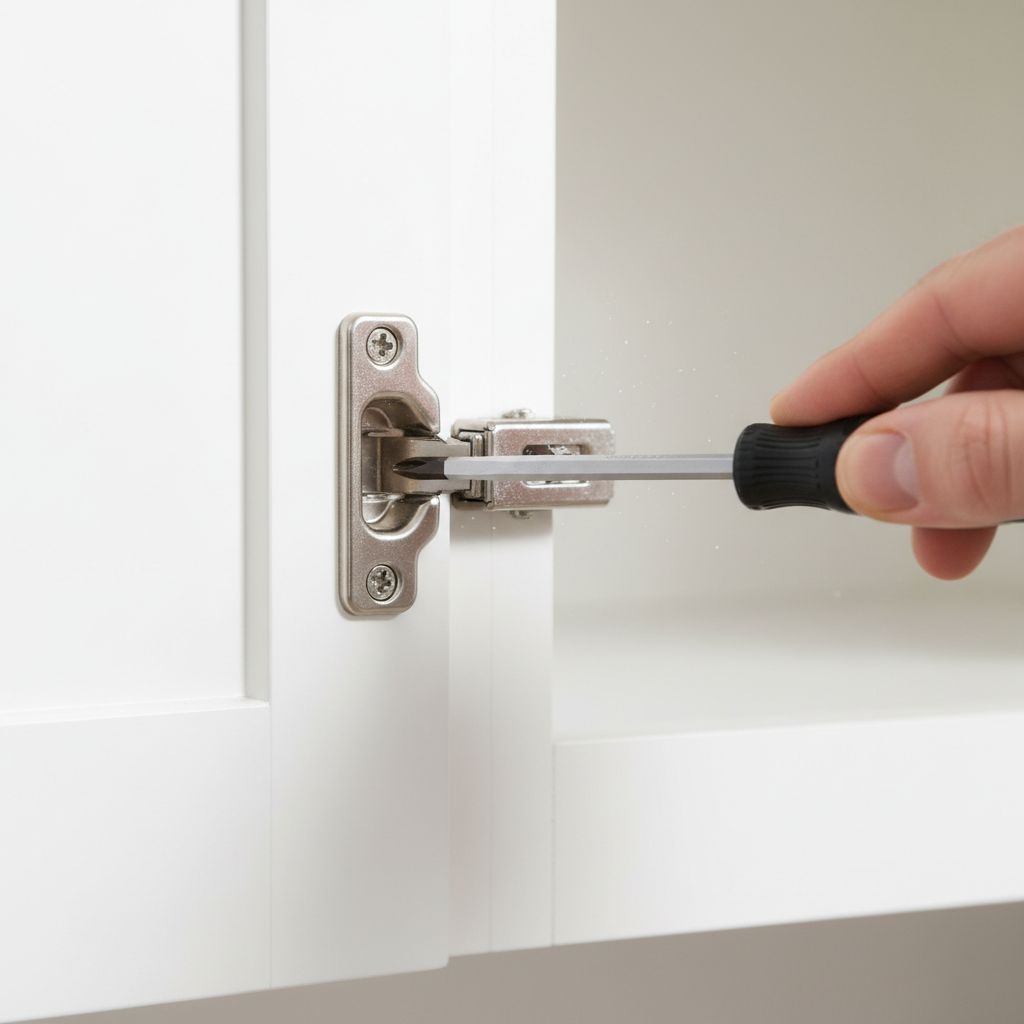
Every European hinge consists of two main parts: the hinge body, which is a cup that sits in a large hole (usually 35mm) drilled into the back of the cabinet door, and a mounting plate, which is screwed to the interior wall or face frame of the cabinet box. The magic happens where these two parts connect. There, you will find (usually) three small screws that serve as the cabinet’s command center.
-
The Side-to-Side Screw (Lateral Adjustment): This is typically the screw you see closest to the door, on the long arm of the hinge. Turning this screw causes the hinge arm to pivot, moving the cabinet door to the left or right. This is your primary tool for setting the gap, or "reveal," between adjacent doors. Turning it clockwise typically moves the door away from the hinge, and counter-clockwise moves it closer.
-
The Depth Screw (In/Out Adjustment): This screw is usually located at the very back of the hinge body. Turning it moves the entire door closer to or further away from the cabinet box. Its purpose is to ensure the door sits perfectly flush with the face of the cabinet when closed, preventing it from looking sunken-in or proud of the surface. It’s also the screw to check if a door won’t completely close (and isn’t blocked by an item inside).
-
The Height Screw (Vertical Adjustment): This adjustment can be the most confusing because it works differently depending on the hinge model. Most commonly, the mounting plate has elongated, oval-shaped screw holes. To adjust the height, you slightly loosen both screws on the mounting plate, physically lift or lower the door into position, and then re-tighten the screws. On more premium hinges, there may be a dedicated third screw (often between the other two on the plate) that works like a cam, raising or lowering the door with each turn. Correcting a "sagging" door is the primary job of this adjustment.
These three adjustments work independently, allowing you to move the door in any direction on the X, Y, or Z axis with remarkable precision.
Step-by-Step Fix
Adjusting your cabinet doors is a job of patience and precision, not brute force. Follow these steps methodically for perfect results.
1. Clear the Area & Grab Your Tool — First, empty the contents of the cabinet you’re adjusting, as well as any adjacent cabinets you might be aligning it with. The weight of items inside can subtly affect alignment. All you'll need is a standard #2 Phillips head screwdriver with a head that's in good condition (a stripped bit can damage the screws) and maybe a step stool.
2. Diagnose the Specific Problem — Before you turn a single screw, stop and analyze what is actually wrong. Ask yourself: * Is the door hanging too high or too low compared to its neighbor? (This is a Height issue.) * Is the gap between two doors uneven—wider at the top than the bottom? (This is a Height or Side-to-Side issue on one or both doors.) * Is the door scraping the door next to it when it closes? (This is a Side-to-Side issue.) * Does the door fail to sit flush with the cabinet box when closed? (This is a Depth issue.)
3. Start with Height (Vertical) Adjustments — Sagging is the most common problem. Start with the door that seems lowest. Open the door and slightly loosen the top and bottom screws on the mounting plates (the part attached to the cabinet wall). Don’t remove them, just loosen them enough to allow movement. Nudge the door up until its top edge aligns with the door or drawer next to it. Once it's in the perfect position, carefully re-tighten the screws. Close the door and check your work.
4. Adjust Side-to-Side (Lateral) Position — Now, let's fix the gaps. Close the door and look at the gap between it and the next door. It should be uniform and about 1/8 inch wide (the thickness of two nickels is a good guide). Open the door and find the lateral adjustment screw on the top hinge. Turn it a quarter-turn at a time—clockwise usually moves the door away from the hinge side, and counter-clockwise moves it closer. Close the door to check. Now do the same for the bottom hinge. The goal is a perfectly straight, even gap from top to bottom.
5. Fine-Tune the Depth — With the door closed, run your hand over the seam where the door edge meets the cabinet face. If the door feels sunken or sticks out, you need the depth screw (the one at the rear of the hinge). Open the door. Turning this screw will push the door in or out. Adjust the top and bottom hinges until the door face is perfectly flush with the cabinet frame or adjacent doors.
6. Tackle One Adjustment at a Time — This is critical. Do not try to adjust height and side-to-side in the same step. Fix the height first, then move on to the lateral gaps, and finish with the depth. Trying to do too much at once will leave you chasing your tail.
7. Focus on the Top Hinge for Sag — The top hinge carries the most weight and is the biggest culprit in a sagging door. Make your initial, larger adjustments to the top hinge, and then use the bottom hinge for fine-tuning the alignment.
8. Work in Tiny Increments — A quarter-turn of a screw can translate to a surprisingly large movement at the edge of the door. Make a small adjustment, close the door, step back, and observe the result. Repeat this process until it's perfect.
9. Use a Spacer for Uniform Gaps — For pro-level results, use a consistent spacer. A credit card, a couple of business cards, or a nickel can be used to check the gaps between doors and drawer fronts to ensure they are perfectly uniform across the whole kitchen.
10. Test the Full Swing — Once you think everything is aligned, open and close the door completely. Make sure it doesn’t make contact with any other door, drawer, or appliance pull during its travel.
11. Snug, But Don't Strip — After your final adjustments, give all the screws a final quarter-turn to make sure they're snug. Don't over-torque them, as this can strip the screw head or the wood, creating a much bigger problem.
Common Causes
Why do cabinet doors fall out of alignment in the first place? It’s rarely a single event.
- Initial Installation: Often, cabinet installers working on a timeline get the doors "close enough" but not perfect. They may not have taken the time for the final, precise tuning.
- House Settling: All houses settle and shift over time. These microscopic movements can rack cabinet boxes slightly out of square, which shows up as misaligned doors.
- Seasonal Wood Movement: Wood is a natural material that expands in humid summer months and contracts in dry winter air. This can cause subtle shifts in both the doors and the cabinet frames, affecting alignment.
- Vibration and Use: The simple act of opening and closing doors, especially if they are slammed shut, creates vibrations that can slowly work hinge screws loose over months or years.
- Weight & Stress: Doors with heavy spice racks or pot lid organizers attached to the inside are under constant stress, which can accelerate hinge sag and pull screws loose.
Common Mistakes
Avoid these common pitfalls that can turn a 10-minute fix into a frustrating ordeal:
- Adjusting the Wrong Screws: Many DIYers mistakenly loosen the screws holding the hinge cup inside the door, or completely remove the mounting plate screws. Stick to the three adjustment screws only.
- Making Huge Adjustments: Don't turn a screw a full 360 degrees right away. You’ll overshoot the mark. Think scalpel, not sledgehammer: quarter-turns are key.
- Forgetting to Empty the Cabinet: The weight of dishes or food presses down on the door and hinges. Adjusting a loaded door means it will be misaligned once you put everything back.
- The "One Door" Snowball Effect: Focusing on just one door in isolation can be a mistake. You may perfectly align it to the cabinet box, only to realize it's now misaligned with the door next to it. Always work in the context of the surrounding doors and drawers.
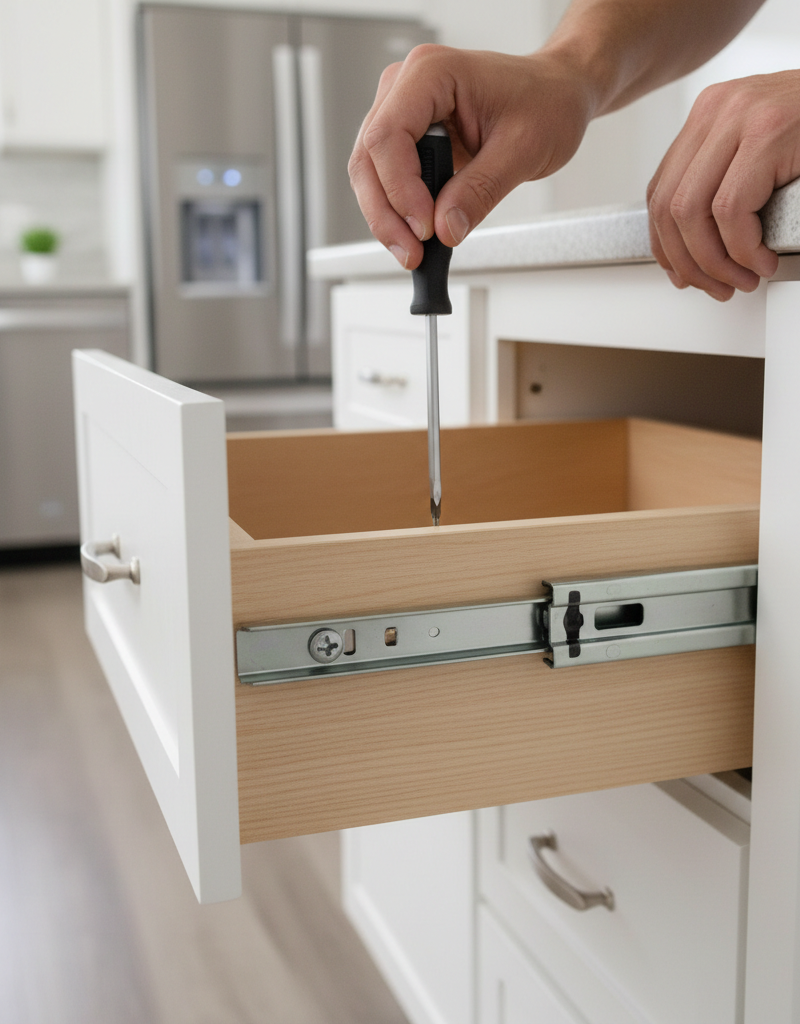
- Using a Power Drill: A drill/driver is overkill and the fastest way to strip a sensitive adjustment screw. Always use a hand-held screwdriver for maximum control.
- Not Aligning Pairs: When adjusting a pair of doors that meet in the middle, work on them together. Adjust them so the gap between them is even and they are level with each other.
Cost & Time Breakdown
This is one of the most satisfying DIY jobs because it offers a huge visual return for virtually no cost.
| Task | DIY Cost | Pro Cost | Time |
|---|---|---|---|
| Diagnose & Gather Tools | $0 | N/A | 5 minutes |
| Adjust Hinges on One Door | $0 | $75 - $125 (min. service) | 10-15 minutes |
| Adjust All Doors in a Kitchen (15 doors) | $0 | $150 - $300 | 1.5 - 2.5 hours |
| Replace One Broken Hinge | $8 - $20 | $100 - $175 | 20 minutes |
| Replace All Old Hinges with Soft-Close | $150 - $400 (for 15 doors) | $400 - $800+ | 3 - 5 hours |
Tips & Prevention
Keep your cabinets looking sharp with these simple habits:
- The Nickel Trick: A standard US nickel is just under 2mm thick. Use one or two stacked together as a feeler gauge to set perfectly consistent gaps between doors.
- Add Hinge Bumpers: Small, clear, self-adhesive silicone or felt dots placed on the inside corners of doors and drawers prevent slamming. This reduces stress on the hinges and frame and keeps screws from vibrating loose.
- Annual Check-Up: Once a year, go around with a screwdriver and gently check all hinge screws to ensure they are snug. Don't tighten them, just check for looseness.
- Go Easy on Door Storage: Avoid loading up the inside of your cabinet doors with heavy organizers. If you must, distribute the weight and check the alignment more frequently.
- Mind Your Cleaning Routine: When wiping down cabinets, use a damp—not soaking wet—cloth. Excessive moisture can compromise the wood around the hinge plate, leading to loose screws.
When to Call a Professional
While most alignment issues are an easy DIY fix, there are times when you need a pro. Call a handyman or cabinet specialist if you encounter any of the following:
- Stripped Screw Holes: If you turn a screw and it just spins without tightening, the wood around it is likely stripped out. A pro can fix this by filling the hole with wood putty or a dowel and re-drilling it properly.
- A Truly Broken Hinge: If you see cracked metal, a bent hinge arm, or a broken pin, the hinge itself has failed. While you can replace it yourself, getting an exact match for an older hinge can be tricky. A pro will know where to source the right hardware.
- Damaged Cabinet Box: If the wood of the cabinet face frame or side panel is cracked, water-damaged, or split around the hinge, simply adjusting the hinge won't solve the problem. The cabinet itself needs repair, which is a job for a carpenter.
- The Box is Out of Square: If you've tried every adjustment and the door still won't sit right, the cabinet box itself might be severely "racked" or skewed. A pro can sometimes diagnose if this is due to a bad installation and potentially shim or re-secure the cabinet to the wall to correct the problem. '''
Related Articles
Keep troubleshooting with these hand-picked guides from FixlyGuide:
- That New Grout Is Already Cracking? Here’s the Hidden Cause — Cracked grout weeks after a renovation is often a sign of a deeper issue with your subfloor or tile installation, not just a problem with t…
- Your Floating Shelves Failed? 3 Hidden Drywall Mistakes. — Learn how to safely and securely install floating shelves into drywall using the right anchors and tools, avoiding common mistakes.
- The 7 Critical Wall Prep Mistakes That Ruin Your Paint Job (And How to Fix Them) — Discover the crucial wall preparation steps often overlooked by DIYers that lead to peeling, cracking, and uneven paint finishes, and learn…
- Your Floating Shelves Sag? The 3 Drywall Mistakes You're Making — Learn how to install floating shelves into drywall securely and prevent common issues like wobbling or damage with the right tools and tech…
- The 4-Inch Drywall Hole Fix: Why Spackle Alone Always Fails — Learn the right way to patch a small drywall hole (up to 4 inches) to ensure a strong, invisible repair that spackle alone can't achieve.
- The 3 Hidden Reasons Your Garage Door Won't Fully Close (and the 10-Minute Fix) — Before you call for an expensive repair, here are the three most common, easy-to-fix reasons your garage door might not be closing complete…
Should you do this yourself?
Answer five quick questions before you start. Safety outranks savings every time.
Your experience with work like this
How high do you have to work?
Does the job involve any of these?
Will it need a permit?
Specialty tools
Free and instant. Educational guidance only — not a quote, inspection, or professional diagnosis.
What should this project cost?
Enter your project details for a realistic cost range before you call anyone.
Cosmetic refreshes start near $5,000; full remodels commonly $25,000–$45,000.
- Regional adjustment
- National average
- Labor share (typical)
- ~$8,550
- Quotes to collect
- 3 written estimates
Educational estimate based on national averages — not a binding quote. Always confirm with written local estimates.
Recommended for DIYers & woodworkers
Sponsored
The Top 20 Tools for Workshops of Any Budget
No stationary machines or power tools required — plus 3 fundamental tools that can't be bought at any price.
Get the free guide
Ted's Woodworking — The #1 Woodworking Resource
Detailed instructions, dimensioned drawings, materials & cutting lists, and 3D schematics for every skill level.
See the plansSponsored: links above are affiliate links. FixlyGuide may earn a commission on qualifying purchases — at no extra cost to you.
Frequently asked questions
Why won't my cabinet door close all the way?+
This is often a depth adjustment issue. One of the three screws on your hinge moves the door closer to or further from the cabinet frame. It could also be obstructed by an object inside or a faulty soft-close mechanism.
How do you fix a sagging cabinet door?+
A sagging door is primarily fixed using the height adjustment on the hinges. By slightly loosening the mounting plate screws and lifting the door, then re-tightening, you can correct the sag. Start with the top hinge, as it bears the most weight.
Can you adjust old-style cabinet hinges?+
Traditional mortise or surface-mount hinges offer very little adjustment. Alignment issues with these often require shimming the hinge with thin cardboard or re-drilling the screw holes in a slightly different position, which is a more advanced fix.
What is the proper gap for cabinet doors?+
A standard, professional-looking gap (or 'reveal') between cabinet doors is typically 1/8 of an inch. Many installers use a nickel or two stacked together as a quick, consistent spacer to set these gaps during adjustment.
Discussion
Loading comments…