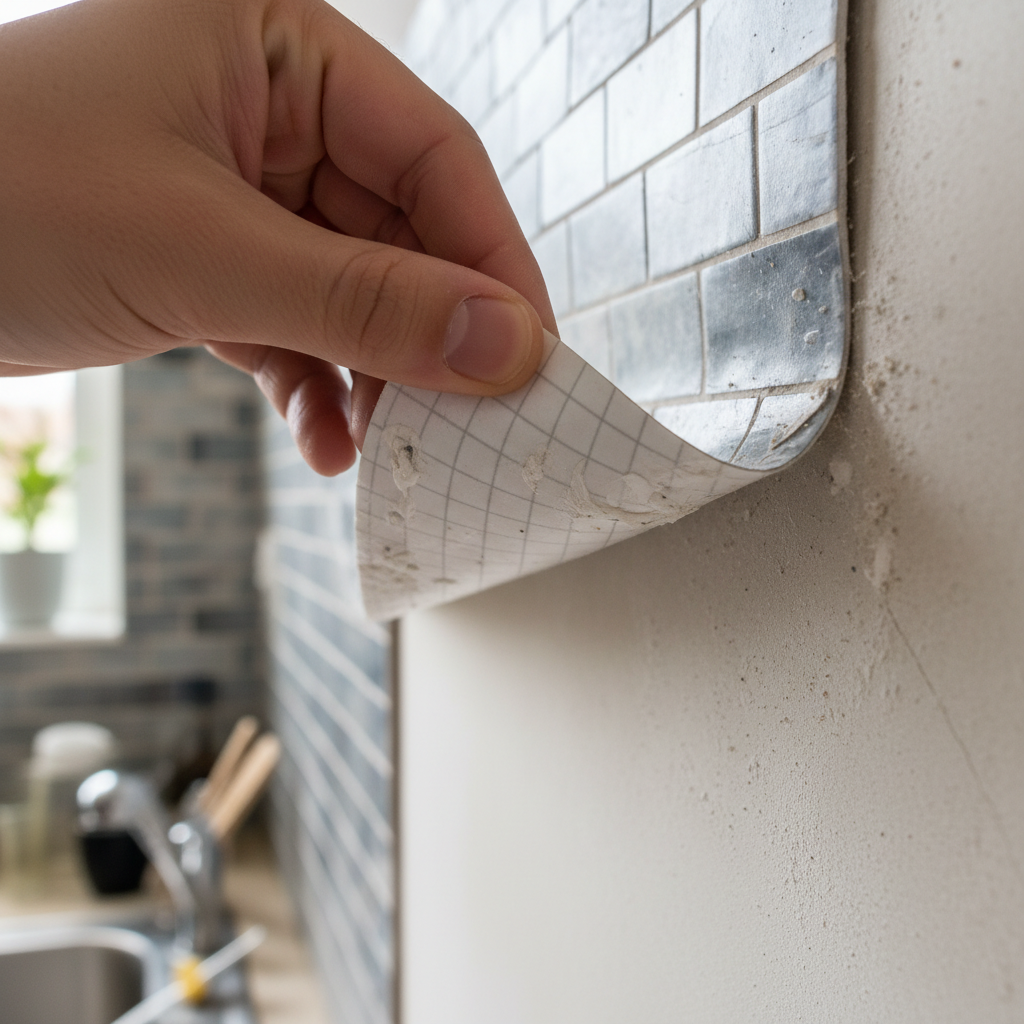
- Unprepared Surface: The wall was not cleaned with a degreaser (TSP, denatured alcohol), leaving a microscopic film of cooking grease and dust.
- Fresh Paint: Tiles were applied to a wall painted less than 21-30 days prior, leading to bond failure from paint off-gassing.
- Wrong Paint Sheen: The underlying surface was a glossy, semi-gloss, or "easy-clean" paint with low surface energy that repels adhesives.
- Textured Walls: The adhesive could only make contact with the high points of the texture, resulting in a significantly weaker bond.
- Skipped Pressure Application: The tiles were simply smoothed by hand, not with a J-roller, so the pressure-sensitive adhesive was never fully activated.
General remodeling · Renovation planning
| Project category | General remodeling |
|---|---|
| Problem type | Renovation planning |
| Trade required | General contracting |
| Urgency | Planned project |
| Safety risk | Low safety risk |
| DIY suitability | Pro recommended |
| Cost category | Major investment |
| Typical timeline | Design and permitting often 2–4 months before work starts |
| Contractor type | General contractor |
Repair option
Phase the work and fix the building envelope first.
Replacement option
Full renovation with permits, design, and a general contractor.
Common causes
- Space no longer fits how the household lives
- Resale preparation
- Deferred maintenance stacking up
Relevant tools:project cost estimatorcompare quoteshome improvement material prices
Published April 27, 2026Last updated August 17, 2026
Tools & materials you'll need
Affiliate links- AmazonPeel-and-Stick TilesPurchase 10-15% extra for cuts and mistakes.
- AmazonTrisodium Phosphate (TSP) or Denatured AlcoholFor degreasing the wall surface.
- AmazonAdhesion-Promoting PrimerZinsser B-I-N (shellac-based) is highly recommended.
- AmazonLightweight SpacklingFor repairing any drywall damage.
- Amazon100% Silicone CaulkFor sealing edges against moisture.
As an Amazon Associate FixlyGuide earns from qualifying purchases — at no extra cost to you. Prices and availability are accurate as of publication and subject to change.
Quick Answer
Your peel-and-stick backsplash is likely falling off not because the tiles are faulty, but due to improper surface preparation. The wall wasn't cleaned with a degreasing agent like TSP or denatured alcohol, or it was painted too recently, causing adhesive failure from paint off-gassing and low surface energy.
The Problem
You spent the weekend transforming your kitchen. The peel-and-stick backsplash looked perfect—a quick, budget-friendly upgrade. But a few weeks later, you see it: a corner curling up near the stove, an edge lifting behind the sink, or an entire sheet of tiles starting to sag. You press it back into place, but the adhesive has lost its grip. It feels like a complete waste of time and money, and the promise of an "easy" DIY project has turned into a frustrating eyesore. The culprit isn't necessarily a cheap product; it's the invisible science of what’s happening between the tile and the wall.
How It Works
The bond failure of peel-and-stick tiles is a fascinating lesson in surface chemistry. These products use a Pressure-Sensitive Adhesive (PSA), a viscoelastic polymer that flows into the microscopic pores of a surface to create a bond. Unlike a liquid glue that cures and hardens, a PSA remains perpetually "tacky." Its success depends almost entirely on the condition of the substrate it’s stuck to. The two secret villains working against your backsplash are surface energy and off-gassing.
First, let's talk about surface energy. Think of it as the wall's willingness to be grabbed. A high-energy surface allows an adhesive to spread out (or "wet out") and achieve maximum contact, creating a strong bond. Unpainted drywall and matte-painted surfaces have higher surface energy. Conversely, low-energy surfaces cause adhesives to bead up, like water on a waxed car, resulting in a weak bond. The culprits for low surface energy? Glossy, semi-gloss, and satin paints, which are formulated to be slick and easy to clean. Even worse are the "stain-resistant" or "washable" paints that contain additives like silicone or Teflon precisely to repel things from sticking to them—including your tile adhesive!
Second, and most critically, is paint off-gassing. Freshly painted walls are chemically active. For weeks after drying, they release volatile organic compounds (VOCs) and other solvents into the air. This process is called "curing." If you apply a non-breathable vinyl tile over a wall that is still off-gassing, those gas molecules get trapped. They exert a steady, outward pressure on the adhesive, effectively pushing the tile off the wall from behind. This is why a backsplash can look perfect for a week and then begin to fail as the gas pressure builds. A wall may feel dry to the touch in hours, but it is not fully cured for at least 21 to 30 days.
Proper preparation—thoroughly degreasing, scuffing, and priming the wall—is not about just cleaning; it’s a chemical process to raise the surface energy and create a stable, inert barrier for the adhesive to grab onto permanently.
Step-by-Step Fix
If your tiles are failing, a lasting fix requires removing them and preparing the wall correctly. This guide ensures your second attempt is your last.
1. Gentle Removal of Old Tiles — Start by warming the tiles with a hairdryer on low heat. This softens the adhesive, allowing you to peel them off more easily. Use a plastic putty knife to get under an edge and slowly work the tile away from the wall. Pulling too fast can rip the drywall paper.
2. Assess and Repair the Wall — Once the tiles are off, inspect the surface. You will likely see patches of torn drywall paper or chunks of paint that came off with the adhesive. Use a putty knife to apply a thin layer of lightweight spackling or joint compound to these damaged areas. Let it dry completely, then sand smooth with a 220-grit sanding sponge.
3. The Critical Degreasing Clean — This is the most important step. Do not use household cleaners, as many leave behind a slick residue. Mix a solution of Trisodium Phosphate (TSP) and water according to the manufacturer's directions, or wipe the entire surface down with a rag dampened with denatured alcohol. Wear gloves and eye protection. This aggressive cleaning removes all grease, oil, and residues, chemically preparing the surface for adhesion.
4. Scuff the Surface — If the wall is painted with a satin, semi-gloss, or gloss finish, you must knock down the shine. Lightly scuff the entire area with a 120-grit sanding block. You aren’t trying to remove the paint, just create a fine-grit, textured profile that gives the primer a mechanical grip. Wipe away all sanding dust with a tack cloth or a clean, damp rag.
5. Apply an Adhesion-Promoting Primer — Apply a single, even coat of a high-quality, adhesion-promoting primer. A shellac-based primer like Zinsser B-I-N is an excellent choice as it seals the wall, blocks stains, and creates a high-energy surface ideal for adhesives. It also acts as a barrier, preventing any potential off-gassing from the underlying paint. Let the primer cure for the time recommended by the manufacturer—usually at least 24 hours.
6. Acclimate and Plan — Unbox your new peel-and-stick tiles and let them sit in the room for 48 hours. This allows them to adjust to the ambient temperature and humidity, preventing expansion or contraction after installation. Use a level and a pencil to draw a perfectly level horizontal guideline on the wall where the top of your first row of tiles will sit.
7. Install with Precision — Peel the backing off your first tile. Do not touch the adhesive with your fingers, as oils from your skin can compromise the bond. Align the top edge of the tile with your level guideline and gently press it into place, starting from the center and smoothing outwards.
8. Apply Firm, Even Pressure — This step activates the pressure-sensitive adhesive. Once a sheet of tiles is in place, use a J-roller or a vinyl grout float to roll over the entire surface with firm pressure. Pay special attention to the edges and corners. This step is non-negotiable for a long-lasting bond.
9. Overlap and Repeat — Most peel-and-stick tiles have a designated overlap area. Ensure you follow the manufacturer's instructions precisely to create a seamless, waterproof joint. Continue installing tiles, working your way across and up the wall.
10. Seal the Perimeter — Once all tiles are installed and rolled, apply a thin bead of 100% silicone kitchen and bath caulk along the bottom edge where the backsplash meets the countertop, and along any vertical edges that meet a wall or cabinet. This prevents moisture from getting behind the tiles and compromising the adhesive.
Common Causes
- Unprepared Surface: The wall was not cleaned with a degreaser (TSP, denatured alcohol), leaving a microscopic film of cooking grease and dust.
- Fresh Paint: Tiles were applied to a wall painted less than 21-30 days prior, leading to bond failure from paint off-gassing.
- Wrong Paint Sheen: The underlying surface was a glossy, semi-gloss, or "easy-clean" paint with low surface energy that repels adhesives.
- Textured Walls: The adhesive could only make contact with the high points of the texture, resulting in a significantly weaker bond.
- Skipped Pressure Application: The tiles were simply smoothed by hand, not with a J-roller, so the pressure-sensitive adhesive was never fully activated.
- Moisture: The tiles were installed in a highly humid room, or water was allowed to seep in behind the edges, weakening the adhesive over time.
Common Mistakes
- Cleaning with the wrong stuff: Using a generic all-purpose cleaner that leaves behind soap scum or slick residue.
- Being impatient with paint: Not waiting the required 3-4 weeks for new paint to fully cure before installation.
- Skipping primer: Assuming a clean wall is enough, without realizing primer is needed to create a uniform, high-energy surface.
- Eyeballing the first row: Not using a level guideline, resulting in crooked tiles that become more obvious as you move up the wall.
- "Set it and forget it": Placing the tile on the wall and not following up with firm pressure from a roller to create a permanent bond.
- Ignoring temperature: Installing tiles on a very cold wall (below 60°F) where the adhesive is too stiff to bond properly.
Cost & Time Breakdown
This breakdown is for re-installing a typical 20 sq. ft. kitchen backsplash.
| Task | DIY Cost | Pro Cost | Time |
|---|---|---|---|
| Removal & Wall Repair | $20 (Spackle, sandpaper) | $75 - $150 | 1-2 hours |
| Surface Prep Materials | $35 (TSP, Primer, Roller) | (Included in labor) | 1 hour + cure time |
| Peel-and-Stick Tiles | $60 - $200 (20 sq. ft.) | (Client supplies materials) | - |
| Installation & Cleanup | $20 (Caulk, new blade) | $250 - $450 | 2-3 hours |
| Total | $135 - $275 | $325 - $600 | 4-6 hours + 24hr cure |
Tips & Prevention
- Use an Adhesion Promoter: For ultimate peace of mind, especially on tricky surfaces, wipe the primed wall with an automotive adhesion promoter (like 3M Primer 94) right before you stick the tile. It creates a hyper-aggressive bond.
- Account for Heat: Do not install vinyl or PVC-based peel-and-stick tiles directly behind a stove without a protective metal panel. The constant heat will cause the material to warp and the adhesive to fail.
- Caulk is Your Friend: Caulk not just the bottom, but any exposed top or side edges. This is your best defense against the two biggest enemies: water and dust.
- Order Extra: Always buy 10-15% more square footage than you need. This covers you for cutting mistakes and allows you to have replacement tiles from the same batch if one gets damaged later.
- Dry Fit First: Before peeling the backing, lay out your tile sheets on the counter to visualize your cuts and layout, especially around outlets.
When to Call a Professional
While this is a very manageable DIY project, there are times when it pays to call in a pro. If, after removing the old tiles, you discover significant wall damage like soft or crumbling drywall from a hidden leak, you need a drywall contractor or handyman to repair the substrate first. Applying new tiles over a compromised wall is a waste of money. Similarly, if your walls have heavy, uneven texture (like "knockdown" or "popcorn"), achieving a smooth surface requires skim coating—a job best left to a professional drywall finisher for a perfectly flat result. Finally, if you’re looking for a permanent, high-end solution that adds significant resale value, a professional tile setter can install a ceramic, porcelain, or stone backsplash that will last for decades.
Related Articles
Keep troubleshooting with these hand-picked guides from FixlyGuide:
- The 7 Critical Wall Prep Mistakes That Ruin Your Paint Job (And How to Fix Them) — Discover the crucial wall preparation steps often overlooked by DIYers that lead to peeling, cracking, and uneven paint finishes, and learn…
- That New Grout Is Already Cracking? Here’s the Hidden Cause — Cracked grout weeks after a renovation is often a sign of a deeper issue with your subfloor or tile installation, not just a problem with t…
- That Heavy Mirror? It Needs More Than Just a Nail — Stop guessing with drywall anchors; the physics of shear force and toggle bolt ratings are the secret to keeping your heavy mirror securely…
- Your Floating Shelves Failed? 3 Hidden Drywall Mistakes. — Learn how to safely and securely install floating shelves into drywall using the right anchors and tools, avoiding common mistakes.
- Your Floating Shelves Sag? The 3 Drywall Mistakes You're Making — Learn how to install floating shelves into drywall securely and prevent common issues like wobbling or damage with the right tools and tech…
- The #1 Overlooked Reason Your Chimney Leaks (It Rots Your Roof!) — Discover the surprising, often-missed culprit behind your leaky chimney and how this common issue can silently damage your home.
What should this project cost?
Enter your project details for a realistic cost range before you call anyone.
Cosmetic refreshes start near $5,000; full remodels commonly $25,000–$45,000.
- Regional adjustment
- National average
- Labor share (typical)
- ~$8,550
- Quotes to collect
- 3 written estimates
Educational estimate based on national averages — not a binding quote. Always confirm with written local estimates.
Recommended for DIYers & woodworkers
Sponsored
The Top 20 Tools for Workshops of Any Budget
No stationary machines or power tools required — plus 3 fundamental tools that can't be bought at any price.
Get the free guide
Ted's Woodworking — The #1 Woodworking Resource
Detailed instructions, dimensioned drawings, materials & cutting lists, and 3D schematics for every skill level.
See the plansSponsored: links above are affiliate links. FixlyGuide may earn a commission on qualifying purchases — at no extra cost to you.
Frequently asked questions
Can I put new peel-and-stick tile over old, existing tile?+
It is not recommended. The grout lines on the existing tile create deep valleys where the new adhesive cannot make contact, leading to a weak bond and an uneven appearance. For a lasting finish, you must create a perfectly smooth surface by either removing the old tile or skim-coating it with a special primer and leveling compound.
How long do I really have to wait to install over fresh paint?+
You must wait a minimum of 21 days, and 30 days is even safer. A wall may feel dry to the touch within hours, but it is still curing and releasing solvent gases (off-gassing). Applying tiles too soon traps these gases, which will push the tiles off the wall over time. Patience is critical.
Why are my peel-and-stick tiles peeling near the stove?+
This is caused by a combination of heat and contamination. The heat from the stove softens the adhesive, reducing its strength. This is often an area with high concentrations of airborne cooking grease. The heat makes the adhesive more susceptible to failure from the grease film on the wall. Always clean with a strong degreaser like TSP and consider a stainless steel panel directly behind the stove.
Do I have to use a primer if my wall is already painted with a matte finish?+
Yes, you should still prime. While a matte finish has better surface energy than gloss, a dedicated adhesion-promoting primer does three things: it ensures a uniformly porous surface, it seals in any residual dust or contaminants you may have missed, and it acts as a barrier against any potential off-gassing from the old paint. It's a critical insurance step.
Discussion
Loading comments…