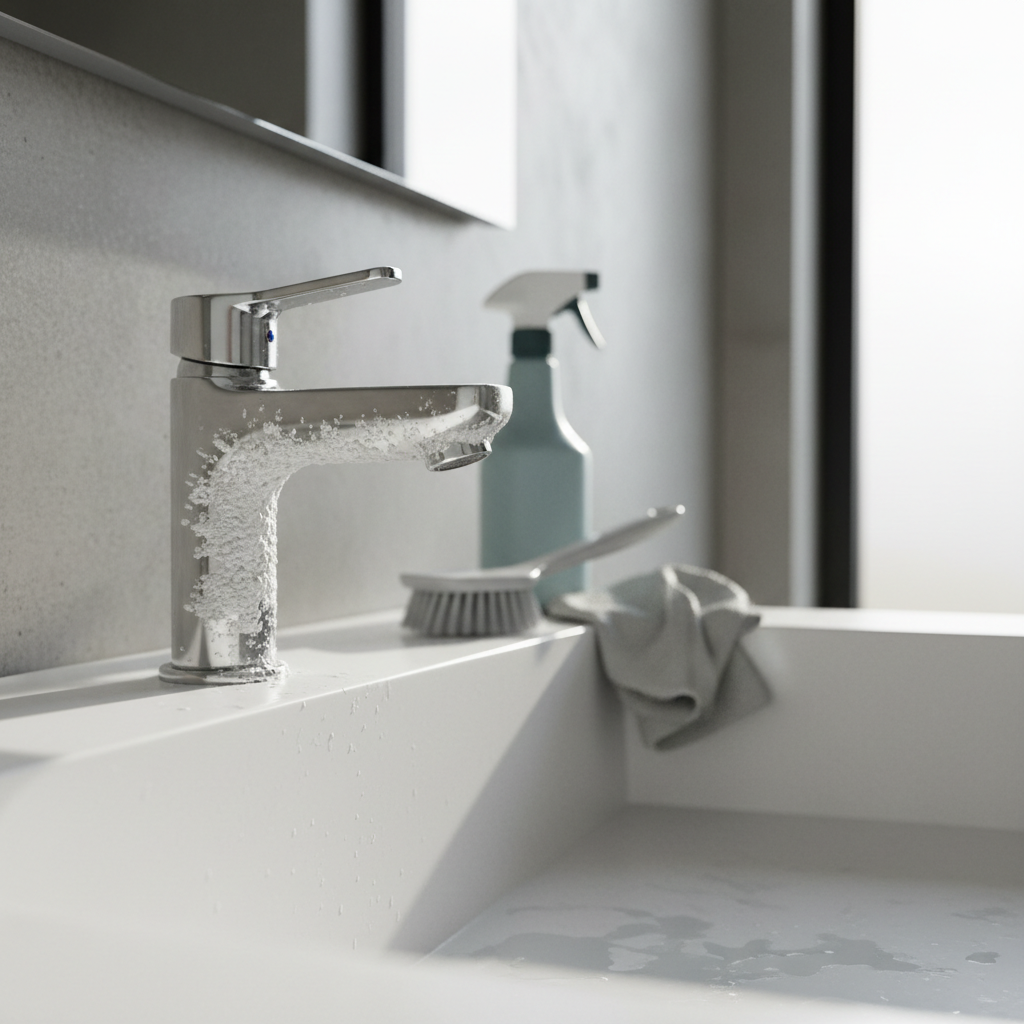
- High Mineral Content: The primary cause is simply having hard water in your municipal supply or well—a geological lottery. You can check your local water utility's website for a water quality report.
- Slow Drips and Leaks: A slowly dripping faucet or showerhead is a limescale factory. The constant, slow evaporation of water leaves behind a concentrated mineral deposit that grows over time.
- Infrequent Cleaning: Ignoring minor water spots allows them to build a foundation. Each subsequent layer of mineral deposit bonds to the last, making it exponentially harder to remove.
- Low-Flow Fixtures: While great for water conservation, the fine screens and narrow passages in modern low-flow fixtures are much more susceptible to clogging from even minor scaling.
Plumbing · Clog
| Project category | Plumbing |
|---|---|
| Problem type | Clog |
| Trade required | Plumbing |
| Urgency | Soon — within weeks |
| Safety risk | Low safety risk |
| DIY suitability | DIY friendly |
| Cost category | Low cost |
| Typical timeline | Same-day DIY attempt; pro visit within a day or two |
| Contractor type | Licensed plumber |
Repair option
Plunger, hand auger, or trap cleanout before chemicals.
Replacement option
Line replacement when clogs return in the same spot repeatedly.
Common causes
- Hair and soap buildup in the trap
- Grease cooling in the branch line
- Flushed wipes or foreign objects
Relevant tools:diy difficultydiy or hire a pro
Published May 5, 2026Last updated August 17, 2026
Tools & materials you'll need
Affiliate links- AmazonOld Toothbrush or Soft Brush1 · For scrubbing deposits without scratching finishes.
- AmazonMicrofiber Cloths2 · One for cleaning, one for polishing.
- AmazonAdjustable Wrench or Pliers1 · Wrap jaws in tape to prevent scratching aerators.
- AmazonSafety Glasses1 · Protect eyes from splashes.
- AmazonRubber Gloves1 pair · Protect hands from acid and grime.
- AmazonDistilled White Vinegar1/2 Gallon · Standard 5% acidity is effective and safe for most finishes.
- AmazonPlastic Bags2-3 · Sandwich or quart size for faucets, gallon size for showerheads.
- AmazonRubber Bands or Zip TiesSeveral · For securing bags to fixtures.
- AmazonCommercial Descaling Solution1 · Optional alternative to vinegar, good for very heavy buildup.
As an Amazon Associate FixlyGuide earns from qualifying purchases — at no extra cost to you. Prices and availability are accurate as of publication and subject to change.
Quick Answer
The white, crusty substance on your faucets and showerheads is calcium carbonate, also known as limescale, left behind by hard water. These mineral deposits clog aerators, reduce water pressure, and can permanently damage fixture finishes. The most effective way to remove it is by dissolving the alkaline mineral buildup with a mild acid, like white vinegar or a dedicated descaling solution.
The Problem
It starts subtly. A few white spots on the chrome faucet base. A faint chalky ring around the tub spout. You wipe it away, but it comes back, more stubborn each time. Soon, it’s a full-blown crusty deposit that defies normal cleaners. Your showerhead, once a powerful stream, is now sputtering and sending jets in odd directions. This is the visible story of hard water damage.
What you're seeing is limescale, the rock-hard evidence of a high concentration of dissolved minerals—primarily calcium and magnesium—in your water supply. As water evaporates, these minerals are left behind, crystallizing into a solid deposit. This isn't just a cosmetic issue; it's a progressive disease for your plumbing fixtures. The scale builds up inside faucet aerators and showerhead nozzles, constricting water flow and leading to frustratingly low pressure. The sputtering and misdirected spray from your shower is a direct result of these tiny passages being physically blocked by mineral deposits.
Beyond simple blockages, limescale can cause permanent damage. The buildup can be so tenacious that removing it requires harsh scraping or chemicals, which can scratch, pit, or strip the protective finish (like chrome, brushed nickel, or oil-rubbed bronze) from your fixtures. Once that finish is compromised, the base metal underneath is exposed to moisture and air, leading to corrosion and rust that can’t be fixed. Furthermore, scale can work its way into the valve stems and cartridges inside faucet handles, making them stiff, difficult to turn, and eventually causing leaks that require a plumber to rebuild or replace the entire fixture.
How It Works
To understand how to beat limescale, you need to understand the simple chemistry behind it. Water is a fantastic solvent. As it travels through the ground, it dissolves minerals from rock. In many regions, this means it picks up a significant amount of calcium (Ca²⁺) and magnesium (Mg²⁺) ions. This is what we call "hard water." These minerals are invisible while dissolved, but they're ready to come out of solution at the slightest provocation.
The two main triggers for limescale formation in your home are changes in temperature and pressure. When cold, hard water enters your water heater, the rise in temperature makes calcium and magnesium far less soluble, causing them to precipitate out and form solid calcium carbonate (CaCO₃)—the primary component of limescale. This is why water heaters are so prone to scale buildup. A similar thing happens on a smaller scale right at your faucet. As water exits the aerator, the pressure drops and it comes into contact with air, encouraging the minerals to crystallize and deposit onto the surface. This is an alkaline substance.
The key to removing it is a basic acid-base reaction. Limescale is alkaline, so when you apply a mild acid like acetic acid (found in vinegar), a chemical reaction occurs. The acid dissolves the calcium carbonate, breaking it down into three harmless components: water (H₂O), a soluble calcium salt (calcium acetate, in the case of vinegar), and carbon dioxide (CO₂) gas. That fizzing you see when you apply vinegar to heavy buildup? That’s the reaction happening in real-time, as the solid mineral scale is converted into gas and a substance that simply washes away.
Step-by-Step Fix
This DIY descaling routine uses common household items to dissolve mineral buildup and restore flow and shine to your fixtures. Plan for a few hours to allow for adequate soaking time.
Safety Note: Always wear gloves and safety glasses when working with any cleaning solution, including vinegar, to protect your skin and eyes. Ensure the area is well-ventilated.
-
Gather Your Supplies: You will need distilled white vinegar (at least 5% acetic acid), several sandwich-sized plastic bags, rubber bands or zip ties, an old toothbrush or other soft-bristled brush, a few microfiber cloths, and, for faucet aerators, a pair of adjustable pliers with the jaws wrapped in electrical tape to prevent scratching.
-
Tackle the Faucet Aerator: The aerator at the tip of your faucet is a primary culprit for flow issues. Wrap the tape around the jaws of your pliers. Gently grip the aerator and turn it counter-clockwise to unscrew it. Take note of the order of any internal parts, like screens or rubber washers. Place the aerator and its components into a small bowl and submerge them completely in white vinegar.
-
Descale the Showerhead (Method 1: Removal): If your showerhead can be easily unscrewed (usually by hand or with gentle persuasion from the taped-up pliers), remove it from the shower arm. Submerge it in a bucket or large bowl filled with enough white vinegar to cover it completely.
-
Descale the Showerhead (Method 2: The Baggie): If the showerhead is fixed or difficult to remove, use this classic method. Fill a plastic sandwich or gallon bag about halfway with white vinegar. Carefully lift the bag up and over the showerhead, ensuring all the nozzles are fully submerged in the vinegar. Secure the bag tightly to the shower arm using several rubber bands or a zip tie.
-
Let It Soak: This is the most crucial step. Allow the parts to soak for at least one to two hours for moderate buildup. For very heavy, stubborn limescale, you may need to let them soak for four hours or even overnight. You should see fizzing as the acid works.
-
Scrub the Deposits: After soaking, remove the parts or take the bag off the showerhead. Most of the limescale should have dissolved, leaving behind a soft, pasty residue. Use an old toothbrush to gently scrub the nozzles, screens, and fixture bodies. The remaining deposits should come off easily.
-
Address Stubborn Spots: For any remaining tough spots, you can create a paste of baking soda and water. While baking soda is alkaline, its mild abrasive quality helps scrub away the softened scale without scratching the finish. Apply the paste and scrub gently with the toothbrush.
-
Rinse Thoroughly: Use the toothbrush to clear any debris from aerator screens and shower nozzles. Rinse all components with clean water. Before reassembling, turn the faucet and shower on for 30-60 seconds to flush out any loosened mineral debris from within the pipes and the fixture body itself.
-
Reassemble and Test: Carefully screw the clean aerator back onto the faucet, hand-tightening first and then giving it a final gentle nudge with the pliers if needed. Re-attach the showerhead. Turn on the water. You should notice a significant improvement in flow and spray pattern.
-
Clean Other Fixtures: Use a vinegar-soaked rag to wipe down and scrub the bases of faucets, handles, and tub spouts. For crusty buildup around these areas, you can lay a vinegar-soaked paper towel directly on the spot for an hour before scrubbing.
-
Final Polish: Once everything is clean and dry, use a clean microfiber cloth to polish the fixtures. This removes any remaining water spots and restores the shine.
Common Causes
- High Mineral Content: The primary cause is simply having hard water in your municipal supply or well—a geological lottery. You can check your local water utility's website for a water quality report.
- High Water Heater Temperature: The hotter the water, the more readily calcium and magnesium will precipitate out of solution. Water heaters set above 120°F can significantly accelerate scale formation throughout your hot water pipes and fixtures.
- Slow Drips and Leaks: A slowly dripping faucet or showerhead is a limescale factory. The constant, slow evaporation of water leaves behind a concentrated mineral deposit that grows over time.
- Infrequent Cleaning: Ignoring minor water spots allows them to build a foundation. Each subsequent layer of mineral deposit bonds to the last, making it exponentially harder to remove.
- Low-Flow Fixtures: While great for water conservation, the fine screens and narrow passages in modern low-flow fixtures are much more susceptible to clogging from even minor scaling.
Common Mistakes
- Using Abrasive Scrubbers: Never use steel wool, scouring pads, or abrasive powders. They will permanently scratch and ruin the finish of your fixtures, making them look dull and creating microscopic grooves where new scale can form even faster.
- Choosing the Wrong Cleaner: Avoid overly aggressive acids like muriatic acid, which can chemically burn and discolor finishes in seconds and cause serious injury. Stick to white vinegar or pH-neutral, specially-formulated limescale removers.
- Not Soaking Long Enough: Simply spraying vinegar on the scale and wiping it off won't work. The acid needs time—at least an hour—to chemically react with and dissolve the rock-hard mineral buildup.
- Prying at the Scale: Resista the urge to use a screwdriver, knife, or any metal tool to chip away at heavy buildup. You will almost certainly slip and gouge or dent the fixture, causing irreparable damage.
- Forgetting to Rinse: Leaving acidic residue on the fixture, especially on sensitive finishes like nickel or brass, can cause etching or discoloration over time. Rinse thoroughly with plain water after descaling.
Cost & Time Breakdown
This is a very budget-friendly DIY project. The primary cost is your time and a bottle of vinegar.
| Item | Quantity | Estimated Cost |
|---|---|---|
| Distilled White Vinegar | 1 Gallon | $3 - $5 |
| Plastic Bags / Rubber Bands | A few | $1 - $2 |
| Soft-Bristled Brush | 1 | $1 - $3 |
| Microfiber Cloths | 2-pack | $3 - $5 |
| DIY Total | $8 - $15 | |
| Commercial Descaler | 1 Bottle | $8 - $20 |
Tips & Prevention
- Wipe Fixtures Dry: The single best habit to prevent buildup is to wipe down faucets, handles, and shower fixtures with a microfiber cloth after each use. No water, no evaporation, no mineral spots.
- Perform a Monthly Vinegar Soak: Make descaling a part of your regular cleaning routine. A quick one-hour soak every month is far easier than an overnight battle with heavy crust every year.
- Check Your Water Heater Temp: Check your water heater's thermostat. If it's set above 120°F (49°C), consider lowering it. This will save energy and reduce scaling throughout your entire plumbing system.
- Use a Daily Shower Spray: After showering, mist the walls and fixtures with a daily shower cleaner. Many of these products contain surfactants that help prevent water from beading up, reducing mineral-spotting.
- The Ultimate Solution: Water Softener: If you live in an area with very hard water, the only way to truly solve the problem at its source is to install a whole-house water softener. This system removes the calcium and magnesium ions before the water ever reaches your fixtures.
When to Call a Professional
While descaling is an effective DIY task, there are times when the problem is beyond a simple cleaning. If you've thoroughly cleaned your fixtures but your water pressure is still low throughout the house, the issue may be a larger-scale buildup deep within your pipes or in your water heater. A professional plumber can use specialized tools and cameras to diagnose deep-pipe blockages that vinegar can't reach. If a fixture is so corroded that it’s permanently discolored, pitted, or the finish is flaking off, it will need to be replaced. Likewise, if a valve is seized or a fixture cannot be disassembled without breaking it, a pro has the experience to get it apart or replace it correctly. Finally, the most effective long-term solution for hard water is a whole-house water softener, and installing one is a complex job best left to a licensed plumber.
Related Articles
Keep troubleshooting with these hand-picked guides from FixlyGuide:
- The 4 Hidden Reasons Your Entire Home Has Low Water Pressure (And the Easy Fixes) — Low water pressure throughout your entire home can be a frustrating and often misunderstood problem, with several common culprits. Learn to…
- The #1 Mistake Homeowners Make When Diagnosing Low Water Pressure (It's Not Your Pipes!) — Discover the most overlooked culprit behind low water pressure throughout your entire house and learn how to fix it with simple steps.
- Your Windows Are Crying? The Hidden Cause of Condensation — Window condensation isn't just a harmless annoyance; it's a clear signal that your home's indoor humidity is too high, potentially leading…
- The #1 Mistake Homeowners Make When Diagnosing Low Water Pressure (and What to Check First) — Before you call a plumber, learn the most common overlooked cause of low water pressure affecting your entire home and how to easily check…
- The 3 Hidden Reasons Your LED Bulbs Die Early (And the Simple Fixes) — LED bulbs promise long life, but often fail prematurely due to hidden electrical issues or incompatible fixtures. Learn the real culprits.
- That Chalky Film on Your Dishes? It's Not Soap Scum — If your dishwasher is leaving a cloudy white film on your glassware and dishes, the culprit is likely hard water mineral deposits, not left…
Should you do this yourself?
Answer five quick questions before you start. Safety outranks savings every time.
Your experience with work like this
How high do you have to work?
Does the job involve any of these?
Will it need a permit?
Specialty tools
Free and instant. Educational guidance only — not a quote, inspection, or professional diagnosis.
Questions to ask before you sign
Ask every contractor the same questions and the cheapest bid stops looking cheapest. Check them off as you go — your progress is saved on this device.
Free, no signup. Bring this to every walkthrough so you compare bids on the same terms.
What should this project cost?
Enter your project details for a realistic cost range before you call anyone.
Common repairs run $150–$650; repipes and water-heater replacements reach $1,500–$4,500.
- Regional adjustment
- National average
- Labor share (typical)
- ~$754
- Quotes to collect
- 3 written estimates
Educational estimate based on national averages — not a binding quote. Always confirm with written local estimates.
Fixly Project Decision Box
- DIY difficulty
- Moderate
- Estimated time
- 30 minutes – half a day
- Cost level
- Moderate
Main tools / materials
- Adjustable wrench
- Plunger or drain auger
- Bucket and towels
- Thread tape
When to stop and call a pro
- Water you cannot shut off at the fixture or main
- Sewage backing up into more than one fixture
- Water near electrical panels or outlets
- Gas water heater work beyond relighting a pilot
Need professional help?
Get a Licensed PlumberHandle this before it gets worse
First steps that limit damage, then a way to reach a qualified pro.
- Emergency repair checklistThe first steps that limit damage before a pro arrives.Open
- Get local estimatesSend one request and compare written estimates from vetted pros.Open
- Estimate this projectGet a cost range for your scope and ZIP before you call anyone.Open
Free, no signup required. Estimates are educational guidance, not a quote or an inspection.
Get the print-ready PDF of this guide
A clean, ad-free, printable version you can keep on your phone or pin to the workshop wall. Free with a FixlyGuide account.
- Print-optimized layout
- Tools, materials & every step included
- Saved to your account
Recommended for DIYers & woodworkers
Sponsored
The Top 20 Tools for Workshops of Any Budget
No stationary machines or power tools required — plus 3 fundamental tools that can't be bought at any price.
Get the free guide
Ted's Woodworking — The #1 Woodworking Resource
Detailed instructions, dimensioned drawings, materials & cutting lists, and 3D schematics for every skill level.
See the plansSponsored: links above are affiliate links. FixlyGuide may earn a commission on qualifying purchases — at no extra cost to you.
Frequently asked questions
How often should I descale my faucets and showerheads?+
For moderately hard water, a good routine is to descale every 1 to 3 months. If your water is very hard and you see buildup returning quickly, you may need to do it monthly. The key is to be proactive before the buildup becomes severe.
Can vinegar damage my 'oil-rubbed bronze' or 'brushed nickel' fixtures?+
Yes, it can. While standard chrome and stainless steel are very resistant to vinegar, plated or 'living' finishes like brushed nickel, oil-rubbed bronze, and brass can be sensitive to acid. The acid can strip the finish or cause discoloration if left on for too long. For these finishes, test the vinegar on a small, inconspicuous spot first or reduce the soaking time to 30-60 minutes and avoid overnight soaks.
What's the difference between hard water spots and soap scum?+
Hard water spots are mineral deposits (calcium and magnesium carbonate) that are gritty and crusty. Soap scum is a reaction between soap and the minerals in hard water, creating a softer, film-like, and often grayish residue. Descaling with vinegar is effective on hard water spots, while soap scum often requires a dedicated bathroom cleaner designed to break down oils and soap.
Will this cleaning method work on my toilet bowl?+
Yes, the same principle applies. To clean limescale rings in a toilet bowl, pour about two cups of white vinegar into the bowl at night. In the morning, scrub the ring with a toilet brush. The overnight soak will have softened and dissolved the mineral ring, making it easy to scrub away.
Discussion
Loading comments…