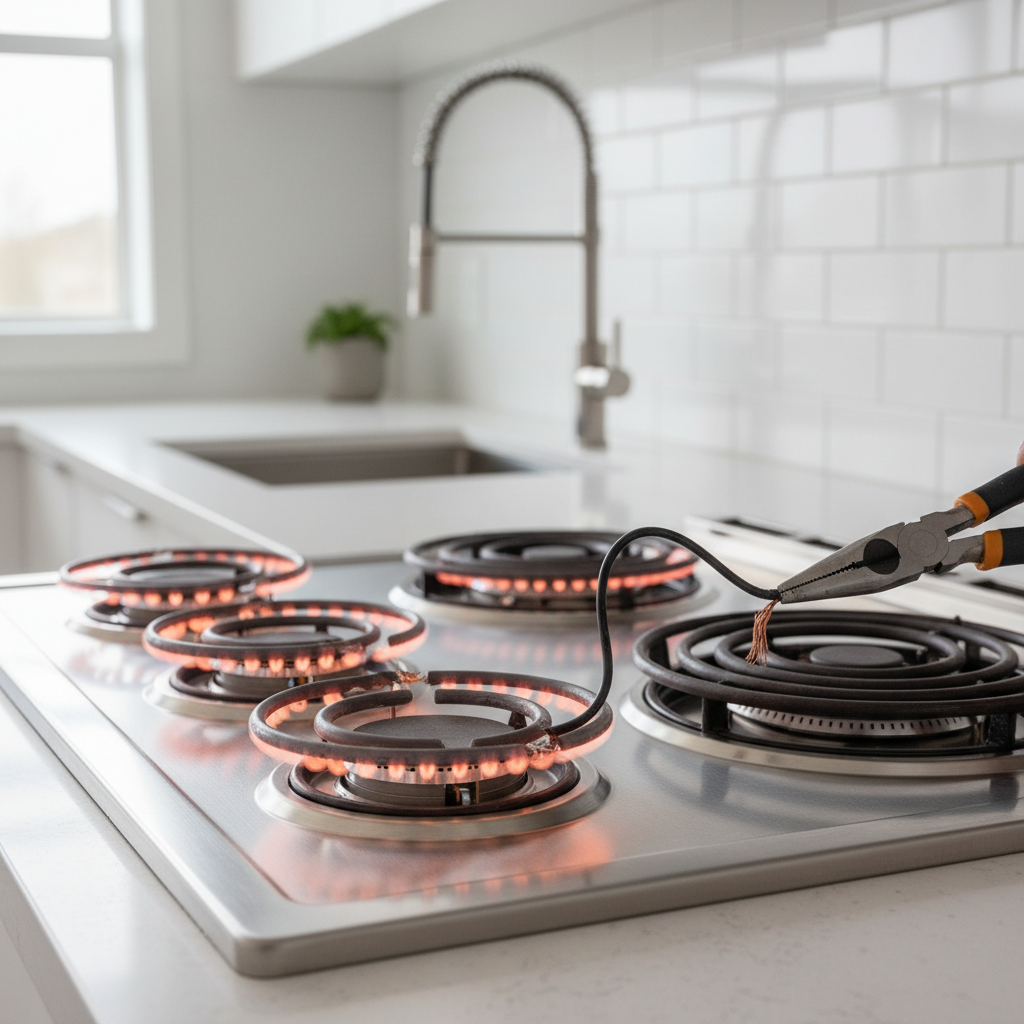
- Failed Burner Coil (Most Common): The internal heating element simply burns out from thousands of heating cycles. This is the most frequent point of failure and the easiest to fix.
- Loose/Burnt Socket Connection: Over time, the prongs of the burner coil can loosen in the socket. This creates electrical arcing, which generates intense heat, burning the socket and wire terminals.
- Defective Burner Socket: The socket itself can crack from heat stress or the internal contacts can corrode, preventing a solid electrical connection.
- Faulty Infinite Switch: The internal contacts or bimetal strip that regulate the power can wear out, causing the switch to fail in the "off" position.
- Damaged Wiring: Though less common, a wire connecting the switch to the socket could break or burn. This is usually evident from a visual inspection.
HVAC · High energy usage
| Project category | HVAC |
|---|---|
| Problem type | High energy usage |
| Trade required | HVAC |
| Urgency | Planned project |
| Safety risk | Low safety risk |
| DIY suitability | DIY for experienced homeowners |
| Cost category | High cost |
| Typical timeline | Assessment within weeks; replacement planned off-season |
| Contractor type | Licensed HVAC technician |
Repair option
Duct sealing, insulation, and a tune-up before touching the equipment.
Replacement option
High-efficiency replacement sized by a load calculation, not a rule of thumb.
Common causes
- Aging, low-efficiency equipment
- Leaking ducts losing conditioned air
- Insufficient attic insulation
- Oversized system short-cycling
Relevant tools:project cost estimatorrepair or replace
Published May 5, 2026Last updated August 17, 2026
Tools & materials you'll need
Affiliate linksAs an Amazon Associate FixlyGuide earns from qualifying purchases — at no extra cost to you. Prices and availability are accurate as of publication and subject to change.
Quick Answer
When a single electric stove burner isn't working, the problem is almost always isolated to that specific burner's components. The most common causes, in order, are a failed burner coil, a loose or damaged connection in the burner socket, a faulty socket, or a bad infinite switch that controls the burner's temperature.
The Problem
You're ready to cook, you turn the knob, and... nothing. The other burners on your electric stove heat up just fine, but one remains stubbornly cold. There's no glow, no heat, just a dark, useless spiral. This is a frustratingly common issue for conventional coil stovetops and can even happen with radiant burners under glass cooktops. The good news is that because the other burners are working, you know the stove is receiving power. The problem is localized to one of four components dedicated to that single heating element: the burner itself, its socket, its control switch, or the wiring connecting them. This focused scope makes it one of the more approachable appliance repairs for a homeowner to tackle.
How It Works
Understanding why one electric stove burner can fail independently requires looking at how your stove is wired. It’s not one single, complex system; rather, it’s a set of four simple, individual circuits sharing a common power source. Think of it like a power strip—if one device you plug in is broken, the others on the strip still work.
Each burner circuit consists of three main parts:
-
The Infinite Switch: This is the control knob on your dashboard or front panel. It doesn't just turn the burner on and off; it regulates the temperature. It does this by cycling the power to the heating element on and off. On a "High" setting, it sends power almost continuously. On "Medium," it might send power for 15 seconds, then turn it off for 15 seconds, repeatedly. This cycling is what often produces a faint clicking sound when the burner is on a lower setting. The switch has a bimetal strip that heats up and bends, opening the contacts to interrupt the power, then cools and straightens to close them again. The knob's position determines how long this cycle takes. Because each burner has its own dedicated switch, one can fail without affecting the others.
-
The Burner Socket (or Terminal Block): This is the "outlet" that the burner coil plugs into. It’s a heavy-duty ceramic or plastic block that physically holds the prongs of the burner and transfers the 240 volts of electricity needed to create heat. These sockets endure thousands of heating and cooling cycles, and the connections can become loose, corroded, or burned over time. A poor connection at this point creates high resistance, generating intense heat that can melt the wiring or the socket itself, interrupting the flow of electricity to just that burner.
-
The Heating Element (Burner Coil): This is the part you see. For a traditional coil stove, it’s a metal tube containing a nickel-chromium alloy wire, which is a resistor. When electricity passes through this resistive wire, the electrical energy is converted into intense heat, making the coil glow red-hot. The element has two terminals that plug into the socket. Over time, the internal resistor wire can break or short out. You might see a visible blister, crack, or bubble on the surface of the coil where the failure occurred. For glass-top stoves, the principle is the same, but the "burner" is a ribbon-style radiant element mounted beneath the ceramic glass.
Because these three components form a self-contained circuit for each burner, a failure in any one of them—a broken wire in the coil, a burnt contact in the socket, or a worn-out bimetal strip in the switch—will prevent only that specific electric stove burner from working.
SAFETY NOTE: Electrical Shock Hazard
Before performing any inspection or repair, you MUST disconnect your stove from its power source. For a freestanding stove, unplug it from the large 240V outlet behind it. For a drop-in cooktop, you MUST turn off the corresponding double-pole breaker in your home's main electrical panel. Confirm the power is off by testing the controls. Failure to do this can result in severe electrical shock.
Step-by-Step Fix
-
Safety First: De-energize the Stove. Pull the stove away from the wall and unplug it. If it's a hardwired cooktop, shut off the breaker. Double-check that all controls are unresponsive before proceeding.
-
Visually Inspect the Burner. Look closely at the non-working coil. Are there any blisters, bubbles, cracks, or breaks in the metal sheath? Check the two metal prongs (terminals) that plug into the stove. Are they discolored, corroded, or burnt-looking compared to the prongs on a working burner?
-
The Swap Test (Coil Stoves Only). This is the easiest and most definitive diagnostic step. Unplug the faulty burner coil by pulling it straight out from its socket. You may need to wiggle it gently. Now, take a working burner of the same size from another position and plug it into the suspect socket. Plug the stove back in momentarily and carefully test it.
- If the good burner heats up: Your original burner coil is dead. The problem is solved; you just need to buy a replacement coil.
- If the good burner does NOT heat up: The problem lies further down the line in the socket or the switch. The original coil is likely fine. Proceed with further diagnosis. Remember to unplug the stove again before continuing.
-
Inspect the Burner Socket. With the stove unplugged and the coil removed, look closely at the socket it plugs into. Do you see any charring, black marks, or melted plastic? Are the metal clips inside the socket openings clean and springy, or are they dark, corroded, or burnt?
-
Use a Multimeter for a Definitive Test. For a more precise diagnosis, you'll need a multimeter.
- Testing the Coil: Set your multimeter to the lowest setting for continuity or ohms (Ω). Touch one probe to each terminal of the burner coil you suspect is bad. A good coil will have a resistance reading, typically between 20 and 120 ohms. If the multimeter reads infinite resistance (OL or "Open Loop"), the wire inside the coil is broken, and the coil must be replaced.
- Testing for Power at the Socket: This is an advanced step and should only be performed if you are comfortable working with live electricity. Plug the stove back in. Set your multimeter to read AC voltage (ACV or V~) in a range that can handle 240V. Turn the corresponding control knob to "High." Carefully insert the multimeter probes into the two slots of the burner socket. You should get a reading of approximately 240V. If you get 120V, it indicates a problem in the wiring or switch. If you get 0V, the infinite switch is almost certainly the culprit. Extreme caution is required here.
-
Replace the Burner Socket. If the swap test failed and the socket looks burnt or corroded, it needs to be replaced. With the power off, lift the cooktop (on many models, it's hinged at the back) or remove the screws securing it. Take a picture of the wiring connections to the old socket before you begin. The wires are usually attached with screws or quick-connect terminals. Carefully disconnect them and remove the old socket. Install the new one, ensuring the wires are connected to the correct terminals, just as they were on the old one. Secure the connections tightly.
-
Access and Inspect the Infinite Switch. If the coil and socket are good, the final suspect is the switch. With the power disconnected, you'll need to access the back of the control panel. This usually involves removing a rear access panel on the stove. Locate the switch that corresponds to the bad burner (they are positioned in the same layout as the burners). Look for any signs of overheating, such as melted plastic or blackened terminals.
-
Test and Replace the Infinite Switch. Before replacing it, you can test the switch. Take a clear photo of the wires connected to it. There will be terminals marked L1, L2, H1, H2, and sometimes P. With the power off, disconnect the wires. Set your multimeter to test for continuity (ohms). Connect the probes to L1 and H1. Turn the switch knob. The meter should show continuity (near zero ohms) at all settings except "Off." Repeat for L2 and H2. If the switch fails this test, it's bad. Replace it with an identical part, carefully transferring the wires one by one to the new switch to avoid mistakes.
-
Reassemble and Test. Once you've replaced the faulty component, put everything back together—lower the cooktop, secure access panels, and plug the stove back in (or turn on the breaker). Test the repaired burner at various heat settings to ensure it cycles on and off correctly.
Common Causes
- Failed Burner Coil (Most Common): The internal heating element simply burns out from thousands of heating cycles. This is the most frequent point of failure and the easiest to fix.
- Loose/Burnt Socket Connection: Over time, the prongs of the burner coil can loosen in the socket. This creates electrical arcing, which generates intense heat, burning the socket and wire terminals.
- Defective Burner Socket: The socket itself can crack from heat stress or the internal contacts can corrode, preventing a solid electrical connection.
- Faulty Infinite Switch: The internal contacts or bimetal strip that regulate the power can wear out, causing the switch to fail in the "off" position.
- Damaged Wiring: Though less common, a wire connecting the switch to the socket could break or burn. This is usually evident from a visual inspection.
Common Mistakes to Avoid
- Forgetting to Unplug the Stove: This is the most dangerous mistake. Always disconnect the power first.
- Ordering the Wrong Part: Stove models have very specific parts. Use your stove's model number (usually found on a plate inside the oven door or storage drawer) to order the exact replacement coil, socket, or switch.
- Ignoring Scorch Marks: Black or brown marks on a socket or wiring are not just dirt; they are signs of a dangerous electrical fault that must be repaired, not just cleaned.
- Forcing Parts: A replacement burner coil or socket should fit snugly but without excessive force. If it doesn't, you may have the wrong part.
- Not Testing After Swapping: When doing the "Swap Test," don't assume the test passes or fails without actually turning the power on to confirm if the swapped burner heats up.
Cost & Time Breakdown
| Task | DIY Cost Estimate | Pro Cost Estimate | Time Estimate |
|---|---|---|---|
| Replace Burner Coil | $20 - $50 | $120 - $180 | 15 minutes |
| Replace Burner Socket | $25 - $60 | $150 - $220 | 45-60 minutes |
| Replace Infinite Switch | $40 - $80 | $180 - $250 | 60-90 minutes |
| Professional Diagnosis | N/A | $90 - $120 (trip fee) | N/A |
Tips & Prevention
- Clean Spills Promptly: Food and liquid spills, especially sugary ones, can burn onto the coil and into the socket, causing corrosion and shorts. Let the burner cool and clean it.
- Avoid Overly Large Pans: A pot that is much larger than the burner coil can reflect heat back onto surrounding surfaces, potentially damaging the socket.
- Don't Use As a Trivet: Avoid placing heavy items on the burners, as this can weaken the coils and their connection to the socket.
- Check for Wiggle: Periodically check if your burners are sitting firmly. A wobbly burner is a sign of a loose connection that should be addressed before it becomes a problem.
- Clean and Tighten: Once a year, unplug the stove, remove the coils, inspect the sockets, and ensure the prongs on the coils are clean for a good connection.
When to Call a Professional
While replacing an electric stove burner is often a manageable DIY task, there are clear signs you should stop and call a qualified appliance repair technician.
Safety is paramount. If you are not completely comfortable with the idea of unplugging your stove, using a multimeter, or working around electrical wiring, it is always best to call a pro. The risk of electrical shock is significant. Call a professional if you encounter any of the following:
- You have a glass or ceramic cooktop: While the underlying components are similar, accessing them requires removing the entire glass top. This is a delicate operation, and cracking the glass can cost hundreds of dollars to replace—far more than a service call.
- You smell burning plastic or a strong electrical odor: This indicates a more serious short circuit that may have damaged the internal wiring harness. A professional needs to trace the source.
- The issue persists after replacing the coil and socket: If you've replaced the most common parts and the burner still doesn't work, the problem is likely with the switch or internal wiring, which is a more complex repair.
- Multiple burners or controls fail simultaneously: This points away from a simple component failure and towards a broader power supply issue within the stove that requires an expert diagnosis.
Related Articles
Keep troubleshooting with these hand-picked guides from FixlyGuide:
- The #1 Mistake Homeowners Make When Their Dryer Isnt Drying (And How to Fix It Free) — Most homeowners assume a slow dryer means a broken dryer, but the most common culprit is a simple, often overlooked maintenance issue that'…
- The #1 Mistake Homeowners Make When Their Dryer Stops Drying (And How to Fix It Free) — If your dryer is taking too long to dry clothes, the most common culprit is a clogged vent, which can be easily fixed with simple tools.
- Your Refrigerator's Loud Hum? The Fix Most People Miss — A constant, loud refrigerator hum is more than annoying—it's a warning sign. Before you call a pro, discover the #1 most overlooked cause a…
- The #1 Mistake Homeowners Make When Their Dishwasher Stops Cleaning (And the Simple Fix) — Discover the most common reason your dishwasher isn't cleaning dishes and learn a simple, effective fix you can do yourself in minutes.
- The #1 Reason Your Ice Maker Stopped (It's Not Clogged!) — Discover the most overlooked culprit behind a non-working ice maker and how a simple fix can restore fresh ice to your freezer.
- Why Does Only One Outlet Have No Power (When the Breaker Is On)? — Discover the surprisingly common reasons a single electrical outlet stops working while its circuit breaker remains on, and learn how to sa…
What should this project cost?
Enter your project details for a realistic cost range before you call anyone.
Cost depends heavily on which system turns out to be the source.
- Regional adjustment
- National average
- Labor share (typical)
- ~$1,620
- Quotes to collect
- 3 written estimates
Educational estimate based on national averages — not a binding quote. Always confirm with written local estimates.
Fixly Project Decision Box
- DIY difficulty
- Professional Recommended
- Estimated time
- Diagnosis 1–2 hours
- Cost level
- Moderate
Main tools / materials
- Non-contact voltage tester
- Outlet tester
- Flashlight
When to stop and call a pro
- Burning smell, scorch marks, or a warm outlet or switch plate
- A breaker that trips again right after being reset
- Any work inside the service panel
- Aluminum wiring or cloth-insulated wiring
Need professional help?
Talk to a Licensed ElectricianGet the print-ready PDF of this guide
A clean, ad-free, printable version you can keep on your phone or pin to the workshop wall. Free with a FixlyGuide account.
- Print-optimized layout
- Tools, materials & every step included
- Saved to your account
Frequently asked questions
Is it worth fixing one burner on an electric stove?+
Absolutely. In most cases, the repair is simple and inexpensive, requiring only a new burner coil which can cost as little as $20. Considering a new electric stove costs $500 or more, a quick repair is a very cost-effective solution.
How do I know for sure if the coil or the switch is bad?+
The easiest way is to swap the non-working coil with a known working coil from the same stove. If the good coil works in the suspect spot, the old coil is bad. If the good coil does not work, the problem is likely the socket or the infinite switch.
Can I use a burner from a different stove model?+
It is not recommended. Burner coils are rated for specific wattages and have unique terminal designs to fit their corresponding sockets. Using the wrong one can be a fire hazard and may not work at all. Always use your stove's model number to buy the exact replacement part.
The burner gets hot but only on the 'High' setting. What's wrong?+
This is a classic symptom of a failed infinite switch. The switch has lost its ability to cycle power on and off for lower temperatures, so it either delivers full power or no power. The switch will need to be replaced.
Discussion
Loading comments…