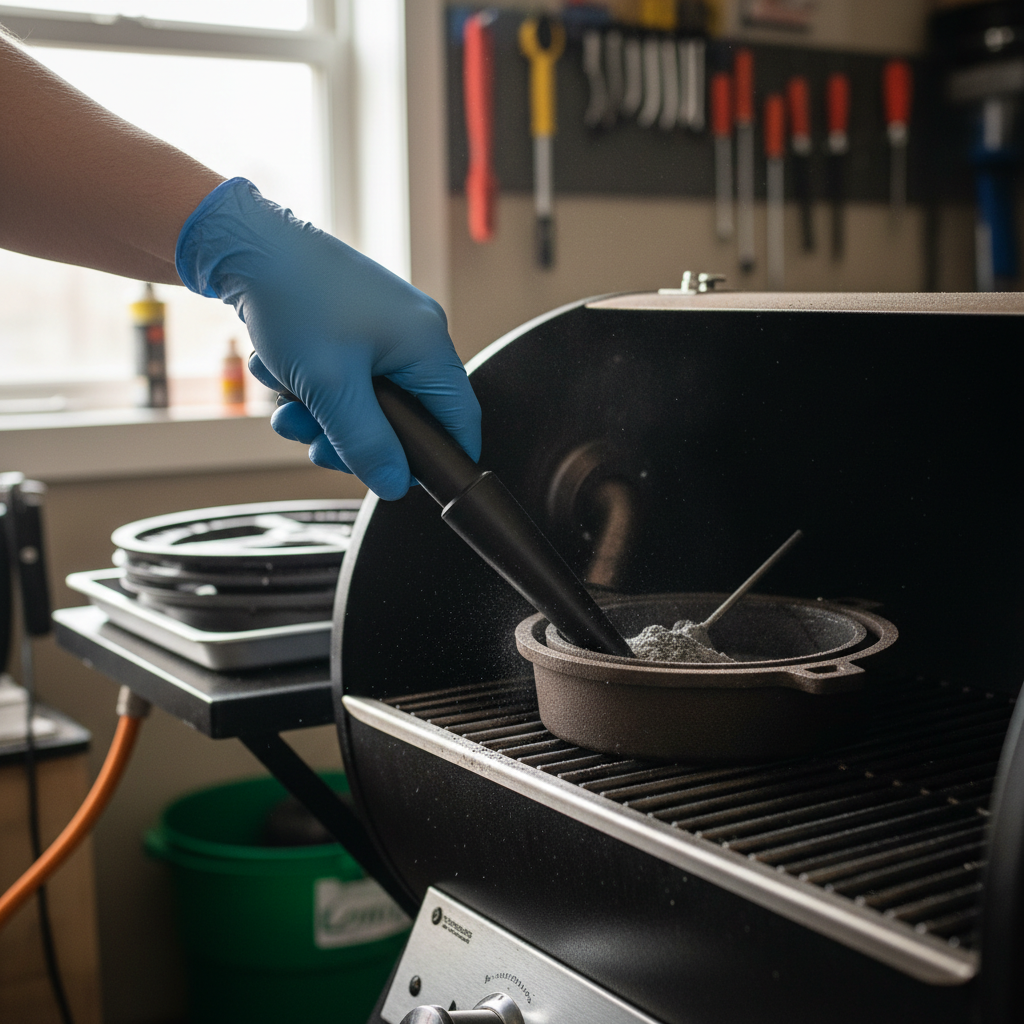
- Clean the Firepot and Ash Pot — Clear restricted airflow and igniter issues
- Safety First: Always unplug your grill before performing any cleaning or maintenance.
- Once the grill is completely cool, open the lid and remove the cooking grates, grease tray, and heat baffle. These parts usually lift out easily.
- Locate the firepot, a small metal cup at the bottom of the cooking chamber. Use a shop-vac to thoroughly vacuum out all ash and debris from the firepot and the surrounding ash pot area. Ensure the intake holes in the firepot are clear.
- If this doesn't work: A stubborn ash buildup might require a stiff brush to dislodge before vacuuming. Look for any carbonized residue around the igniter rod itself.
Published May 18, 2026Last updated August 17, 2026
Tools & materials you'll need
Affiliate linksAs an Amazon Associate FixlyGuide earns from qualifying purchases — at no extra cost to you. Prices and availability are accurate as of publication and subject to change.
Quick Answer
Unpredictable temperature swings in a pellet grill are often caused by ash buildup in the firepot, which chokes the igniter and restricts airflow, leading to inconsistent heat. Regularly vacuuming the firepot and ensuring your pellets are dry and high-quality are crucial for stable cooking temperatures and optimal performance.
The Problem
You've set your pellet grill to a precise temperature, expecting a consistent cook, only to find the internal temperature gauge jumping wildly or stubbornly refusing to climb. Your brisket is taking longer than expected, or your ribs are drying out. This frustrating inconsistency, known as temperature swing, is a widespread issue for pellet grill owners. It can lead to undercooked or overcooked food, extended cooking times, and a general lack of confidence in your grill's ability to hold a steady temperature. While pellet grills are celebrated for their “set it and forget it” convenience, temperature swings throw a wrench into that promise, turning a relaxing cookout into a babysitting session.
How It Works
To understand temperature swings, it helps to understand how a pellet grill achieves and maintains its heat. At the heart of every pellet grill is the firepot, a small, perforated metal cup where wood pellets are ignited. An auger, a spiral-shaped rod, feeds pellets from the hopper into this firepot. An igniter rod, essentially a heating element, gets red-hot to ignite these pellets. Once burning, a fan blows air through the firepot, stoking the flame and distributing heat throughout the grill's cooking chamber. A digital controller, acting as the grill's brain, constantly monitors the internal temperature via a thermocouple probe. When the temperature drops below the set point, the controller signals the auger to feed more pellets and the fan to stoke the fire. When the temperature rises too high, it pauses pellet delivery and slows the fan. This continuous feedback loop aims to maintain a remarkably consistent temperature, often within 10-15°F of the set point. Problems arise when any component in this delicate system is compromised, leading to the dreaded temperature swings. For instance, ash buildup can smother the flame. Moisture in pellets can cause them to swell and jam the auger. A faulty fan might not provide enough oxygen, or a dirty temperature probe could give inaccurate readings, causing the controller to overcompensate.
Step-by-Step Fix
Here's how to diagnose and resolve common causes of pellet grill temperature swings:
-
Clean the Firepot and Ash Pot — Clear restricted airflow and igniter issues
- Safety First: Always unplug your grill before performing any cleaning or maintenance.
- Once the grill is completely cool, open the lid and remove the cooking grates, grease tray, and heat baffle. These parts usually lift out easily.
- Locate the firepot, a small metal cup at the bottom of the cooking chamber. Use a shop-vac to thoroughly vacuum out all ash and debris from the firepot and the surrounding ash pot area. Ensure the intake holes in the firepot are clear.
- If this doesn't work: A stubborn ash buildup might require a stiff brush to dislodge before vacuuming. Look for any carbonized residue around the igniter rod itself.
-
Inspect Pellet Quality and Storage — Ensure proper fuel burning
- Pellets should be dry, uniform in size, and have a good wood-smoke aroma. Check for any signs of moisture, such as swelling, clumping, or sawdust-like consistency.
- If pellets appear damp or compromised, remove them from the hopper using the hopper clean-out door (if your grill has one) or by scooping them out. Replace with fresh, dry pellets.
- Tip: Always store pellets in an airtight container in a cool, dry place. Metal garbage cans with tightly fitting lids or specialized pellet storage containers work well.
-
Check for Auger Jams — Ensure consistent pellet delivery
- With the grill unplugged and cleared of pellets, visually inspect the auger tube (the channel leading from the hopper to the firepot) for any obstructions. Sometimes, broken or swollen pellets can get wedged.
- If no visual jam is apparent, plug the grill back in and set it to a low temperature. Watch the auger to ensure it’s rotating smoothly and consistently feeding pellets into the firepot. Listen for any grinding or straining noises.
- If this doesn't work: If the auger isn't turning at all or is struggling, it could indicate a motor issue or a hidden jam deeper in the housing, which might require professional service.
-
Clean the Temperature Probe — Restore accurate temperature readings
- Locate the internal temperature probe, usually a small metal rod protruding into the cooking chamber near the left side. It often has a pointed tip.
- Using a clean cloth or paper towel, gently wipe away any grease, smoke residue, or food particles that have accumulated on the probe. Do not use abrasive cleaners or harsh scouring pads, as this can damage the sensor.
- Important: A dirty probe gives inaccurate readings to the controller, leading to it either over-feeding or under-feeding pellets.
-
Inspect the Induction Fan — Confirm proper airflow
- With the grill unplugged, open the hopper lid and look down into the auger mechanism. You should be able to see the induction fan blades.
- Gently try to spin the fan blades by hand to ensure they move freely. Look for any debris (pellet dust, small pieces of wood) that might be obstructing its movement.
- If this doesn't work: If the fan doesn't spin freely or if you hear unusual noises during operation, it could be a motor issue requiring replacement. Ensure the fan's power connection is secure.
-
Season the Grill (Initial Burn-In) — Establish proper burn conditions
- If you've performed extensive cleaning or this is a new grill, a proper seasoning burn-in can help stabilize future cooks. Apply a thin layer of high-heat cooking oil (like canola or grapeseed) to the grates and interior surfaces (not directly on the firepot or igniter).
- Set the grill to a high temperature (around 350-400°F and run it for 45-60 minutes with the lid closed. This burns off any manufacturing residues and allows the components to settle into optimal operation.
-
Monitor Environmental Factors — Account for external influences
- High winds, low ambient temperatures, or strong drafts can significantly impact a pellet grill's ability to maintain a steady temperature. Consider using a wind deflector or positioning your grill in a more sheltered spot.
- Tip: Never cover the grill's exhaust stack or vents, as this can create dangerous carbon monoxide buildup and negatively impact temperature regulation.
Common Causes
- Ash Buildup in Firepot: The most frequent culprit. Ash smothers the igniter rod, restricts airflow, and prevents pellets from burning efficiently, leading to lower temperatures and
Related Articles
Keep troubleshooting with these hand-picked guides from FixlyGuide:
- The Hidden Reason Your GFCI Trips (and Why Most Homeowners Miss It) — A continuously tripping GFCI outlet is a safety warning, often signaling common but overlooked issues like moisture intrusion, appliance fa…
- The Hidden Reason Your GFCI Trips — And Why Most Homeowners Get It Wrong — A continuously tripping GFCI outlet is a safety warning, often indicating a problem like moisture, a faulty appliance, or a wiring issue th…
- The Hidden Reason Your AC Isn't Cooling (And 7 Fixes Homeowners Miss) — If your central AC isn't cooling your home, the culprit often lies in an overlooked issue that's simple to fix, preventing costly professio…
- The Hidden Culprit Behind Your AC Not Cooling (and How to Find It) — If your central AC isn't cooling your home, the issue often stems from a surprisingly simple problem that's easy to overlook. Learn how to…
- The Hidden Reason Your GFCI Trips (and 7 Ways to Stop It) — A persistently tripping GFCI outlet is a safety warning, often indicating moisture, a faulty appliance, or a wiring problem that homeowners…
- Is a Tiny Clog Halving Your Toilet's Flush Power? The Hidden Fill Valve Secret — A slow-filling toilet tank is a common, frustrating issue often caused by a restricted fill valve, easily fixed with basic tools.
Should you do this yourself?
Answer five quick questions before you start. Safety outranks savings every time.
Your experience with work like this
How high do you have to work?
Does the job involve any of these?
Will it need a permit?
Specialty tools
Free and instant. Educational guidance only — not a quote, inspection, or professional diagnosis.
What should this project cost?
Enter your project details for a realistic cost range before you call anyone.
Cost depends heavily on which system turns out to be the source.
- Regional adjustment
- National average
- Labor share (typical)
- ~$1,620
- Quotes to collect
- 3 written estimates
Educational estimate based on national averages — not a binding quote. Always confirm with written local estimates.
Before you start
Check the difficulty, permits, and safety risk — then decide whether to call a pro.
- Estimate this projectGet a cost range for your scope and ZIP before you call anyone.Open
- Get local estimatesSend one request and compare written estimates from vetted pros.Open
Free, no signup required. Estimates are educational guidance, not a quote or an inspection.
Get the print-ready PDF of this guide
A clean, ad-free, printable version you can keep on your phone or pin to the workshop wall. Free with a FixlyGuide account.
- Print-optimized layout
- Tools, materials & every step included
- Saved to your account
This article was independently written by FixlyGuide based on the source topic.
Frequently asked questions
Why does my pellet grill temperature keep dropping?+
The most common reason for a pellet grill temperature drop is a clogged firepot due to ash buildup, which prevents consistent pellet ignition and airflow. Other factors include low-quality or moist pellets, a dirty temperature probe, or even strong winds affecting the grill.
How do I make my pellet grill hold a consistent temperature?+
To ensure your pellet grill holds a consistent temperature, regularly clean the firepot and ash pot, use high-quality, dry wood pellets, keep the internal temperature probe clean, and perform periodic checks on the induction fan and auger for obstructions. Also, shield your grill from strong winds and extreme cold.
Can bad pellets cause temperature swings?+
Yes, absolutely. Low-quality, moist, or inconsistent pellets can cause severe temperature swings. Moist pellets swell and can jam the auger, preventing consistent fuel delivery, while pellets with excessive sawdust can burn inefficiently, leading to fluctuating heat.


Discussion
Loading comments…