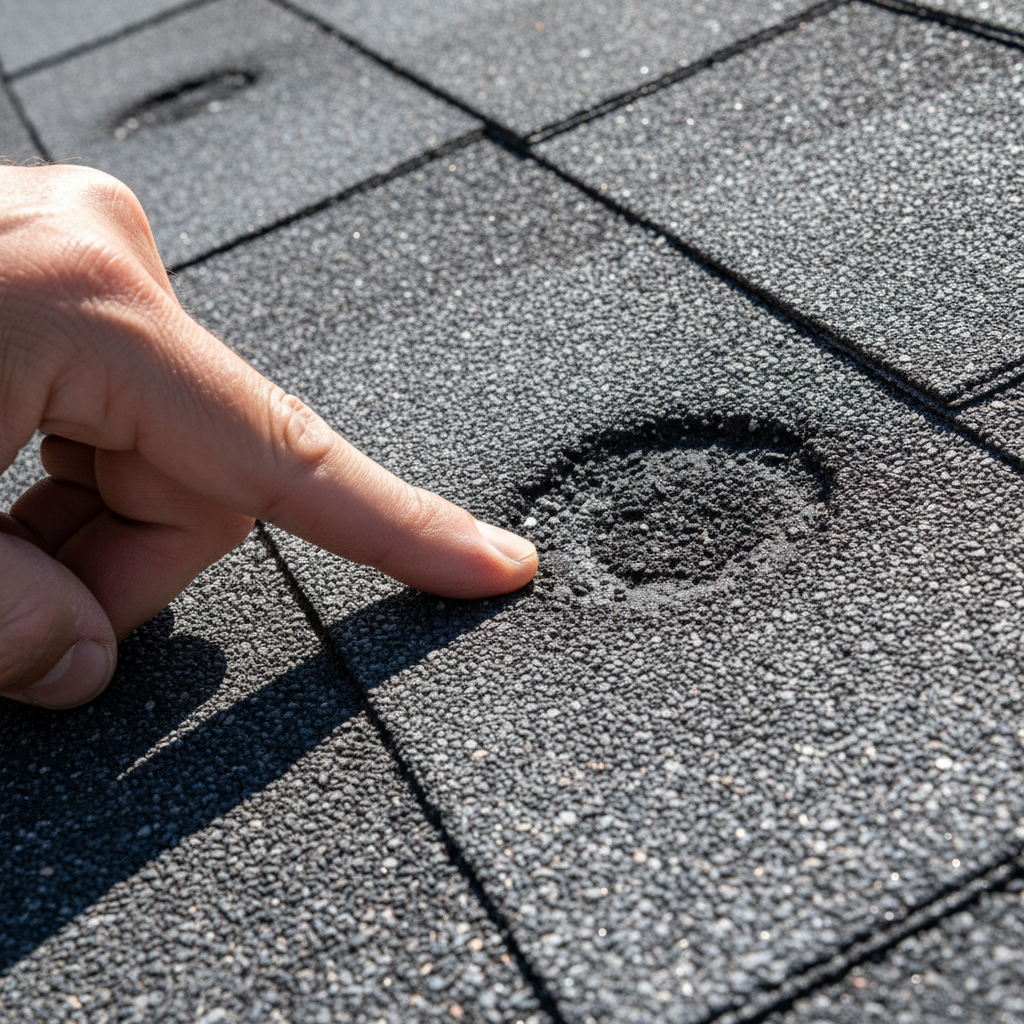
- Identify Hail "Bruises" — Inside your test square, run your hand gently over the shingles. You are looking and feeling for:
- Dark Spots: Circular or linear spots where the granules are gone and the black asphalt is exposed.
- Soft Feel: When you press on a suspected hit, it will feel soft, spongy, or slightly yielding compared to the surrounding shingle. This is the "bruise."
- Visible Indentation: On harder hits, you will see a clear divot in the shingle.
- Distinguish from Blisters: Blisters are bumps or bubbles that happen during manufacturing and are not impact-related. They will not have a soft or bruised feel.
Roofing · Hail damage
| Project category | Roofing |
|---|---|
| Problem type | Hail damage |
| Trade required | Roofing |
| Urgency | Urgent — within days |
| Safety risk | Moderate safety risk |
| DIY suitability | Licensed pro only |
| Cost category | High cost |
| Typical timeline | Inspection within days; claim and build often several weeks |
| Contractor type | Licensed roofing contractor |
Repair option
Spot repair for isolated slopes with limited impact marks.
Replacement option
Insurance-scope replacement when impacts exceed the carrier threshold per square.
Common causes
- Impact bruising that knocked granules loose
- Cracked mat under the surface, not visible from the ground
- Damaged soft metals: vents, gutters, flashing
Relevant tools:repair or replace roofcompare quotes
Published June 12, 2026Last updated August 17, 2026
Tools & materials you'll need
Affiliate links- AmazonBinoculars1 · Essential for safely inspecting the roof from the ground.
- AmazonSturdy Extension Ladder1 · Use only on stable, level ground and if you are comfortable with ladder work. Must extend 3ft past the roof edge.
- AmazonCamera or Smartphone1 · For documenting all suspected damage with photos.
- AmazonWork Gloves1 pair · Protects hands from abrasive shingle granules.
- AmazonRubber-Soled Shoes1 pair · For providing good traction if you get on the roof.
- AmazonQuarter coin1 · Used in photos to provide a sense of scale for hail impacts.
- AmazonChalk1 stick · For marking a 10x10 test square on the roof.
As an Amazon Associate FixlyGuide earns from qualifying purchases — at no extra cost to you. Prices and availability are accurate as of publication and subject to change.
Quick Answer
Plano homeowners file a high number of roof claims due to the city's location in North Texas' "Hail Alley," a corridor prone to severe supercell thunderstorms. These storms frequently produce hail large enough to cause "functional damage" to asphalt shingles, such as granule loss and bruising, which insurance policies cover. You can spot this damage by looking for dark, soft spots on shingles, dents in metal vents and gutters, and an accumulation of shingle granules in your downspouts after a storm.
The Problem
If you live in Plano, you've heard the rhythm of a Texas spring: the tornado sirens test on the first Wednesday, the sudden darkening of the sky, and then, the unmistakable, deafening clatter of hail. A week later, the neighborhood comes alive with a different sound: hammers. Your neighbor is getting a new roof. And the neighbor across the street. And the one two doors down. It feels like a constant, expensive cycle.
The core problem for Plano homeowners isn't just the hail itself, but the uncertainty that follows. Is my roof damaged? Is it bad enough for a claim? A dozen roofing trucks appear overnight, with salespeople knocking on your door telling you that you have "significant damage." They offer a "free inspection" and promise to "work with" your insurance—or even "handle" the whole claim. It’s overwhelming and confusing. You’re left wondering if the damage is real or if you're being sold something you don't need. This informational vulnerability can lead to two costly outcomes: either you miss legitimate, insurance-covered damage that leads to leaks and bigger repair bills down the road, or you get pushed into a premature claim by an aggressive storm-chasing contractor.
How It Works
Understanding why Plano is a hail magnet requires a look at meteorology, material science, and the local insurance landscape.
DFW's "Hail Alley" Geography: North Texas, particularly Collin County where Plano resides, is part of a notorious weather corridor often called "Hail Alley." During the spring months (typically March through June), three ingredients combine to form explosive supercell thunderstorms. First, warm, moist air flows north from the Gulf of Mexico at low altitudes. Second, cold, dry air from the Rocky Mountains pushes in at the upper levels. Third, a strong jet stream provides the "shear" or twisting motion in the atmosphere. This collision of air masses creates powerful updrafts that can suspend raindrops high in the freezing-cold parts of the atmosphere, allowing them to grow into large, destructive hailstones. Plano's specific location puts it directly in the path of many of these developing or mature supercells as they track east across the Dallas-Fort Worth Metroplex.
Material Science: How Hail Actually Damages a Roof: It’s not just about holes. Hail damages a standard architectural asphalt shingle in a specific way that insurance companies label "functional damage." Here's the process:
- Granule Loss: The primary purpose of the sandpaper-like granules on a shingle is to protect the underlying asphalt and fiberglass mat from UV radiation. A hard-impact hailstone, even one just the size of a quarter, blasts these granules off at the point of impact.
- Mat Bruising: The force of the impact doesn't just remove the surface; it fractures or "bruises" the fiberglass mat within the shingle. You can often feel this as a soft, spongy spot, like a bruised apple. This structural failure compromises the shingle's ability to shed water.
- Accelerated Aging: Once the granules are gone, the black asphalt is exposed directly to the brutal North Texas sun. Summer roof temperatures in DFW can easily exceed 160°F. This intense UV radiation and heat rapidly dries out the shingle, causing it to become brittle, crack, and fail years before its expected lifespan is over. A hail-bruised roof might not leak tomorrow, but its life has been drastically shortened, turning a 25-year shingle into a 5-year liability.
This is why insurance covers it. The policy is designed to restore the roof to the functional state it was in pre-storm. For this reason, investing in Class 4 impact-rated shingles is a popular upgrade in Plano. These shingles are designed to withstand impacts from larger hail and can often earn homeowners a significant discount on their insurance premiums.
Step-by-Step Fix: Performing Your Post-Storm Inspection
The most critical action you can take after a storm is to perform a safe, thorough inspection yourself. This empowers you to make an informed decision and call a professional from a position of knowledge. SAFETY FIRST: Never get on a wet, windy, or steep-pitched roof (anything above a 6:12 pitch, or a 27-degree angle). High two-story roofs are best left to professionals with proper safety gear. If you are not 100% comfortable on a ladder, do not proceed.
-
Check the "Ground Truth" — Start on the ground. Look at things around your property that tell the story of the hail. Are your gutter downspouts dented? Are the aluminum fins on your air conditioner unit smashed flat? Are your window screens torn? Are there pockmarks on your wood fence? This is undeniable evidence of hail size and intensity that you can photograph.
-
Grab Binoculars — Before climbing any ladders, use a pair of binoculars to scan each slope of your roof from the ground. You are looking for abnormally dark spots that look like polka dots on the roof. These are often signs of hail hits, where the granules have been knocked off.
-
Ladder Safety Check — If you have a single-story home with a low-sloped roof and feel confident, place your ladder on stable, level ground. Ensure it extends three feet above the roof edge and is set up at a 4-to-1 angle (for every four feet of height, the base should be one foot away from the wall). Maintain three points of contact (two feet, one hand; or two hands, one foot) at all times when climbing.
-
Chalk a Test Square — Once safely on the roof, pick a 10-foot by 10-foot area on each slope (North, South, East, West, as storms can impact slopes differently). Mark the corners of this "test square" with a piece of chalk. This is the same method insurance adjusters use.
-
Identify Hail "Bruises" — Inside your test square, run your hand gently over the shingles. You are looking and feeling for:
- Dark Spots: Circular or linear spots where the granules are gone and the black asphalt is exposed.
- Soft Feel: When you press on a suspected hit, it will feel soft, spongy, or slightly yielding compared to the surrounding shingle. This is the "bruise."
- Visible Indentation: On harder hits, you will see a clear divot in the shingle.
- Distinguish from Blisters: Blisters are bumps or bubbles that happen during manufacturing and are not impact-related. They will not have a soft or bruised feel.
-
Count the Hits — Count the number of legitimate, bruised hail hits within your 10x10 chalk square. Most insurance carriers in Texas consider a roof "totaled" and eligible for full replacement if there is an average of 8-10 qualifying hits per square.
-
Inspect Roof Penetrations — Carefully check all the metal and plastic components on your roof. Dents on metal turbine vents, box vents, plumbing pipe caps (soft lead boots), and step flashing are the easiest type of hail damage to spot and photograph.
-
Document Everything — Use your phone to take pictures. Take wide shots of each entire roof slope. Then, take close-up photos of individual hail hits, using a quarter or a small ruler for scale. Photograph the dented gutters, AC fins, and vents. This documentation is invaluable for your claim.
-
Check for Interior Leaks — Head inside and check the ceilings in rooms directly below the roofline. Look for any faint brown or yellow stains. If you can safely access your attic, use a flashlight to look at the underside of the roof decking for dark streaks or damp insulation, especially around vents and chimneys.
-
Review Your Findings — If you found 8-10+ hits per square on multiple slopes, significant denting on metals, or any signs of a leak, you have a strong case for calling your insurance provider to initiate a claim.
Common Causes of Missed Damage
- Angled Hail Impact: Storms rarely drop hail straight down. The wind can drive it against one or two slopes of the roof while leaving the others untouched. Only inspecting the front of your house can cause you to miss significant damage on the back.
- Small, Granule-Scrubbing Hail: Hail under 1" in diameter might not be big enough to bruise the mat, but it can act like sandpaper, scrubbing off a significant percentage of the protective granules across the entire roof, drastically shortening its life.
- Confusing Hail with Other Issues: Homeowners (and inexperienced roofers) can mistake manufacturing defects like blistering, or mechanical damage from foot traffic, for hail. True hail damage has a distinct pattern and feels soft to the touch.
- Ignoring Soft Metals: The first and most obvious clues—dented gutters, vents, and window beading—are often overlooked. These items confirm that hail of a damaging size has impacted the property.
Common Mistakes
- Hiring a "Storm Chaser": Never hire the first contractor who knocks on your door. Many are out-of-town companies that follow storms, do subpar work, and are gone when warranty issues arise. Stick with established, local DFW roofing companies with a long track record.
- Signing a Contract Before a Claim is Approved: Do not sign any document that gives a roofer exclusive rights to your repair before the insurance adjuster has even seen your roof and approved the replacement. This can lock you into a contract with a bad contractor.
- Not Knowing Your Policy: You must know your deductible (this is your out-of-pocket cost) and whether your policy is for RCV (Replacement Cost Value) or ACV (Actual Cash Value). ACV policies only pay for the depreciated value of your old roof, leaving you to cover the rest.
- Attempting Unsafe Inspections: Falls from ladders are a leading cause of injury for homeowners. If your roof is high, steep, or you are not physically able, pay a professional for a formal inspection.
- Accepting the "Deductible Eaters": Some roofers may offer to "cover" or "eat" your deductible. This is insurance fraud in the state of Texas. A reputable roofer will always require you to pay your deductible.
Cost & Time Breakdown
The cost of dealing with hail damage varies wildly, from a simple inspection to a full replacement.
| Task | DIY Cost | Pro Cost | Time |
|---|---|---|---|
| Initial Damage Inspection | $0 (or ~$50 for good binoculars) | $0-$300 (for a detailed report) | 1-2 hours |
| Emergency Leak Tarping | $50-$100 (for a heavy-duty tarp) | $250-$500 | 1 hour |
| Minor Shingle Repair (a few shingles) | $75-$150 (shingles, sealant, tools) | $350-$650 | 2-4 hours |
| Full Roof Replacement (30yr Architectural) | N/A | $12,000 - $25,000+ | 1-3 days |
| Upgrade to Class 4 Impact-Resistant Shingles | N/A | Add $2,000 - $5,000 to total replacement cost | No extra time |
| Your Insurance Deductible | N/A | $2,000 - $7,000+ (typically 1-2% of dwelling value) | N/A |
Tips & Prevention
- Review Your Insurance Annually: Before storm season, call your agent and confirm your deductible and coverage type (RCV vs. ACV). Ask about discounts for installing a Class 4 roof.
- Invest in a Class 4 Roof: When it's time for a replacement, upgrading to Class 4 impact-resistant shingles is the single best investment a Plano homeowner can make. The upfront cost is higher, but it can prevent future claims and lower your insurance premiums.
- Check Attic Ventilation: A properly ventilated attic (a 1:300 ratio of vent space to attic floor space is a good target for DFW) keeps shingles from baking and becoming brittle in the 100°F+ summer heat, making them more resilient to hail.
- Keep Trees Trimmed: Trim tree branches away from your roofline to prevent them from scraping shingles or falling and causing damage during a storm.
- Take "Before" Photos: On a clear day, take pictures of your clean roof from all angles. This provides a baseline of your roof's condition to compare against after a storm.
When to Call a Professional
While a DIY inspection is a critical first step, you should call a seasoned, local DFW professional in several scenarios. Always call a pro if your roof is two or more stories high, has a steep pitch (above 6:12), is wet, or if you are not physically able to safely manage a ladder. Beyond safety, a professional roofer is essential for navigating the complexities of an insurance claim. If your initial inspection reveals widespread hits, or if you spot any evidence of an active leak (water stains on the ceiling), it's time to call in an expert. A reputable roofer can validate your findings, meet with the insurance adjuster on-site to ensure all damage is accounted for (including code-required items like drip edge, ice & water shield, and proper flashing, which adjusters can miss), and negotiate for supplements if the initial estimate is insufficient. Their expertise is your best tool for ensuring your claim is handled correctly and your home is protected.
Should you do this yourself?
Answer five quick questions before you start. Safety outranks savings every time.
Your experience with work like this
How high do you have to work?
Does the job involve any of these?
Will it need a permit?
Specialty tools
Free and instant. Educational guidance only — not a quote, inspection, or professional diagnosis.
Questions to ask before you sign
Ask every contractor the same questions and the cheapest bid stops looking cheapest. Check them off as you go — your progress is saved on this device.
Free, no signup. Bring this to every walkthrough so you compare bids on the same terms.
What should this project cost?
Enter your project details for a realistic cost range before you call anyone.
Spot repairs commonly run $400–$1,800; full replacement typically $9,000–$18,000 for an average home.
- Regional adjustment
- National average
- Labor share (typical)
- ~$2,948
- Quotes to collect
- 3 written estimates
Educational estimate based on national averages — not a binding quote. Always confirm with written local estimates.
Fixly Project Decision Box
- DIY difficulty
- Professional Recommended
- Estimated time
- Inspection 1–2 hours · repairs 1–3 days
- Cost level
- High
Main tools / materials
- Binoculars for a ground-level look
- Flashlight for attic checks
- Moisture meter
- Roofing cement (temporary patch only)
When to stop and call a pro
- Active leak near lights, fans, or any wiring
- Sagging, bulging, or water-filled ceiling
- Steep, wet, or two-story roof — do not climb it
- Storm or hail damage you plan to claim on insurance
Need professional help?
Free roof assessment first — no phone calls until you ask for them.
Get Local Roofing HelpGet help with your roof now
Stay off the roof. These free tools help you protect the house and reach the right professional fast.
- Emergency repair checklistThe first steps that limit damage before a pro arrives.Open
- Repair or replace your roof?Answer 10 questions about age, leaks, and damage to get a clear next step.Open
- Get local estimatesSend one request and compare written estimates from vetted pros.Open
Free, no signup required. Estimates are educational guidance, not a quote or an inspection.
Get the print-ready PDF of this guide
A clean, ad-free, printable version you can keep on your phone or pin to the workshop wall. Free with a FixlyGuide account.
- Print-optimized layout
- Tools, materials & every step included
- Saved to your account
Frequently asked questions
How many hail hits does it take to get a new roof in Texas?+
Most insurance companies and adjusters in Texas use a '10x10 square' rule. If they find an average of 8 to 10 legitimate, mat-bruising hail impacts in a 10-foot by 10-foot test area on multiple slopes of your roof, they will likely agree to a full replacement.
Will my insurance rates go up if I file a hail claim in Plano?+
No, at least not directly. Hail damage is considered a 'no-fault' or 'Act of God' claim. Your insurance company cannot single you out for a rate increase because you filed a claim. However, if a major storm causes widespread damage across a large area like Plano, the provider may raise rates for everyone in that region to cover the significant losses.
What's the difference between RCV and ACV insurance for a roof?+
RCV (Replacement Cost Value) is the premium coverage. It pays to replace your roof with brand-new materials of similar kind and quality, minus your deductible. ACV (Actual Cash Value) only pays the depreciated value of your existing roof. For example, if your 15-year-old roof is damaged, an ACV policy might only pay out 50% of the replacement cost, leaving you to cover the rest. Always aim for RCV coverage in North Texas.
Should I get a roofer before or after my insurance adjuster visit?+
It's wise to have a reputable, local roofer you trust inspect your roof *before* you even file a claim to verify the damage is significant enough. If it is, you can have that same roofer present when the insurance adjuster performs their inspection. The roofer can act as your advocate, pointing out damage the adjuster might miss and ensuring you get a fair assessment based on local building codes.
Discussion
Loading comments…