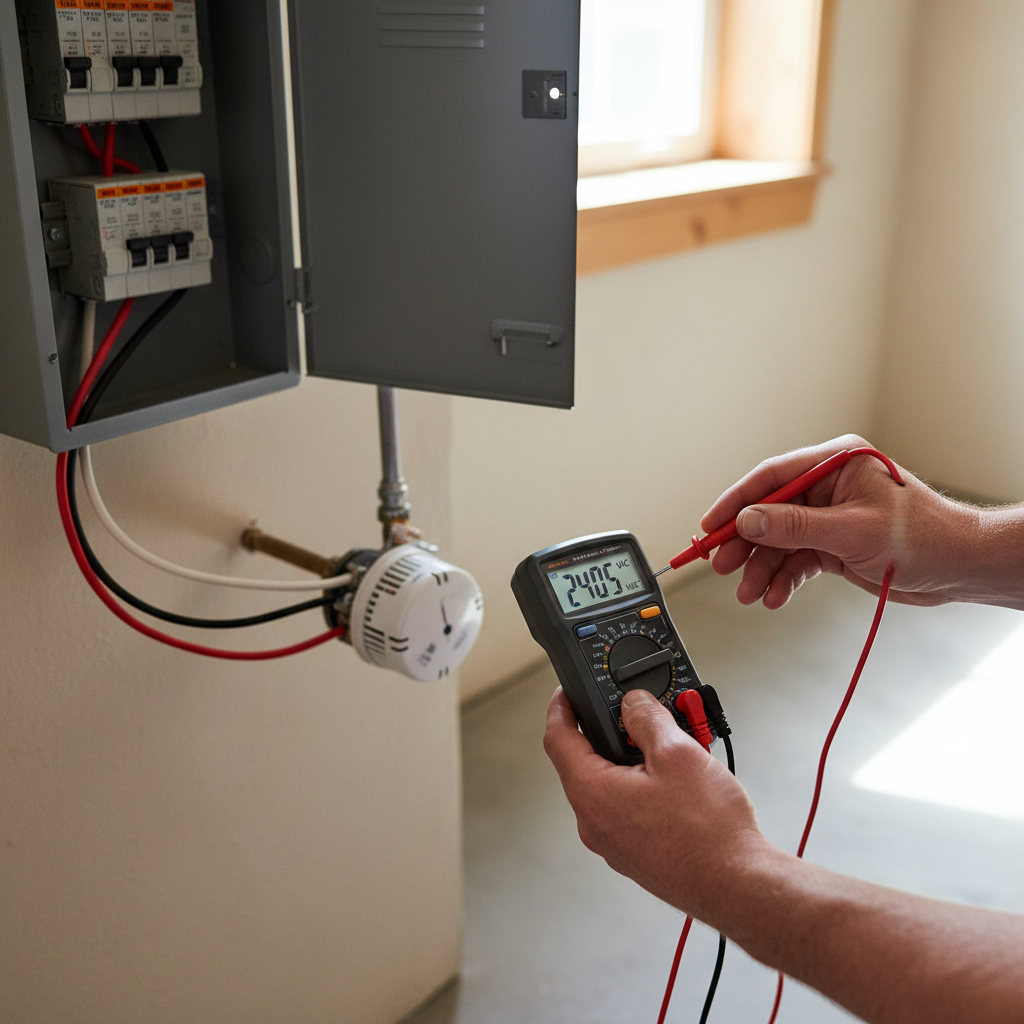
- Locate your breaker panel and turn off the circuit breaker labeled for your water heater. This is typically a double-pole 30-amp or 40-amp breaker. You might need to turn off the main breaker if your panel isn't clearly labeled.
- Verify power is off using a non-contact voltage tester on the wires leading into the water heater junction box. Never assume power is off without testing.
- Safety Note: Electric water heaters carry significant voltage. Always treat them with extreme caution. If you are uncomfortable with electrical work, stop here and call a professional.
Plumbing · Water heater problem
| Project category | Plumbing |
|---|---|
| Problem type | Water heater problem |
| Trade required | Plumbing |
| Urgency | Urgent — within days |
| Safety risk | Moderate safety risk |
| DIY suitability | Pro recommended |
| Cost category | Moderate cost |
| Typical timeline | Diagnosis same day; replacement typically a half-day install |
| Contractor type | Licensed plumber |
Repair option
Element, thermostat, or thermocouple replacement on a tank still in good condition.
Replacement option
Full replacement once the tank leaks or passes roughly a decade of service.
Common causes
- Failed heating element or thermocouple
- Sediment buildup reducing capacity
- Tank corrosion at end of service life
Relevant tools:repair or replaceproject cost estimator
Published May 10, 2026Last updated August 17, 2026
Tools & materials you'll need
Affiliate links- AmazonReplacement water heater thermostatEnsure it matches your water heater model
As an Amazon Associate FixlyGuide earns from qualifying purchases — at no extra cost to you. Prices and availability are accurate as of publication and subject to change.
Quick Answer
Experiencing showers that go from warm to icy in seconds, or water that's too hot to touch? The unsung hero (or villain) behind your home's hot water woes is frequently the water heater thermostat. While a failing water heater often takes the blame, a thermostat problem is a much simpler, cheaper fix that many homeowners can tackle themselves, bringing consistent hot water back to every tap.
The Problem
Picture this: You're mid-shower, enjoying the warmth, and then, without warning, the water turns frigid. Or perhaps your dishes never seem to get clean because the "hot" water feels barely lukewarm. Conversely, you might find the water so scalding it's a burn hazard. These aren't just minor inconveniences; they're signs your water heater thermostat is likely malfunctioning. Without a properly functioning thermostat, your water heater can't accurately sense the water temperature or command the heating elements to cycle on and off correctly, leading to a host of frustrating and potentially dangerous issues.
How It Works
At its core, a water heater thermostat is a temperature-sensitive switch. Most residential electric water heaters have two thermostats: an upper and a lower. Each thermostat is responsible for controlling a corresponding heating element. When you set a desired temperature, say 120°F (49°C), the thermostat uses a bimetallic strip or an electronic sensor to measure the water temperature within the tank. If the water temperature drops below the set point, the thermostat closes an electrical circuit, sending power to its heating element. The element then heats the water until the thermostat detects that the desired temperature has been reached, at which point it opens the circuit, cutting power to the element.
This two-thermostat system is critical for efficient operation. The upper thermostat typically controls the upper heating element and acts as the primary control. It heats the top portion of the water in the tank first. Once the top water reaches the set temperature, the upper thermostat then sends power to the lower thermostat, which in turn controls the lower heating element. The lower element then heats the remaining water at the bottom of the tank. This sequential heating ensures that you always have a reserve of hot water at the top of the tank, preventing complete cold-water delivery if a lot of hot water is used quickly. A high-limit switch, often integrated into the upper thermostat, serves as a crucial safety feature, preventing the water from overheating to dangerous levels (typically above 170°F or 77°C) by cutting all power to the heating elements if a fault occurs.
Step-by-Step Fix
1. Safety First – Always disconnect power before working on an electric water heater.
*   **Locate your breaker panel** and turn off the circuit breaker labeled for your water heater. This is typically a double-pole 30-amp or 40-amp breaker. You might need to turn off the main breaker if your panel isn't clearly labeled.
*   **Verify power is off** using a non-contact voltage tester on the wires leading into the water heater junction box. Never assume power is off without testing.
*   **Safety Note:** Electric water heaters carry significant voltage. Always treat them with extreme caution. If you are uncomfortable with electrical work, stop here and call a professional.
2. Access the Thermostats and Heating Elements – Expose the components for inspection and testing.
*   **Remove the access panels:** On your water heater, locate the small rectangular metal panels, usually one near the top and one near the bottom. These are typically held in place by a few screws.
*   **Peel back insulation:** Beneath the panels, you'll find insulation. Carefully peel this back to reveal the plastic safety covers protecting the thermostats and heating elements.
*   **Remove safety covers:** Gently unclip or unscrew the plastic covers to get full access to the thermostats and the ends of the heating elements.
3. Test for Continuity (Electrical Check) – Determine if the thermostat switch is working correctly.
*   **Identify terminals:** Each thermostat will have several screw terminals where wires connect. Pay attention to their existing connections.
*   **Set multimeter:** Turn your multimeter to the ohms (Ω) setting for continuity. If it has a continuity beeper, select that.
*   **Check upper thermostat:** With the wires still connected, place one probe on the upper input terminal (usually "L1" or "Hot") and the other probe on the upper output terminal (usually "T1" or going to the element). A working thermostat should show continuity (a low resistance reading or a beep). If there's no continuity, the thermostat is likely bad.
    *   **If no continuity:** The upper thermostat is faulty and needs replacement. This is a common cause of no hot water.
*   **Check lower thermostat:** Repeat the process for the lower thermostat, testing its input and output terminals. It should also show continuity when calling for heat.
    *   **If no continuity:** The lower thermostat is faulty.
*   **Important:** If the water in the tank is already at or above the set temperature, the thermostat will show open (no continuity) as it won't be calling for heat. Turn your water heater off for a few hours to let the water cool down before testing, or test the high-limit switch by pressing the red reset button, if present, and then retesting.
4. Test Heating Elements (If No Continuity Found on Thermostats) – Ensure the elements themselves aren't the problem.
*   **Disconnect wires from elements:** Use a screwdriver to carefully disconnect the wires from the terminals of *one* heating element at a time.
*   **Test element continuity:** Place one multimeter probe on each of the two screw terminals of the heating element. You should get a resistance reading (typically between 10 and 30 ohms for a 240V element). If you get an open circuit (no reading, infinite resistance) or a short circuit (close to 0 ohms) the element is bad and needs replacing.
*   **Test for ground fault:** Place one probe on a heating element terminal and the other probe on the metal body of the water heater (ground). There should be no continuity (open circuit). If there is continuity, the element is shorted to ground and is dangerous; it must be replaced.
    *   **If element is bad:** Replace the faulty heating element. This could be the primary cause of your hot water issue.
5. Adjust Thermostat Temperature – Calibrate your hot water for comfort and efficiency.
*   **Locate adjustment dial:** Once continuity is confirmed for both elements and thermostats, look for a temperature dial or screw on the thermostat. Most thermostats have a small arrow or indicator line.
*   **Set upper thermostat:** Adjust the upper thermostat first. A common recommendation for energy efficiency and safety is 120°F (49°C). For homes with young children or elderly residents, 110°F (43°C) might be safer to prevent scalding.
*   **Set lower thermostat:** Set the lower thermostat to the *same* temperature as the upper thermostat. Having them diverge can lead to inconsistent heating patterns and potentially less hot water overall.
*   **Reassemble:** Replace the plastic safety covers and then the outer metal access panels. Ensure all screws are tight.
6. Restore Power and Monitor – Verify the fix and ensure proper operation.
*   **Turn on breaker:** Return to your electrical panel and flip the water heater breaker back on.
*   **Wait and monitor:** Give your water heater at least 1–2 hours to heat a full tank of water. Test the hot water at various faucets in the house.
*   **Fine-tune if needed:** If the water is still not ideal, you may need to repeat the process, slightly adjusting the thermostats up or down in 5-degree increments until you find your desired comfort level. Always disconnect power before making adjustments.
Common Causes
- Wear and Tear: Thermostats are mechanical or electronic devices with components that can degrade over time, leading to inaccurate readings or switch failures.
- Sediment Buildup: In electric water heaters, excessive sediment at the bottom of the tank can insulate the lower heating element and interfere with the lower thermostat's ability to accurately sense water temperature.
- Electrical Surges: Power fluctuations or lightning strikes can sometimes damage the delicate internal circuitry of electronic thermostats.
- Loose Wiring: Vibrations or improper installation can cause electrical connections to loosen over time, leading to intermittent power to the thermostat or heating elements.
- High-Limit Switch Trip: This safety feature can trip if the water overheats, often indicating a faulty thermostat or element, but sometimes can be a one-off event. It prevents scalding but also stops all heating.
Common Mistakes
- Ignoring the High-Limit Reset Button: Many homeowners immediately assume the thermostat is completely broken, forgetting to check and simply press the red reset button on the upper thermostat. Always try resetting first.
- Setting Thermostats at Different Temperatures: This is a common rookie mistake. Both thermostats should be set to the same temperature for balanced and efficient heating. Differential settings can lead to "short cycling" and less overall hot water.
- Not Disconnecting Power: Attempting any work on an electric water heater without absolutely verifying the power is off at the breaker is extremely dangerous and can result in severe electrical shock.
- Adjusting Temperature Too Drastically: Making large temperature adjustments (e.g., more than 10 degrees at a time) can lead to overshooting the desired temperature or scalding hazards. Make small, incremental adjustments.
- Forgetting to Reinstall Safety Covers: The plastic thermostat covers and outer metal panels are vital for safety, protecting against electrical shock and keeping insulation in place. Always reattach them properly.
- Misdiagnosing a Bad Element as a Bad Thermostat: While often related, a faulty heating element will also cause cold water. Always test elements if thermostats appear good, especially if only one part of the tank heats.
Cost & Time Breakdown
| Task | DIY Cost | Pro Cost | Time |
|---|---|---|---|
| Diagnosing thermostat | $0 (multimeter) | $80–$150 | 15–30 minutes |
| Thermostat replacement | $20–$50 | $150–$300 | 30–60 minutes |
| Heating element replacement | $20–$40 | $150–$350 | 45–90 minutes |
| Full water heater inspection | N/A | $100–$200 | 30–60 minutes |
| Minor temperature adjustment | $0 | $80–$150 | 10–20 minutes |
Tips & Prevention
- Annual Flush: Periodically flush your water heater tank (at least once a year, or more often in hard water areas) to remove sediment buildup that can impact lower thermostat performance and element lifespan.
- Check Temperature Setting Annually: Verify your water heater temperature setting once a year. Over time, settings can accidentally be bumped, or thermal drift can occur in older thermostats. Maintain the recommended 120°F (49°C) for efficiency and safety.
- Reset High-Limit Switch First: If you suddenly lose hot water, always check the red high-limit reset button on the upper thermostat before assuming a major failure. A power surge or minor fault could have tripped it.
- Insulate Pipes: Insulating the first six feet of hot and cold water pipes connected to the water heater can help maintain temperature stability and reduce the workload on your thermostat and heating elements.
- Monitor for Warning Signs: Pay attention to early signs like lukewarm water, water that's too hot, or longer recovery times after hot water use. Addressing these promptly can prevent full thermostat failure.
When to Call a Professional
While thermostat adjustments and replacements are often within a homeowner
Related Articles
Keep troubleshooting with these hand-picked guides from FixlyGuide:
- The Single Cedar Board Secret to Attracting Bluebirds to Your Yard — Discover how to construct an ideal bluebird nesting box using just one cedar board, providing a safe and inviting habitat for these cherish…
- The Secret Power Tool Hiding in Your Garage for a Speedier Clean — Unlock the hidden potential of your cordless drill to tackle stubborn household grime, soap scum, and dirt with specialized cleaning attach…
- 7 Hidden Equity Drains Costing You Thousands Annually — Your home is an asset, but silent problems like minor leaks, poor insulation, and deferred maintenance can drain its value. Discover the se…
- The 12 Checks That Prevent 80% of Costly Home Repairs — Don't wait for a disaster. Our comprehensive monthly home maintenance checklist reveals the surprising, simple tasks that catch small issue…
- The Surprising Reason Your House Ticks and Pops At Night (And What It Means) — That unsettling ticking or popping sound in your house at night is usually normal thermal expansion and contraction, but sometimes it signa…
- Your shower's cold? 3 sneaky reasons your hot water vanishes — Tired of your hot shower turning lukewarm unexpectedly? We uncover the three most common culprits, from a hidden part in your water heater…
What should this project cost?
Enter your project details for a realistic cost range before you call anyone.
Common repairs run $150–$650; repipes and water-heater replacements reach $1,500–$4,500.
- Regional adjustment
- National average
- Labor share (typical)
- ~$754
- Quotes to collect
- 3 written estimates
Educational estimate based on national averages — not a binding quote. Always confirm with written local estimates.
Fixly Project Decision Box
- DIY difficulty
- Advanced
- Estimated time
- Homeowner checks 20–30 minutes
- Cost level
- Moderate
Main tools / materials
- Clean air filter
- Garden hose for condenser coils
- Shop vac for the condensate line
When to stop and call a pro
- Burning smell, smoke, or a tripping breaker
- Refrigerant lines iced over or hissing
- Any work inside the sealed refrigerant circuit (EPA-licensed only)
- Gas smell near a furnace — leave and call the utility
Need professional help?
Find an HVAC Pro Near YouThis article was independently written by FixlyGuide based on the source topic.
Frequently asked questions
How do I know if my water heater thermostat is bad?+
Common signs of a bad water heater thermostat include water that's too hot or too cold, inconsistent water temperatures, or a complete lack of hot water. If resetting the high-limit switch doesn't help, testing the thermostat with a multimeter for continuity can confirm a fault.
Can I replace a water heater thermostat myself?+
Yes, in most cases, replacing a water heater thermostat (for electric models) is a DIY-friendly task. It requires basic electrical safety precautions, a screwdriver, and a multimeter to confirm the diagnosis. Always ensure the power is off at the breaker before starting any work.
What is the ideal temperature setting for a water heater thermostat?+
For most homes, a water heater temperature setting of 120°F (49°C) is recommended. This provides sufficient hot water for daily needs while minimizing energy consumption and reducing the risk of scalding, especially for homes with children or elderly residents.
Why does my water heater have two thermostats?+
Electric water heaters typically have an upper and a lower thermostat, each controlling a heating element. This two-thermostat system heats water in stages, ensuring hot water is always available at the top of the tank while efficiently heating the rest of the tank's contents, providing a more consistent supply.
Discussion
Loading comments…