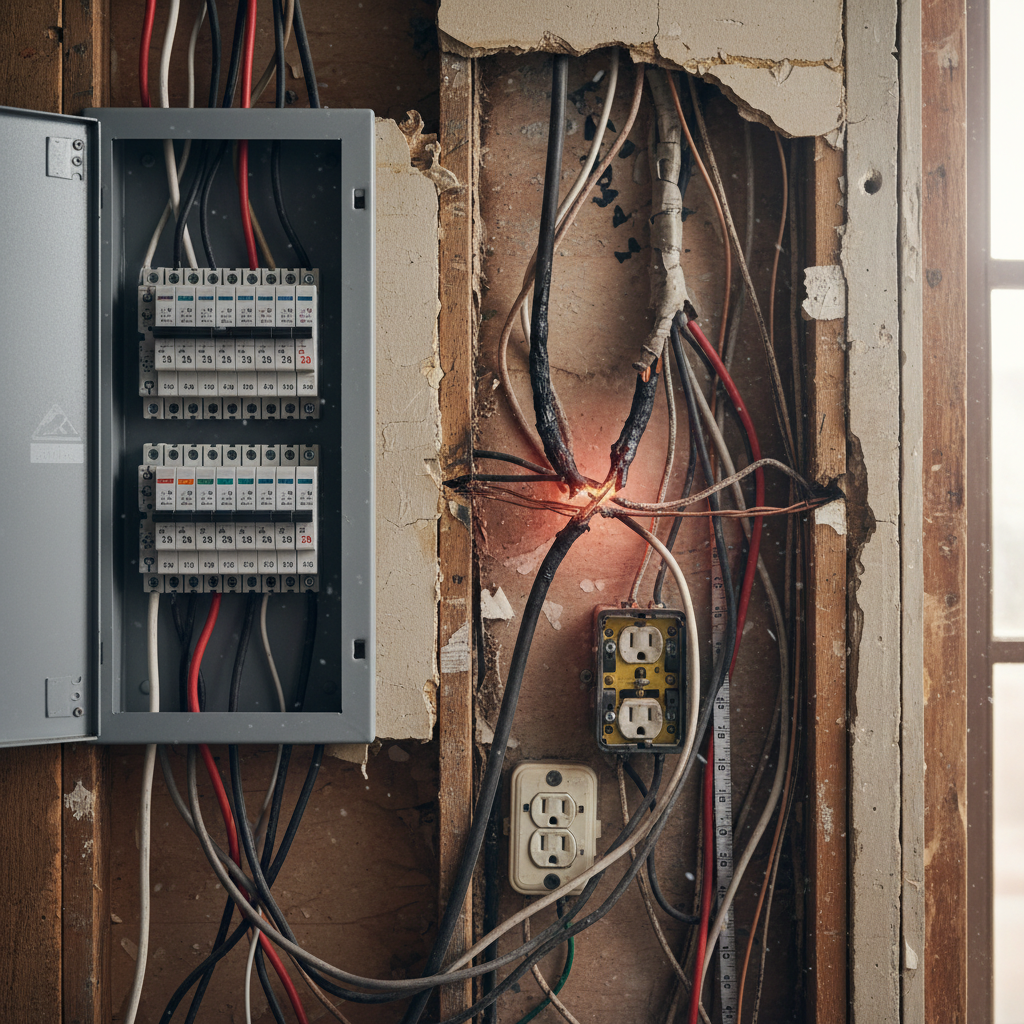
- 14-gauge AWG wire is thinner and has higher resistance.
- 12-gauge AWG wire is thicker and has lower resistance.
- 10-gauge AWG wire is even thicker and has even lower resistance.
Electrical · Panel or service upgrade
| Project category | Electrical |
|---|---|
| Problem type | Panel or service upgrade |
| Trade required | Electrical |
| Urgency | Planned project |
| Safety risk | High safety risk |
| DIY suitability | Licensed pro only |
| Cost category | High cost |
| Typical timeline | Permit plus utility scheduling, commonly 2–6 weeks |
| Contractor type | Licensed electrician |
Repair option
Add a subpanel when the main service is adequate.
Replacement option
Full service upgrade with utility coordination and permits.
Common causes
- Obsolete or recalled panel brands
- Service capacity too small for added loads
- No room for required AFCI/GFCI breakers
Relevant tools:project cost estimatorcompare quotes
Published May 5, 2026Last updated August 17, 2026
Tools & materials you'll need
Affiliate linksAs an Amazon Associate FixlyGuide earns from qualifying purchases — at no extra cost to you. Prices and availability are accurate as of publication and subject to change.
'''
Quick Answer
Wire gauge matters more than amperage because the wire's thickness (its gauge) determines its resistance to electrical current. Using a wire that is too thin (a higher gauge number) for the circuit's amperage causes the wire itself to dangerously overheat due to excessive resistance, creating a serious fire hazard long before the circuit breaker ever trips. The breaker protects against overcurrent, but the correctly-sized wire is what prevents the system from melting down under a normal load.
The Problem
In the world of home electricity, the circuit breaker gets all the attention. It’s the loud, clicking sentinel in your basement or utility closet, and most homeowners know that a 15-amp breaker handles less power than a 20-amp one. This leads to a dangerously simple assumption: as long as you don’t overload the breaker, you’re safe. People think the breaker is a foolproof guard against all electrical evils.
This is a critical, and potentially fatal, misunderstanding. The real, silent arbiter of electrical safety isn’t just the breaker—it’s the gauge of the copper wire hiding behind your drywall. An electrical circuit is a complete system, and the breaker is just one component. The wire itself is the path the electricity travels, and if that path is too narrow for the traffic, the results can be catastrophic.
Imagine a fire hose connected to a massive hydrant. The hydrant can push out 500 gallons per minute (the amperage), but you’ve attached a standard garden hose (the wire). The pressure is immense, and the garden hose will swell, heat up, and violently rupture long before the hydrant ever reaches its full potential. This is precisely what happens inside your walls when you have a wire gauge that is too small for the circuit breaker’s amperage rating. The breaker won’t trip, because the amount of current isn't exceeding its limit. But the wire itself is "straining," generating tremendous heat, melting its plastic insulation, and creating the perfect conditions for a fire to start within the wall cavity. You won’t see it, you won’t smell it until it’s far too late. The breaker will stand by, completely unaware of the meltdown occurring along the line.
How It Works
To understand why wire gauge is paramount, we need a quick lesson in the physics of electricity. Think of your home’s wiring as a plumbing system.
- Voltage (Volts): This is the electrical "pressure." In our plumbing analogy, it’s the water pressure in the pipes. For most standard home circuits in the U.S., this is a constant 120 volts.
- Current (Amperes or Amps): This is the "flow rate" of the electricity. It’s the volume of electrons moving through the wire. In plumbing terms, this is how many gallons per minute are flowing through the pipe. When you plug in a high-power device like a vacuum cleaner or a space heater, you are demanding a higher flow rate (more amps).
- Resistance (Ohms): This is the friction or opposition to the flow of current. Every material has some electrical resistance. For plumbing, this is the narrowness of the pipe. A wide, smooth pipe has low resistance and allows water to flow easily. A narrow, rough pipe has high resistance, forcing the pump to work harder and generating friction and heat.
This is where wire gauge comes in. Wire gauge is measured in AWG (American Wire Gauge). The crucial, counter-intuitive rule is: the smaller the AWG number, the thicker the wire and the lower its resistance.
- 14-gauge AWG wire is thinner and has higher resistance.
- 12-gauge AWG wire is thicker and has lower resistance.
- 10-gauge AWG wire is even thicker and has even lower resistance.
Now, let's connect this to heat. The heat generated in a wire is described by a fundamental law of physics called Joule's Law, which can be stated as: Heat = Current² x Resistance.
Let’s break that down. The amount of heat generated is proportional to the resistance of the wire. But it is proportional to the square of the current. This means that even a small increase in current creates a much larger increase in heat. And if the resistance of the wire is too high to begin with (because it's too thin), the heat generation skyrockets.
A circuit breaker is an overcurrent protection device. It only trips when the flow rate (amps) exceeds its rating (e.g., more than 20 amps on a 20A breaker). It has no idea how hot the wires are getting.
Here’s the dangerous scenario:
- A DIYer or careless handyman installs a new 20-amp circuit for a kitchen, but uses cheaper, easier-to-work-with 14-gauge wire instead of the required 12-gauge wire.
- You plug in a new high-end coffee maker that draws 9 amps and a toaster that draws 8 amps. Total current draw: 17 amps.
- The 20-amp breaker is perfectly happy. The current is 17 amps, which is less than 20. It will not trip.
- But that 17 amps is flowing through a 14-gauge wire, which is only rated to safely handle 15 amps. According to Joule's Law, the wire's higher resistance is now causing it to heat up dramatically. The plastic sheathing can reach its melting point (around 200°F for standard NM-B cable), exposing the bare copper wire and creating an extreme risk of arcing and fire inside your walls.
The system "works," but it's a ticking time bomb. The breaker did its job, but it was matched with the wrong wire. The wire gauge, not the breaker, became the point of failure.
Step-by-Step Fix: How to Check for a Mismatch
This process is an inspection. The "fix" for a mismatch is a job for a professional, but any homeowner can and should perform this safety check.
SAFETY NOTE: You will be opening your main electrical panel. While you won't be touching anything live, it's crucial to be cautious. Do not stick tools or fingers into the panel. Wear safety glasses.
-
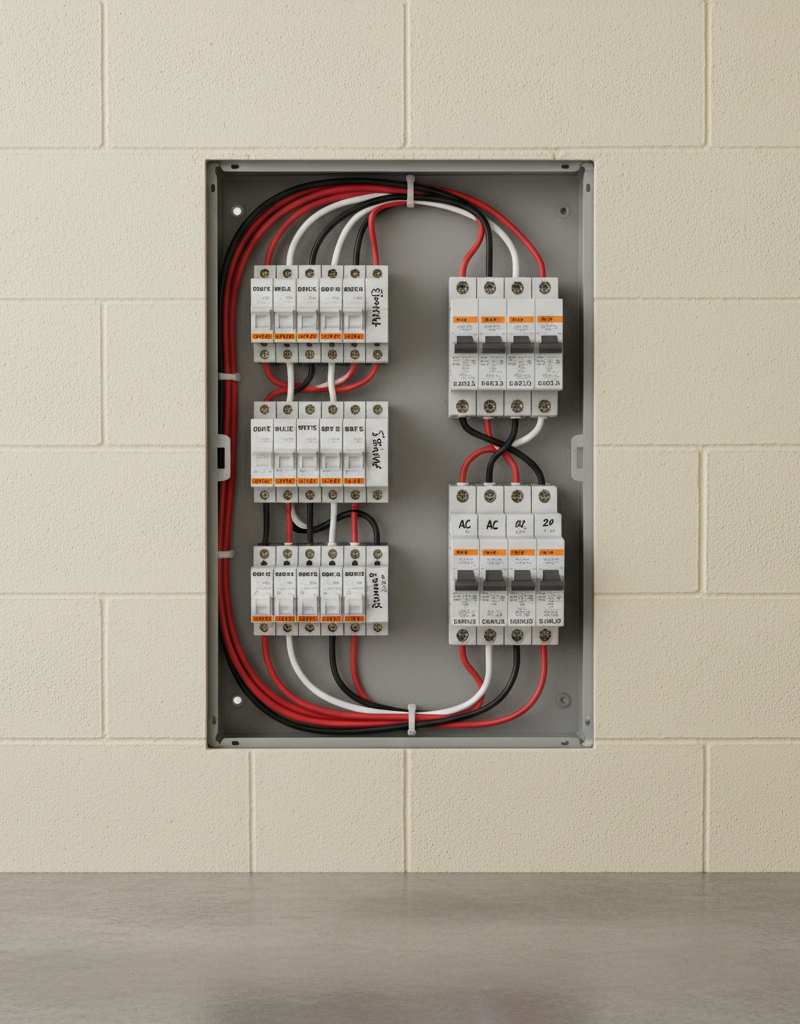
Safety First - See, Don't Touch: Go to your main electrical panel. Your goal is just to read the numbers on the breakers and find the corresponding wires. Do not attempt to remove breakers or touch any of the metal bus bars they connect to. Just open the panel door.
-
Identify a Circuit Breaker: Pick a standard circuit, such as one labeled "Living Room Outlets" or "Bedroom Lights." Look at the number on the switch. It will typically be "15" or "20." This is the amp rating.
-
Find the Corresponding Cable: Carefully look at where the wires enter the panel, usually at the top or bottom. Try to trace the cable that connects to the breaker you identified. In most modern homes, this will be a white or yellow plastic-sheathed cable called Non-Metallic (NM) or Romex®.
-
Examine the Cable Sheathing: This is the key step. Shine a bright flashlight on the outer plastic jacket of the cable. You are looking for printed or embossed text. It might be faint, but it will be there. You are looking for a code that looks like "NM-B 14/2" or "NM-B 12/2 G".
-
Decode the Markings:
- The first number is the gauge. "14" means 14-gauge wire. "12" means 12-gauge wire.
- The second number is the count of insulated conductors. "/2" means two conductors (a hot and a neutral). "/3" means three conductors.
- Sometimes there is a "G" for "Ground."
- By convention, 14-gauge NM cable has a white outer sheath, and 12-gauge NM cable has a yellow outer sheath. Do not rely on color alone, as old or non-standard cables may vary. Always read the printed text.
-
The Golden Rule: Match Gauge to Breaker: Now, compare the wire gauge to the breaker's amp rating. The National Electrical Code (NEC) has strict rules:
- 15-Amp Breaker ⇒ Requires 14-Gauge Wire (or thicker/lower gauge #).
- 20-Amp Breaker ⇒ Requires 12-Gauge Wire (or thicker/lower gauge #).
- 30-Amp Breaker ⇒ Requires 10-Gauge Wire.
-
Identify a Mismatch: A dangerous mismatch is when the wire gauge number is higher (thinner wire) than what the breaker requires. Example of a major hazard: A "20" on the breaker connected to a cable marked "14/2". This means a 20-amp breaker is protecting a wire only rated for 15 amps.
-
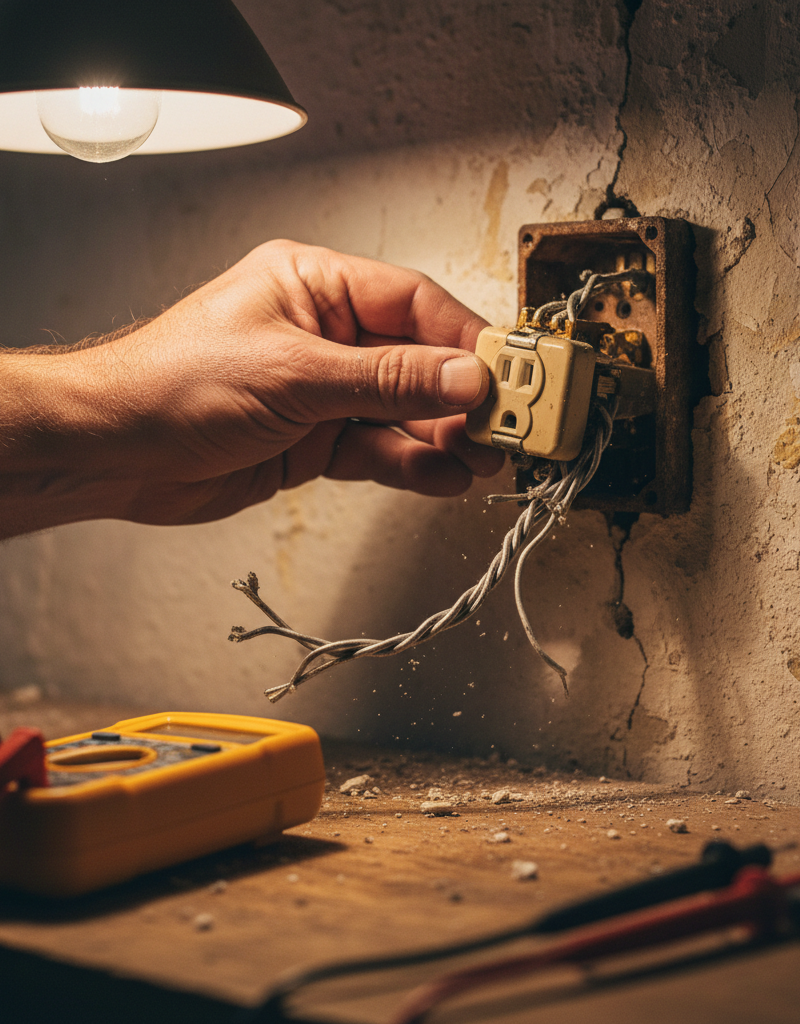
Spot Check a Receptacle (Optional): Turn off the circuit breaker. Use a voltage tester to confirm the power is off at an outlet on that circuit. Unscrew the outlet and gently pull it out. Look at the wire connected to it and the sheathing inside the box. Does it match what you saw in the panel?
-
The Extension Cord Trap: This same principle applies to extension cords. A cheap, thin 16- or 18-gauge cord used with a powerful 12-amp circular saw is a fire hazard. The cord itself will overheat. Always use a heavy-duty cord (12-gauge or 14-gauge) for power tools and appliances.
-
Found a Mismatch? Document and Call a Pro: If you discover a 20-amp breaker on 14-gauge wire, or any other similar mismatch, this is a serious fire hazard. Do not use the circuit for high-draw appliances. The safest course of action is to leave the breaker off, label it clearly with a note about the mismatch, and call a licensed electrician immediately. The proper fix is often to replace the 20-amp breaker with a 15-amp breaker, which is a quick and inexpensive job for a professional.
Common Causes
How does this dangerous mismatch happen? It's rarely malicious, but almost always a result of ignorance or corner-cutting.
- Uninformed DIY: A homeowner experiences a breaker that trips frequently (because it's actually overloaded). Annoyed, they go to the hardware store, see a 20-amp breaker, and "upgrade" it from the 15-amp original, thinking a bigger number is better. They have just created a fire hazard because they didn't upgrade the 14-gauge wire in the walls.
- Handyman Corner-Cutting: An unethical or unknowledgeable handyman is hired to add an outlet. To save about $50 on a roll of wire, they use the cheaper 14-gauge wire but tap into an existing 20-amp kitchen circuit (which is properly wired with 12-gauge). The new part of the circuit is now dangerously undersized.
- Adding On Over Time: Someone adds a new bathroom outlet to a nearby bedroom circuit. Then someone else adds a light. Over years, the total potential load on the circuit creeps up, pushing the original wiring to its thermal limit, even if the breaker doesn't trip.
- "Breaker Slapping": This is the most dangerous cause. When a breaker trips, a person without proper knowledge simply forces it back on or, worse, physically wedges something in the panel to hold it in place. This completely defeats the safety mechanism and essentially guarantees an overheating event.
Common Mistakes
- Mistake 1: Assuming the Breaker is a "Smart" Device. Thinking the breaker intelligently protects against all forms of electrical danger, including heat. It does not; it only detects overcurrent.
- Mistake 2: Using a Higher Amp Breaker to "Fix" Tripping. A tripping breaker is a symptom, not the disease. The cause is overload or a short circuit. "Upgrading" the breaker is like taking out your oil-pressure warning light because it keeps blinking.
- Mistake 3: Believing "If it Works, it's Safe." The circuit with mismatched wire will "work" perfectly—lights will turn on, devices will run. It will continue to work right up until the point it starts a fire.
- Mistake 4: Reading the Gauge Number Backwards. Forgetting that a smaller number (12 AWG) means a thicker, more capable wire than a larger number (14 AWG).
- Mistake 5: Ignoring Extension Cord Ratings. Using a flimsy indoor extension cord for a high-power garage tool or outdoor appliance. The cord itself becomes the weak, overheating link.
- Mistake 6: Trusting Previous Work Blindly. Assuming the person who wired the house before you knew what they were doing. Always verify.
Cost & Time Breakdown
The "job" is inspecting for and correcting a breaker/wire mismatch. The inspection is a DIY task; the correction is a professional job.
| Task | DIY Cost | Pro Cost | Time |
|---|---|---|---|
| Visual Circuit Inspection | $0 - $20 (flashlight) | $100 - $200 (service call) | 30-60 minutes |
| Breaker Replacement (Downgrade) | Not recommended | $125 - $250 | 1 hour |
| Outlet & Switch Check | $0 | (Included in inspection) | 1-2 hours |
| Full Circuit Rewire (per circuit) | Not recommended | $700 - $2,500+ | 4 hours - 2 days |
Pro costs vary significantly by location and the accessibility of the wiring.
Tips & Prevention
- Memorize the Core Rule: 15-amp = 14-gauge. 20-amp = 12-gauge. 30-amp = 10-gauge. Write this on a label inside your panel door.
- Invest in Good Extension Cords: For power tools, space heaters, or air conditioners, use a 12-gauge or 14-gauge extension cord that is as short as possible. The longer the cord, the thicker it needs to be.
- Treat Tripping Breakers as a Warning: If a breaker trips, don't just reset it. Unplug devices from that circuit. If it trips again with nothing plugged in, call an electrician immediately.
- Feel Your Outlets: Periodically, feel your outlet cover plates, especially those with many devices or a large appliance plugged in. If a plate ever feels warm to the touch, unplug everything from that outlet and have it inspected.
- Hire Licensed Electricians: For any new wiring—from adding a single outlet to wiring a new room—always use a licensed, insured electrician who understands and follows the National Electrical Code.
- Plan New Circuits: When finishing a basement or remodeling, map out your electrical needs. High-load areas like workshops, home theaters, and kitchens need dedicated 20-amp circuits, and the electrician must run 12-gauge wire.
When to Call a Professional
While the inspection described above is within a homeowner's ability, any corrective action or deeper investigation requires a pro. Any work inside a live electrical panel can be fatal.
Call a licensed electrician immediately if you encounter any of the following:
- You discover a breaker and wire gauge mismatch in your panel.
- A circuit breaker trips repeatedly, even after you’ve reduced the load.
- You hear any buzzing, crackling, or humming from your breaker panel, outlets, or switches.
- You smell a "fishy" or sharp, acrid plastic odor near outlets or your electrical panel.
- Outlets, switches, or cover plates are discolored or warm/hot to the touch.
- Your lights flicker or dim dramatically when a large appliance (like your AC or a microwave) kicks on.
- You are planning any modification or addition to an existing circuit.
Think of your wiring as your home's circulatory system. The breaker is just a single valve, but the veins and arteries—the wires themselves—are what keep the system operating safely. Giving them the respect they deserve is fundamental to protecting your home and family from the hidden danger of electrical fires. '''
Related Articles
Keep troubleshooting with these hand-picked guides from FixlyGuide:
- That tripped breaker? 80% miss the hidden cause. — A tripping circuit breaker is a common household problem, often indicating an overloaded circuit or a short circuit. Understanding the caus…
- That One Warm Breaker Is Trying to Tell You Something — A single warm circuit breaker is not normal; it's a critical warning sign of an electrical issue, often an overload or a dangerous loose co…
- Why Your Wall Switch Feels Hot: The Hidden Danger Most Homeowners Miss — A hot light switch isn't just uncomfortable; it's a critical warning sign of potential electrical hazards that demand immediate attention.
- Why is Your Light Switch Hot? (The Hidden Danger Most Homeowners Miss) — A hot light switch isn't just uncomfortable; it's a critical warning sign of electrical issues that should never be ignored due to fire ris…
- Why Your Outlet Died But the Breaker's STILL On (The GFCI Culprit) — Discover the hidden reasons an electrical outlet stops working, even when the circuit breaker remains on, often pointing to a tripped GFCI.
- The Hidden Reason Your GFCI Trips (It's Not Always a Faulty Outlet) — A continuously tripping GFCI outlet is a critical safety warning, often indicating moisture, a faulty appliance, or a wiring problem that r…
Repair or replace this system?
Plug in four numbers and see which choice holds up financially.
Free and instant. Educational guidance only — not a quote, inspection, or professional diagnosis.
Questions to ask before you sign
Ask every contractor the same questions and the cheapest bid stops looking cheapest. Check them off as you go — your progress is saved on this device.
Free, no signup. Bring this to every walkthrough so you compare bids on the same terms.
What should this project cost?
Enter your project details for a realistic cost range before you call anyone.
Outlet and switch work usually $150–$400; panel upgrades commonly $1,800–$4,200.
- Regional adjustment
- National average
- Labor share (typical)
- ~$709
- Quotes to collect
- 3 written estimates
Educational estimate based on national averages — not a binding quote. Always confirm with written local estimates.
Repair or replace?
Run the age, cost ratio, and repair history through the calculator before you commit.
- Estimate this projectGet a cost range for your scope and ZIP before you call anyone.Open
- Get local estimatesSend one request and compare written estimates from vetted pros.Open
Free, no signup required. Estimates are educational guidance, not a quote or an inspection.
Get the print-ready PDF of this guide
A clean, ad-free, printable version you can keep on your phone or pin to the workshop wall. Free with a FixlyGuide account.
- Print-optimized layout
- Tools, materials & every step included
- Saved to your account
Frequently asked questions
What happens if you use 14-gauge wire on a 20-amp circuit?+
Using 14-gauge wire on a 20-amp circuit is a serious fire hazard. The 14 AWG wire is too thin to safely handle the current that a 20A breaker allows. Under a heavy load (e.g., 17-19 amps), the wire will dangerously overheat, potentially melting its insulation and igniting surrounding materials like wood and insulation long before the breaker ever trips.
Can I replace a 15-amp breaker with a 20-amp one?+
You can only replace a 15-amp breaker with a 20-amp one if you have confirmed that the ENTIRE circuit, including every wire, connection, and outlet, is wired with 12-gauge AWG copper wire or thicker. If any part of the circuit uses thinner 14-gauge wire, making this switch creates a significant fire risk and is a code violation.
Is thicker wire always better for home wiring?+
From a safety and efficiency standpoint, a thicker wire (lower gauge number) is always better as it has less resistance and runs cooler. However, it's not practical or cost-effective to use excessively thick wire. The National Electrical Code specifies the minimum gauge required for a given amperage, which provides a safe and effective standard. Using the correct gauge for the breaker is the most important rule.
How can I tell the gauge of the wire in my walls?+
The most reliable way is to find a visible section of the cable, either near your electrical panel or in an unfinished basement or attic. The outer plastic sheathing of the cable (e.g., Romex) is printed with information that includes the gauge, such as 'NM-B 14/2' for 14-gauge wire or 'NM-B 12/2' for 12-gauge wire.
Discussion
Loading comments…