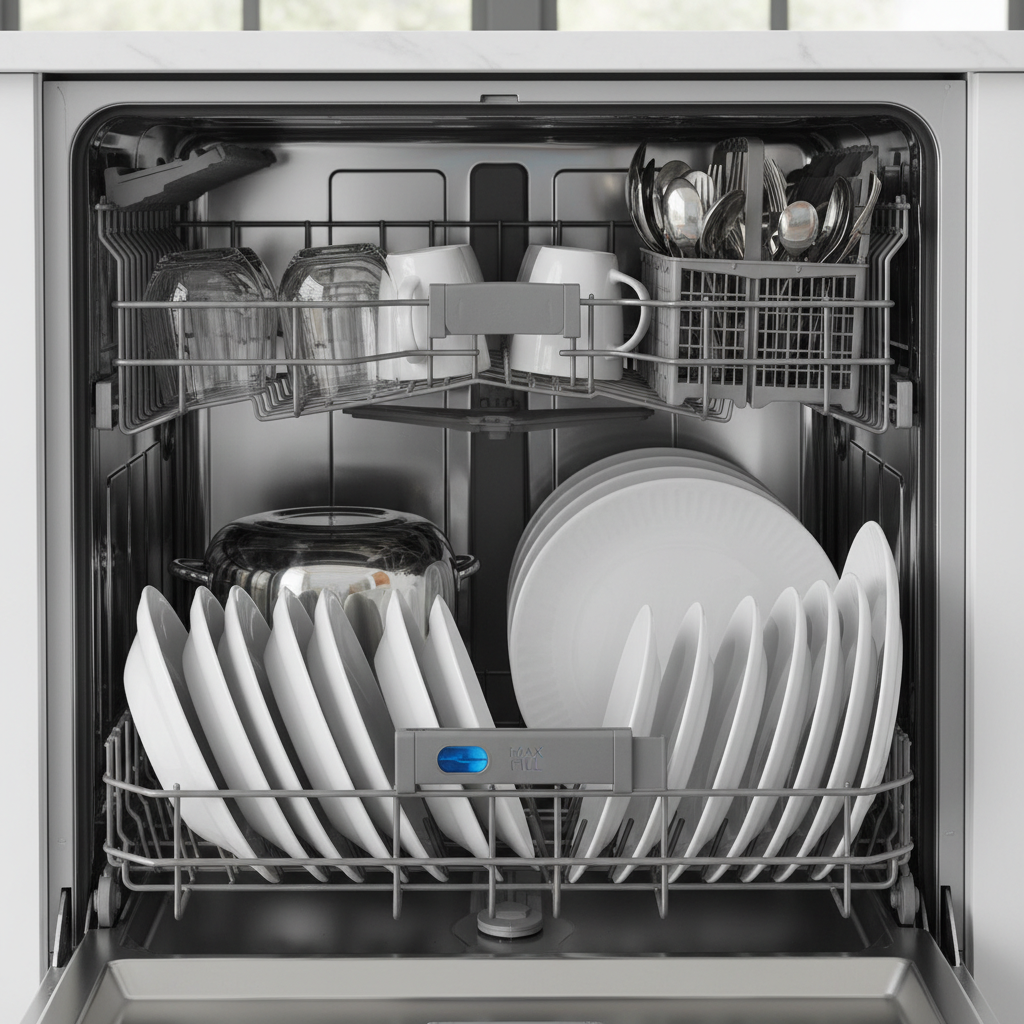
- Correct Dish Loading Technique — Improper loading can trap water and block airflow, defeating even the most powerful drying system. A poorly loaded rack is a primary cause of wet dishes.
- Ensure water can drain from all surfaces. Angle mugs, cups, and bowls downward so their interiors do not become pools.
- Do not allow items to nest or touch. Create space between plates for heated air to circulate. Place plastics on the top rack, where the heat is less intense, and separate them to prevent pooling.
- Confirm that no tall platters, pans, or utensils are blocking the spray arms or the detergent/rinse aid dispenser door. Spin the arms by hand to check for clearance.
HVAC · High energy usage
| Project category | HVAC |
|---|---|
| Problem type | High energy usage |
| Trade required | HVAC |
| Urgency | Planned project |
| Safety risk | Low safety risk |
| DIY suitability | DIY for experienced homeowners |
| Cost category | High cost |
| Typical timeline | Assessment within weeks; replacement planned off-season |
| Contractor type | Licensed HVAC technician |
Repair option
Duct sealing, insulation, and a tune-up before touching the equipment.
Replacement option
High-efficiency replacement sized by a load calculation, not a rule of thumb.
Common causes
- Aging, low-efficiency equipment
- Leaking ducts losing conditioned air
- Insufficient attic insulation
- Oversized system short-cycling
Relevant tools:project cost estimatorrepair or replace
Published April 17, 2026Last updated August 17, 2026
How it works
A dishwasher’s drying performance depends on one of two primary technologies: heated drying or condensation drying. Understanding which system your appliance uses is key to diagnosing why dishes remain wet.
Heated Drying Systems: Common in many North American models, this method relies on an exposed heating element at the bottom of the dishwasher tub, similar to an electric oven coil. After the final rinse cycle, the main control board activates this element, which typically draws 1000-1200 watts. The element heats the air inside the tub to temperatures between 130°F and 170°F. Simultaneously, a small vent, often located on the top or side of the door, opens. A small fan or a wax motor-actuated flap allows the hot, moist air to be actively or passively exhausted from the tub, drawing in cooler, drier ambient air to replace it. A high-limit thermostat is wired in series with the element to prevent overheating, cutting power if temperatures exceed a safe threshold. The combination of intense heat and active moisture removal evaporates water directly from the dish surfaces.
Condensation Drying Systems: Prevalent in European and high-efficiency models (like Bosch, Miele, and some KitchenAid units), this method uses no dedicated drying element. Instead, it leverages thermodynamics. The final rinse cycle uses extremely hot water (up to 160°F), which heats the dishes and the stainless steel tub. Because the dense ceramic and glass dishes retain this heat longer than the thin steel tub walls, a temperature differential is created. The hot water on the dish surfaces evaporates into steam. This steam is then attracted to the relatively cooler stainless steel tub walls, where it condenses back into water droplets. This collected water runs down the walls and is drained away by the pump, effectively removing moisture from the air and leaving dishes dry. This process is silent, energy-efficient, and safer for plastics, but it relies heavily on rinse aid to sheet water off dishes and a very hot final rinse.
Step-by-Step Fix
Follow these steps in order, from the simplest external adjustments to more involved internal component checks.
-
Verify Cycle Selections and Options — The most common issue is often user-selected settings that intentionally bypass the drying phase to save energy. Before assuming a mechanical fault, confirm you are using a cycle that includes a full drying period.
- Look for buttons or menu options like "Heated Dry," "Max Dry," "Power Dry," or a sanitize option, which typically adds a high-heat rinse and extended drying time.
- Avoid using "Quick Wash," "Eco," or "Air Dry" cycles if you want maximum drying performance, as these are designed to conserve energy by limiting or eliminating heat.
-
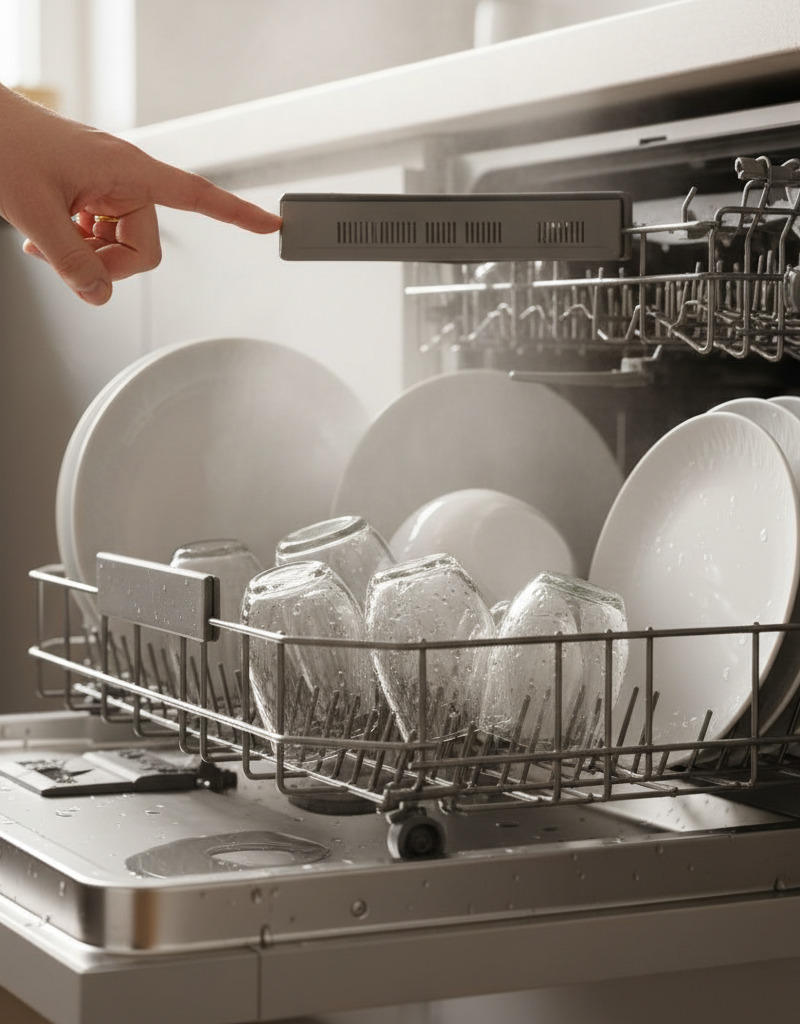
Refill and Adjust the Rinse Aid Dispenser — Rinse aid is a surfactant, not a soap. It works by breaking the surface tension of water, forcing it to run off dishes in thin sheets rather than forming stubborn droplets that take much longer to evaporate.
- Locate the dispenser on the interior of the dishwasher door, next to the detergent compartment. Twist or pop the cap open and fill the reservoir with a liquid rinse aid until the indicator is full.
- Most dispensers have a small adjustable dial (often numbered 1-4). A higher number dispenses more rinse aid per cycle. If your dishes are wet, and especially if you have hard water, set this to a higher setting like 3 or 4.
-
Correct Dish Loading Technique — Improper loading can trap water and block airflow, defeating even the most powerful drying system. A poorly loaded rack is a primary cause of wet dishes.
- Ensure water can drain from all surfaces. Angle mugs, cups, and bowls downward so their interiors do not become pools.
- Do not allow items to nest or touch. Create space between plates for heated air to circulate. Place plastics on the top rack, where the heat is less intense, and separate them to prevent pooling.
- Confirm that no tall platters, pans, or utensils are blocking the spray arms or the detergent/rinse aid dispenser door. Spin the arms by hand to check for clearance.
-
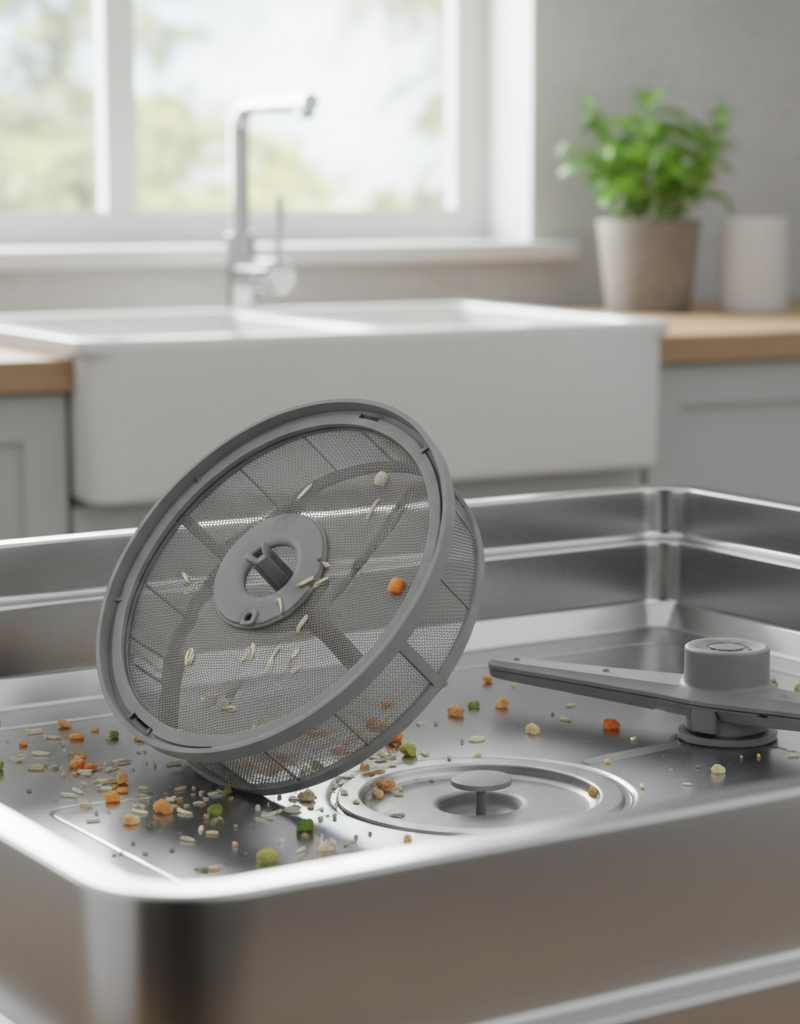
Inspect and Clean the Dishwasher Filter — A clogged filter assembly at the bottom of the tub prevents the dishwasher from fully draining dirty water. This remaining soiled water can redeposit on dishes and leaves the entire tub humid, inhibiting drying.
- Locate the filter at the bottom of the dishwasher tub, usually beneath the lower spray arm. It typically consists of a cylindrical fine mesh screen and a flat coarse filter plate.
- Twist the cylindrical filter (usually counter-clockwise) to unlock and lift it out. Remove the filter plate if it is a separate piece.
- Rinse all parts thoroughly under warm running water. Use a soft brush to gently scrub away any grease or food particles from the mesh screen. Reassemble and lock it back into place.
-
Check Incoming Water Temperature — Dishwashers require a hot water supply of at least 120°F for effective cleaning and to assist in drying. If the water isn't hot enough, detergents won't fully activate and condensation drying systems will fail.
- Turn on the hot water tap at the kitchen sink nearest the dishwasher. Let it run for one minute to get a stable reading from the water heater.
- Use a kitchen or meat thermometer to measure the temperature of the water in a cup. If it is below 120°F, consider turning up your home's water heater thermostat. Most experts recommend a setting of 120-125°F for a balance of safety and performance.
-
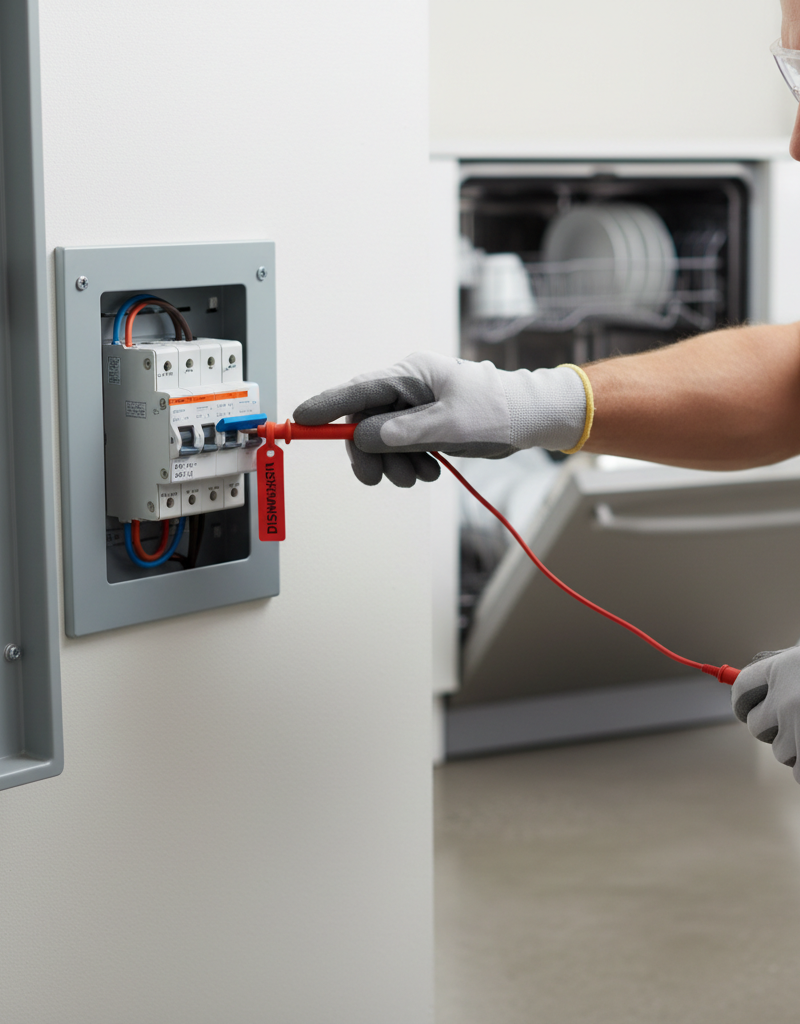
Test the High-Limit Thermostat — This safety device is wired in series with the heating element. If it fails in the open position, it will permanently cut power to the element, preventing it from ever heating up.
- Safety First: Disconnect the dishwasher from power at the circuit breaker.
- The thermostat is a small, round component mounted on the underside of the dishwasher tub. You will need to pull the dishwasher out from under the counter to access it.
- Disconnect the two wires attached to its terminals. Set a multimeter to the continuity setting (which beeps) or the lowest ohms (Ω) setting. Touch one probe to each terminal. A functional thermostat should show continuity (a beep or a reading of zero ohms). If there is no continuity (no beep or an "OL" reading), the thermostat has failed and must be replaced.
-
Test the Heating Element — A broken or burned-out heating element is a direct cause of no heat. A visual inspection may reveal a break, but an electrical test is definitive.
- Safety First: Ensure power is disconnected at the breaker.
- The element is the circular or U-shaped metal tube at the bottom of the tub. The terminals protrude through the bottom of the tub on the underside.
- Disconnect the wires from the element's terminals. Set your multimeter to the ohms setting (Ω). Touch one probe to each terminal. A healthy heating element should have a resistance reading between 10 and 30 ohms. If the meter reads infinite resistance ("OL"), the element is broken internally and requires replacement.
-
Inspect the Vent and Wax Motor — In heated dry models, a stuck vent will trap moisture. The vent is usually a plastic assembly in the door with a flap controlled by a small "wax motor."
- With the power off, you may need to remove the inner door panel (held by Torx screws) to access the assembly.
- Check that the vent flap moves freely and is not blocked by debris. The wax motor has a small pin that extends when heated to open the flap. Check for visible damage or signs of burning on the motor.
- If the wax motor is suspect, you can test it for resistance with a multimeter. A typical reading is between 1,000 and 2,000 ohms. An "OL" reading indicates a failed motor that needs replacement.
Common mistakes
- Assuming All Plastics Will Be Bone-Dry. Plastic items have low thermal mass, meaning they don't retain heat from the final rinse. They will almost always be wetter than glass or ceramic dishes, especially in condensation dry models. This is normal behavior, not a sign of a broken appliance.
- Pre-Rinsing Dishes Too Clean. Modern dishwashers use a turbidity sensor to detect how dirty the water is. If you pre-rinse dishes until they are spotless, the sensor may prompt the dishwasher to run a lighter, shorter, or lower-temperature cycle, which significantly impairs drying performance. Instead, scrape off large food debris and let the machine handle the rest.
- Neglecting the Drain Hose "High Loop". The dishwasher drain hose must be looped up to a point higher than the sink drain connection or garbage disposal inlet. Without this "high loop," wastewater from the sink can flow back into the dishwasher, leaving a pool of dirty water at the bottom of the tub and creating a humid environment that prevents drying.
- Using 3-in-1 Pods Without Adjusting Settings. While convenient, some detergent pods contain a very small amount of rinse aid that may be insufficient, especially in areas with hard water. If you use pods and dishes are wet, you should still fill the separate rinse aid dispenser and set it to a medium or high level for best results.
- Blocking the Rinse Aid Dispenser. Placing a tall pan, cookie sheet, or cutting board in the front of the lower rack can physically block the rinse aid dispenser door from opening at the correct time in the cycle. This prevents the surfactant from being released, leading directly to poor drying.
Cost & time breakdown
| Task | DIY Cost | Pro Cost | Time |
|---|---|---|---|
| Refill Rinse Aid & Adjust Settings | $5 - $15 (for rinse aid) | N/A | 5 minutes |
| Clean Filter & Check Water Temp | $0 | $120 - $200 (service call) | 15 minutes |
| Test High-Limit Thermostat | $15 - $30 (for multimeter) | $150 - $250 | 1 - 2 hours |
| Replace Heating Element | $40 - $100 (part only) | $200 - $400 | 1.5 - 3 hours |
| Replace Vent Assembly / Wax Motor | $30 - $70 (part only) | $180 - $300 | 1 - 2 hours |
| Replace High-Limit Thermostat | $15 - $40 (part only) | $150 - $250 | 1 - 2 hours |
When to call a pro
While many drying issues are correctable with simple adjustments, certain symptoms point to problems best left to a qualified appliance technician. Call a professional if you encounter any of the following situations:
- You are not comfortable with electrical testing. Safely using a multimeter and handling live electrical connections requires knowledge and caution. If you are hesitant to work inside the machine with the power off, or if you don't own or know how to use a multimeter, it is safer to call a pro.
- Multiple components test as faulty. If both the heating element and a thermostat test bad, there may be an underlying issue with the control board sending incorrect voltage. A professional can diagnose this sequencing problem.
- Error codes appear on the display. If your dishwasher is showing a specific error code that you cannot clear or decipher with the owner's manual, a technician can interpret the code and access service diagnostics.
- There are signs of water leakage. If you notice water dripping from around the heating element gasket or from any other component underneath the tub, this requires immediate professional attention to prevent water damage to your floor and cabinetry.
- The problem persists after replacing a part. If you replace the heating element and the dishes are still wet, the fault likely lies with the control board or wiring harness, which requires more advanced diagnostic skills.
Prevention & maintenance
- Routinely Clean the Filter: Once a month, remove and rinse the filter assembly at the bottom of the tub. This prevents food particles from redepositing on dishes and ensures proper drainage, which is critical for a dry and odor-free interior.
- Always Use Rinse Aid: Make it a habit to check the rinse aid level every couple of weeks and top it off as needed. Consistent use is the single most effective way to improve drying performance across all dishwasher types.
- Run a Monthly Cleaning Cycle: Use a commercial dishwasher cleaning tablet (like Affresh or Finish) or run an empty, hot cycle with two cups of white vinegar in a bowl on the top rack. This descales mineral deposits from the tub, spray arms, and heating element, maintaining their efficiency.
- Inspect Spray Arms Quarterly: The small nozzles on the spray arms can become clogged with hard water deposits or food debris. Remove the arms (they usually unclip or unscrew) and clear any blocked holes with a toothpick or small wire.
- Maintain a 120°F Water Supply: Periodically check the hot water temperature at your kitchen sink. If it drops below 120°F, adjust your home’s water heater. Consistently hot water is essential for both cleaning and drying.
- Check the Drain Hose Annually: Ensure the drain hose behind the dishwasher is not kinked or flattened. Confirm it is securely looped up as high as possible under the sink before connecting to the drain or garbage disposal to prevent backflow.
Related Articles
Keep troubleshooting with these hand-picked guides from FixlyGuide:
- The #1 Mistake Wrecking Your Dishwasher's Cleaning Power (It's Not Soap!) — Your dishwasher isn't cleaning dishes because of a common, overlooked issue with its spray arms, leading to poor water distribution.
- Your 'Clean' Dishes Are Still Dirty? The Culprit Is Hiding — Frustrated by gritty, food-flecked dishes after a full wash cycle? The problem isn't your detergent. Your dishwasher is making dishes dirti…
- The #1 Mistake Homeowners Make When Their Dryer Isnt Drying (And How to Fix It Free) — Most homeowners assume a slow dryer means a broken dryer, but the most common culprit is a simple, often overlooked maintenance issue that'…
- The #1 Mistake Homeowners Make When Their Dishwasher Stops Cleaning (And the Simple Fix) — Discover the most common reason your dishwasher isn't cleaning dishes and learn a simple, effective fix you can do yourself in minutes.
- Your Dishwasher Dishes Come Out Cloudy? It's This, Not Soap — Tired of cloudy glasses and spotty plates? The unsightly white residue from your dishwasher is almost always caused by hard water mineral d…
- Dishwasher Not Draining? Easy Fixes for a Clogged Drain — A dishwasher that won't drain at the end of a cycle is a common problem, often caused by simple clogs or blockages that homeowners can fix…
Should you do this yourself?
Answer five quick questions before you start. Safety outranks savings every time.
Your experience with work like this
How high do you have to work?
Does the job involve any of these?
Will it need a permit?
Specialty tools
Free and instant. Educational guidance only — not a quote, inspection, or professional diagnosis.
What should this project cost?
Enter your project details for a realistic cost range before you call anyone.
Cost depends heavily on which system turns out to be the source.
- Regional adjustment
- National average
- Labor share (typical)
- ~$1,620
- Quotes to collect
- 3 written estimates
Educational estimate based on national averages — not a binding quote. Always confirm with written local estimates.
Fixly Project Decision Box
- DIY difficulty
- Advanced
- Estimated time
- Homeowner checks 20–30 minutes
- Cost level
- Moderate
Main tools / materials
- Clean air filter
- Garden hose for condenser coils
- Shop vac for the condensate line
When to stop and call a pro
- Burning smell, smoke, or a tripping breaker
- Refrigerant lines iced over or hissing
- Any work inside the sealed refrigerant circuit (EPA-licensed only)
- Gas smell near a furnace — leave and call the utility
Need professional help?
Find an HVAC Pro Near YouBefore you start
Check the difficulty, permits, and safety risk — then decide whether to call a pro.
- Estimate this projectGet a cost range for your scope and ZIP before you call anyone.Open
- Get local estimatesSend one request and compare written estimates from vetted pros.Open
Free, no signup required. Estimates are educational guidance, not a quote or an inspection.
Get the print-ready PDF of this guide
A clean, ad-free, printable version you can keep on your phone or pin to the workshop wall. Free with a FixlyGuide account.
- Print-optimized layout
- Tools, materials & every step included
- Saved to your account
Frequently asked questions
Why are my plastic dishes always wet?+
Plastic doesn't retain heat like glass or ceramic, so water doesn't evaporate as easily from its surface. Many dishwashers struggle to dry plastic items completely. Using extra rinse aid and ensuring proper loading can help, but some residual wetness is common.
How do I know if my dishwasher heating element is bad?+
After a heated dry cycle, if the inside of your dishwasher (excluding the dishes) is cold, it's a strong indicator of a faulty heating element. Visibly inspecting the coil for breaks or corrosion after disconnecting power can also confirm damage.
Can I use less detergent if dishes are still wet?+
Detergent levels usually don't directly impact drying, though using too much can leave residue that makes dishes feel wet or streaky. Focusing on rinse aid, proper loading, and cycle selection is more effective for drying issues. Always use the recommended amount of detergent for your water hardness.
Discussion
Loading comments…