- Location: Usually near where the main water line enters your house, often in the basement, utility closet, or outside near your water meter.
- Action: If it's a gate valve (round handle), turn it clockwise until snug, then counter-clockwise a quarter turn or two. If it's a ball valve (lever handle), ensure the handle is parallel with the pipe.
- Safety: Always locate your main water shut-off before any plumbing work. Know how to turn it off quickly.
- If this doesn't work: Move to the filter or PRV. A partially closed main valve can significantly restrict flow.
Plumbing · Low water pressure
| Project category | Plumbing |
|---|---|
| Problem type | Low water pressure |
| Trade required | Plumbing |
| Urgency | Soon — within weeks |
| Safety risk | Low safety risk |
| DIY suitability | DIY friendly |
| Cost category | Low cost |
| Typical timeline | DIY checks in under an hour; PRV replacement a half day |
| Contractor type | Licensed plumber |
Repair option
Clean aerators, then test static pressure before replacing the PRV.
Replacement option
Repipe when scaling in galvanized lines is the cause.
Common causes
- Clogged aerators or fixture screens
- Failing pressure-reducing valve
- Partially closed main shutoff
- Galvanized pipe scaling in older homes
Relevant tools:diy difficulty
Published June 2, 2026Last updated August 17, 2026
Tools & materials you'll need
Affiliate linksAs an Amazon Associate FixlyGuide earns from qualifying purchases — at no extra cost to you. Prices and availability are accurate as of publication and subject to change.
Quick Answer
Low water pressure affecting your entire home is a frustrating issue, but it's frequently traced back to one of two common, and often overlooked, culprits: a severely clogged whole-house water filter or a malfunctioning pressure reducing valve (PRV). While other factors can contribute, addressing these two components first tends to resolve the problem for most homeowners. A clogged filter restricts water flow into your home, while a failing PRV can incorrectly regulate the incoming pressure, leading to a noticeable drop at all fixtures.
The Problem
Imagine stepping into the shower, expecting a refreshing cascade, only to be met with a disappointing trickle. Or trying to run multiple appliances, like your dishwasher and washing machine, simultaneously, only to find neither has enough water to operate effectively. This widespread low water pressure isn't just an annoyance; it can impact everything from basic hygiene to the efficiency of your appliances and even the health of your lawn and garden irrigation. When every faucet, showerhead, and appliance struggles for adequate water flow, it signals a systemic issue within your home's main water supply system, not just an isolated fixture problem.
How It Works
Your home's water supply system is a network designed to deliver pressurized water to every fixture. Water typically enters your home from a municipal supply line or a well, often passing through a main shut-off valve, then through a pressure reducing valve (PRV) if your municipal pressure is too high (above 80 psi), and frequently a whole-house water filter. The PRV's job is crucial: it reduces and maintains a consistent, safe water pressure throughout your home, usually around 50-70 psi. Inside a PRV, a spring-loaded diaphragm or piston reacts to the incoming water pressure, adjusting an internal valve to control the outgoing pressure. If this diaphragm or spring weakens or gets obstructed by sediment, it can fail to open fully, choking off your home's water supply.
Similarly, a whole-house water filter, placed directly after the main shut-off or PRV, is designed to trap sediment, rust, and other particles before they enter your plumbing. This protects your pipes and fixtures, but like any filter, it has a finite capacity. Over time, as it accumulates more and more debris, the microscopic pores in the filter cartridge become clogged. This accumulation acts like a dam, creating significant resistance to water flow. The pump on a well system or the municipal pressure simply can't push enough water through the restricted filter, resulting in a dramatic drop in pressure perceptible at every tap in your house. Because these components are upstream of all your fixtures, issues with either one will affect your entire house, differentiating them from localized problems like clogged aerators or individual showerheads.
Step-by-Step Fix
1. Test Water Pressure — Quantify the problem before you begin.
- Tool: Water pressure gauge (available at hardware stores for under $15).
- Method: Screw the gauge onto an outdoor spigot or a utility sink faucet. Make sure no other water is running in the house. Open the spigot fully and read the gauge. A healthy range for residential homes is typically 40-80 psi. Below 40 psi is generally considered low.
- If your pressure is above 80 psi: And you're experiencing low flow, your PRV might be failing in a different way, or you could have partially closed valves somewhere. Proceed cautiously. If it's consistently over 80psi, your PRV isn't doing its job and needs replacement, though this isn't typically associated with low pressure.
2. Check Main Shut-Off Valve — Ensure it's fully open.
- Location: Usually near where the main water line enters your house, often in the basement, utility closet, or outside near your water meter.
- Action: If it's a gate valve (round handle), turn it clockwise until snug, then counter-clockwise a quarter turn or two. If it's a ball valve (lever handle), ensure the handle is parallel with the pipe.
- Safety: Always locate your main water shut-off before any plumbing work. Know how to turn it off quickly.
- If this doesn't work: Move to the filter or PRV. A partially closed main valve can significantly restrict flow.
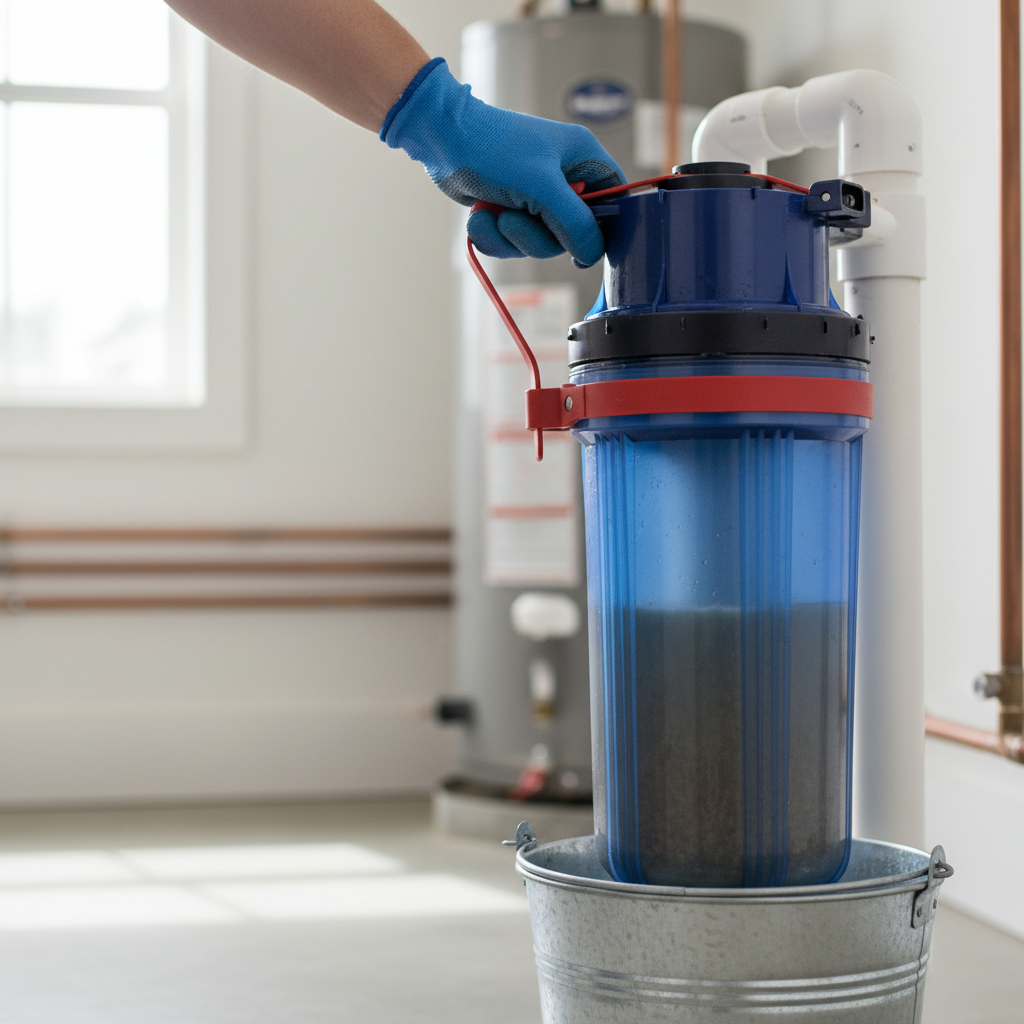
3. Inspect/Replace Whole-House Water Filter — The most common DIY culprit.
-
Location: Typically found in the basement, garage, or utility area, inline with the main water supply after the shut-off valve and often before the water heater.
-
Tools: Filter wrench (usually included with the housing), bucket, new filter cartridge (ensure it's the correct size and micron rating).
-
Steps:
- Turn off main water supply. Open a nearby cold faucet to relieve pressure.
- Place bucket below filter housing. Use the filter wrench to unscrew the housing. It may be tight.
- Carefully lower the housing. Empty any water into the bucket and remove the old filter cartridge. Observe its condition – is it dark, slimy, or heavily caked with sediment?
- Clean the housing. Wash out any sediment inside the housing and clean the O-ring seal. Inspect the O-ring for cracks; replace it if damaged.
- Insert new cartridge. Ensure it's seated correctly. Lube the O-ring with a tiny amount of silicone grease (plumber's grease) before reassembling.
- Screw housing back on by hand. Then use the wrench for a final snug quarter-turn. Do not overtighten.
- Slowly turn main water supply back on. Check for leaks. Open a cold faucet (starting with the lowest one) to purge air from the system.
-
If this doesn't work: If the new filter doesn't restore pressure, the filter wasn't the sole issue, or your PRV might be next.
4. Diagnose/Adjust Pressure Reducing Valve (PRV) — A common but less obvious cause.
-
Location: Usually located on the main water line shortly after it enters your home, often identifiable by its bell-shaped top and a bolt/screw for adjustment.
-
Tools: Water pressure gauge, adjustable wrench, flathead screwdriver or hex key (depending on PRV model).
-
Steps (Adjustment):
- Attach pressure gauge to an outdoor spigot or utility sink faucet.
- Locate the adjustment screw/bolt on the top or side of the PRV. It often has a locknut that needs to be loosened first.
- To increase pressure: Turn the adjustment screw clockwise in small increments (quarter turns). Run water for 30 seconds at a nearby faucet to equalize pressure, then re-check the gauge.
- To decrease pressure: Turn the adjustment screw counter-clockwise in small increments. Run water for 30 seconds, then re-check the gauge.
- Aim for 50-70 psi. Once set, tighten the locknut (if applicable).
-
If adjustment doesn't work: If adjusting the PRV has no effect on the pressure gauge reading, or if the pressure fluctuates wildly, the PRV is likely failing internally and needs replacement. This is a job often best left to a professional plumber due to the impact on the entire house's water supply and potential for improper installation.
5. Check for Leaks (Advanced DIY, if all else fails) — A hidden drain on your pressure.
- Method: Turn off all water-using appliances and faucets in your home. Check your water meter. Note the reading. Wait 15-30 minutes without using any water, then check the meter again. If the numbers have changed, you likely have a leak somewhere. For a well system, listen for your pump cycling frequently when no water is being used.
- Proximity: Check for damp spots on walls, ceilings, or under sinks, and listen for dripping sounds. Even small, constant leaks can cumulatively reduce system pressure.
Common Causes
- Clogged Whole-House Water Filter: Over time, sediment, rust, and debris accumulate, restricting water flow and causing a system-wide pressure drop.
- Failing Pressure Reducing Valve (PRV): The internal components (diaphragm, spring) can wear out or become clogged with sediment, preventing the valve from opening fully and maintaining proper pressure.
- Partially Closed Main Water Shut-Off Valve: An accidentally or intentionally partially closed main valve will restrict all water entering the home.
- Sediment Buildup in Pipes (Older Homes): Galvanized steel pipes, common in homes built before the 1970s, are prone to internal rust and mineral scale buildup, gradually narrowing the pipe's diameter.
- Water Heater Sediment: While less likely to affect all cold water, significant sediment buildup in the water heater can restrict hot water flow to all fixtures, especially if it's drawing from the tank's bottom.
- Municipal Supply Issues or Well Pump Problems: Less common, but sometimes the problem originates outside your home. Check with neighbors or assess your well pump's operation.
- Hidden Leaks: Even a small, continuous leak can divert enough water to significantly reduce pressure throughout the system.
Common Mistakes
- Only Checking Individual Fixtures: Many homeowners mistakenly troubleshoot a single low-pressure faucet or showerhead (e.g., cleaning the aerator) when the problem is house-wide. Always confirm the problem affects all fixtures before diving deep.
- Ignoring the Whole-House Filter: This is often the easiest and cheapest fix, yet it's frequently overlooked. It's an out-of-sight, out-of-mind component.
- Over-tightening Filter Housing: Applying too much force with the wrench can crack the filter housing or damage the O-ring, leading to leaks.
- Adjusting PRV without a Pressure Gauge: Guessing the correct PRV setting can lead to dangerously high pressure, damaging appliances and pipes, or still-low pressure. Always use a gauge.
- Failing to Bleed Air from System: After turning off water for repairs, air gets trapped. Opening the highest and then lowest faucets helps purge air and prevent sputtering or temporary low flow.
- Replacing PRV before other diagnostics: Replacing a PRV can be costly. Ensure you've ruled out simpler, less expensive issues like a clogged filter first.
Cost & Time Breakdown
| Task | DIY Cost ($) | Pro Cost ($) | Time |
|---|---|---|---|
| Check Water Pressure Gauge | 15–25 | N/A | 5 min |
| Replace Whole-House Filter | 20–70 | N/A | 20–30 min |
| Adjust PRV | 0 | 100–250 (service call) | 15–30 min |
| Replace PRV | 70–200 | 400–800 | 1–3 hours |
| Diagnose Hidden Leak | 0 (DIY) | 150–500+ | 30 min–few hours |
Tips & Prevention
- Regular Filter Changes: Mark your calendar! Replace your whole-house water filter every 3-6 months, or as recommended by the manufacturer, especially if you have hard water or well water.
- Monitor PRV: Periodically (e.g., annually) check your home's water pressure with a gauge to ensure the PRV is maintaining the correct setting. Fluctuations can be an early sign of failure.
- Flush Water Heater Annually: Draining a few gallons from your water heater's drain valve helps remove sediment, which can otherwise impede hot water flow and reduce the unit's efficiency and lifespan.
- Know Your Plumbing Layout: Take the time to identify the location of your main water shut-off, whole-house filter, and PRV. This knowledge is invaluable during an emergency or for routine maintenance.
- Consider Water Softener: If you have hard water, installing a water softener can prevent mineral buildup in pipes and fixtures, preserving pressure and extending plumbing life.
When to Call a Professional
If you've systematically checked and addressed your whole-house water filter and PRV, and still experience chronically low water pressure, it's time to call a licensed plumber. This is especially true if you suspect larger issues like major hidden leaks within walls or under foundations, significant pipe corrosion in older homes, or municipal supply line problems. Replacing a PRV, while covered here as an advanced DIY, involves tampering with your main water supply and can be complex; an experienced plumber ensures proper installation, correct pressure settings, and adherence to local codes. For well systems, persistent low pressure could indicate a failing well pump, a job requiring specialized equipment and expertise. Do not attempt to replace a PRV or diagnose large-scale pipe issues without a thorough understanding and the right tools, as improper work can lead to leaks, extensive water damage, or even contaminate your water supply. Your plumber can also perform a diagnostic check to pinpoint less obvious causes of pressure loss effectively and safely.
Related Articles
Keep troubleshooting with these hand-picked guides from FixlyGuide:
- The #1 Hidden Culprit Behind Your Whole-House Low Water Pressure (It's Not Your City!) — Discover the most common, overlooked cause of low water pressure throughout your entire home and how to easily diagnose and fix it yourself.
- The #1 Hidden Culprit Behind Your Whole-House Low Water Pressure (It's Not Your City!) — Discover the most common, often overlooked cause of low water pressure throughout your entire home and how to fix it yourself.
- The #1 Mistake Homeowners Make When Diagnosing Low Water Pressure (It's Not Your Pipes!) — Discover the most common, often overlooked culprit behind low water pressure impacting your entire home and how to easily fix it.
- The 4 Hidden Reasons Your Entire Home Has Low Water Pressure — Low water pressure throughout your house can stem from several hidden issues, ranging from municipal supply problems to your home's main sh…
- The 4 Hidden Reasons Your Entire Home Has Low Water Pressure (And the Easy Fixes) — Low water pressure throughout your entire home can be a frustrating and often misunderstood problem, with several common culprits. Learn to…
- The #1 Reason Your Fridge Ice Maker Stops—And the 20-Minute Fix — Uncover the most common culprit behind a non-producing ice maker and learn how to implement a quick, effective fix in about 20 minutes.
Should you do this yourself?
Answer five quick questions before you start. Safety outranks savings every time.
Your experience with work like this
How high do you have to work?
Does the job involve any of these?
Will it need a permit?
Specialty tools
Free and instant. Educational guidance only — not a quote, inspection, or professional diagnosis.
What should this project cost?
Enter your project details for a realistic cost range before you call anyone.
Cost depends heavily on which system turns out to be the source.
- Regional adjustment
- National average
- Labor share (typical)
- ~$1,620
- Quotes to collect
- 3 written estimates
Educational estimate based on national averages — not a binding quote. Always confirm with written local estimates.
Fixly Project Decision Box
- DIY difficulty
- Moderate
- Estimated time
- 30 minutes – half a day
- Cost level
- Moderate
Main tools / materials
- Adjustable wrench
- Plunger or drain auger
- Bucket and towels
- Thread tape
When to stop and call a pro
- Water you cannot shut off at the fixture or main
- Sewage backing up into more than one fixture
- Water near electrical panels or outlets
- Gas water heater work beyond relighting a pilot
Need professional help?
Get a Licensed PlumberBefore you start
Check the difficulty, permits, and safety risk — then decide whether to call a pro.
- Estimate this projectGet a cost range for your scope and ZIP before you call anyone.Open
- Get local estimatesSend one request and compare written estimates from vetted pros.Open
Free, no signup required. Estimates are educational guidance, not a quote or an inspection.
Get the print-ready PDF of this guide
A clean, ad-free, printable version you can keep on your phone or pin to the workshop wall. Free with a FixlyGuide account.
- Print-optimized layout
- Tools, materials & every step included
- Saved to your account
Recommended for DIYers & woodworkers
Sponsored
The Top 20 Tools for Workshops of Any Budget
No stationary machines or power tools required — plus 3 fundamental tools that can't be bought at any price.
Get the free guide
Ted's Woodworking — The #1 Woodworking Resource
Detailed instructions, dimensioned drawings, materials & cutting lists, and 3D schematics for every skill level.
See the plansSponsored: links above are affiliate links. FixlyGuide may earn a commission on qualifying purchases — at no extra cost to you.
Frequently asked questions
Why is my water pressure suddenly low throughout the house?+
Sudden, house-wide low water pressure is most often caused by a severely clogged whole-house water filter or a problem with your pressure reducing valve (PRV). Less commonly, it could be a main shut-off valve that's partially closed or a sudden issue with your municipal water supply. Check your filter first, then your PRV.
How do I check my whole-house water filter?+
To check your whole-house water filter, first turn off your main water supply. Then, open a nearby faucet to relieve pressure. Place a bucket under the filter housing, unscrew it with a filter wrench, and inspect the cartridge. If it's dark, slimy, or heavily caked with sediment, it needs to be replaced. Remember to clean the housing and inspect the O-ring before installing a new filter and slowly turning the water back on.
Can a bad pressure reducing valve (PRV) cause low water pressure?+
Yes, a bad or failing pressure reducing valve (PRV) is a common cause of low water pressure throughout your house. If the internal components of the PRV wear out or get blocked by sediment, it can restrict water flow and fail to maintain consistent pressure, leading to a noticeable drop at all your fixtures.
How much does it cost to fix low water pressure?+
The cost to fix low water pressure varies. A DIY fix like replacing a whole-house water filter typically costs $20-$70 for the cartridge. Adjusting an existing pressure reducing valve (PRV) costs nothing if you have a gauge. Replacing a PRV yourself might cost $70-$200 for the part, while professional replacement runs $400-$800. Diagnosing a hidden leak can be free DIY or $150-$500+ for a pro.
What PSI should my house water pressure be?+
For most residential homes, the ideal water pressure should be between 40 and 80 PSI (pounds per square inch). Pressures below 40 PSI are generally considered low, while pressures consistently above 80 PSI can be damaging to your plumbing and appliances. A pressure reducing valve (PRV) helps maintain this range.
Discussion
Loading comments…