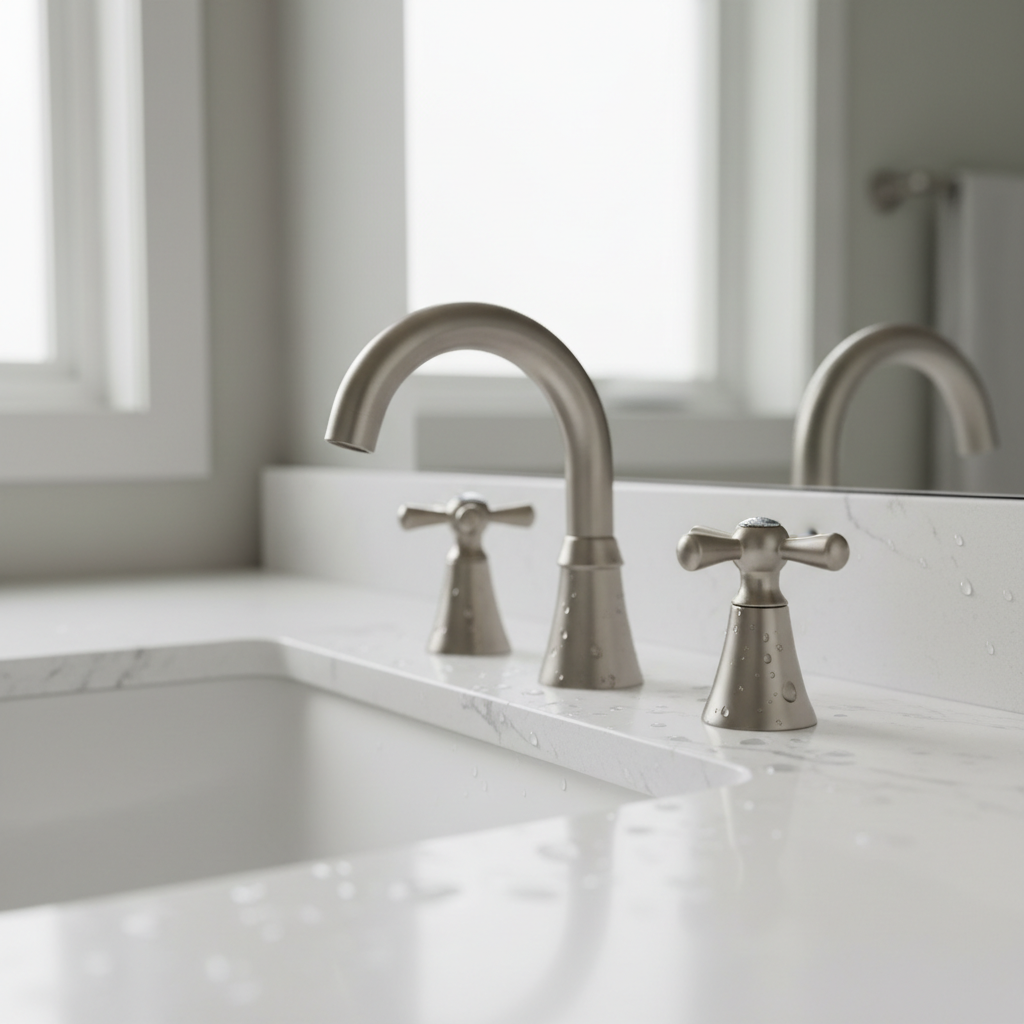
- Internal Cartridge Wear: The primary reason for drips and leaks. In builder-grade models, these are often cheap plastic cartridges with rubber O-rings that degrade over time.
- Finish Corrosion: Low-quality plating and finishes quickly show spotting, tarnish, and can physically chip or peel, exposing the base metal (or plastic) underneath.
- Aerator Clogging: Mineral deposits from hard water build up inside the aerator screen, leading to erratic spray patterns and reduced water pressure.
- Gasket & Seal Failure: The simple gaskets and putty used to seal the faucet base to the sink deck can dry out, crack, and fail, allowing water to seep underneath and potentially damage the vanity cabinet.
- Outdated Aesthetics: A polished brass or round, chrome ball-style faucet instantly dates a bathroom to the 1980s or 90s, undermining any other modern updates.
Landscaping · Drainage or grading problem
| Project category | Landscaping |
|---|---|
| Problem type | Drainage or grading problem |
| Trade required | Landscaping |
| Urgency | Soon — within weeks |
| Safety risk | Low safety risk |
| DIY suitability | Pro recommended |
| Cost category | Moderate cost |
| Typical timeline | Most yards 1–3 days |
| Contractor type | Landscaping contractor |
Repair option
Regrade, extend downspouts, and add a French drain where water collects.
Replacement option
Full drainage system with catch basins for chronic flooding.
Common causes
- Negative grade toward the house
- Compacted clay soil
- Downspouts discharging at the foundation
Relevant tools:project cost estimator
Published June 5, 2026Last updated August 17, 2026
Tools & materials you'll need
Affiliate linksAs an Amazon Associate FixlyGuide earns from qualifying purchases — at no extra cost to you. Prices and availability are accurate as of publication and subject to change.
'''
Quick Answer
Upgrading to a widespread faucet modernizes a bathroom by creating a sense of space and premium quality. The separated handles and spout look less cluttered and more intentional than a combined 'builder-grade' unit, while also offering easier cleaning and a more substantial feel. This single change can elevate the entire look of your vanity.
The Problem
Walk into most homes built in the last 30 years, and you'll find it: the builder-grade 4-inch centerset faucet. It sits on a single, often plastic, base plate, with the handles and spout crammed together. The finish might be a dated polished brass or a peeling "chrome" that is mostly plastic. It feels lightweight and flimsy. The base, a notorious trap for gunk, toothpaste, and hard water stains, is nearly impossible to clean around. Aerators are often clogged with mineral deposits, reducing flow to a trickle. More than just a functional object, this type of faucet is a visual signal of "basic" and "cost-effective construction." It visually shrinks the vanity top and screams "no updates here." The core problem is that this single, inexpensive component anchors the entire bathroom in a bygone era, no matter how much you upgrade the towels or paint.
How It Works
The magic of the widespread faucet lies in its architecture. Unlike a centerset faucet, where the handles and spout are fixed on a 4-inch center-to-center measurement, a widespread faucet's components are three individual pieces. The standard measurement for a widespread setup is 8 inches between the center of the hot and cold handle holes, but it can range from 8 to 16 inches, offering significant installation flexibility.
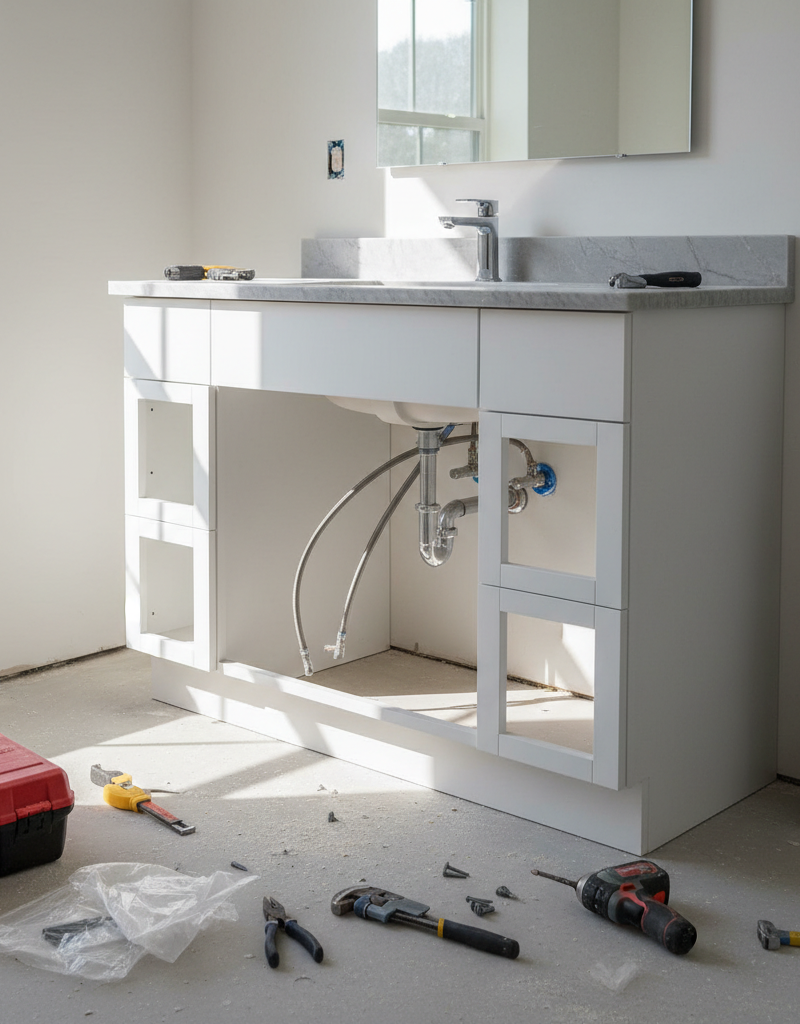
This separation is what creates the high-end, custom look. Each component—hot handle, cold handle, and spout—gets its own hole drilled into the countertop or sink deck. Under the sink, the system is surprisingly simple. The hot and cold valves are independent units. Flexible connector hoses run from each valve and connect to a brass T-fitting on the underside of the central spout. When you turn a handle, it opens its valve, allowing water to flow through the connector hose, into the T-fitting, and up out of the spout.
The components themselves are also of a higher caliber. Widespread faucets almost universally use brass bodies and ceramic disc valves. These valves feature two ultra-hard ceramic discs that rotate against each other to control water flow. They are incredibly durable and resistant to the wear and tear that causes traditional rubber washer-based faucets to drip. This robust construction not only provides a better user experience—a smooth, solid handle feel—but ensures a much longer, leak-free service life. The visual space created by "spreading out" the faucet makes the entire vanity feel larger, less cluttered, and more luxurious.
Step-by-Step Fix
Safety Note: This project involves water supply lines. Before you begin, clear everything from under the sink. Turn the hot and cold water shutoff valves clockwise until they are fully closed. Turn the old faucet on to relieve any pressure and confirm the water is off. Place a bucket and towels under the work area.
1. Prepare for Removal — With the water off, the first challenge is access. The space under a bathroom sink is cramped. A good headlamp or flashlight is essential. Take a photo of the existing plumbing connections with your phone. This can be a valuable reference if you get confused later.
2. Disconnect Supply Lines — Use an adjustable wrench or channel-lock pliers to loosen the nuts connecting the hot and cold supply lines to the shutoff valves. Have a small bowl or towel ready to catch residual water. Once disconnected from the valves, loosen the nuts connecting the other end of these lines to the faucet tails. It's best practice to replace these lines anyway, so don't worry about damaging them.
3. Remove the Old Faucet — This is often the hardest step. The old faucet is held in place by two large mounting nuts, usually plastic or brass, on threaded posts. They are deep under the sink deck and often corroded. This is where a basin wrench is indispensable. Fit the spring-loaded claw of the wrench around a nut and use the T-handle to break it loose. It will take patience. Once the nuts are off, you can also remove the lift rod for the drain stopper if it's connected to the faucet.
4. Lift and Clean — With the nuts and lines removed, pull the old faucet assembly up and out from the top of the vanity. Now, thoroughly clean the sink deck. Use a plastic putty knife to scrape away any old plumber's putty or sealant. A cleaner formulated for mineral deposits (like CLR) can remove stubborn hard water stains. The surface must be perfectly clean and dry for the new faucet to seal properly.
5. Install the New Spout — Your new widespread faucet has three pieces. Start with the central spout. Some models use a foam or rubber gasket on the base. If yours does, ensure it's seated correctly. If it calls for plumber's putty, roll a snake of putty and apply it to the base. From the top, feed the spout through the center hole. Underneath, slide on the plastic or rubber gasket, followed by the metal washer and mounting nut. Hand-tighten, check the spout's alignment from above, then use your basin wrench to give it a final quarter-turn. Do not over-tighten.
6. Install the Handles — Install the hot (left) and cold (right) valve bodies the same way you did the spout, ensuring the gaskets or putty are properly applied. Align them carefully so the handles will be parallel or perpendicular to the sink edge in the "off" position, as intended by the design. Tighten the mounting nuts from below.
7. Connect the Faucet Hoses — Your kit includes two short flexible hoses and a T-fitting. Attach the T-fitting to the bottom of the spout. Then, connect one hose from the hot valve to the "H" side of the T-fitting and the other from the cold valve to the "C" side. These connections usually only need to be hand-tight plus a slight snug with a wrench.
8. Install the New Drain Assembly — Do not reuse your old drain. The new one is designed to work with the new faucet. Unscrew the old drain from below. Clean the drain opening in the sink. Apply a ring of 100% silicone sealant (or plumber's putty, check manual) to the underside of the new drain flange. Insert it into the drain hole from above. From below, install the gasket and retaining nut, tightening it securely. Connect the new tailpiece and the pop-up linkage if your model has one.
9. Connect New Supply Lines — Now, connect your new braided steel supply lines. Attach one end to the bottom of the hot valve and the other to the hot shutoff valve. Repeat for the cold side. The conical seals on these lines mean you should only need to hand-tighten firmly, then give a 1/8 to 1/4 turn with a wrench. Over-tightening can damage the seal.
10. Power Up and Test for Leaks — Remove the aerator from the new spout (this prevents any debris from clogging it on first use). Turn the shutoff valves counter-clockwise slowly. Open the new faucet handles to the warm position and let the water run for a minute to flush the lines. While it runs, use your flashlight to meticulously inspect every single connection point from the shutoff valves to the faucet bodies and the drain assembly. Check for even the smallest drip. Once satisfied, turn the water off, replace the aerator, and perform the check again.
Common Causes of Old Faucet Failure
- Internal Cartridge Wear: The primary reason for drips and leaks. In builder-grade models, these are often cheap plastic cartridges with rubber O-rings that degrade over time.
- Finish Corrosion: Low-quality plating and finishes quickly show spotting, tarnish, and can physically chip or peel, exposing the base metal (or plastic) underneath.
- Aerator Clogging: Mineral deposits from hard water build up inside the aerator screen, leading to erratic spray patterns and reduced water pressure.
- Gasket & Seal Failure: The simple gaskets and putty used to seal the faucet base to the sink deck can dry out, crack, and fail, allowing water to seep underneath and potentially damage the vanity cabinet.
- Outdated Aesthetics: A polished brass or round, chrome ball-style faucet instantly dates a bathroom to the 1980s or 90s, undermining any other modern updates.
Common Mistakes
- Buying the Wrong Faucet Type: The most common mistake is buying an 8-inch widespread faucet for a sink drilled with 4-inch centerset holes. Measure the distance between your sink's handle holes before you shop.
- Reusing Old Supply Lines: The flexible water supply lines are a wear item. Always replace them when you replace a faucet. A burst supply line can cause catastrophic water damage.
- Over-Tightening Connections: More is not better. Over-tightening plastic mounting nuts can crack them, and over-tightening supply line nuts can deform the rubber seal, causing a leak.
- Forgetting to Clean the Surface: Any grit, old putty, or grime left on the vanity top can compromise the new faucet's seal, leading to a slow, hidden leak.
- Not Replacing the Drain: Skipping the drain replacement results in a mismatched finish and pop-up mechanism. The new drain is part of the complete faucet system.
- Misjudging the Basin Wrench: Not using a basin wrench makes removing the old faucet nearly impossible and installing the new one incredibly frustrating. It is the one specialty tool you absolutely need.
Cost & Time Breakdown
| Task | DIY Cost | Pro Cost | Time (DIY) |
|---|---|---|---|
| Quality Widespread Faucet | $150 - $400 | (included) | - |
| Basin Wrench & Pliers | $20 - $40 | (included) | - |
| New Supply Lines, Putty/Sealant | $20 - $30 | (included) | - |
| Plumber Labor | $0 | $200 - $450 | 1.5 - 2.5 hours |
| Total | $190 - $470 | $350 - $850+ | 2-4 hours |
Tips & Prevention
- Measure Thrice, Buy Once: Before you even browse, measure the distance from the center of the far-left hole to the center of the far-right hole on your vanity. This dictates what you can buy.
- Invest in the Finish: Look for faucets with a Physical Vapor Deposition (PVD) finish, especially for matte black, gold, or bronze tones. PVD is far more durable and resistant to scratches and tarnish than standard powder coating.
- Save the Manual and Tool: Some faucets come with a special plastic wrench or aerator key. Tape this to the pipe under the sink or put it in your toolbox. It will be invaluable for future maintenance.
- Choose Ceramic Discs: Ensure the faucet specifications list "ceramic disc valves." This is the hallmark of a quality, long-lasting faucet that will operate smoothly and resist drips.
- Patience with Removal: The old faucet is the enemy. It will fight you. Budget most of your time for this step. If a nut is completely seized, a Dremel tool with a cutting wheel can be used to carefully cut it off as a last resort.
When to Call a Professional
While this is a very achievable DIY project, there are clear signs you should call a licensed plumber. If the shutoff valves under your sink are frozen, won't turn, or continue to leak after you've closed them, stop immediately. Replacing shutoff valves often requires turning off water to the entire house and is a job for a pro. Similarly, if you encounter old, fragile, or corroded plumbing pipes, a professional has the experience to work on them without causing a bigger problem. Finally, if you have a beautiful quartz or granite countertop and want to switch from a centerset to a widespread faucet, you must hire a professional stone fabricator to drill the new holes. Attempting to drill a stone countertop yourself will almost certainly result in a cracked and ruined vanity top. '''
What should this project cost?
Enter your project details for a realistic cost range before you call anyone.
Mid-range remodels commonly $12,000–$22,000; small repairs often under $600.
- Regional adjustment
- National average
- Labor share (typical)
- ~$5,603
- Quotes to collect
- 3 written estimates
Educational estimate based on national averages — not a binding quote. Always confirm with written local estimates.
Fixly Project Decision Box
- DIY difficulty
- Moderate
- Estimated time
- 30 minutes – half a day
- Cost level
- Moderate
Main tools / materials
- Adjustable wrench
- Plunger or drain auger
- Bucket and towels
- Thread tape
When to stop and call a pro
- Water you cannot shut off at the fixture or main
- Sewage backing up into more than one fixture
- Water near electrical panels or outlets
- Gas water heater work beyond relighting a pilot
Need professional help?
Get a Licensed PlumberRecommended for DIYers & woodworkers
Sponsored
The Top 20 Tools for Workshops of Any Budget
No stationary machines or power tools required — plus 3 fundamental tools that can't be bought at any price.
Get the free guide
Ted's Woodworking — The #1 Woodworking Resource
Detailed instructions, dimensioned drawings, materials & cutting lists, and 3D schematics for every skill level.
See the plansSponsored: links above are affiliate links. FixlyGuide may earn a commission on qualifying purchases — at no extra cost to you.
Frequently asked questions
Can I put a widespread faucet in a 4-inch centerset sink?+
No, not without replacing the sink or countertop. Widespread faucets require three holes with 8-inch spacing between the outer two, while centerset sinks have a 3-hole configuration with 4-inch spacing.
Do I need plumber's putty for a new faucet installation?+
It depends on the model. Many modern faucets include high-quality foam or rubber gaskets that create a seal without putty. However, you will almost always need plumber's putty or 100% silicone sealant to properly seal the new drain flange in the sink basin.
What is the hardest part of changing a bathroom faucet?+
By far the most difficult and time-consuming part is removing the old faucet. The mounting nuts securing it under the sink are often corroded and located in a very tight, hard-to-reach space. A basin wrench is essential for this step.
Is a widespread faucet better than a centerset?+
From a quality and aesthetic standpoint, widespread faucets are generally considered superior. They offer a more high-end, spacious look, are typically made from better materials like solid brass, and are easier to clean around. However, the best faucet is the one that fits your sink's hole drilling and your budget.
Discussion
Loading comments…