
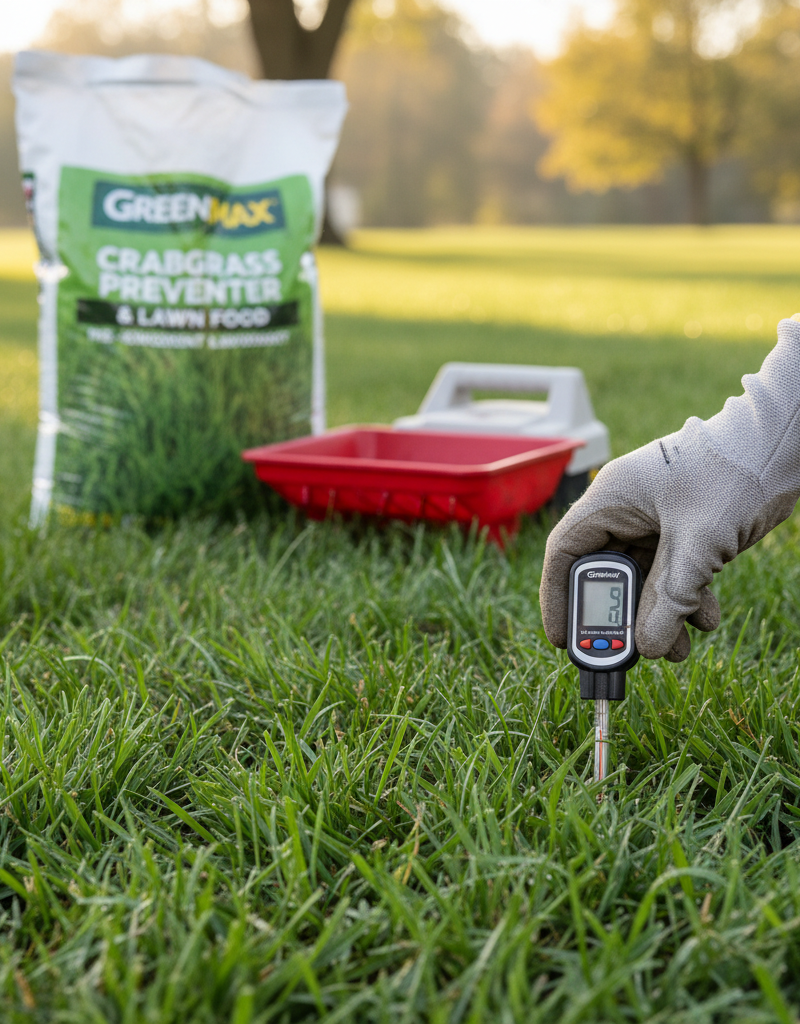
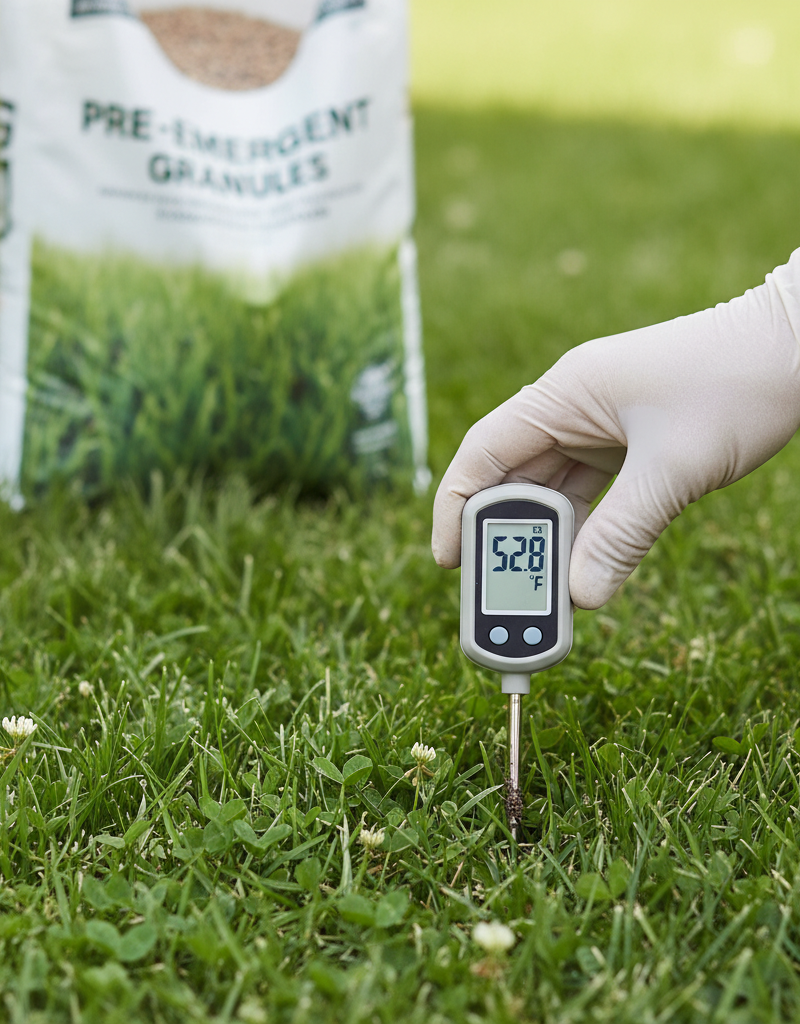
- Purchase a Soil Thermometer: Available at most garden centers for $10-$20. Insert it 2-3 inches deep into your lawn. Take readings daily in different areas of your yard, especially spots that get more sun or shade.
- Use Online Resources: Many university extension offices and weather websites provide local soil temperature maps and forecasts. Search for "soil temperature map [your state/region]".
- Monitor for Natural Cues: While less precise, traditional gardeners often note when Forsythia bushes have stopped blooming (for spring applications) as a visual indicator, or when maples start to turn red (for fall applications).
Landscaping · Deck or fence project
| Project category | Landscaping |
|---|---|
| Problem type | Deck or fence project |
| Trade required | Landscaping |
| Urgency | Planned project |
| Safety risk | Moderate safety risk |
| DIY suitability | DIY for experienced homeowners |
| Cost category | High cost |
| Typical timeline | Most builds 3–10 days depending on size |
| Contractor type | Landscaping contractor |
Repair option
Replace failed boards, posts, and hardware; reseal the surface.
Replacement option
Rebuild when framing or the ledger connection is unsafe.
Common causes
- Rot at posts and ledger
- Storm damage
- Adding outdoor living space
Relevant tools:home improvement material pricesproject cost estimator
Published May 19, 2026Last updated August 17, 2026
Tools & materials you'll need
Affiliate links- AmazonGranular Pre-Emergent Herbicide1 bag
As an Amazon Associate FixlyGuide earns from qualifying purchases — at no extra cost to you. Prices and availability are accurate as of publication and subject to change.
Quick Answer
Pre-emergent weed killer works by forming a chemical barrier in the soil that prevents weed seeds from germinating. The crucial factor for success is applying it when soil temperatures are consistently between 50-55°F (for spring applications targeting summer annuals) or below 70°F and falling (for fall applications targeting winter annuals). Missing this narrow window by even a few degrees can drastically reduce its effectiveness, leading to wasted product and a yard full of weeds. Monitor local soil temperatures, not just air temperatures, to ensure optimal application.
The Problem
Every spring, countless homeowners wage war against crabgrass, dandelions, and a host of other unwelcome invaders. The weapon of choice for many is pre-emergent weed killer, a powerful tool designed to stop weeds before they even have a chance to sprout. Yet, year after year, many look out at their lawns in late spring, only to find the very weeds they hoped to prevent thriving. The universal frustration is clear: "I applied pre-emergent, but it didn't work!" The culprit, almost without fail, isn't a faulty product or incorrect application technique, but rather a fundamental misunderstanding of one critical factor: timing. Applying pre-emergent too early or too late renders it almost useless, leaving both your wallet lighter and your lawn vulnerable. This article will equip you with the precise knowledge to hit that perfect window, ensuring a weed-free lawn all season.
How It Works
Pre-emergent herbicides don't kill existing weeds; their magic lies in prevention. When applied to the lawn, the active ingredients, typically dinitroanilines or something similar, create a microscopic chemical barrier in the top quarter to half-inch of the soil. This barrier doesn't prevent weed seeds from germinating in the traditional sense of killing them outright. Instead, as the weed seed swells with water and begins to sprout, the emerging root (radicle) or shoot tip absorbs the herbicide. This absorption disrupts cell division in the nascent plant, effectively halting its growth before it can break through the soil surface. The weed seed itself might still be viable, but its growth is arrested at the earliest stage, preventing it from ever becoming a noticeable plant.
Think of it like a security gate: the seeds are trying to get through, but the pre-emergent creates a temporary, invisible fence that stops them. This barrier remains effective for a period, typically 8-12 weeks, slowly degrading over time due to microbial action, sunlight, and water. This finite lifespan means that repeat applications might be necessary in areas with long growing seasons or for persistent weed problems. Crucially, the soil barrier must be in place before the weed seeds begin their germination process. Once a weed seedling has emerged from the soil, a pre-emergent will have little to no effect, requiring a different type of herbicide (a post-emergent) to control it. Understanding this mechanism underscores why precise timing, dictated primarily by soil temperature, is paramount for success.
Step-by-Step Fix
Step 1: Understand Your Target Weeds — Pinpoint the specific weeds you're fighting.
- Summer Annuals (e.g., Crabgrass, Goosegrass, Spurge): These germinate when soil temperatures warm up in spring, typically requiring consistent temperatures of 50-55°F for several consecutive days. They complete their life cycle by fall.
- Winter Annuals (e.g., Henbit, Chickweed, Annual Bluegrass (Poa annua)): These germinate in late summer or early fall when soil temperatures cool down (below 70°F and falling), grow over winter, and produce seeds in spring before dying off in summer heat.
Step 2: Track Your Soil Temperature — Air temperature is misleading; soil temperature is key.
- Purchase a Soil Thermometer: Available at most garden centers for $10-$20. Insert it 2-3 inches deep into your lawn. Take readings daily in different areas of your yard, especially spots that get more sun or shade.
- Use Online Resources: Many university extension offices and weather websites provide local soil temperature maps and forecasts. Search for "soil temperature map [your state/region]".
- Monitor for Natural Cues: While less precise, traditional gardeners often note when Forsythia bushes have stopped blooming (for spring applications) as a visual indicator, or when maples start to turn red (for fall applications).
Step 3: Define Your Application Window — Apply at the right soil temperature.
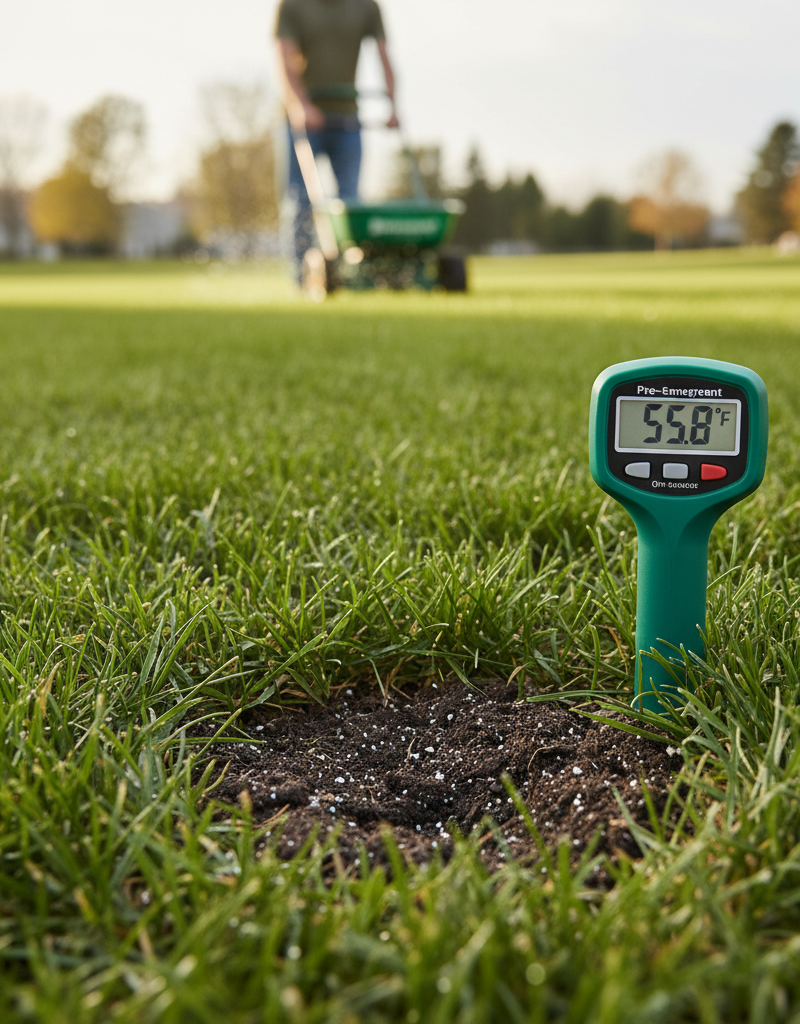
- Spring Application (Summer Annuals): Apply when soil temperatures consistently reach 50-55°F at a 2-inch depth for 3-5 consecutive days. This is often when daytime air temperatures are in the 60s and 70s.
- Fall Application (Winter Annuals): Apply when soil temperatures cool down to below 70°F and are falling, typically in late August or September in many regions.
Step 4: Choose the Right Product — Don't just grab any bag; check the label.
- Granular vs. Liquid: Granular is often easier for DIYers to apply evenly with a spreader. Liquid requires dilution and a sprayer. Both are effective if applied correctly.
- Active Ingredient: Look for dithiopyr (Dimension) or pendimethalin (Pendulum) for broad-spectrum pre-emergent control. Prodiamine (Barricade) is excellent for longer residual control.
- Read the Label: Critically important! The label details application rates, safety precautions, watering instructions, and specific weeds controlled. Some pre-emergents are not safe for certain grass types or young seedlings.
Step 5: Prepare Your Lawn — A clear canvas for the chemical barrier.
- Mow Your Lawn: Mow at your regular height a day or two before application. This ensures the granules or liquid can reach the soil surface unimpeded.
- Clear Debris: Rake up any leaves, grass clippings, or other organic matter that could prevent the pre-emergent from reaching the soil.
- Don't Dethatch or Aerate: Avoid these activities after applying pre-emergent, as they will break the chemical barrier, allowing weeds to germinate. If you must dethatch or aerate, do it before application.
Step 6: Calibrate Your Spreader — Even coverage is essential for an even barrier.
- Refer to the Product Label: It will provide recommended spreader settings for various brands and types (broadcast vs. drop).
- Perform a Test Run: Measure a small, known area (e.g., 100 sq ft). Apply the recommended amount of product for that area. Adjust your spreader settings until you achieve the correct distribution. Undere d over-application can both lead to issues.
Step 7: Apply the Pre-Emergent Evenly — Walk at a consistent pace.
- Spread in Overlapping Passes: For broadcast spreaders, overlap each pass by about 6-12 inches to ensure uniform coverage. For drop spreaders, align each pass precisely.
- Half-Rate Method: For extra assurance, apply half the recommended rate in one direction (e.g., north-south) and the other half in a perpendicular direction (east-west). This minimizes streaks and missed spots.
Step 8: Water It In — Activate the barrier.
- Check the Label: Most granular pre-emergents require watering in to activate the chemical barrier. Apply about 0.25 to 0.5 inches of water immediately after application (or within 24-48 hours, as directed by the label).
- Avoid Heavy Rains: While some water is good, a torrential downpour immediately after application can wash away the product or concentrate it unevenly. Check the forecast before applying.
Step 9: Practice Good Lawn Care — Sustain the fight against weeds.
- Mow High: Taller grass shades the soil, naturally suppressing weed germination.
- Fertilize Appropriately: A healthy, dense lawn crowds out weeds.
- Water Deeply and Infrequently: Encourages deep root growth, making your lawn more resilient.
Common Causes
- Applying Too Early: The most common mistake. If applied before soil temperatures reach the germination threshold, the pre-emergent barrier will degrade significantly before seeds even begin to sprout, becoming ineffective.
- Applying Too Late: Once weed seeds have already germinated and emerged, pre-emergents have no effect. You're essentially locking the barn door after the horse has bolted.
- Incorrect Soil Temperature Monitoring: Relying solely on air temperature or vague seasonal indicators leads to mis-timed applications. Soil temperature is the only reliable metric.
- Insufficient Watering After Application: Many granular products require water to dissolve and activate the chemical barrier. Without it, the product sits inert on the surface.
- Disturbing the Soil Barrier: Dethatching, aerating, or even heavy raking after application will break the protective barrier, creating gaps for weeds to emerge.
- Uneven Application: Missed spots or over-applied areas will lead to patchy weed control, with some areas being protected and others left vulnerable.
- Wrong Product for the Weed: Some pre-emergents are specific to certain weed types. Always ensure the product label targets the weeds you're trying to control.
Common Mistakes
- Guessing the Timing: Never assume
Related Articles
Keep troubleshooting with these hand-picked guides from FixlyGuide:
- The #1 Pre-Emergent Mistake Wrecking Your Weed Control (And How to Fix It) — Applying pre-emergent at the wrong time is the most common mistake, leading to ineffective weed control and wasted effort for homeowners.
- The #1 Pre-Emergent Mistake Wasting Your Lawn Care Dollars – And How to Fix It — Applying pre-emergent weed control at the wrong time is the most common and costly mistake homeowners make, leading to ineffective results…
- The #1 Timing Mistake That Makes Pre-Emergents Useless (And How to Fix It) — Applying pre-emergent weed control at the wrong time is the most common reason for failure, leading to wasted product and persistent weeds.
- The #1 Mistake Homeowners Make When Fighting Lawn Grubs (And How to Fix It) — Discover the crucial mistake homeowners often make when treating lawn grubs and learn the most effective, timing-sensitive strategies to el…
- The #1 Mistake Killing Your Lawn's Grass (and 3 Simple Fixes) — Patchy grass can ruin your lawn's appearance, but often the cause is a common mistake that's easy to correct with the right approach.
- The 3 Hidden Mistakes That Make Your Deck Sealer Fail (And How to Fix Them) — Properly sealing your wood deck protects it from the elements, but common mistakes often lead to early failure. Learn how to reseal your de…
Should you do this yourself?
Answer five quick questions before you start. Safety outranks savings every time.
Your experience with work like this
How high do you have to work?
Does the job involve any of these?
Will it need a permit?
Specialty tools
Free and instant. Educational guidance only — not a quote, inspection, or professional diagnosis.
What should this project cost?
Enter your project details for a realistic cost range before you call anyone.
Cost depends heavily on which system turns out to be the source.
- Regional adjustment
- National average
- Labor share (typical)
- ~$1,620
- Quotes to collect
- 3 written estimates
Educational estimate based on national averages — not a binding quote. Always confirm with written local estimates.
Before you start
Check the difficulty, permits, and safety risk — then decide whether to call a pro.
- Estimate this projectGet a cost range for your scope and ZIP before you call anyone.Open
- Get local estimatesSend one request and compare written estimates from vetted pros.Open
Free, no signup required. Estimates are educational guidance, not a quote or an inspection.
Frequently asked questions
What is pre-emergent weed killer?+
Pre-emergent weed killer is a herbicide that forms a chemical barrier in the soil, preventing weed seeds from germinating and sprouting. It does not kill existing weeds, only stops new ones from emerging.
When should I apply pre-emergent in the spring?+
For spring application targeting summer annual weeds like crabgrass, apply when soil temperatures consistently reach 50-55°F at a 2-inch depth for 3-5 consecutive days. This typically occurs when Forsythia bushes are finishing their bloom.
When should I apply pre-emergent in the fall?+
For fall application targeting winter annual weeds like henbit and annual bluegrass, apply when soil temperatures cool down to below 70°F and are consistently falling, usually in late August or September.
What happens if I apply pre-emergent too early or too late?+
Applying too early means the barrier will degrade before weed seeds germinate, making it ineffective. Applying too late means weed seeds have already sprouted, and the pre-emergent will have no effect. Precise timing is crucial for success.
Do I need to water in pre-emergent?+
Yes, most granular pre-emergent products require watering in (about 0.25 to 0.5 inches of water) shortly after application to activate the chemical barrier in the soil. Always check the product label for specific instructions.
Discussion
Loading comments…