- The Secret Window AC Trick That Slashes Your Summer Electric Bill By 30% — Mastering simple window AC maintenance can significantly reduce your cooling costs and extend the life of your unit, often by more than 30%.
- The Surprising Trick to Cutting Your Dryer Bill By $100 Per Year — Installing a clothesline can significantly reduce your energy bills and add a fresh scent to your laundry. This guide covers how to choose…
- The Secret to Saving 40% on Outdoor Power Tools (Even When There's No Sale) — Unlock deep discounts on outdoor power tools year-round, even without a major holiday sale, by leveraging strategic timing and smart shoppi…
- 7 Inspection Red Flags That Secretly Signal a $20,000 Bill — Don't let your dream home become a money pit. Many buyers and even some inspectors overlook subtle home inspection red flags that lead to f…
- The Secret to Endless Hot Showers? It's Not Your Water Heater's Age — Inconsistent hot water or no hot water at all often points to a single, often overlooked culprit: the thermostat. Understanding its role is…
Published June 5, 2026Last updated August 17, 2026
Tools & materials you'll need
Affiliate links- AmazonSmart Thermostat1 · If you don't already have one
As an Amazon Associate FixlyGuide earns from qualifying purchases — at no extra cost to you. Prices and availability are accurate as of publication and subject to change.
Quick Answer
Adjusting your air conditioning usage to align with your utility company's off-peak energy rates can significantly lower your monthly electricity bill. This often involves pre-cooling your home before peak times and minimally running your AC during the most expensive periods, effectively leveraging cheaper electricity when demand is low.
The Problem
Summer often brings soaring temperatures and, consequently, soaring electricity bills. A major culprit is your home's air conditioning system, which consumes a significant amount of power, especially during the hottest parts of the day when energy demand (and thus, cost) is highest. Many homeowners set their thermostats and forget them, unwittingly paying top dollar for electricity during "peak" hours. This means that while your home stays cool, your wallet takes a hit, often without you realizing that a simple scheduling shift could make a substantial difference.
How It Works
To understand how to save, it's crucial to grasp how electricity pricing works. Many utility companies use a "Time-of-Use" (TOU) or "Peak/Off-Peak" pricing structure. Simply put, electricity isn't priced the same 24 hours a day. During times of high demand – typically weekday afternoons and early evenings when everyone is getting home from work, cooking, and running appliances, including AC – the cost per kilowatt-hour (kWh) is significantly higher. These are "peak" hours. Conversely, during periods of lower demand, such as overnight, early mornings, and weekends, the cost per kWh drops considerably; these are "off-peak" hours. Your AC system, being one of the largest energy consumers in your home, becomes a prime target for optimization under this pricing model. By shifting its heaviest workload to off-peak times, you purchase electricity when it's cheapest. This usually involves "pre-cooling" your home: dropping the thermostat a few degrees lower than usual during off-peak hours to build up thermal mass (meaning walls, furniture, etc., absorb the cold). Then, during peak hours, you allow the temperature to rise a few degrees, relying on the pre-cooling and your home's insulation to maintain comfort with minimal AC run-time, or even turning the AC off entirely for a few hours without discomfort.
Step-by-Step Fix
-
Understand Your Utility's Rates — The crucial first step is to know your enemy, or rather, your utility company's pricing structure. Call your electricity provider or check their website for their Time-of-Use (TOU) or peak/off-peak rate schedules. Some utilities automatically enroll customers in TOU plans, while others require opting in. Most provide an online portal where you can view your specific plan details.
- If you can't find the information: Look for "tariffs," "rate schedules," or "time-of-use pricing" on your utility's website. If all else fails, a quick call to customer service should clarify your options.
-
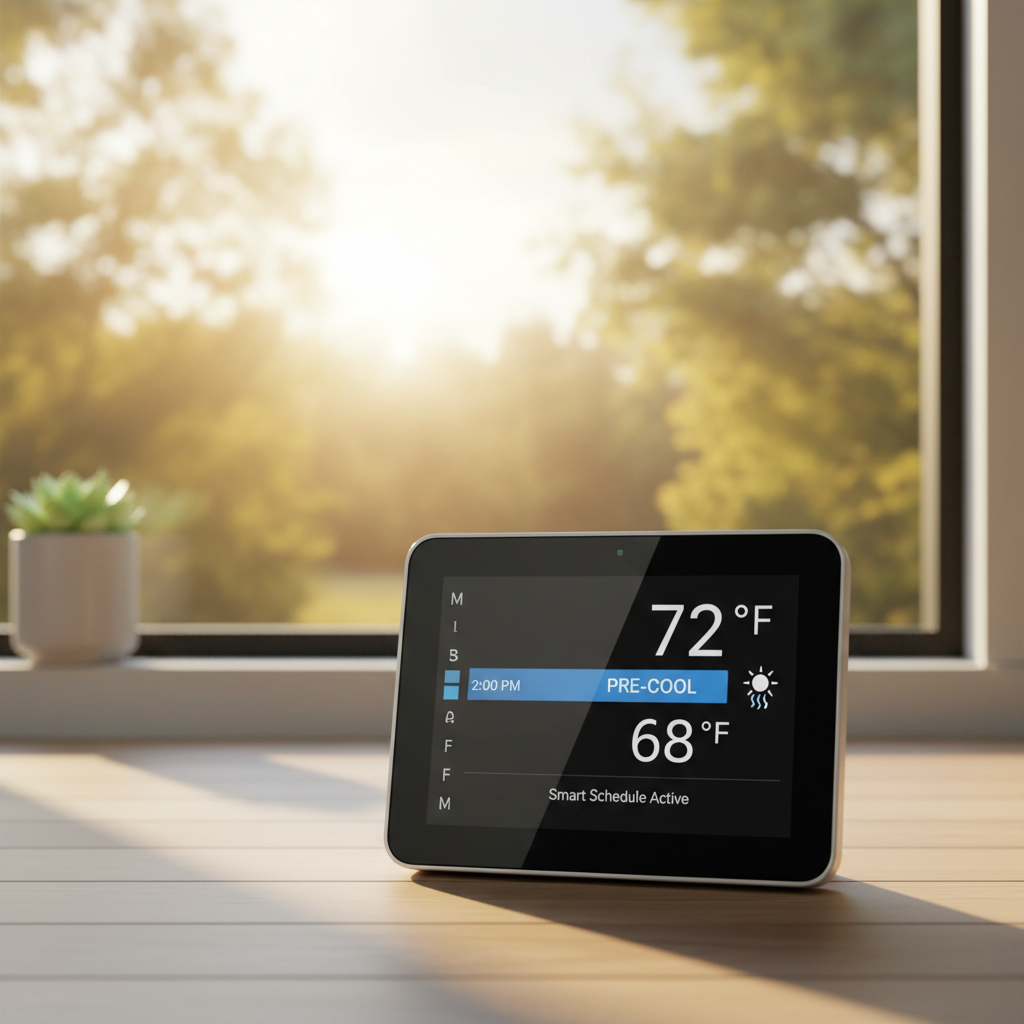
Invest in a Smart Thermostat — While manual adjustment is possible, a smart thermostat automates the process and offers greater precision and convenience. Brands like ecobee, Nest, and Honeywell offer robust programming options and can even integrate with various utility demand-response programs.
- Consider energy reports: Many smart thermostats provide energy usage reports that can help you fine-tune your schedule over time.
-
Program Your Pre-Cooling Strategy — Based on your utility's off-peak hours, set your smart thermostat to drop the temperature by 3-5 degrees Fahrenheit below your typical comfort setting for 2-3 hours before peak rates begin. For example, if peak rates start at 2 PM, program your AC to reach 70°F by 1:30 PM, even if you normally prefer 73°F.
- Don't overdo it: Dropping the temperature too low can negate savings. Aim for a comfortable but significant pre-cooling.
-
Set Peak-Hour Adjustments — During peak rate hours, program your thermostat to increase the temperature by 2-4 degrees Fahrenheit from your preferred setting. For example, if you normally like 73°F, set it to 75-77°F during peak times. The goal is to minimize compressor run-time when electricity is most expensive.
- Experiment with offsets: Some homes hold cooler air better than others. It might take a few days of experimentation to find the optimal peak-hour offset that keeps you comfortable without running the AC excessively.
-
Leverage Humidity Control (If Available) — Many smart thermostats and modern AC units have humidity control features. High humidity makes you feel warmer. If you can slightly increase the thermostat setting during peak hours while still maintaining lower humidity, you'll often remain comfortable at a higher air temperature.
- Consider a standalone dehumidifier: For homes with severe humidity issues, a whole-house or portable dehumidifier can complement your AC strategy.
-
Optimize Fan Settings — During off-peak pre-cooling, setting your fan to "On" instead of "Auto" can help distribute the cooler air more effectively throughout your home, building up that thermal mass. During peak hours, switch it back to "Auto" to only run when cooling is needed.
- Check your filter: A dirty air filter restricts airflow, making your fan work harder and reducing efficiency. Replace it regularly.
-
Monitor and Adjust — After implementing your new schedule, monitor your energy usage (most smart thermostats and utility portals provide this data) and your comfort levels. You may need to fine-tune temperatures and timings over the first week or two to find the sweet spot for your home and lifestyle.
- Seasonal changes: Remember that peak/off-peak schedules and optimal settings might change slightly with the seasons.
Common Causes
The primary "cause" of high AC bills during peak hours is simply using electricity when it's most expensive. This isn't a fault of the AC system itself, but rather our usage patterns colliding with utility company pricing models. Here are the underlying factors:
- Time-of-Use (TOU) Pricing Not Leveraged: Homeowners are often unaware of or don
Related Articles
Keep troubleshooting with these hand-picked guides from FixlyGuide:
- The Secret Window AC Trick That Slashes Your Summer Electric Bill By 30% — Mastering simple window AC maintenance can significantly reduce your cooling costs and extend the life of your unit, often by more than 30%.
- The Surprising Trick to Cutting Your Dryer Bill By $100 Per Year — Installing a clothesline can significantly reduce your energy bills and add a fresh scent to your laundry. This guide covers how to choose…
- The Secret to Saving 40% on Outdoor Power Tools (Even When There's No Sale) — Unlock deep discounts on outdoor power tools year-round, even without a major holiday sale, by leveraging strategic timing and smart shoppi…
- 7 Inspection Red Flags That Secretly Signal a $20,000 Bill — Don't let your dream home become a money pit. Many buyers and even some inspectors overlook subtle home inspection red flags that lead to f…
- The Secret to Endless Hot Showers? It's Not Your Water Heater's Age — Inconsistent hot water or no hot water at all often points to a single, often overlooked culprit: the thermostat. Understanding its role is…
- The 5-Minute Trick That Halves Your Spring Yard Work (and Most Homeowners Miss It) — Discover how a simple, often-overlooked winterizing step can drastically reduce your spring yard preparation efforts and costs.
Should you do this yourself?
Answer five quick questions before you start. Safety outranks savings every time.
Your experience with work like this
How high do you have to work?
Does the job involve any of these?
Will it need a permit?
Specialty tools
Free and instant. Educational guidance only — not a quote, inspection, or professional diagnosis.
Estimate your own project cost
National averages are a starting point. Enter your details for a range that fits your house.
HVAC replacement cost
- Equipment$2,200 – $3,800
- Installation labor$1,200 – $2,500
Always insist on a Manual J load calculation — sq-ft sizing is only a rough check. Federal heat-pump rebates may reduce cost significantly.
Educational estimate only — always confirm with written local bids.
What should this project cost?
Enter your project details for a realistic cost range before you call anyone.
Cost depends heavily on which system turns out to be the source.
- Regional adjustment
- National average
- Labor share (typical)
- ~$1,620
- Quotes to collect
- 3 written estimates
Educational estimate based on national averages — not a binding quote. Always confirm with written local estimates.
Fixly Project Decision Box
- DIY difficulty
- Advanced
- Estimated time
- Homeowner checks 20–30 minutes
- Cost level
- Moderate
Main tools / materials
- Clean air filter
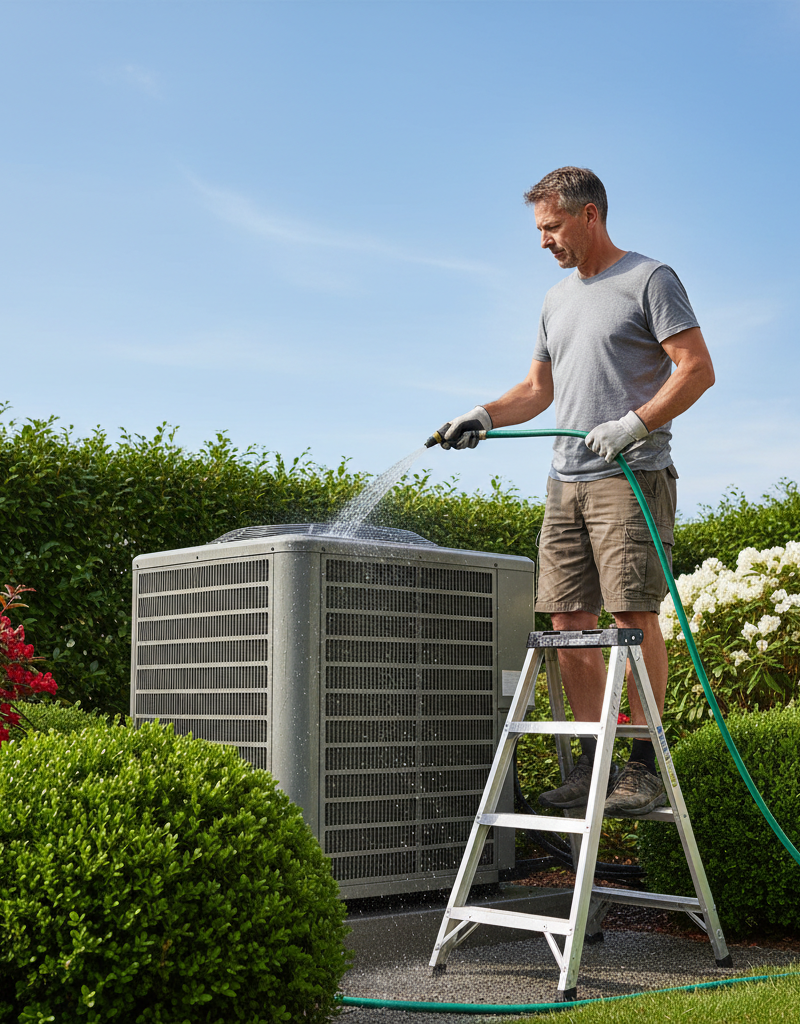
- Garden hose for condenser coils
- Shop vac for the condensate line
When to stop and call a pro
- Burning smell, smoke, or a tripping breaker
- Refrigerant lines iced over or hissing
- Any work inside the sealed refrigerant circuit (EPA-licensed only)
- Gas smell near a furnace — leave and call the utility
Need professional help?
Find an HVAC Pro Near YouBefore you start
Check the difficulty, permits, and safety risk — then decide whether to call a pro.
Free, no signup required. Estimates are educational guidance, not a quote or an inspection.
Get the print-ready PDF of this guide
A clean, ad-free, printable version you can keep on your phone or pin to the workshop wall. Free with a FixlyGuide account.
- Print-optimized layout
- Tools, materials & every step included
- Saved to your account
This article was independently written by FixlyGuide based on the source topic.
Frequently asked questions
What are off-peak energy hours?+
Off-peak energy hours are periods when electricity demand is low, typically overnight, early mornings, and weekends. During these times, utility companies charge less per kilowatt-hour, providing an opportunity for savings if you shift your energy usage.
How much can I save by using off-peak AC?+
Savings vary widely depending on your utility's rate structure, your home's insulation, and your local climate. However, many homeowners report a 10-25% reduction in their monthly electricity bills during peak cooling seasons by strategically shifting AC usage to off-peak times.
Do I need a smart thermostat for this trick?+
While a smart thermostat makes managing off-peak AC usage much easier and more efficient through automated programming, you can manually adjust your thermostat. However, a smart thermostat helps ensure consistency and maximizes savings.
Will pre-cooling make my home uncomfortable?+
No, pre-cooling is designed to build up thermal mass in your home, allowing it to stay cooler for longer during peak hours even with the AC running less or off. You'll likely find that a strategically pre-cooled home remains comfortable.


Discussion
Loading comments…