- The 9 Sneaky Filters Stealing Your Home's Efficiency (And How to Fix It) — Unseen or neglected filters throughout your home can secretly inflate utility bills, degrade air quality, and lead to expensive appliance b…
- 7 Hidden Equity Drains Costing You Thousands Annually — Your home is an asset, but silent problems like minor leaks, poor insulation, and deferred maintenance can drain its value. Discover the se…
- Your Home's Secret To-Do List: Are You Missing It? — Most new homeowners focus on decorating, but ignoring a basic home maintenance checklist can lead to thousands in unexpected repairs. Learn…
- The Secret 5 Bugs Invading Homes (It's Not Just Lanternflies) — Discover the five most common invasive bugs pest professionals treated last year that homeowners often overlook, and learn how to protect y…
- The Single Board Secret to Attracting Bluebirds: A Quick DIY House — Discover how to construct an ideal bluebird house using just one cedar board, providing a safe and inviting home for these cherished backya…
Published June 19, 2026Last updated August 17, 2026
Tools & materials you'll need
Affiliate linksAs an Amazon Associate FixlyGuide earns from qualifying purchases — at no extra cost to you. Prices and availability are accurate as of publication and subject to change.
Quick Answer
Unfiltered well water can contain a surprising array of contaminants, from harmless sediment to concerning bacteria and heavy metals. A properly selected whole-house well water filtration system addresses these issues by removing particles, neutralizing chemicals, and eliminating biological threats, providing safe and pleasant-to-use water at every tap, protecting your family's health and your home's plumbing and appliances.
The Problem
Imagine filling a glass from your kitchen faucet, only to see it cloudy or notice a strange smell. Or perhaps your white laundry comes out with an orange tint, and your shower walls are perpetually stained. For homeowners relying on well water, these aren't just minor inconveniences; they're strong indicators of unseen problems lurking in your water supply. Unlike municipal water, which is treated and regulated, private well water quality is entirely the homeowner's responsibility. It's directly influenced by local geology, surrounding land use (agricultural, industrial, residential), and the condition of the well itself. This means your water could contain anything from naturally occurring minerals like iron and manganese, to bacteria, nitrates from fertilizers, pesticides, or even volatile organic compounds (VOCs) from nearby spills. These contaminants don't just affect taste and aesthetics; many pose serious health risks with long-term exposure, while others wreak havoc on your plumbing, appliances, and fixtures, leading to costly repairs and premature replacements. Ignoring these signs can lead to chronic health issues, continuous hard water problems, corroded pipes, and stained laundry, diminishing your quality of life and the longevity of your home's infrastructure.
How It Works
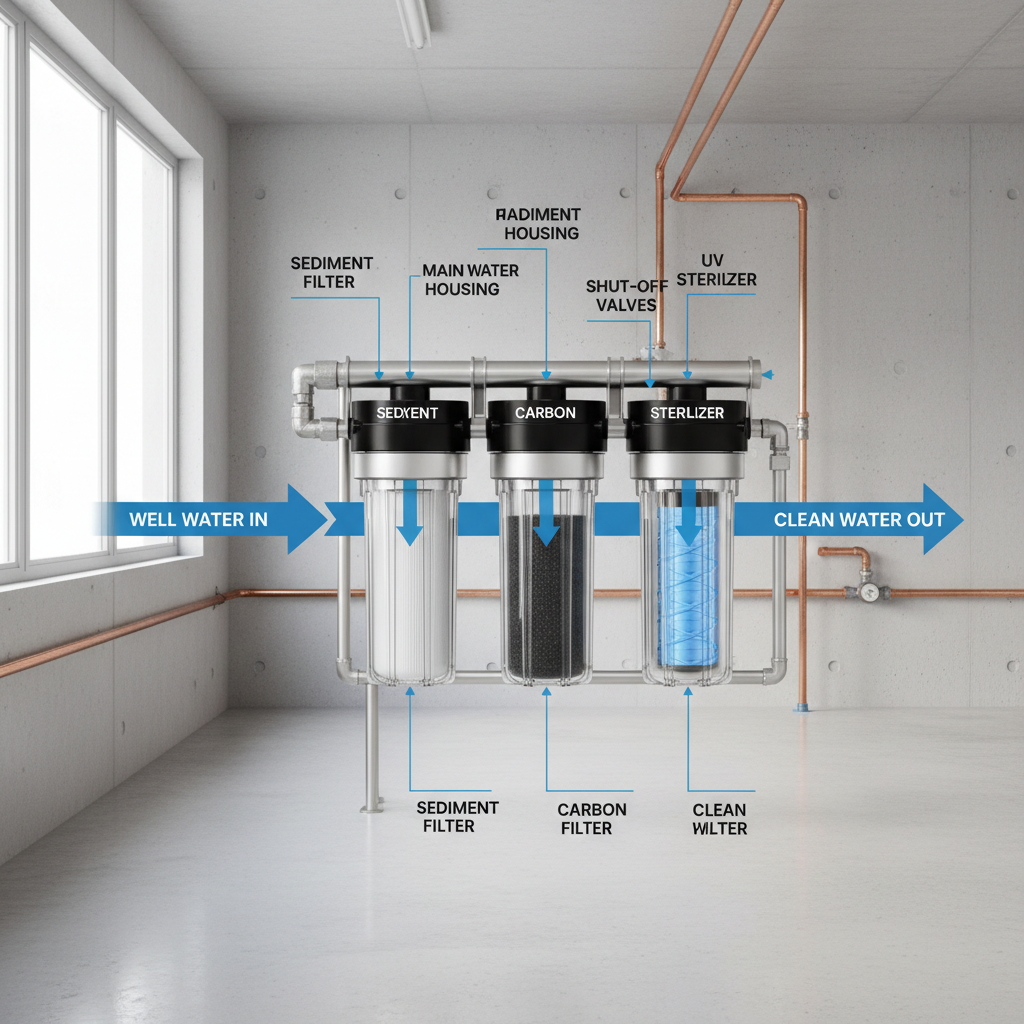
Whole-house well water filtration operates on a multi-stage principle, trapping or neutralizing contaminants before they reach your indoor plumbing. The process typically begins with sediment filtration, which is the frontline defense. A pre-filter, often a pleated or spun polypropylene cartridge with a micron rating between 5 and 50, physically blocks larger particles like sand, silt, rust flakes, and clay. This protects subsequent finer filters from premature clogging, extending their lifespan.
Following sediment removal, water often passes through a carbon filter. Activated carbon, with its immense porous surface area, excels at adsorbing organic compounds. This includes chlorine (if your well is shock-chlorinated), pesticides, herbicides, VOCs, and often improves taste and odor by removing sulfur and other dissolved gases. Carbon filters come in granular activated carbon (GAC) or carbon block forms, with block filters generally offering finer filtration and longer contact time.
For specific issues, specialized media are introduced. If you have high iron or manganese, an iron filter might use processes like oxidation with an air injection system or a manganese greensand media to precipitate these dissolved metals, making them filterable. For hydrogen sulfide (that rotten-egg smell), an aeration system or a specialized catalytic carbon filter can be used. If your water hardness is excessive, a water softener exchanges hard minerals (calcium and magnesium ions) with sodium or potassium ions, preventing scale buildup.
Finally, for biological contaminants like bacteria, viruses, or cysts, a UV sterilizer is an effective solution. Water flows through a chamber where it's exposed to ultraviolet light, which scrambles the DNA of microorganisms, rendering them unable to reproduce and cause illness. Unlike chemical treatments, UV purification doesn't alter water chemistry or leave residuals.
All these stages work in concert, typically in a series, with each filter media targeting specific impurities. Regular maintenance, primarily filter cartridge replacement and periodic backwashing of certain media filters, is crucial to maintain system efficiency and ensure a continuous supply of clean, safe well water.
Step-by-Step Fix
Safety First — Always shut off the main water supply to your home and depressurize the system before working on any water filtration components. If working with a UV system, always unplug it from the electrical outlet before servicing the bulb or sleeve. Wear appropriate eye protection and gloves.
-
Understand Your Water Test Results — Before doing anything, get a comprehensive well water test. This professional analysis, costing between $100–$500, identifies specific contaminants (bacteria, nitrates, heavy metals, pH, hardness, iron, sulfur, etc.).
- If your test reveals dangerous bacteria (e.g., E. coli), consult a well professional immediately for shock chlorination and system sanitization before installing any filtration.
- Note: A DIY test kit can give you a basic idea of hardness or pH, but professional lab testing is crucial for contaminants like lead, arsenic, or coliform bacteria.
-
Size Your System Correctly — Based on your water test and household's peak water demand, select a whole-house system with adequate flow rates and appropriate filter stages. The system should be able to process enough gallons per minute (GPM) to avoid pressure drops during simultaneous use (e.g., shower and washing machine).
- If you have a large household with high peak demand (e.g., 2+ bathrooms, frequent laundry), aim for a system with a minimum 10-15 GPM flow rate.
-
Choose the Right Location — Install the system on the main water line after the well pressure tank and before your water heater and any branches to fixtures. This ensures all incoming water is treated and protects your water heater from sediment buildup. Allow ample space around the units for future filter changes and maintenance.
- Ensure the location is easily accessible, protected from freezing temperatures, and has a nearby drain for backwashing systems.
-
Gather Tools and Materials — Collect everything you need: pipe wrenches, hacksaw/pipe cutter, deburring tool, measuring tape, Teflon tape, pipe fittings (adapters, unions, shut-off valves), and the filtration system components. Having all tools ready prevents interruptions.
- Consider using PEX or copper tubing with shark-bite fittings for easier installation if you're not comfortable soldering or threading galvanized pipe.
-
Install Bypass Valves — Crucial for maintenance! Install three full-port shut-off valves: one before the system, one after, and one in a bypass line between the two main line valves. This allows you to isolate the filter system for cartridge changes or repairs without shutting off water to your entire home.
- The bypass line should be slightly longer than the filter housing to allow for future system upgrades or different filter types.
-
Mount Filter Housings — Securely mount filter housings to a sturdy wall stud or a plywood backer board using lag screws. Ensure they are plumb and level. Leave enough clearance below for filter wrench access and replacement.
- Use a level and mark pilot holes carefully to avoid crooked installations that can stress plumbing connections.
-
Connect Plumbing — Cut into your main water line (after the pressure tank, before the water heater) and install the necessary fittings, unions, and the bypass assembly. Connect the filter housings in the correct sequence according to your system's design (e.g., sediment filter first, then carbon, then specialty filters, then UV).
- Apply Teflon tape to all threaded fittings (3-4 wraps clockwise) to ensure leak-proof connections. Hand-tighten, then use a wrench for another 1/2 to 1 full turn.
-
Flush the System — Once plumbing is complete and leak-free, slowly turn on the main water supply, keeping the bypass valve closed and the filter system valves open. Allow water to run through the system and out a designated
Related Articles
Keep troubleshooting with these hand-picked guides from FixlyGuide:
- The 9 Sneaky Filters Stealing Your Home's Efficiency (And How to Fix It) — Unseen or neglected filters throughout your home can secretly inflate utility bills, degrade air quality, and lead to expensive appliance b…
- 7 Hidden Equity Drains Costing You Thousands Annually — Your home is an asset, but silent problems like minor leaks, poor insulation, and deferred maintenance can drain its value. Discover the se…
- Your Home's Secret To-Do List: Are You Missing It? — Most new homeowners focus on decorating, but ignoring a basic home maintenance checklist can lead to thousands in unexpected repairs. Learn…
- The Secret 5 Bugs Invading Homes (It's Not Just Lanternflies) — Discover the five most common invasive bugs pest professionals treated last year that homeowners often overlook, and learn how to protect y…
- The Single Board Secret to Attracting Bluebirds: A Quick DIY House — Discover how to construct an ideal bluebird house using just one cedar board, providing a safe and inviting home for these cherished backya…
- The #1 Mistake Homeowners Make When Diagnosing Low Water Pressure (It's Not Your Pipes) — Discover the most common, overlooked culprit behind low water pressure impacting your entire home and learn how to fix it yourself with bas…
What should this project cost?
Enter your project details for a realistic cost range before you call anyone.
Cost depends heavily on which system turns out to be the source.
- Regional adjustment
- National average
- Labor share (typical)
- ~$1,620
- Quotes to collect
- 3 written estimates
Educational estimate based on national averages — not a binding quote. Always confirm with written local estimates.
Get the print-ready PDF of this guide
A clean, ad-free, printable version you can keep on your phone or pin to the workshop wall. Free with a FixlyGuide account.
- Print-optimized layout
- Tools, materials & every step included
- Saved to your account
This article was independently written by FixlyGuide based on the source topic.
Frequently asked questions
How often should I test my well water?+
You should test your well water annually for total coliform bacteria, nitrates, pH, and other common contaminants. If there's a change in taste, odor, appearance, or if a new well is drilled nearby, test immediately. For specific concerns like lead or pesticides, test every 3-5 years or as needed.
Can I install a whole-house well water filter myself?+
Yes, a handy homeowner with basic plumbing skills can install most whole-house well water filtration systems. However, sizing the system correctly, interpreting water test results, and ensuring all connections are leak-free are critical. For complex systems or if you're uncomfortable with plumbing, hiring a professional is recommended.
What's the difference between a water filter and a water softener for well water?+
A water filter removes impurities like sediment, chemicals (chlorine, VOCs), and biological contaminants (bacteria). A water softener, specifically, removes hardness minerals (calcium and magnesium) to prevent scale buildup but doesn't filter out other contaminants. Many well water homes benefit from both a filtration system and a softener.
How much does a whole-house well water filtration system cost?+
The cost for a whole-house well water filtration system can range widely, from $500 for a basic sediment/carbon system to $5,000+ for complex multi-stage systems including iron removal, UV sterilization, and water softening. Installation costs by a professional can add another $500-$2,000 to the total.
Do I need a UV filter for well water?+
A UV filter is highly recommended for well water, especially if your water test shows any presence of bacteria, viruses, or other microorganisms, or if your well is shallow or prone to surface water contamination. It provides a chemical-free way to disinfect your water and ensure it's safe to drink.


Discussion
Loading comments…