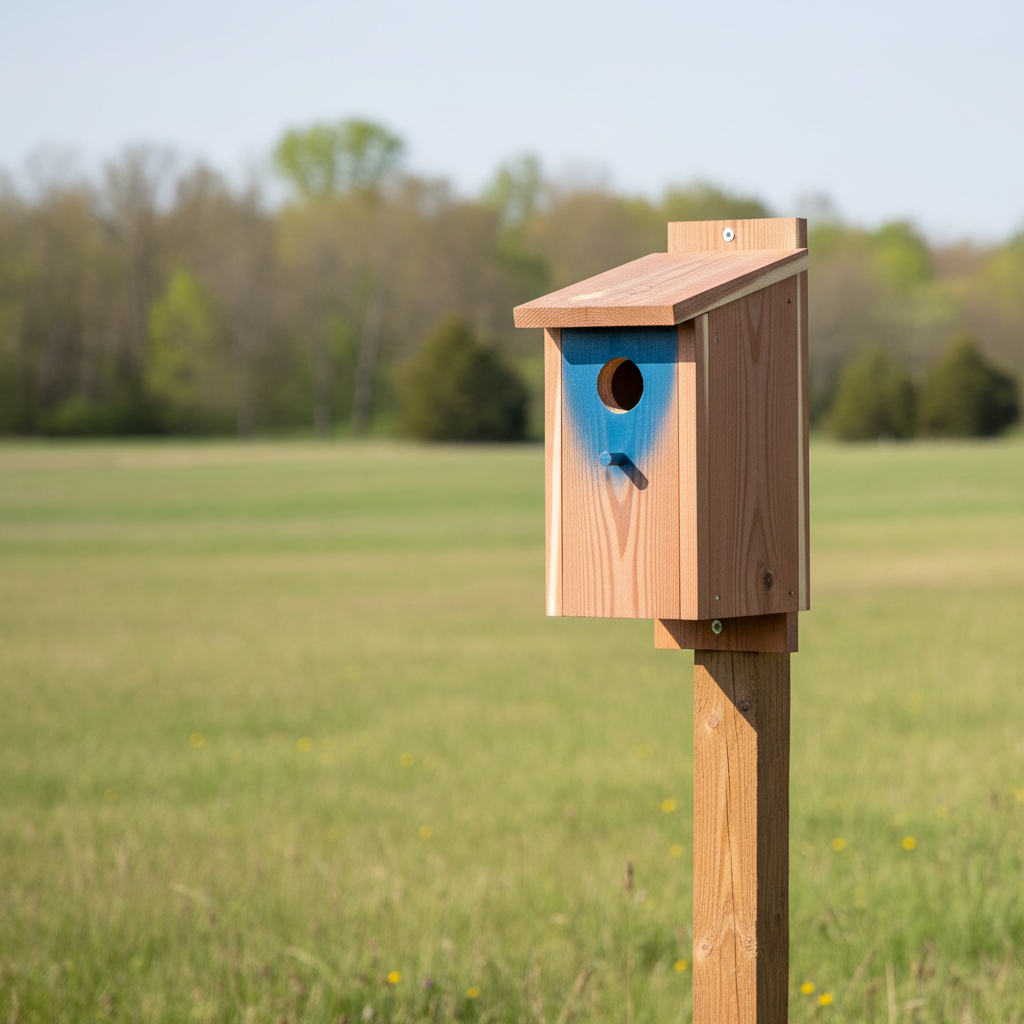
- You'll need one standard 1 inch x 6 inch x 6 foot cedar board. Cedar is naturally rot-resistant and doesn't require chemical treatment.
- Refer to your cut list carefully: two 10-inch pieces (front/back), two 8-inch pieces (sides), one 4x4 inch piece (floor), and one 6x7 inch piece (roof).
- Safety Note: Always wear safety glasses when cutting wood. Consider hearing protection too.
Published May 9, 2026Last updated August 17, 2026
Tools & materials you'll need
Affiliate linksAs an Amazon Associate FixlyGuide earns from qualifying purchases — at no extra cost to you. Prices and availability are accurate as of publication and subject to change.
Quick Answer
Building a successful bluebird house requires precise adherence to specific dimensions: a 1-1/2 inch entrance hole, an interior floor space of 4x4 inches, a distance of 6 inches from the floor to the bottom of the entrance hole, and a total interior height of 8-1/2 to 10 inches. These measurements deter predators and competitors while providing a safe, attractive nesting site for Eastern, Western, or Mountain bluebirds.
The Problem
Many well-intentioned DIYers build birdhouses, only to find them vacant, occupied by undesirable species like sparrows, or worse, discovered with abandoned nests. The heartbreak of an empty or unsuccessful birdhouse often stems from seemingly minor dimensional inaccuracies. A quarter-inch difference in the entrance hole, an extra inch of floor space, or imprecise floor-to-hole height can turn a potential bluebird paradise into an eviction notice. These subtle errors allow larger, more aggressive birds to enter, provide insufficient protection from predators, or simply make the house unappealing or unsafe for the specific needs of bluebirds. Without the right design, your efforts to attract these cherished insect-eaters can inadvertently create a hazard or a home for non-native species that outcompete native birds.
How It Works
Bluebirds, like all cavity-nesting birds, have very specific requirements for their homes. These requirements are not arbitrary; they are the result of evolutionary adaptations to maximize survival and successful breeding. The entrance hole size is paramount. A 1-1/2 inch diameter hole is the sweet spot: it's large enough for an adult bluebird to enter comfortably, but just small enough to exclude larger, more aggressive starlings, which often usurp nest boxes. House sparrows, another common competitor, can sometimes squeeze through, which is why monitoring is key.
Inside, the floor dimensions of 4x4 inches provide adequate space for a nest and a clutch of 4-6 eggs, plus the growing nestlings, without being so large that the nest becomes difficult for the parent birds to keep warm. A larger floor might seem more generous but can make the nest too cold in early spring or too difficult for parent birds to defend.
The distance from the floor to the bottom of the entrance hole (6 inches) is critical for two reasons: First, it prevents predators with long claws or paws, such as raccoons, from reaching down into the nest and grabbing eggs or nestlings. It effectively creates a 'reach-proof' barrier. Second, it gives the nestlings enough vertical space to grow before they are tempted to fledge prematurely, which can happen if the hole is too close to the nest.
Finally, the total interior height (8-1/2 to 10 inches) ensures there's enough airspace above the entrance hole and gives the bluebirds a sense of security. It also allows for ventilation and temperature regulation, crucial for the health of both eggs and chicks. The design often includes a sloped roof for drainage and a hinged side or front panel for easy cleaning between broods, which is vital for bluebird health and continued occupancy.
Step-by-Step Fix
1. Gather Your Materials and Plan Your Cuts — Lay out your cedar board and mark all cuts precisely before touching a saw.
- You'll need one standard 1 inch x 6 inch x 6 foot cedar board. Cedar is naturally rot-resistant and doesn't require chemical treatment.
- Refer to your cut list carefully: two 10-inch pieces (front/back), two 8-inch pieces (sides), one 4x4 inch piece (floor), and one 6x7 inch piece (roof).
- Safety Note: Always wear safety glasses when cutting wood. Consider hearing protection too.
2. Cut Your Cedar Board Pieces — Make all your cuts cleanly and accurately.
- Use a miter saw or circular saw to cut the two 10-inch pieces for the front and back panels. These will be 9-1/2 inches wide (actual dimension of a 1x6).
- Cut the two 8-inch pieces for the side panels. These will also be 9-1/2 inches wide. One side panel should be hinged for future cleaning access.
- Cut the 4x4 inch piece for the floor. Precision here is key.
- Cut the 6x7 inch piece for the roof. A slight overhang on all sides helps with water runoff.
- If your cuts aren't perfectly square: Use a sanding block or plane to true up the edges. Imperfect joints can lead to drafts or gaps that allow insects in.
3. Drill the Entrance Hole — Create the perfectly sized bluebird-specific entry point.
- On one of the 10-inch panels (this will be your front), measure 6 inches up from the bottom edge. Mark the center point at 4-3/4 inches across (half of 9-1/2 inches).
- Using a 1-1/2 inch spade bit or hole saw, drill the entrance hole at this marked center point. Ensure the hole is clean with no splintering.
- Why this specific size? 1-1/2 inches is ideal for Eastern, Western, and Mountain bluebirds, while excluding larger, more aggressive starlings.
- If the hole is slightly too large: You can get a metal hole restrictor plate online or from a bird supply store to reduce the opening to 1-1/2 inches. Do not attempt to fill and re-drill.
4. Add Ventilation and Drainage Holes — Essential for bluebird health and nest dryness.
- Drill two to four 1/4-inch diameter ventilation holes near the top edge of each side panel, just below where the roof will sit.
- Drill four 1/4-inch diameter drainage holes in each corner of the 4x4 inch floor piece. This prevents water from pooling if it gets inside.
- Why ventilation and drainage? Prevents overheating in summer and keeps the nest dry, reducing mold and disease risk for nestlings.
5. Assemble the Box Body — Fasten the front, back, and side panels together.
- Align the front and back panels with the side panels, ensuring all top edges are flush.
- Use galvanized or stainless steel screws (1-1/2 inch) to assemble the box. These resist rust and provide a strong hold.
- Pre-drill pilot holes to prevent splitting the cedar, especially near edges. Two screws per joint are usually sufficient.
- Tool Tip: An impact driver makes driving screws much easier.
6. Attach the Floor — Secure the foundation of the nest box.
- Insert the 4x4 inch floor piece into the bottom opening of the assembled box. It should fit snugly.
- Fasten the floor to the bottom edges of the front, back, and side panels using 1-1/2 inch galvanized screws. Drive screws up through the bottom of the floor into the side walls.
- Ensure it's flush: A tightly fitted floor prevents drafts and insect entry.
7. Install the Hinged Side for Cleaning — Make future maintenance simple and safe.
- Choose one side panel to be the hinged cleaning door. Attach two small (1-inch) rust-resistant hinges to the top edge of this panel and the bottom edge of the roof, or along the side junction with a fixed panel.
- Install a simple latch mechanism (e.g., a hook-and-eye latch or a pivoting wooden block) on the opposite side of the hinged panel to keep it securely closed.
- Importance of cleaning: Bluebirds can have multiple broods in a season. Cleaning out old nests between broods is crucial to prevent parasites and encourage new nesting.
- Pro Tip: Attach a small dowel or piece of wood inside the box, just below the entrance hole, but NOT protruding through the hole. This acts as a ladder for fledglings to climb out. Do NOT add an external perch, as it can aid predators and house sparrows.
8. Attach the Roof — Provide shelter and protection.
- Position the 6x7 inch roof piece so it overhangs slightly on the front, back, and sides. This provides extra protection from rain and sun.
- Attach the roof to the top edges of the front, back, and stationary side panels using 1-1/2 inch galvanized screws. If you hinged the side to the roof, ensure the hinges are functional and secure.
- Seal if needed: For extra weather protection, you can run a bead of silicone caulk along the top edges where the roof meets the walls, avoiding the hinged mechanism.
9. Mount the Bluebird House — Placement is as important as construction.
- Mount your finished bluebird house on a pole 5 to 6 feet high, preferably in an open area with scattered trees, facing south or east.
- Use conduit, a fence post, or a dedicated birdhouse pole. Attach a baffle below the house to deter climbing predators like raccoons and snakes.
- Avoid trees directly: Mounting on a tree invites climbing predators and can attract house sparrows. Also, avoid placing near bird feeders where house sparrows congregate.
Common Causes
- Incorrect Entrance Hole Size: The most frequent mistake. Too large (e.g., 1.5 - 1.75 inches for woodpeckers) allows starlings; too small (e.g., 1.125 inches for wrens) excludes bluebirds.
- Insufficient Floor-to-Hole Distance: Less than 5-6 inches makes it easy for predators (raccoons, cats) to reach into the nest.
- Lack of Ventilation/Drainage: Causes overheating in summer or leads to wet, moldy nests, which are detrimental to nestlings' health.
- Presence of an External Perch: While seemingly helpful, a perch makes it easier for predators and competitor birds (like house sparrows) to access the entrance hole.
- Wrong Mounting Location: Placing a bluebird house too low, in dense woods, or too close to active human areas or other bird feeders often leads to non-occupancy or competition.
- Using Treated Lumber or Paint: Chemicals in treated lumber are toxic to birds. Dark paints can cause overheating. Cedar is ideal because it's naturally pest and rot-resistant and light in color.
Common Mistakes
- Ignoring Actual Board Dimensions: A
Related Articles
Keep troubleshooting with these hand-picked guides from FixlyGuide:
- The Secret to Lush Raised Beds? It's Not Just About How You Water — Smart irrigation for raised garden beds isn't just about automation; it's about delivering the right amount of water precisely when your pl…
- The Hidden Reason Your GFCI Trips (It's Not Always a Faulty Outlet) — A continuously tripping GFCI outlet is a critical safety warning, often indicating moisture, a faulty appliance, or a wiring problem that r…
- The Single Cedar Board Secret to Attracting Bluebirds to Your Yard — Discover how to construct an ideal bluebird nesting box using just one cedar board, providing a safe and inviting habitat for these cherish…
- The 6 Cleaning Secrets Hiding in Your Power Drill (Plus Attachments to Master) — Your power drill isn't just for DIY projects; with the right attachments, it's a powerful and efficient cleaning tool for tackling tough gr…
- The 5 Essential Tools Every New Gardener Needs (And 3 You Can Skip) — Starting a garden doesn't require a huge investment in tools; savvy new gardeners can thrive with just a few key items and save money by kn…
- Is Your Gutter Sagging After Every Storm? The Hidden Flaw Most Homeowners Miss — Discover the overlooked reason your gutters sag after every storm and learn the lasting fix that most homeowners miss.
What should this project cost?
Enter your project details for a realistic cost range before you call anyone.
Cost depends heavily on which system turns out to be the source.
- Regional adjustment
- National average
- Labor share (typical)
- ~$1,620
- Quotes to collect
- 3 written estimates
Educational estimate based on national averages — not a binding quote. Always confirm with written local estimates.
This article was independently written by FixlyGuide based on the source topic.
Frequently asked questions
What is the best entrance hole size for a bluebird house?+
The ideal entrance hole size for a bluebird house is 1-1/2 inches in diameter. This size allows bluebirds to enter comfortably while largely excluding larger, invasive species like European Starlings.
How high should a bluebird house be mounted?+
Bluebird houses should typically be mounted on a pole 5 to 6 feet high. This height, combined with a predator baffle, helps protect the nest from ground predators like raccoons and snakes.
Should a bluebird house have a perch?+
No, a bluebird house should not have an external perch. Perches provide an advantage for predators and competitor birds (like house sparrows) to access the entrance hole. Bluebirds can cling to the opening without a perch.
How do you clean a bluebird house?+
Bluebird houses should be cleaned between broods and at the end of the nesting season. Many designs include a hinged side or front panel for easy access. Remove old nesting material, sanitize with a mild bleach solution if necessary, and allow it to dry completely before re-closing.
Discussion
Loading comments…