- Is the attachment secure?
- Can the existing section be adjusted?
- Is the material sound enough to reuse?
- Does anything behind the gutter need separate attention?
General remodeling · Renovation planning
| Project category | General remodeling |
|---|---|
| Problem type | Renovation planning |
| Trade required | General contracting |
| Urgency | Planned project |
| Safety risk | Low safety risk |
| DIY suitability | Pro recommended |
| Cost category | Major investment |
| Typical timeline | Design and permitting often 2–4 months before work starts |
| Contractor type | General contractor |
Repair option
Phase the work and fix the building envelope first.
Replacement option
Full renovation with permits, design, and a general contractor.
Common causes
- Space no longer fits how the household lives
- Resale preparation
- Deferred maintenance stacking up
Relevant tools:project cost estimatorcompare quoteshome improvement material prices
Published November 2, 2026
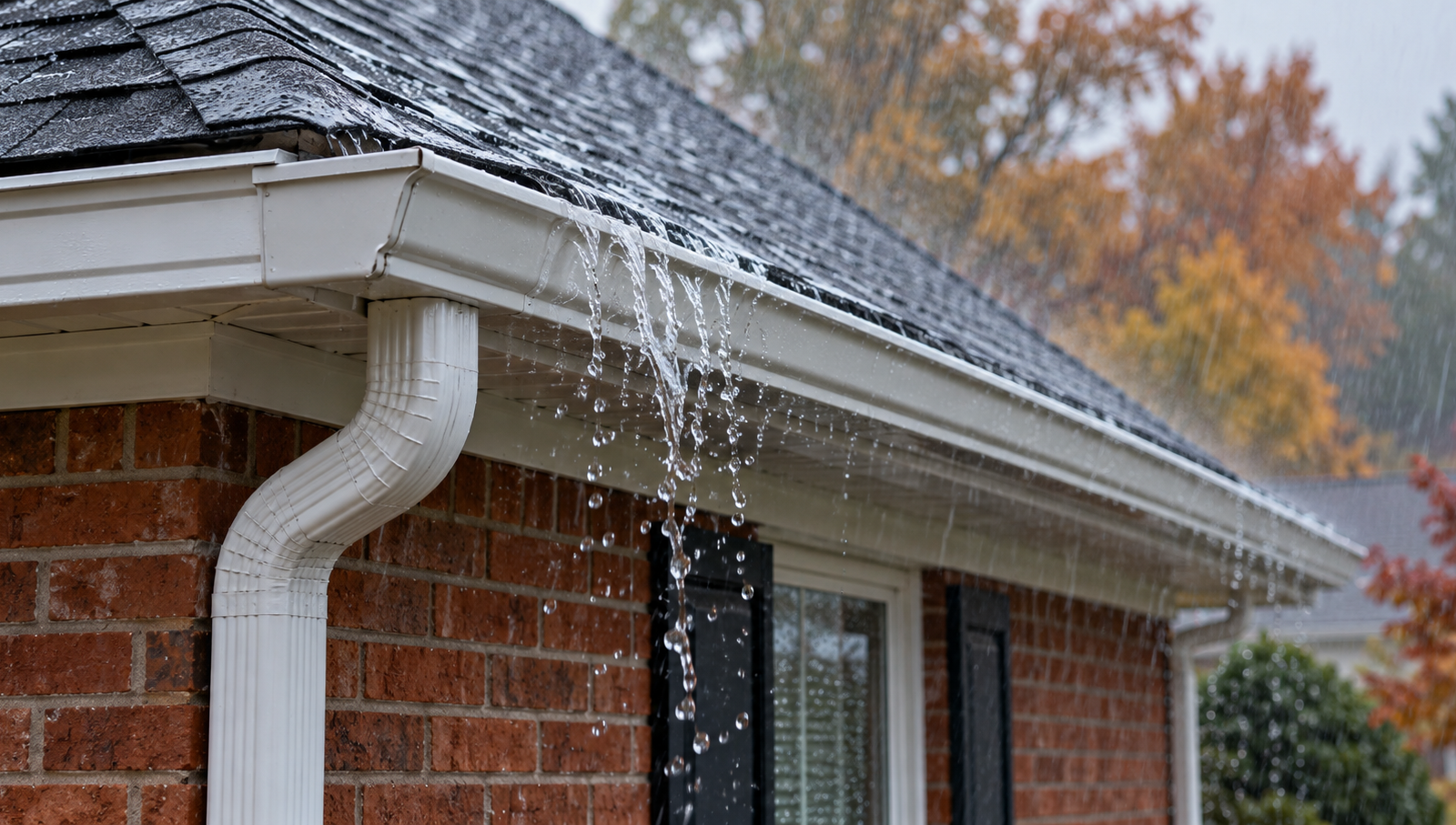
You paid to have the gutters cleaned. The leaves are gone. Then the next downpour arrives, and water pours over the same corner again.
Now what?
It is tempting to assume the cleaner missed something or that the gutters need to be bigger. Either explanation might be right. But the trouble could also be a clogged downspout elbow, a low spot, a roof-edge detail, or a buried drain that cannot carry water away.
Buying a repair before identifying where the water goes wrong can leave you with the same problem and a new bill.
This guide explains how to recognize useful clues, what a professional should investigate, and how to compare proposed fixes. Fall leaf drop makes this a timely home-maintenance check, but the same approach works whenever rain reveals a drainage problem.
Why are my gutters overflowing?
Overflowing gutters can result from debris, restricted downspouts, incorrect slope, sagging sections, or insufficient capacity. Water that appears to overflow may actually be missing the gutter because of its position or the roof flashing. A backed-up underground drain can also affect the system.
The first question is simple: Where does the water leave its intended path?
Do not assume every puddle below the roof means the same repair is needed.
A little rain can deliver a surprising amount of water
One inch of rainfall on a 1,000-square-foot horizontal roof catchment represents approximately 623 gallons of water before collection losses. That calculation uses about 0.623 gallons per square foot per inch of rain, a conversion published by Seattle Public Utilities.[1]
That is the rain falling on the catchment, not a promise that every gallon reaches one downspout. Roof geometry, losses, and the way the roof divides runoff all matter.
Still, the example explains why a small-looking drainage problem deserves attention. Your gutter system has to handle a substantial flow, and that flow needs somewhere appropriate to go after it reaches the ground.
A useful way to think through the system is:
Roof → gutter → outlet → downspout → discharge point → drainage away from the house.
Ask a contractor to identify which part of that route is failing.
First, separate these three problems
Before scheduling work, describe what you actually see.
| What you notice | What to ask a professional to investigate |
|---|---|
| Water rises inside the gutter and spills over the front | Debris, outlet restrictions, slope, and capacity |
| Water runs between the gutter and the house | Gutter position and roof-edge flashing |
| Water reaches the bottom but pools beside the house | Discharge location, surface grading, and downstream drainage |
| One corner overflows while neighboring sections behave normally | Conditions specific to that corner and its roof catchment |
| A joint drips even when the gutter is not full | The joint, seal, and surrounding material |
| A buried-drain connection backs up | The underground line and its outlet |
These are starting points for an inspection, not diagnoses. More than one problem can exist at the same house.
For example, cleaning a blocked outlet may restore flow while revealing that the downspout still empties into a low spot beside the wall. Both issues need attention.
1. The blockage may be below the gutter
An empty-looking gutter does not prove that its entire drainage route is clear.
NC State Extension specifically advises keeping downspouts and their elbows free of debris, along with regularly inspecting and maintaining the gutters themselves.[2]
When booking cleaning, ask what the service includes. Does the crew only remove material from the open channel? Does it check the outlets and downspouts? What happens if it finds a restriction farther down?
A useful request is:
"Please show me whether water can travel from the gutter outlet through the downspout, and identify anything you could not inspect."
That wording gives you a clearer result than simply asking whether the gutters are clean.
If your system connects to underground piping, ask the company to distinguish between the above-ground work it performed and any buried drainage it did not evaluate. Do not assume that one cleaning invoice covers both.
Before paying for another visit: Review the earlier scope and any photographs. You may need a different service, rather than a repeat of exactly the same work.
2. A low spot may be holding water
Gutters need a drainage path toward their outlets. A section that sags or slopes incorrectly deserves investigation even if it contains no leaves.
Portland's stormwater maintenance guidance calls for checking gutter tilt, identifying low spots, and repairing sagging areas. It also emphasizes maintaining downspout connections and clearing bends.[3]
From the ground, a dip in the gutter line or a section pulling away from the house is worth photographing. Do not attempt to straighten a loaded gutter by pulling on it.
Ask the installer:
- Where is the low point?
- Is the attachment secure?
- Can the existing section be adjusted?
- Is the material sound enough to reuse?
- Does anything behind the gutter need separate attention?
The answer may support a localized repair, but you should not assume that adjustment alone is sufficient. Ask for photographs and a written explanation if the contractor finds damage that changes the scope.
A useful estimate describes the location and proposed correction, rather than listing "gutter repair" as one unexplained charge.
3. The system may not suit the amount of runoff
Bigger gutters can move more water when the rest of the system supports that flow. Pacific Northwest National Laboratory's Building America guidance emphasizes appropriately sized gutters and downspouts and notes the importance of sufficient outlets.[4]
That does not mean every overflow requires an upgrade.
Ask anyone recommending replacement to explain the basis for it:
- Which roof areas feed the affected section?
- What rainfall intensity is the design intended to handle?
- Are the existing outlets and downspouts adequate?
- Would changing the outlet arrangement address the problem?
- Where will the increased discharge go?
A recommendation becomes easier to assess when it connects the observed problem to a specific design change.
Be especially cautious about comparing proposals that list only gutter width and total length. Two quotes can look similar while providing different outlet arrangements, installation details, and discharge work.
The question to answer: What will the proposed system do differently during rain?
4. Water may be running behind the gutter
If water is traveling between the gutter and the house, removing leaves may not address its route.
Roof-edge flashing helps direct runoff into the gutter. PNNL's homeowner guidance says the drip edge should discharge into the gutter rather than behind it.[5]
Tell the contractor where the water appears. A streak beneath a gutter, a wet fascia board, and a stream over the front edge are different observations.
Ask for the roof edge and gutter position to be evaluated together. If the proposal is simply to apply sealant, ask:
"What joint or opening are you sealing, and how will water drain after the repair?"
That is a reasonable request for an explanation. Sealant can have legitimate uses, but the estimate should identify the condition it addresses.
If the problem started after a roof replacement, gutter installation, or exterior renovation, include that timing in your notes. It gives the inspector a useful place to begin without proving that the earlier contractor caused the issue.
5. A roof-to-wall junction may need attention
Some houses have a lower roof that meets a taller wall. The bottom of that junction deserves special attention when stains or repeated wetting appear below it.
The Department of Energy's Building Science Education guidance explains that kick-out flashing directs runoff into the gutter and helps protect the adjacent wall. An inadequate detail can allow concentrated water to run down the wall.[6]
This is a reason to involve someone who understands roofing and flashing, particularly when the problem extends beyond the gutter channel.
Ask the inspector to document the junction and explain whether the proposed repair includes the necessary integration with the surrounding roof and wall materials.
If separate companies are involved, clarify who owns each part of the work. A gutter contractor and roofer should not leave you assuming the other company completed the critical detail.
Useful question: "Does this proposal address the water path where the roof meets the wall, or only the gutter attached below it?"
6. The water may have nowhere suitable to go
Follow the downspout all the way to its destination.
Does it discharge beside the wall? Has an extension been removed? Does the outlet empty into a depression? Does a buried line have an identifiable discharge point?
University of Minnesota Extension recommends evaluating gutters, downspouts, and surface grading when investigating basement moisture. Its guidance explains why concentrating roof runoff beside a foundation can contribute to water problems.[7]
PNNL's gutter guide describes discharge onto sloping grade at least five feet from the foundation as one approach.[4] That is guidance for a particular drainage arrangement, not a guarantee that a five-foot extension will solve every property.
The destination, slope, soil, available space, and applicable local requirements still matter.
Ask a drainage professional to explain the complete route, especially before purchasing buried piping or a collection system. A pipe disappearing underground is not proof of a working outlet.
For an estimate, request:
- The intended discharge location.
- The proposed route and materials.
- How the system can be accessed for maintenance.
- How the contractor will check completed flow.
- How overflow will be handled.
- Who will confirm any required local approvals.
Do not solve your drainage issue by directing water toward another building or neighboring property. Site-specific planning matters.[3]
7. Snow and ice can create a different problem
If trouble appears during snowmelt or freezing conditions, mention that before scheduling ordinary gutter work.
An ice dam forms when melting snow refreezes near the roof edge and obstructs drainage. University of Minnesota Extension describes the role of differing roof-surface temperatures and explains why heat escaping from the house can contribute.[8]
A larger gutter is not automatically the answer to that mechanism.
Record whether the leak occurs during rainfall, thawing snow, or both. Note where ice appears without approaching areas beneath hanging ice.
Ask an appropriately qualified professional to assess the roof conditions and whether attic air leakage or insulation issues need investigation. Avoid treating visible ice as proof that the gutter itself caused the problem.
Do not climb onto an icy roof or chip at ice while standing on a ladder.
How to collect useful clues safely
You do not need a rooftop inspection to prepare for a contractor visit.
Start with a dry-weather walk around the house from stable ground. Photograph visible sagging, detached extensions, stains, damaged connections, and the locations where you previously noticed overflow.
Make a simple note for each area:
- Exact location, such as "rear corner beside kitchen."
- When the problem happens.
- Whether it occurs in ordinary rain or only heavier rain.
- Where water first appears.
- Whether there is an associated indoor stain.
- Date of the last cleaning or repair.
- Any recent roof, landscaping, or gutter work.
A short video can be useful if it can be obtained safely during ordinary rain. Never remain outside to collect evidence when thunder is audible. The National Weather Service advises going into safe shelter and waiting at least 30 minutes after the last thunder before resuming outdoor activity.[9]
WVU Extension also warns against gutter or ladder work during storms or when precipitation or ice is possible.[10] Hire qualified help when access requires roof work, difficult ladder placement, or working near electrical lines.
Do gutter guards solve overflowing gutters?
Ask what problem the proposed guard is intended to solve.
A debris-control product may be worth discussing when leaves repeatedly enter the system. NC State Extension suggests considering guards or strainers as part of gutter management, while still recommending regular inspection.[2]
Before buying, ask the installer:
- Is the existing drainage problem being corrected first?
- What maintenance does this specific product require?
- Who removes and reinstalls it when access is needed?
- What does the written warranty cover?
- What conditions or maintenance omissions exclude coverage?
- Is the quoted price for guards only or for other repairs too?
Request the manufacturer's care instructions before signing.
A demonstration or sales claim should not replace an inspection of the conditions at your house. If the proposed work does not explain the recurring overflow, ask for that explanation before approving it.
What should a gutter repair estimate include?
A good proposal should let you understand both the problem and the finished result.
Ask for the affected locations, material specifications, work included, work excluded, and how completion will be checked. For replacement work, request the proposed gutter and downspout layout.
Also clarify how concealed damage will be handled. If fascia or another supporting component needs work after removal, how will you receive photographs, pricing, and approval options?
Compare at least these questions across quotes:
| Estimate question | Why it helps |
|---|---|
| What condition did you find? | Connects the price to an observed problem |
| What are you repairing or replacing? | Makes the scope comparable |
| Where will the water discharge? | Extends the proposal beyond the roof edge |
| What is excluded? | Reveals separate work you may still need |
| How will completed performance be checked? | Defines what happens before closeout |
| What maintenance and warranty terms apply? | Clarifies your responsibilities afterward |
There is no useful universal price for every "overflowing gutter" repair. Clearing an accessible obstruction and redesigning a complicated system are different jobs. Compare clearly defined scopes before deciding which price offers value.
When should you arrange prompt help?
Do not keep postponing an assessment if water is entering the house, the gutter is visibly pulling away, or the same location remains wet after repeated attempted repairs.
Treat a new indoor stain as a reason to investigate, not as proof of one particular exterior cause. Roofing, flashing, plumbing, and other sources may require different specialists.
When scheduling, describe the active symptom first:
"Water is entering above the rear window during rain," is more useful than, "I think I need larger gutters."
Keep dated photographs and copies of prior invoices. They help the next professional understand what has already been attempted.
Frequently asked questions
Why do my gutters overflow after cleaning?
The cleaning may not have addressed a downspout restriction, drainage slope, capacity issue, roof-edge detail, or downstream problem. Ask what was inspected and whether the whole flow path was checked.
Does overflow mean I need new gutters?
No. The right scope depends on the condition found. Request an explanation of why repair is or is not practical before approving replacement.
How often should gutters be inspected?
NC State Extension advises inspection yearly and after major weather events.[2] Your maintenance needs may be greater where debris accumulates quickly. Use actual conditions and the installed product's instructions to set the schedule.
Can gutter problems contribute to basement moisture?
Yes. Poorly managed roof runoff and grading can be contributing factors. However, University of Minnesota Extension also identifies other moisture sources, so gutters should not be assumed to explain every damp basement.[7]
Should I install a French drain first?
Ask for a site assessment before choosing a drainage product. Describe the water problem and request a proposed route and discharge plan. The name of a product alone does not establish that it is appropriate for your property.
What should I ask before approving a repair?
Ask: "What did you find, what will this work change, and how will you verify the result?" Then make sure the written scope matches the explanation.
Make your next repair decision with better information
The most useful first step is to identify where water leaves its intended path. Then match the repair to that finding.
Before the next appointment, gather your photographs, mark the problem locations, and write down when the trouble happens. Ask the contractor to explain the entire route from roof to discharge point.
Save this guide before you hire someone to repair your gutters. Visit FixlyGuide.com for more practical homeowner guidance, and follow Fixly Guide for tips that help you ask better questions before spending money.
Sources
- Seattle Public Utilities: Rainwater Harvesting
- NC State Extension: Moisture Control and Prevention—Gutter Management
- City of Portland: Stormwater Facility Maintenance
- PNNL Building America Solution Center: Gutters and Downspouts
- PNNL Building America Solution Center: Look for Missing Roof and Wall Flashing
- DOE Building Science Education: Kick-out Flashing at Roof-Wall Intersections
- University of Minnesota Extension: Moisture in Basements—Causes and Solutions
- University of Minnesota Extension: Dealing With and Preventing Ice Dams
- National Weather Service: Lightning Tips
- WVU Extension: Gutter Safety
What should this project cost?
Enter your project details for a realistic cost range before you call anyone.
Minor crack sealing $800–$2,500; pier and beam stabilization $10,000–$30,000+.
- Regional adjustment
- National average
- Labor share (typical)
- ~$4,961
- Quotes to collect
- 3 written estimates
Educational estimate based on national averages — not a binding quote. Always confirm with written local estimates.
Fixly Project Decision Box
- DIY difficulty
- Professional Recommended
- Estimated time
- Inspection 1–2 hours · repairs 1–3 days
- Cost level
- High
Main tools / materials
- Binoculars for a ground-level look
- Flashlight for attic checks
- Moisture meter
- Roofing cement (temporary patch only)
When to stop and call a pro
- Active leak near lights, fans, or any wiring
- Sagging, bulging, or water-filled ceiling
- Steep, wet, or two-story roof — do not climb it
- Storm or hail damage you plan to claim on insurance
Need professional help?
Free roof assessment first — no phone calls until you ask for them.
Get Local Roofing HelpDecide what your roof needs
Two minutes of questions turns "something is wrong up there" into a clear next step.
- Repair or replace your roof?Answer 10 questions about age, leaks, and damage to get a clear next step.Open
- Compare contractor quotesScore up to four bids on price, warranty, licensing, and timeline.Open
- Get local estimatesSend one request and compare written estimates from vetted pros.Open
Free, no signup required. Estimates are educational guidance, not a quote or an inspection.
Recommended for DIYers & woodworkers
Sponsored
The Top 20 Tools for Workshops of Any Budget
No stationary machines or power tools required — plus 3 fundamental tools that can't be bought at any price.
Get the free guide
Ted's Woodworking — The #1 Woodworking Resource
Detailed instructions, dimensioned drawings, materials & cutting lists, and 3D schematics for every skill level.
See the plansSponsored: links above are affiliate links. FixlyGuide may earn a commission on qualifying purchases — at no extra cost to you.
Frequently asked questions
Why do my gutters overflow after cleaning?+
The cleaning may not have addressed a downspout restriction, drainage slope, capacity issue, roof-edge detail, or downstream problem. Ask what was inspected and whether the whole flow path was checked.
Does overflow mean I need new gutters?+
No. The right scope depends on the condition found. Request an explanation of why repair is or is not practical before approving replacement.
How often should gutters be inspected?+
NC State Extension advises inspection yearly and after major weather events. Your maintenance needs may be greater where debris accumulates quickly. Use actual conditions and the installed product's instructions to set the schedule.
Can gutter problems contribute to basement moisture?+
Yes. Poorly managed roof runoff and grading can be contributing factors. However, University of Minnesota Extension also identifies other moisture sources, so gutters should not be assumed to explain every damp basement.
Should I install a French drain first?+
Ask for a site assessment before choosing a drainage product. Describe the water problem and request a proposed route and discharge plan. The name of a product alone does not establish that it is appropriate for your property.
What should I ask before approving a repair?+
Ask: "What did you find, what will this work change, and how will you verify the result?" Then make sure the written scope matches the explanation.


Discussion
Loading comments…