
- Contractor’s legal business name
- Business address and contact information
- Materials and product specifications
- Quantity or measurements when relevant
- Work specifically excluded
Published October 3, 2026
You requested estimates from three contractors.
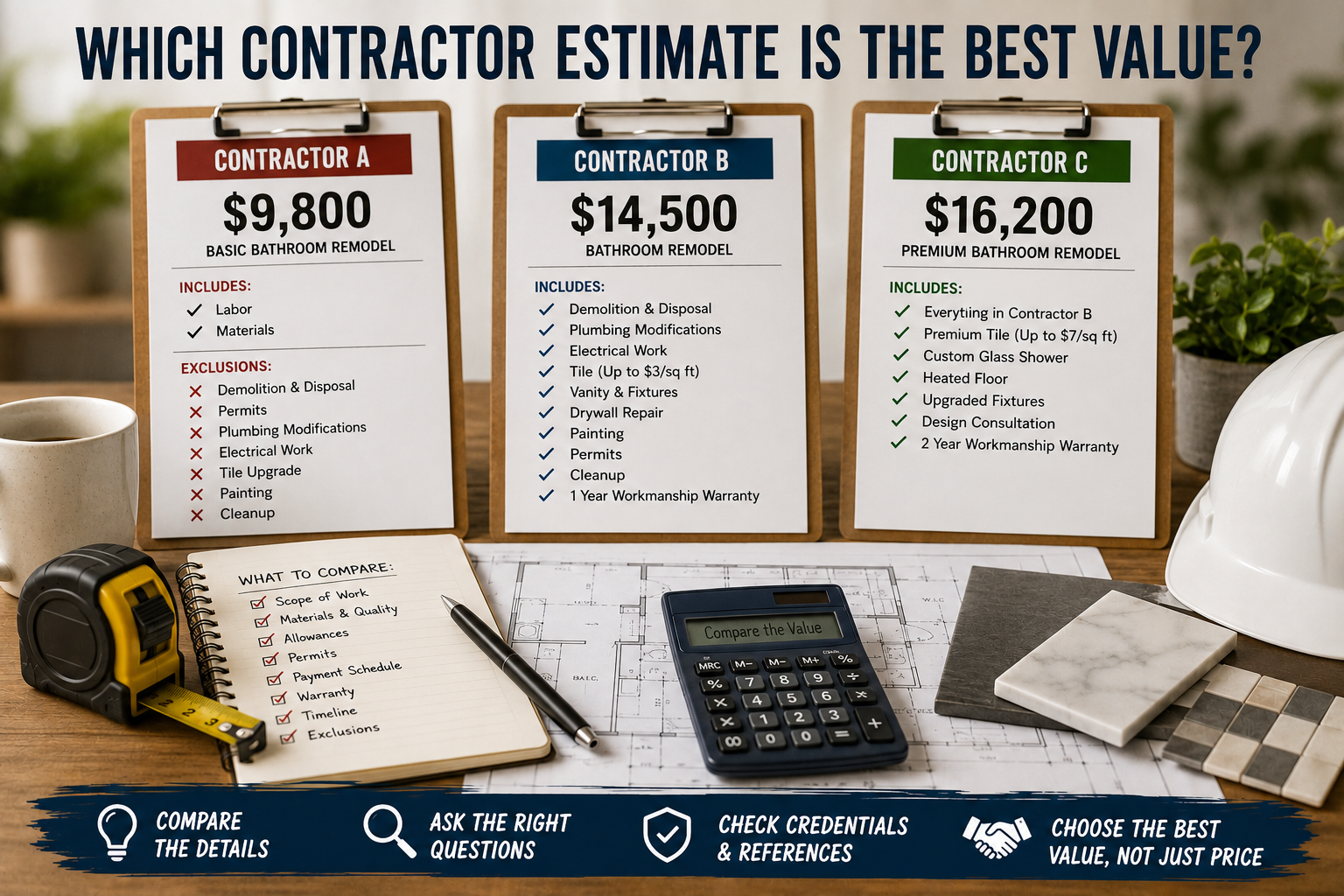
One quote is $34,000. Another is $46,000. The third is $58,000.
At first glance, the $34,000 contractor appears to offer the best deal. But what if that estimate excludes permits, demolition, debris removal, painting, electrical upgrades, or important finish work?
The lowest number is not always the lowest final cost.
Contractor estimates can differ because companies use different materials, include different amounts of work, make different assumptions, and apply different levels of project management. One contractor may provide a nearly complete project price, while another offers a low starting number that grows through allowances and change orders.
The right way to compare estimates is to compare the complete scope, specifications, exclusions, schedule, payment terms, and contractor—not merely the total at the bottom of the page.
What Should a Contractor Estimate Include?
A useful estimate should clearly identify:
- Contractor’s legal business name
- Business address and contact information
- Property address
- Detailed scope of work
- Materials and product specifications
- Quantity or measurements when relevant
- Labor included
- Demolition and disposal
- Permits and inspections
- Allowances
- Work specifically excluded
- Estimated start date
- Estimated duration
- Payment schedule
- Warranty information
- Change-order procedure
- Estimate expiration date
- Total estimated price
The Federal Trade Commission recommends getting multiple written estimates and says an estimate should include the work, materials, completion date, and price. It also advises homeowners not to begin work until they have reviewed and signed a written contract.
A one-page quote containing little more than “remodel kitchen — $38,000” does not give you enough information to make an informed decision.
Estimate, Bid, Proposal and Contract: What Is the Difference?
These terms are frequently used interchangeably, but they may represent different stages of the hiring process.
Estimate
An estimate is the contractor’s assessment of what the work is likely to cost based on currently available information.
The final price may change when quantities, products, site conditions, or project details become clearer.
Bid
A bid is usually a more formal price offered for a defined scope of work. Even a bid can contain assumptions and exclusions, so it must be read carefully.
Proposal
A proposal may combine the scope, products, price, schedule, company qualifications, and proposed construction process.
Contract
The contract is the binding agreement that should define the contractor’s and homeowner’s responsibilities.
Do not assume an estimate automatically contains all the protections needed in a final contract.
Step 1: Make Sure Every Contractor Prices the Same Project
You cannot accurately compare three estimates if each contractor was given different instructions.
Before requesting prices, create a basic project description covering:
- Rooms or areas involved
- Features being removed
- Features being retained
- Desired products and materials
- Layout changes
- Required repairs
- Expected finish level
- Work the homeowner will perform
- Known budget limitations
- Desired completion period
For a kitchen remodel, this might include the cabinet style, countertop material, flooring, appliances, backsplash, lighting, plumbing fixtures, painting, and whether the existing layout will change.
Give each contractor the same project information. If one contractor suggests a different approach, ask that company to price both the original scope and its recommended alternative separately.
Step 2: Build a Side-by-Side Comparison
Do not compare estimates from memory. Create a table showing exactly what each contractor included.
| Comparison category | Contractor A | Contractor B | Contractor C |
|---|---|---|---|
| Demolition | Included | Included | Unclear |
| Debris removal | Included | Extra | Unclear |
| Permits | Included | Owner pays | Excluded |
| Cabinets | Stock | Semi-custom | Allowance |
| Countertops | Quartz included | Allowance | Granite included |
| Plumbing | Included | Limited | Included |
| Electrical | Included | Allowance | Excluded |
| Painting | Included | Excluded | Included |
| Warranty | 2 years | 1 year | Unspecified |
| Estimated duration | 8–10 weeks | 10–12 weeks | Not listed |
| Total | $46,000 | $39,000 | $34,000 |
That $34,000 estimate may no longer look inexpensive when you discover that electrical work, permits, disposal, and several finishes are missing.
Step 3: Compare the Scope of Work
The scope of work explains what the contractor has agreed to accomplish.
Weak scope:
Remodel the bathroom with new finishes.
Strong scope:
Remove the existing vanity, countertop, floor tile, bathtub surround and plumbing fixtures. Install a 60-inch double vanity, quartz countertop, porcelain floor tile, waterproof shower system, new fixtures, exhaust fan, lighting and two coats of interior paint.
The scope should answer four questions:
- What is being removed?
- What is being installed?
- What preparatory and repair work is included?
- What finished condition will the contractor deliver?
Look for work that may be implied during a sales conversation but missing from the written estimate.
Step 4: Examine Material Specifications
“New cabinets,” “quality flooring,” and “premium paint” are not product specifications.
Material descriptions should be specific enough to determine what you are buying. Depending on the project, that may include:
- Manufacturer
- Product line
- Model number
- Material
- Dimensions
- Color or finish
- Grade or performance rating
- Installation method
- Quantity
- Warranty
For products not yet selected, the estimate should provide a clear allowance.
Without specifications, contractors can price completely different quality levels while appearing to quote the same project.
Step 5: Understand Every Allowance
An allowance is a placeholder amount for a product or portion of work that has not been finalized.
For example:
- Plumbing fixtures: $1,500 allowance
- Tile: $4 per square foot allowance
- Appliances: $6,000 allowance
- Cabinet hardware: $500 allowance
Allowances are common, but unrealistic allowances make an estimate appear cheaper than the likely final cost.
If you expect a $2,500 range but the estimate includes a $700 appliance allowance, the project is already underbudgeted.
Ask:
- Does the allowance cover materials only?
- Does it include tax and delivery?
- Is installation included elsewhere?
- Is the allowance realistic for the products I want?
- What happens if I spend less?
- What markup applies if I spend more?
- When must selections be finalized?
Try to make important selections before signing the contract. The fewer unknowns that remain, the more reliable the project price becomes.
Step 6: Study What Is Excluded
The exclusions section can be as important as the included work.
Common exclusions include:
- Permit fees
- Architectural or engineering services
- Hazardous-material testing
- Mold remediation
- Structural repairs
- Electrical panel upgrades
- Plumbing repairs inside walls
- Landscaping restoration
- Drywall repair
- Painting
- Appliance installation
- Material delivery
- Debris removal
- Final cleaning
- Work required by concealed conditions
An exclusion does not automatically make an estimate bad. It tells you what must be priced separately or handled by someone else.
The problem occurs when important exclusions are hidden, vague, or never discussed.
Step 7: Compare Labor and Project Management
Two contractors may use similar materials but provide very different levels of service.
Find out whether the price includes:
- Project planning
- Material ordering
- Scheduling subcontractors
- On-site supervision
- Home protection
- Daily cleanup
- Quality-control inspections
- Permit coordination
- Progress meetings
- Final walkthrough
- Punch-list completion
- Warranty service
A professionally managed project may cost more upfront but reduce delays, miscommunication, rework, and unfinished details.
Ask who will manage your project and how often that person will be on-site.
Step 8: Review the Payment Schedule
A payment schedule should connect payments to reasonable project milestones—not merely dates on a calendar.
An example might include:
- Initial deposit after signing
- Payment when materials arrive
- Payment after rough plumbing and electrical
- Payment after cabinets or major finishes are installed
- Final payment after inspection and punch-list completion
Avoid paying the entire project price upfront. The Texas Attorney General advises homeowners not to pay in full until the work is complete, inspected, and satisfactory.
Ask whether payments cover materials, completed work, or both. Confirm which payment methods are accepted and obtain a receipt for every payment.
For large projects, consider asking how the contractor documents payments to subcontractors and suppliers. Texas homeowners should also understand that unpaid subcontractors or suppliers may create lien-related risks under certain circumstances.
For a major contract or a situation involving lien documents, consult a qualified Texas attorney rather than relying solely on general online guidance.
Step 9: Review the Change-Order Process
A change order is a written modification to the original project.
It may change:
- Scope
- Materials
- Price
- Schedule
- Construction method
- Contractor responsibilities
A strong contract requires change orders to be documented and approved before the additional work proceeds, except when immediate action is necessary for safety.
Each change order should identify:
- The requested change
- Why it is needed
- Added or deducted cost
- Schedule impact
- Required approval
Do not rely on verbal agreements for expensive changes.
Step 10: Evaluate the Schedule
The fastest estimate is not necessarily the most realistic.
Ask each contractor:
- When can the project start?
- How long should construction take?
- Are materials available?
- Which items have long lead times?
- Will crews work continuously?
- Is the contractor managing other projects simultaneously?
- What could delay the schedule?
- How will delays be communicated?
- Does the schedule depend on inspections or homeowner selections?
Be cautious when a contractor promises an unusually fast completion without discussing material availability, inspections, subcontractor coordination, or site conditions.
Step 11: Verify Insurance, Licensing and Permits
Request proof of insurance directly related to the business and work being performed.
Depending on the project, this may include:
- General liability insurance
- Workers’ compensation coverage
- Commercial automobile coverage
- Trade-specific licensing
- Required registrations
- Permit responsibility
Do not accept “licensed and insured” as sufficient verification. Ask what license the contractor holds, who issued it, whether it is active, and what work it covers.
Texas does not treat every construction trade identically. For example, non-exempt electrical work must be performed under the appropriate Texas electrical licensing structure, while air-conditioning and refrigeration contractors are regulated through the Texas Department of Licensing and Regulation.
Verify any required professional or trade license with the issuing agency and confirm local permit requirements with the city or authority having jurisdiction.
Step 12: Check the Contractor—not Just the Number
A detailed estimate from an unreliable contractor is still a risk.
Before hiring, review:
- Legal business identity
- Business history
- Physical address
- Insurance documentation
- Applicable licenses
- Recent project photos
- References for similar work
- Online reviews across multiple platforms
- Complaint patterns
- Communication quality
- Written warranties
- Current workload
- Subcontractor relationships
Call recent references and ask:
- Did the final price remain close to the contract price?
- Were changes explained before the work proceeded?
- Did the crew protect the home?
- Was the project reasonably close to schedule?
- Did the contractor communicate consistently?
- Were problems corrected?
- Would you hire the contractor again?
The FTC recommends comparing reviews from multiple sources instead of relying on one website or one group of ratings.
Why the Lowest Estimate May Cost More
A substantially lower estimate may result from:
- Missing work
- Unrealistically low allowances
- Lower-grade products
- Fewer preparation steps
- Limited supervision
- No permit costs
- Insufficient insurance
- Pricing mistakes
- Heavy reliance on later change orders
- A misunderstanding of the project
- Intentional low bidding to secure the contract
A low estimate is not automatically wrong. It may reflect a more efficient company or a practical construction method.
The contractor should, however, be able to explain why the price is lower.
What If One Estimate Is Much Higher?
A higher estimate may include:
- Better materials
- More extensive preparation
- More complete protection and cleanup
- Skilled specialty labor
- Stronger project management
- More realistic allowances
- Permit and inspection costs
- Longer warranties
- Work excluded by competing bids
- A larger contingency for known risks
Ask the higher-priced contractor to walk through the estimate line by line. Then ask the other contractors whether those same items are included in their prices.
Contractor Estimate Red Flags
Proceed carefully if an estimate:
- Contains no detailed scope
- Has large blank sections
- Uses vague material descriptions
- Includes unrealistic allowances
- Requires full payment upfront
- Excludes permits without explanation
- Has no business address
- Contains no warranty information
- Does not explain change orders
- Provides no estimated schedule
- Is dramatically below every competing estimate
- Includes work the contractor cannot legally perform
- Requires an immediate signature
- Relies heavily on verbal promises
- Is presented as “just an estimate” but contains binding contract language
Texas insurance regulators also warn homeowners not to sign documents with blank sections or accept a document casually described as an estimate without understanding what it legally authorizes.
Questions to Ask Before Accepting an Estimate
- Is this a preliminary estimate or a fixed proposal?
- What work is specifically included?
- What is specifically excluded?
- Which materials are specified?
- Which items are allowances?
- Are taxes and delivery included?
- Who obtains and pays for permits?
- Is demolition included?
- Is debris removal included?
- Who supervises the project?
- Which trades will be subcontracted?
- What insurance does the company carry?
- Which licenses are required?
- How are unexpected conditions handled?
- How are change orders priced and approved?
- What payment schedule is required?
- When could the project start?
- What is the realistic duration?
- What warranty is included?
- What would cause the final price to increase?
A Simple Contractor-Selection Scorecard
Price should be part of the decision, but it should not control the entire decision.
| Category | Suggested weight |
|---|---|
| Scope completeness | 25% |
| Contractor qualifications | 20% |
| Communication and professionalism | 15% |
| Materials and specifications | 15% |
| Price and overall value | 15% |
| Schedule and availability | 5% |
| Warranty and follow-up service | 5% |
Score each contractor from 1 to 5 in every category. This provides a more balanced comparison than automatically selecting the lowest total. You can also use our free contractor quote comparison tool to line up your bids side by side.
Frequently Asked Questions
Should I always get three contractor estimates?
Three written estimates provide a useful comparison for many projects. Highly specialized work may have fewer qualified providers, while small repairs may not justify an extensive bidding process.
The goal is to understand the reasonable market range and compare contractors—not collect the greatest possible number of quotes.
Should contractors charge for estimates?
Some provide free estimates. Others charge for detailed consultations, design work, troubleshooting, measurements, or complex estimating.
Ask about fees before scheduling. A paid estimate is not necessarily a warning sign if the charge and deliverables are explained upfront.
How detailed should a remodeling estimate be?
The estimate should be detailed enough for you to understand what work, materials, allowances, exclusions, and responsibilities are included.
The larger and more complex the project, the more detailed the documentation should be.
Is the cheapest contractor ever the right choice?
Yes. A lower-priced contractor can still be the right choice when the scope is complete, materials are comparable, qualifications are verified, and the contractor provides a convincing explanation for the price difference.
How much higher can the final price be than the estimate?
There is no universal percentage. The answer depends on whether the document is a preliminary estimate, fixed-price agreement, or cost-plus contract—and whether the homeowner requests changes or concealed problems are discovered.
Ask the contractor to explain every circumstance that could change the price.
What should I do when estimates describe different solutions?
Ask each contractor to explain the advantages, disadvantages, expected service life, and cost of the proposed method.
Then request revised prices based on the same chosen solution whenever possible.
Final Takeaway
The best contractor estimate is not necessarily the cheapest or most expensive. It is the estimate that most clearly defines the project and comes from a qualified contractor you trust to complete it properly.
Before signing:
- Give every contractor the same project description.
- Compare estimates line by line.
- Identify missing work and unrealistic allowances.
- Review materials, exclusions, payments, and warranties.
- Verify insurance and any required licenses.
- Contact recent references.
- Require written change orders.
- Read the complete contract before paying a deposit.
A clear estimate protects both the homeowner and the contractor by establishing realistic expectations before construction begins.
Ready to request estimates? Use Fixly Guide to find qualified contractors serving your area. Also see our guide to why contractor quotes are so different.
Should you do this yourself?
Answer five quick questions before you start. Safety outranks savings every time.
Your experience with work like this
How high do you have to work?
Does the job involve any of these?
Will it need a permit?
Specialty tools
Free and instant. Educational guidance only — not a quote, inspection, or professional diagnosis.
What should this project cost?
Enter your project details for a realistic cost range before you call anyone.
Scope drives everything — single-room work often $10,000–$40,000; whole-home much higher.
- Regional adjustment
- National average
- Labor share (typical)
- ~$21,825
- Quotes to collect
- 3 written estimates
Educational estimate based on national averages — not a binding quote. Always confirm with written local estimates.
Before you start
Check the difficulty, permits, and safety risk — then decide whether to call a pro.
- Estimate this projectGet a cost range for your scope and ZIP before you call anyone.Open
- Get local estimatesSend one request and compare written estimates from vetted pros.Open
Free, no signup required. Estimates are educational guidance, not a quote or an inspection.
Frequently asked questions
Should I always get three contractor estimates?+
Three written estimates provide a useful comparison for many projects. Highly specialized work may have fewer qualified providers, while small repairs may not justify an extensive bidding process. The goal is to understand the reasonable market range and compare contractors—not collect the greatest possible number of quotes.
Should contractors charge for estimates?+
Some provide free estimates. Others charge for detailed consultations, design work, troubleshooting, measurements, or complex estimating. Ask about fees before scheduling. A paid estimate is not necessarily a warning sign if the charge and deliverables are explained upfront.
How detailed should a remodeling estimate be?+
The estimate should be detailed enough for you to understand what work, materials, allowances, exclusions, and responsibilities are included. The larger and more complex the project, the more detailed the documentation should be.
Is the cheapest contractor ever the right choice?+
Yes. A lower-priced contractor can still be the right choice when the scope is complete, materials are comparable, qualifications are verified, and the contractor provides a convincing explanation for the price difference.
How much higher can the final price be than the estimate?+
There is no universal percentage. The answer depends on whether the document is a preliminary estimate, fixed-price agreement, or cost-plus contract—and whether the homeowner requests changes or concealed problems are discovered. Ask the contractor to explain every circumstance that could change the price.
What should I do when estimates describe different solutions?+
Ask each contractor to explain the advantages, disadvantages, expected service life, and cost of the proposed method. Then request revised prices based on the same chosen solution whenever possible.


Discussion
Loading comments…