- Is old siding being removed?
- What happens if rotten sheathing is discovered?
- Are trim pieces included?
- Who handles exterior fixtures?
- Will landscaping be protected?
General remodeling · Renovation planning
| Project category | General remodeling |
|---|---|
| Problem type | Renovation planning |
| Trade required | General contracting |
| Urgency | Planned project |
| Safety risk | Low safety risk |
| DIY suitability | Pro recommended |
| Cost category | Major investment |
| Typical timeline | Design and permitting often 2–4 months before work starts |
| Contractor type | General contractor |
Repair option
Phase the work and fix the building envelope first.
Replacement option
Full renovation with permits, design, and a general contractor.
Common causes
- Space no longer fits how the household lives
- Resale preparation
- Deferred maintenance stacking up
Relevant tools:project cost estimatorcompare quoteshome improvement material prices
Published August 17, 2026Last updated August 17, 2026
Tools & materials you'll need
Affiliate links- AmazonEstimate comparison scorecard
As an Amazon Associate FixlyGuide earns from qualifying purchases — at no extra cost to you. Prices and availability are accurate as of publication and subject to change.
Quick Answer
Never compare contractor estimates by the bottom-line number alone. Compare scope, materials, allowances, permits, demolition and disposal, payment schedule, timeline, warranty, insurance and exclusions first. Once two bids cover the same work, the price finally means something — and sometimes the cheapest bid really is the best one.
Three Estimates, Three Very Different Numbers
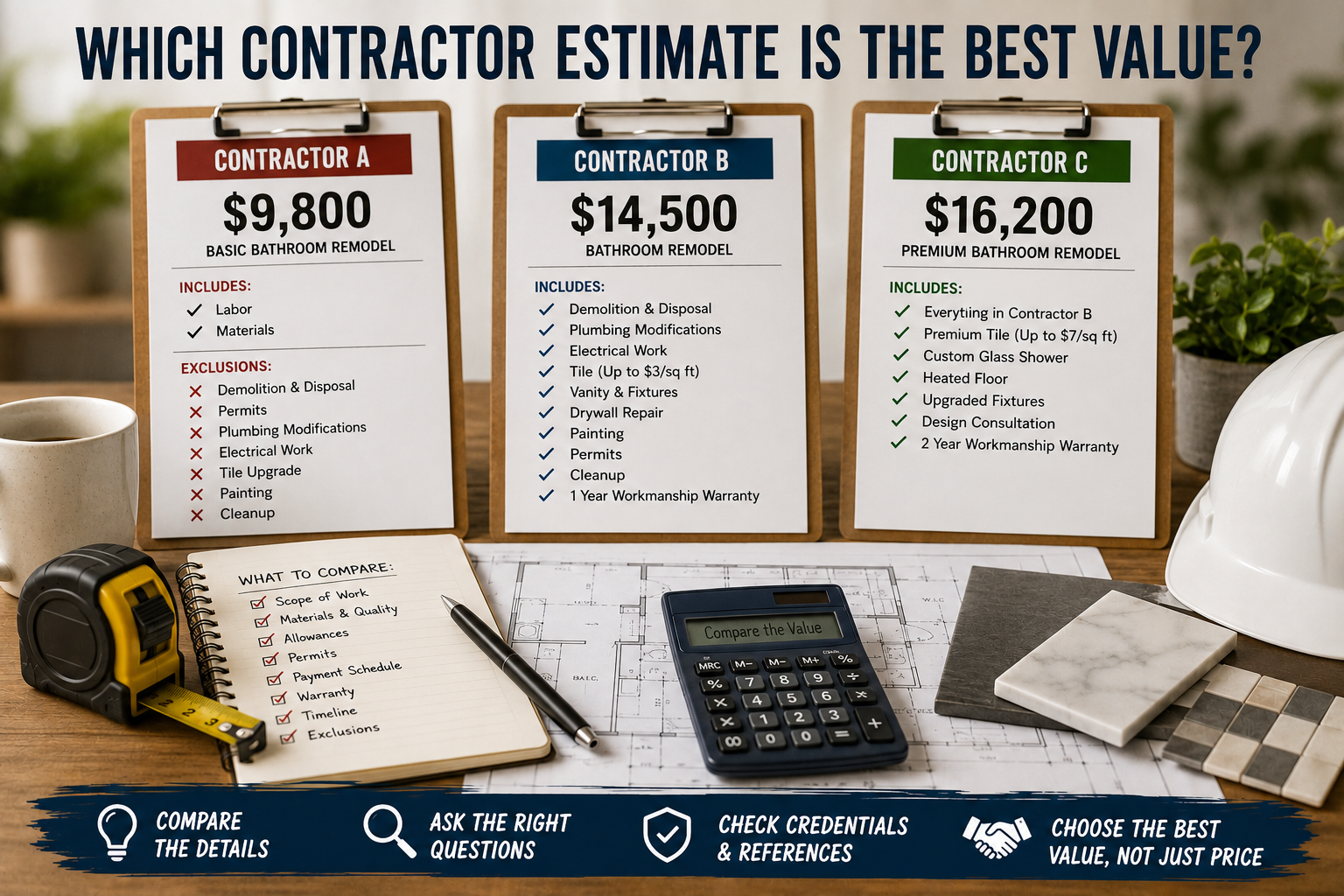
Three contractors walk through your house. They're all quoting the same remodeling project.
A few days later the estimates arrive:
| Contractor | Estimate |
|---|---|
| Contractor A | $9,800 |
| Contractor B | $14,500 |
| Contractor C | $16,200 |
Which one would you hire?
It's tempting to jump straight to Contractor A. That's $6,400 less than the highest bid.
But here's the problem: you don't actually know whether those three contractors quoted the same project.
One estimate might include demolition, disposal, permits, premium materials, preparation, cleanup and warranty coverage. Another might include little more than labor and basic materials.
And that $9,800 estimate? It might legitimately be the best deal of the three. Or it could become the most expensive one the moment construction begins.
The price at the bottom of an estimate tells you surprisingly little until you understand everything above it.
Stop Comparing Prices. Start Comparing Scope.
This is the single biggest lesson in this guide.
Say you're remodeling a bathroom.
Estimate A — $11,500 says: Bathroom remodel — labor and materials included.
Estimate B — $15,300 includes:
- Demolition
- Debris removal
- Plumbing modifications
- Shower waterproofing system
- Specific tile allowance
- Vanity installation
- Electrical modifications
- Exhaust fan
- Drywall repair
- Painting
- Trim
- Permit allowance
- Final cleanup
- Written warranty
At first glance, Estimate A is $3,800 cheaper. But is it? You can't answer that yet, because you don't know whether Estimate A covers half the work listed in Estimate B.
Your first question shouldn't be "Why are you more expensive?" It should be:
"Exactly what is included — and what isn't?"
That one question changes how you evaluate every contractor on your list.
Why Contractor Estimates Can Be Thousands of Dollars Apart
Homeowners often assume contractors should all land on roughly the same price. Real projects aren't that simple.
Two legitimate contractors can arrive at very different numbers because they have different:
- Labor costs
- Crew structures
- Material suppliers
- Insurance expenses
- Overhead
- Equipment
- Subcontractors
- Warranty programs
- Project-management systems
- Material quality
- Scope assumptions
One contractor might send an experienced in-house crew and finish in two weeks. Another leans heavily on subcontractors. One includes premium materials, another quotes builder-grade. One includes permits, another expects you to pull them.
The difference isn't automatically dishonesty. Your job is to discover what the difference actually represents.
The $9,800 Estimate That Becomes $15,200
Here's a hypothetical that plays out constantly.
You accept an estimate for $9,800. Construction begins. Then:
| Item | Cost |
|---|---|
| Original estimate | $9,800 |
| Demolition/disposal not included | +$1,200 |
| Floor preparation | +$900 |
| Electrical work | +$1,100 |
| Permit-related costs | +$500 |
| Additional finishing work | +$700 |
| Hidden damage found after demolition | +$1,000 |
| New total | $15,200 |
Notice something important: this does not necessarily mean the contractor scammed you. Some costs — especially genuinely hidden damage — can't be known before demolition.
The real problem is that the homeowner compared a $9,800 incomplete scope against a $14,500 comprehensive scope and assumed the first one was cheaper.
That's why detailed estimates matter.
The Most Important Line May Be the One That's Missing
Homeowners naturally look for what's included. Experienced homeowners look for exclusions.
Before signing, ask: "What is specifically NOT included in this price?" Write the answer down.
Common exclusions include permits, engineering, architectural plans, demolition, hauling, dump fees, painting, drywall repair, electrical upgrades, plumbing modifications, subfloor repair, floor leveling, landscaping repair, material delivery, appliance installation, furniture moving and cleanup.
An exclusion isn't necessarily a red flag. An exclusion you didn't know about can become one.
1. Compare the Exact Scope of Work
Start here before comparing anything else.
Don't accept "Install new siding." You want details:
- What siding, exactly?
- Is old siding being removed?
- Is house wrap included?
- What happens if rotten sheathing is discovered?
- Are trim pieces included?
- Is disposal included?
- Who handles exterior fixtures?
- Will landscaping be protected?
- Who cleans the property afterward?
The larger the project, the more scope matters.
2. Compare Materials — Not Just the Word "Materials"
Two estimates might both say materials included. That tells you almost nothing.
Imagine two roof estimates. One specifies shingle manufacturer, product line, underlayment, ice-and-water protection where required, flashing, ventilation components, starter shingles and ridge caps. The other says roofing materials.
Those aren't equally useful documents.
Whenever possible, pin down manufacturer, product, grade, model, finish, quantity and allowance. You don't need to become a construction expert — you just need enough information to know whether you're comparing similar products.
3. Understand Allowances Before Signing
This one bites hardest in kitchens and bathrooms.
An allowance is money set aside in the budget for something you haven't picked yet.
Example: the estimate carries a tile allowance of $3 per square foot. You later choose tile at $8 per square foot. That difference becomes additional project cost.
The same thing happens with cabinets, countertops, faucets, lighting, flooring, appliances, hardware and plumbing fixtures.
This is one reason a remodel can climb in price even when the contractor did nothing wrong.
Before signing, ask: "Which items in this estimate are allowances?" Then: "Are these allowances realistic for the products we're expecting?"
Have that conversation before construction, not during.
4. Understand the Change-Order Process
A change order modifies the original scope, price, materials or schedule.
Some change orders happen because you changed your mind — you want better countertops. That's your change.
Others happen because construction reveals a legitimate hidden problem. The shower wall comes down and damaged framing appears. That's different.
Trouble starts when extra work begins before everyone agrees on what changed, why, what it costs and whether it affects the schedule.
Before signing, ask: "How are change orders approved?" and "Will I see the price before additional work begins?"
5. Compare Payment Schedules
Two $20,000 contracts can expose you to wildly different financial risk depending on when money is due.
Payments may be tied to a deposit, material delivery, demolition completion, rough-in completion, inspection milestones, installation milestones, substantial completion or final walkthrough.
Structures vary by project and jurisdiction. What matters is understanding what triggers each payment.
Be especially cautious about paying nearly the entire project price before meaningful work is done. Check applicable state and local law, too — deposit limits vary.
6. Compare Timelines
Contractor A: $18,000, estimated completion three weeks. Contractor B: $16,500, estimated completion eight weeks.
Which is better? Again — you don't know yet. Maybe the timeline doesn't matter. But if you're remodeling your only bathroom, six extra weeks matters enormously.
Ask:
- When can work begin?
- Roughly how long should the project take?
- Will the crew work continuously?
- Are there known material lead times?
- What could delay completion?
- Who communicates schedule changes?
Don't assume "start date" and "completion time" mean the same thing.
7. Compare Warranties Carefully
"Warranty included." Great — what warranty?
Ask whether coverage applies to workmanship, materials, labor or specific components. Then ask how long it lasts, who handles manufacturer claims, what isn't covered and whether it's provided in writing.
A ten-year manufacturer material warranty is not the same thing as a ten-year workmanship warranty. Know the difference.
8. Verify Insurance and Required Licensing
Requirements vary dramatically by state and locality. Depending on the trade and location, you may need to verify business registration, trade license, contractor license, general liability insurance, workers' compensation coverage and specialty certifications.
Don't assume a website, a truck and business cards mean everything checks out. And don't rely on a screenshot — verify licensing through the appropriate government authority and confirm insurance documentation is current.
9. Who Is Actually Doing the Work?
You loved the person who sold you the project. Will they ever come back? Maybe. Maybe not.
Ask: "Who will actually be working in my home?" The answer might be company employees, a dedicated crew, subcontractors, several specialty subs, or a combination.
Subcontracting isn't a problem — it's normal. What matters is knowing who supervises the project, who your main contact is, who owns quality control and who handles problems.
You want accountability.
10. Don't Let a Beautiful Estimate Fool You
A polished proposal is nice. It isn't proof of quality.
The reverse is true too: a skilled small contractor may hand you a simpler document than a large firm with expensive proposal software.
Evaluate the substance. Not the logo, not the presentation, not the salesperson.
11. Don't Assume the Most Expensive Contractor Is the Best
High prices aren't proof of quality either. A contractor can charge more because of higher overhead, heavy advertising spend, larger administrative staff, premium positioning, greater demand or higher margins.
Some expensive contractors are absolutely worth it. Others aren't.
The goal isn't avoid the cheapest contractor. It's understand what you're paying for.
The Contractor Estimate Scorecard
Compare every bid side by side before choosing.
| What to compare | Bid #1 | Bid #2 | Bid #3 |
|---|---|---|---|
| Total price | ☐ | ☐ | ☐ |
| Detailed scope | ☐ | ☐ | ☐ |
| Materials specified | ☐ | ☐ | ☐ |
| Labor included | ☐ | ☐ | ☐ |
| Demolition | ☐ | ☐ | ☐ |
| Disposal / cleanup | ☐ | ☐ | ☐ |
| Permits | ☐ | ☐ | ☐ |
| Allowances identified | ☐ | ☐ | ☐ |
| Change-order process | ☐ | ☐ | ☐ |
| Payment schedule | ☐ | ☐ | ☐ |
| Start timeframe | ☐ | ☐ | ☐ |
| Estimated duration | ☐ | ☐ | ☐ |
| Warranty | ☐ | ☐ | ☐ |
| Insurance verified | ☐ | ☐ | ☐ |
| Required licensing checked | ☐ | ☐ | ☐ |
| References / reviews checked | ☐ | ☐ | ☐ |
| Exclusions identified | ☐ | ☐ | ☐ |
Save this table before you start interviewing contractors.
The 7 Questions to Ask Every Contractor
If you remember nothing else from this guide, remember these:
- What exactly is included?
- What exactly is NOT included?
- Which costs are allowances rather than fixed prices?
- How do you handle change orders?
- What could realistically increase this price?
- What warranty do I receive?
- Who will manage my project from beginning to end?
The Question Almost Nobody Asks
You've received a $14,500 estimate. Try this:
"If you were trying to reduce this project by $2,000 without cutting corners, what would you change?"
That's a far better question than "Can you knock $2,000 off?"
You're asking the contractor to help you value-engineer the project. Maybe there's a less expensive material, a feature you don't need, work you can postpone, a simpler design, an alternative product or a portion you can finish later.
You're reducing scope intelligently instead of demanding the same work for less money.
Red Flags That Deserve More Investigation
One red flag doesn't prove dishonesty. But these should make you slow down:
- Refusing to provide a written estimate
- Pressure to sign immediately
- Refusing to explain pricing
- Large unexplained upfront payment requests
- No verifiable insurance
- Required licensing that can't be verified
- Vague material descriptions
- No written change-order process
- No clear business contact information
- Refusal to provide references
- Encouraging you to skip required permits
- Price dramatically below other bids with no clear explanation
The correct response isn't panic. It's asking more questions.
Green Flags Matter Too
Homeowners spend so much energy hunting for scams that they overlook signs of professionalism.
Good signs include a contractor who explains what you don't need, tells you when a cheaper option makes sense, clearly identifies uncertainties, documents changes, provides detailed scopes, answers uncomfortable questions, encourages you to compare proposals, sets realistic expectations, doesn't promise things outside their control and communicates consistently.
A contractor who says "You don't need to replace that yet" is demonstrating something more valuable than salesmanship. They're demonstrating judgment.
The Cheapest Bid Could Still Be the Best Bid
Fixly Guide isn't here to scare you away from affordable contractors.
Sometimes the cheapest contractor really is the right choice. Maybe they own their equipment, carry lower overhead, don't spend heavily on advertising, have excellent supplier pricing, run a smaller company, specialize in exactly your project type or operate an efficient crew.
If the scope is comparable, credentials check out, references are strong and communication is excellent, there's nothing wrong with choosing the lowest bid.
Price matters. It just shouldn't be the only thing that matters.
What If All Three Estimates Recommend Different Work?
This happens more than you'd think. One contractor recommends repair. Another recommends partial replacement. The third wants to tear everything out.
Don't immediately decide which one you trust most. Ask each: "Why are you recommending this approach?"
Then ask them to show you. Photos help. Measurements help. Manufacturer requirements help. Building-code requirements help. Clear explanations help most of all.
If it's a major financial decision and recommendations vary dramatically, paying for an independent professional evaluation can be money well spent.
What If a Contractor Won't Break Down Every Dollar?
That doesn't automatically mean they're hiding something. Contractors structure estimates differently — some line-item everything, others price complete scopes because individual costs are interconnected.
You don't need to know a contractor's profit on every board and screw. You do need to understand what you're receiving, what you're not receiving, what materials are used, how changes are priced, when payments are due and what happens when something unexpected appears.
That's enough to make an informed decision.
Should You Tell Contractors the Other Bid Prices?
Avoid turning your project into an auction where contractors just race to undercut each other.
Instead, use competing estimates to identify differences:
"Another contractor included replacing the flashing. I don't see that in your proposal. Is it included?"
Or:
"One estimate includes permit costs and yours doesn't. Who handles the permit?"
Now you're comparing scope instead of playing contractors against each other. Much more productive.
Before You Sign: The 10-Minute Test
Put the contract down and set a timer for ten minutes. See whether you can answer these without calling the contractor:
- What exactly are they building or repairing?
- Which materials are being used?
- What does it cost?
- When are payments due?
- When should work begin?
- Roughly how long should it take?
- How are changes handled?
- What warranty do I receive?
- What's excluded?
- Who do I contact when something goes wrong?
If the paperwork can't answer most of those, you need more information before signing.
Don't Hire a Price — Hire a Contractor
That sounds obvious, but homeowners forget it while staring at three numbers.
You're hiring someone to enter your home, work around your family, open walls, handle expensive materials, make decisions that affect your property for years, solve unexpected problems and stand behind the finished work.
The best contractor isn't necessarily the cheapest. It isn't necessarily the most expensive. It's the one offering the right combination of competence, transparency, scope, communication and value for your particular project.
The Bottom Number Is Just the Beginning
Back to our original three estimates: $9,800, $14,500, $16,200.
Which should you choose? After reading this guide, the honest answer is "I don't have enough information yet."
That's exactly the point.
Compare scope, materials, allowances, permits, insurance, payment schedules, timelines, change orders, warranties, exclusions and references. Then compare price.
Sometimes the winner will be the $9,800 contractor. Sometimes the $14,500 contractor. Sometimes the $16,200 contractor. The informed homeowner knows how to figure out why.
Need a Contractor?
Before requesting estimates, get clear on your project, budget and priorities. Then compare qualified professionals on more than price.
Fixly Guide helps homeowners understand their projects first — and connect with qualified local contractors when professional help makes sense.
Related Guides
Questions to ask before you sign
Ask every contractor the same questions and the cheapest bid stops looking cheapest. Check them off as you go — your progress is saved on this device.
Free, no signup. Bring this to every walkthrough so you compare bids on the same terms.
What should this project cost?
Enter your project details for a realistic cost range before you call anyone.
Cost depends heavily on which system turns out to be the source.
- Regional adjustment
- National average
- Labor share (typical)
- ~$1,620
- Quotes to collect
- 3 written estimates
Educational estimate based on national averages — not a binding quote. Always confirm with written local estimates.
Check these numbers against your project
National averages are a starting point. These tools narrow it to your scope and ZIP.
- Estimate this projectGet a cost range for your scope and ZIP before you call anyone.Open
- Get local estimatesSend one request and compare written estimates from vetted pros.Open
Free, no signup required. Estimates are educational guidance, not a quote or an inspection.
Recommended for DIYers & woodworkers
Sponsored
The Top 20 Tools for Workshops of Any Budget
No stationary machines or power tools required — plus 3 fundamental tools that can't be bought at any price.
Get the free guide
Ted's Woodworking — The #1 Woodworking Resource
Detailed instructions, dimensioned drawings, materials & cutting lists, and 3D schematics for every skill level.
See the plansSponsored: links above are affiliate links. FixlyGuide may earn a commission on qualifying purchases — at no extra cost to you.
Frequently asked questions
Should I always get three contractor estimates?+
Three is a useful rule of thumb for significant projects because it gives you comparison points, but there is no magic number. The goal is to gather enough information to understand reasonable scope, pricing and approaches for your specific job.
Should I choose the middle bid?+
Not automatically. The middle price is not inherently safer than the lowest or highest. Choose based on scope, qualifications, communication, materials, warranty, references and overall value.
Why is one contractor so much cheaper than the others?+
Ask them directly. There may be a perfectly legitimate explanation — lower overhead, owned equipment, better supplier pricing or a smaller crew. If they can clearly explain the difference and the scope is comparable, a lower price can be excellent value. If the scope is thinner, you are not comparing the same project.
Can a contractor increase the price after I sign?+
Costs can change when scope changes, the homeowner requests upgrades, allowances are exceeded, or legitimate unforeseen conditions are discovered. Your contract and applicable law govern how those situations are handled, which is why you should understand the change-order process before construction begins.
Should I negotiate a contractor estimate?+
You can discuss budget, but instead of demanding an arbitrary discount, ask whether cost can be reduced through alternative materials, simplified design, revised scope or phasing the work. Ask what the contractor would change to cut $2,000 without cutting corners.
What should a contractor estimate always include?+
A detailed scope of work, specified materials, labor, demolition and disposal, permit responsibility, allowances, a payment schedule, a timeline, warranty terms, the change-order process, and a clear list of exclusions.
Should I tell contractors what the other bids were?+
Avoid turning the project into an auction. Instead, use competing estimates to ask about specific scope differences, such as whether flashing replacement or permit fees are included. That compares scope rather than pressuring contractors to undercut each other.


Discussion
Loading comments…