- The 4 Critical Power Tools Every New Homeowner FORGETS to Buy (Don't Be One of Them) — New homeowners often overlook essential power tools that make common home repairs and maintenance tasks significantly easier. Learning whic…
- The 5 Essential Tools Every New Gardener Needs (And 3 You Can Skip) — Starting a garden doesn't require a huge investment in tools; savvy new gardeners can thrive with just a few key items and save money by kn…
- 7 Inspection Red Flags That Secretly Signal a $20,000 Bill — Don't let your dream home become a money pit. Many buyers and even some inspectors overlook subtle home inspection red flags that lead to f…
- The Secret 5 Bugs Invading Homes (It's Not Just Lanternflies) — Discover the five most common invasive bugs pest professionals treated last year that homeowners often overlook, and learn how to protect y…
- 7 Hidden Equity Drains Costing You Thousands Annually — Your home is an asset, but silent problems like minor leaks, poor insulation, and deferred maintenance can drain its value. Discover the se…
Published June 8, 2026Last updated August 17, 2026
Tools & materials you'll need
Affiliate links- AmazonCordless Drill Kit12V or 18V with drill and driver bits
- AmazonBasic Hand Tool SetIncludes screwdrivers, pliers, adjustable wrench, hammer, tape measure
- AmazonWet/Dry Shop Vacuum2-5 gallon capacity for home use
- AmazonFlange PlungerSpecifically for toilets, creates a better seal
- AmazonElectronic Stud FinderWith deep-scan functionality if possible
- AmazonDigital MultimeterBasic model sufficient for voltage and continuity checks
- AmazonCaulk GunSmooth rod or dripless model recommended
- AmazonSafety Glasses
- AmazonAll-purpose Caulk1 tube
As an Amazon Associate FixlyGuide earns from qualifying purchases — at no extra cost to you. Prices and availability are accurate as of publication and subject to change.
Quick Answer
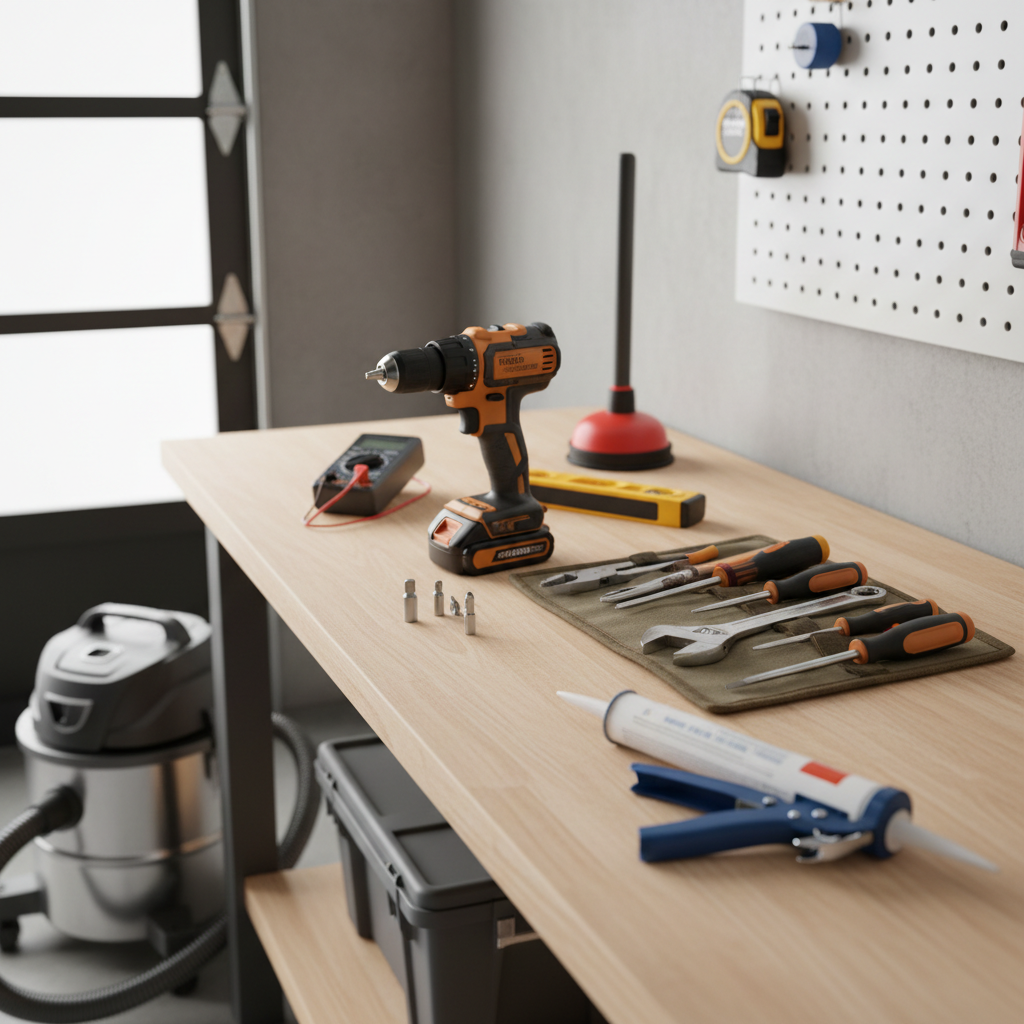
Moving into a new home is exciting, but it quickly reveals the need for proper tools. The seven most critical tools every new homeowner should acquire early are a cordless drill, a comprehensive hand tool set, a wet/dry shop vacuum, a high-quality plunger, a reliable stud finder, a basic multimeter, and a good caulk gun. These tools empower you to tackle common household issues, from hanging pictures and assembling furniture to minor plumbing fixes and electrical diagnostics, saving both time and money in the long run.
The Problem
You’ve just bought a house. Congratulations! Now comes the often-unforeseen reality: things break, things need assembly, and things need maintenance. Many new homeowners find themselves scrambling to borrow tools from neighbors, making multiple trips to the hardware store, or worse, calling a professional for simple tasks that could easily be DIYed with the right equipment. The problem isn't just about having any tools; it's about having the right tools – those foundational items that empower you to handle the inevitable small issues that arise, preventing them from escalating into bigger, more expensive problems.
Without these essential tools, even minor tasks like tightening a loose cabinet hinge, unclogging a toilet, or hanging a shelf become frustrating ordeals. You might end up damaging fixtures by using the wrong tool, putting off necessary repairs, or overspending on professional services for straightforward jobs. The upfront cost of acquiring these core tools is an investment that pays dividends in convenience, capability, and long-term savings.
How It Works
Understanding how basic tools work helps you appreciate their value and use them effectively. Take the cordless drill, for instance. At its heart is a powerful electric motor, usually powered by a rechargeable lithium-ion battery (typically 12V or 18V for home use). This motor spins a chuck, which securely holds various drill bits or screwdriver bits. The drill's clutch setting allows you to control the torque, preventing you from over-driving screws or stripping screw heads. The speed setting (often low for driving screws, high for drilling) provides versatility for different materials. A drill makes quick work of assembly, hanging, and minor repair tasks around the house, from putting together flat-pack furniture to mounting curtain rods.
The hand tool set encompasses a range of manual implements. Screwdrivers (Phillips and flathead) rely on leverage and rotational force to drive or remove fasteners. Their tips are designed to fit specific screw head types for maximum grip. Wrenches (adjustable or combination) use leverage to turn nuts and bolts, designed to fit snugly around hexagonal or square fasteners. Pliers provide grip and leverage for bending, cutting, or holding small objects. These tools require an understanding of mechanical advantage – using a longer handle provides more leverage for the same amount of force. For example, a longer screwdriver allows you to apply more torque with less effort. Hammers use kinetic energy: the weight of the head, combined with the force of your swing, drives nails. It’s a simple force transfer, but proper technique prevents bent nails and damaged surfaces.
A wet/dry shop vacuum is essentially a powerful air pump. It uses an electric motor to create a strong suction, drawing in air and debris. Unlike a regular household vacuum, it's designed to handle both dry dirt and liquids, thanks to a robust motor, a larger capacity tank, and often specialized filters that can be swapped for wet or dry use. The air travels through a hose and into the collection tank, where a filter separates solid particles before the air is expelled. For liquids, a float mechanism prevents the tank from overfilling and damaging the motor. This makes it invaluable for cleaning up spills, sawdust, or even clogged drains.
A stud finder utilizes sensors to detect changes in wall density. Most electronic stud finders use an electrical capacitance sensor. When you slide the device across a wall, it measures the wall's dielectric constant. When it passes over a denser object, like a wooden or metal stud, the dielectric constant changes, triggering an alert (light, sound). This allows you to accurately locate framing members behind drywall, crucial for securely hanging heavy items without damaging plumbing or electrical wires. Magnetic stud finders are simpler, detecting the metal screws or nails used to attach drywall to studs.
A multimeter is an electronic measuring instrument. It combines several measurement functions in one unit, typically measuring voltage (volts), current (amps), and resistance (ohms). It works by using a sensitive internal circuit to detect and display these electrical properties. When measuring voltage, it senses the potential difference between two points. For current, it measures the flow of electrons through a circuit. Resistance measures how much a component opposes the flow of current. For the homeowner, it’s a diagnostic tool, allowing you to check if an outlet is live, a battery has power, or a switch is faulty, preventing dangerous guesswork with electrical circuits.
A caulk gun is a mechanical dispenser. It holds a tube of sealant (caulk) and, when you squeeze the trigger, a rod pushes a plunger into the tube, forcing the caulk out of the nozzle. The trigger mechanism uses a ratchet system or a smooth rod to apply consistent pressure, ensuring an even bead of caulk. This allows you to seal gaps, cracks, and joints around windows, doors, bathtubs, and sinks, preventing water damage, drafts, and pest entry.
Step-by-Step Fix
While these aren't
Related Articles
Keep troubleshooting with these hand-picked guides from FixlyGuide:
- The 4 Critical Power Tools Every New Homeowner FORGETS to Buy (Don't Be One of Them) — New homeowners often overlook essential power tools that make common home repairs and maintenance tasks significantly easier. Learning whic…
- The 5 Essential Tools Every New Gardener Needs (And 3 You Can Skip) — Starting a garden doesn't require a huge investment in tools; savvy new gardeners can thrive with just a few key items and save money by kn…
- 7 Inspection Red Flags That Secretly Signal a $20,000 Bill — Don't let your dream home become a money pit. Many buyers and even some inspectors overlook subtle home inspection red flags that lead to f…
- The Secret 5 Bugs Invading Homes (It's Not Just Lanternflies) — Discover the five most common invasive bugs pest professionals treated last year that homeowners often overlook, and learn how to protect y…
- 7 Hidden Equity Drains Costing You Thousands Annually — Your home is an asset, but silent problems like minor leaks, poor insulation, and deferred maintenance can drain its value. Discover the se…
- The #1 HVAC Mistake That Costs Homeowners $500 Every Year — Discover the crucial HVAC maintenance step homeowners often overlook, leading to higher energy bills, frequent repairs, and premature syste…
Your seasonal maintenance checklist
The small jobs that prevent the expensive repairs. Tick them off — progress saves on this device.
Free, no signup. Skip anything that requires roof access or working near live electrical.
What should this project cost?
Enter your project details for a realistic cost range before you call anyone.
Cost depends heavily on which system turns out to be the source.
- Regional adjustment
- National average
- Labor share (typical)
- ~$1,620
- Quotes to collect
- 3 written estimates
Educational estimate based on national averages — not a binding quote. Always confirm with written local estimates.
Before you start
Check the difficulty, permits, and safety risk — then decide whether to call a pro.
- Is this a safe DIY job?Check permits, tools, and risk before you start the steps below.Open
- Estimate this projectGet a cost range for your scope and ZIP before you call anyone.Open
- Get local estimatesSend one request and compare written estimates from vetted pros.Open
Free, no signup required. Estimates are educational guidance, not a quote or an inspection.
This article was independently written by FixlyGuide based on the source topic.
Frequently asked questions
What's the absolute first tool a new homeowner should buy?+
The absolute first tool a new homeowner should invest in is a good quality cordless drill. It's incredibly versatile for assembly, hanging, and minor repairs, saving countless hours and preventing frustration.
Can I really save money by owning these tools?+
Absolutely. Owning these foundational tools allows you to tackle numerous small repairs and projects yourself, avoiding the often-expensive call-out fees for professionals on tasks like hanging shelves, unclogging minor drains, or basic electrical checks.
Should I buy the cheapest version of these tools?+
While it's tempting to go for the cheapest option, especially as a new homeowner, it's often a false economy. Opt for mid-range tools from reputable brands. They offer better durability, performance, and safety, providing a better return on your investment over time.
How do I store all these new tools?+
Start with a sturdy toolbox or a wall-mounted pegboard system for smaller hand tools. For larger items like the wet/dry vac or drill, dedicate a shelf or corner in your garage, utility closet, or basement. Good organization prevents tools from getting lost and extends their lifespan.



Discussion
Loading comments…