- Buying and selling expenses
- Immediate improvements to the new house
- Higher taxes or insurance, depending on the property
- The possibility that the new house still needs renovations
General remodeling · Renovation planning
| Project category | General remodeling |
|---|---|
| Problem type | Renovation planning |
| Trade required | General contracting |
| Urgency | Planned project |
| Safety risk | Low safety risk |
| DIY suitability | Pro recommended |
| Cost category | Major investment |
| Typical timeline | Design and permitting often 2–4 months before work starts |
| Contractor type | General contractor |
Repair option
Phase the work and fix the building envelope first.
Replacement option
Full renovation with permits, design, and a general contractor.
Common causes
- Space no longer fits how the household lives
- Resale preparation
- Deferred maintenance stacking up
Relevant tools:project cost estimatorcompare quoteshome improvement material prices
Published August 16, 2026Last updated August 17, 2026
Tools & materials you'll need
Affiliate linksAs an Amazon Associate FixlyGuide earns from qualifying purchases — at no extra cost to you. Prices and availability are accurate as of publication and subject to change.
Quick Answer
More homeowners are renovating instead of moving in 2026 because they love their locations, housing costs are high, and aging housing stock needs updates. Houzz found 54% of surveyed homeowners renovated in 2025 and 50% plan renovations in 2026, with a median planned spend of $15,000. The best projects solve real problems: kitchen bottlenecks, missing bathrooms, wasted space, home offices, aging-in-place bathrooms, and neglected structural repairs.
Introduction
You love your neighborhood.
Your kids know everyone on the street.
Your commute works.
The backyard is finally the way you want it.
But there's a problem.
The house doesn't work anymore.
Maybe the kitchen is too small. Maybe two people now work from home and neither has an office. Maybe you're tired of sharing one outdated bathroom every morning. Maybe your parents are getting older and you need space for them. Or perhaps you simply look around and think:
“Do we spend money fixing this house—or sell it and start over?”
That's becoming one of the biggest homeownership questions of 2026.
And increasingly, homeowners are choosing a third option: don't buy another house. Turn the one you already own into the house you actually need.
Recent remodeling research shows how significant this movement has become. Houzz found that 54% of surveyed homeowners renovated in 2025, while 50% plan renovations in 2026. Median renovation spending was $20,000 in 2025, although the median planned budget for 2026 has fallen to $15,000—suggesting homeowners are still remodeling, but many are being more selective about where their money goes.
That creates a much more important question than “Should I remodel?”
The better question is: which improvements would make staying in this house worth it?
Let's figure that out.
The House You Bought Isn't Necessarily the House You Need Today
Think about how much a household can change in ten years.
You might have bought your home as newlyweds. Now you have three children. Or the kids have moved out. Maybe you started working remotely. Maybe an aging parent needs somewhere to live. Maybe stairs that never bothered you before are becoming inconvenient. Or perhaps you've simply accumulated ten years of possessions and realized this house has nowhere to put anything.
That's why remodeling isn't always about making a house prettier. Increasingly, it's about making an existing home fit a new stage of life.
Houzz reports that nearly two-thirds of homeowners planning renovations expect to remain in their homes for at least 11 years. That long-term mindset is helping drive interest in adaptable layouts, aging-in-place improvements, and multigenerational living.
That's a major shift. Instead of asking, “Will buyers like this?” more homeowners can reasonably ask, “Will this make our lives better for the next 10 or 20 years?”
Those are very different renovation strategies.
Renovate or Move? Start With This Test
Before calling a Realtor or a remodeling contractor, separate problems with your house from problems with your location.
This distinction matters enormously.
Suppose you dislike your kitchen, your flooring, your bathroom, your storage, or your outdoor living area. Those are potentially fixable.
But suppose you dislike your commute, the neighborhood, the school situation, your lot, your property taxes, or the overall location. A $100,000 remodel won't move your house.
That's why the first question should be: If this exact house were renovated exactly how I wanted it, would I want to stay here?
If the answer is no, be extremely careful about pouring money into major renovations.
If the answer is an immediate yes, remodeling deserves a serious look.
1. Fix the Kitchen That Makes You Want to Move
For many households, the kitchen isn't merely outdated. It doesn't function.
Maybe there's nowhere to prepare food. The pantry is tiny. The refrigerator blocks a walkway. Three people can't stand in the kitchen without bumping into one another. There's nowhere for kids to do homework while dinner is being prepared.
These aren't cosmetic problems. They're lifestyle problems.
And that's where remodeling can have enormous everyday value. But there's an important distinction: you may not need a $75,000 kitchen. Sometimes homeowners assume the solution must be to rip everything out. Not necessarily.
You might get much of the improvement from:
- Better cabinet storage
- New countertops
- Improved lighting
- A redesigned pantry
- Additional outlets
- Better appliance placement
- New flooring
- A more useful island
- Improved traffic flow
The smartest kitchen renovation isn't automatically the most expensive one. It's the one that removes the frustrations you experience every single day.
2. Add a Bathroom Before Adding an Entire House
Here's a familiar scenario: two adults, three kids, one main bathroom. Every weekday morning feels like an airport security line.
A homeowner might conclude: “We need a bigger house.” Maybe. But perhaps what you actually need is another bathroom.
That's why remodeling decisions should begin with bottlenecks. Ask: What repeatedly makes living here difficult?
Sometimes adding or reconfiguring a bathroom can change how an entire household functions without requiring a move. And because plumbing, electrical work, waterproofing, ventilation and permits can make bathroom projects complicated, this is one area where detailed contractor estimates matter.
3. Stop Wasting the Space You Already Own
This is one of my favorite renovation strategies because homeowners frequently overlook it.
Before adding square footage, ask: Are we actually using the square footage we already have?
Think about:
- Formal dining rooms used twice a year
- Spare bedrooms storing boxes
- Oversized hallways
- Poorly designed closets
- Unfinished basements
- Underused lofts
- Awkward bonus rooms
You could have a 2,500-square-foot house that feels smaller than a well-designed 1,900-square-foot home. Why? Layout beats square footage.
Before spending heavily on an addition, ask a designer or experienced remodeling contractor whether your existing footprint could work harder.
4. The Home Office Isn't Going Away
A spare bedroom with a folding table worked when working from home was temporary. Years later, maybe not.
A permanent office doesn't necessarily require an addition. Homeowners can sometimes convert guest bedrooms, closets, dining rooms, loft areas, bonus rooms, or underused corners.
The key isn't simply creating somewhere to put a laptop. It's creating somewhere you can actually work. That means considering sound, doors, lighting, electrical outlets, internet connectivity, storage, video-call backgrounds, heating and cooling.
One intelligently designed office can make a home feel dramatically more functional.
5. The “Forever Home” Bathroom
Here's where 2026 gets particularly interesting. Some of the smartest renovations aren't being designed only for today. They're being designed for 20 years from today.
HIRI's 2026 aging-in-place research found that 53% of aging-in-place projects included bathroom modifications, and 28% of households with an older adult reported difficulty using some aspect of the home.
That makes bathrooms a logical place to think long-term. Consider:
- Walk-in showers
- Lower thresholds
- Better lighting
- Slip-resistant flooring
- Wider access
- Comfortable-height toilets
- Reinforced walls where grab bars could eventually be installed
And here's the important part: accessible doesn't have to look institutional. A well-designed walk-in shower can look like a luxury upgrade today while becoming extremely useful later. That's smart remodeling.
6. Create Space for Parents Without Losing Everyone's Privacy
Multigenerational living creates an interesting design challenge. Families want to be close. They don't necessarily want to be that close.
That's why some homeowners are exploring:
- Garage conversions
- In-law suites
- Private bedroom/bathroom combinations
- Finished basements
- Separate entrances
- Accessory dwelling units (ADUs), where allowed
A well-designed multigenerational space can provide independence while keeping family nearby. But this is not a project to begin without research. Local zoning, permits, utilities, setbacks, parking requirements and ADU rules can significantly affect what's possible. Check local requirements before spending money on architectural plans.
7. Build Outdoor Space You Will Actually Use
There's a big difference between having a backyard and using your backyard.
A neglected patch of grass may technically be outdoor space. But add the right deck, patio, shade structure, lighting, seating, outdoor kitchen, or landscaping, and suddenly you've created another living area.
The mistake is building the backyard you saw online instead of the backyard your family will actually use. If nobody cooks outside, maybe you don't need a $20,000 outdoor kitchen. Maybe you need a shaded patio, comfortable furniture and a place for the grill you already own.
Design around behavior—not trends.
8. Storage May Be More Valuable Than More Square Footage
Ask homeowners what they need and many will say: “More space.” Ask them what is driving them crazy and you'll often hear: “We have nowhere to put anything.”
Those aren't necessarily the same problem.
Before building an addition, consider:
- Full-height kitchen cabinets
- Pantry systems
- Built-in shelving
- Garage storage
- Closet systems
- Under-stair storage
- Mudroom cabinetry
- Laundry storage
A house full of clutter feels small. A house where everything has a place can feel significantly larger.
9. Don't Ignore the Expensive Boring Stuff
Here's the renovation advice nobody wants to hear: the beautiful kitchen may need to wait.
If your house has an aging roof, foundation movement, plumbing problems, unsafe electrical equipment, failing HVAC, serious drainage issues, or active water intrusion, those should generally take priority.
There is very little joy in installing $25,000 worth of beautiful flooring and then discovering water damage underneath it.
Think of your renovation budget in this order:
- Protect the structure.
- Protect the people.
- Improve function.
- Improve appearance.
That order isn't exciting. It's smart.
10. Don't Remodel Yourself Into a Financial Trap
This is where homeowners need discipline. Just because you can renovate doesn't mean you should spend everything you can borrow.
Houzz found the median planned renovation budget declined from $20,000 for 2025 to $15,000 for 2026. Meanwhile, rising product and material costs were the most commonly anticipated renovation challenge in its plans survey, cited by 63% of respondents.
Budget pressure is real. Before committing to a major project, understand the complete estimated cost, financing costs, permit costs, design fees, temporary living expenses, material upgrades, potential change orders, and contingency funds.
Don't compare the cost of remodeling only with doing nothing. Compare it with the total cost of moving.
Here's the Calculation Most Homeowners Forget
Suppose you're considering a $60,000 renovation. That sounds enormous. So you begin looking at houses. But the comparable house that solves your problems costs substantially more than your current home.
Now consider everything involved in moving:
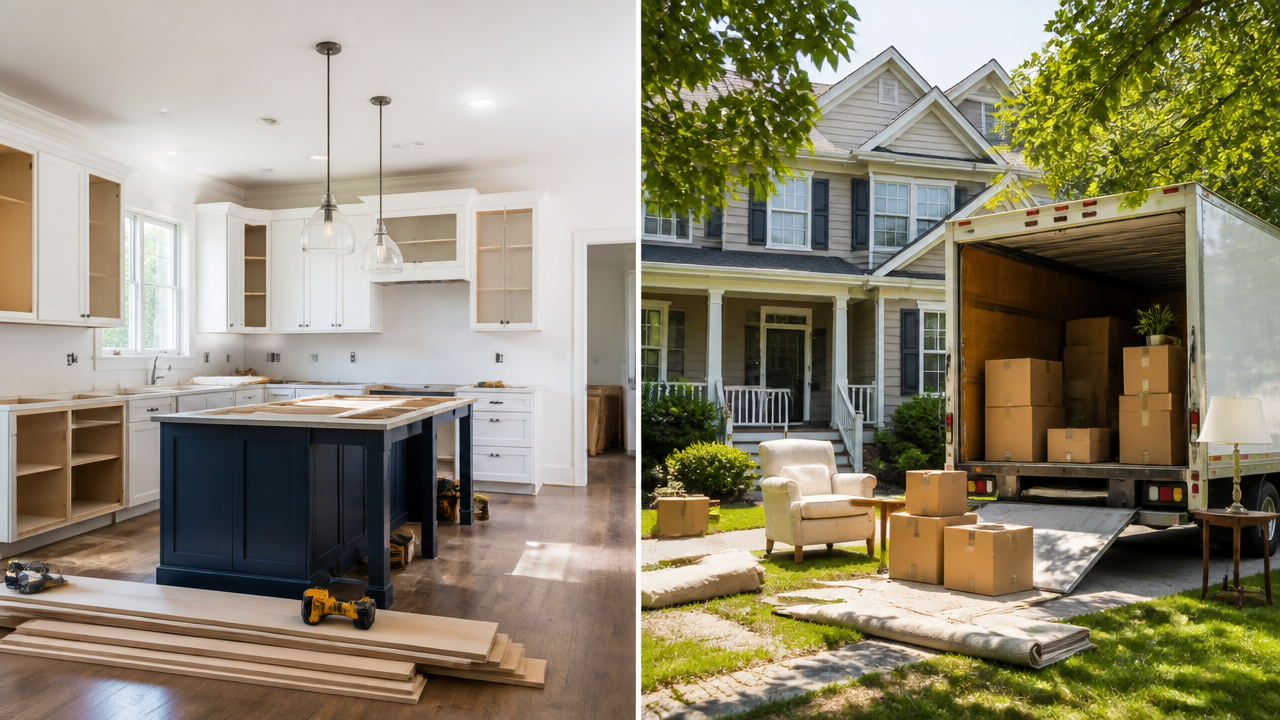
- Buying and selling expenses
- Moving costs
- Repairs before listing
- New furniture
- Immediate improvements to the new house
- Financing differences
- Higher taxes or insurance, depending on the property
- The possibility that the new house still needs renovations
Suddenly the question isn't: “Is $60,000 a lot of money?” Of course it is.
The question becomes: Which option leaves us with the better home and financial position? That's the calculation worth making.
The $50,000 Question: What Would You Change?
Try this exercise tonight. Walk outside, turn around, and pretend you've never seen your house before. Then walk through the front door like you're considering buying it. Don't think like the owner. Think like a buyer.
What immediately bothers you? Write down the first five things. Now label each:
- REPAIR
- FUNCTION
- COSMETIC
- LOCATION
You'll probably learn something interesting. If most complaints are cosmetic or functional, renovation may solve them. If most involve location or fundamental property limitations, moving may deserve more consideration.
Renovations That Can Make Staying Easier
For homeowners who genuinely like where they live, these categories often deserve consideration:
Function
- Kitchen layout improvements
- Additional bathroom
- Better storage
- Laundry improvements
- Home office
Comfort
- HVAC upgrades
- Insulation
- Windows where replacement is warranted
- Shade and outdoor living improvements
Long-Term Living
- First-floor bedroom
- Walk-in shower
- Reduced thresholds
- Better lighting
- Wider access
Maintenance
- Roofing
- Siding
- Drainage
- Plumbing
- Electrical upgrades
Lifestyle
- Deck or patio
- Finished bonus space
- Hobby room
- Home gym
- Multigenerational space
The right project depends on what your house is preventing you from doing today.
When Moving Is Probably the Better Choice
Remodeling isn't always the answer. Moving may make more sense if:
- You need a different location. You can't remodel your commute or school district.
- You need dramatically more space. Turning a 1,200-square-foot home into a 3,000-square-foot home may not be practical.
- The lot doesn't work. If you need acreage and own a small city lot, renovation won't solve that.
- The required renovation is financially unrealistic. At some point, modifying the house may cost more than finding one that already meets your needs.
- You simply don't like the house. If you don't like the architecture, neighborhood, property or overall feel of the home, don't spend a fortune trying to convince yourself otherwise.
When Renovating May Be the Smarter Choice
Renovating becomes especially compelling when:
- You love your location.
- You have enough overall square footage.
- The layout can realistically be improved.
- The house has good structural fundamentals.
- You plan to stay for many years.
- Moving would substantially increase your housing costs.
- The renovation solves a specific recurring problem.
NAHB expects remodeling to remain resilient, citing aging housing stock, the tendency of homeowners to stay put, and aging-in-place needs among the forces supporting the market. In other words, this isn't simply a design trend. It's part of a broader change in how Americans are thinking about their existing homes.
Before Calling a Contractor, Do These 7 Things
Don't begin with: “How much to remodel my house?” Start with a much clearer plan.
- Write down the problems you're trying to solve.
- Separate must-haves from nice-to-haves.
- Establish a realistic maximum budget.
- Research whether permits may be required.
- Collect examples of what you like.
- Get detailed estimates from qualified contractors.
- Compare scope—not just the bottom-line price.
Houzz found that more than nine in ten homeowners in its renovation-plans survey expected to work with professionals, with general contractors, electricians, builders, plumbers, and design professionals among the commonly hired categories.
The Contractor Question I Want Every Homeowner to Ask
When reviewing an estimate, don't just ask: “What's included?” Ask: “What is NOT included?” That's where surprises often hide.
You may discover the estimate doesn't include:
- Permits
- Demolition
- Disposal
- Painting
- Electrical upgrades
- Plumbing changes
- Material delivery
- Flooring preparation
- Structural repairs
- Finish work
Two $40,000 estimates aren't necessarily quoting the same $40,000 project. Compare them line by line.
Renovate or Move? The Fixly Guide Decision Test
Give yourself one point for every statement that's true:
- We love our neighborhood.
- We plan to stay at least several more years.
- Our biggest complaints can realistically be fixed.
- The house has enough overall space or expansion potential.
- We can renovate without putting ourselves under unreasonable financial pressure.
- The project would noticeably improve everyday life.
- We've compared renovation costs with the realistic cost of moving.
- We're renovating for ourselves—not simply following a trend.
If you checked most of those boxes, improving your existing home deserves serious consideration. If you barely checked any, don't force a house to become something it isn't.
Frequently Asked Questions
Is it cheaper to renovate or move?
There isn't a universal answer. The correct comparison includes the complete renovation budget versus the full financial impact of selling, buying, financing, moving and improving another property.
What renovation should I do first?
Prioritize structural, safety and water-related problems before cosmetic improvements. After those are addressed, focus on changes that solve the biggest everyday problems in the house.
Should I renovate before selling?
Not automatically. Some repairs and improvements may help marketability, but a large remodel shortly before selling doesn't guarantee you'll recover everything spent. Consider local buyer expectations and talk with qualified local real estate professionals before undertaking major resale-focused work.
How many contractor estimates should I get?
For a significant project, comparing multiple detailed written estimates is usually wise. Make sure you're comparing equivalent scopes of work rather than simply choosing the lowest number.
How much should I budget for unexpected renovation costs?
There is no percentage that fits every project. Older houses, demolition-heavy renovations and projects involving hidden plumbing, electrical or structural components generally have more uncertainty. Build a contingency appropriate to the risk and discuss potential unknowns with your contractor before work begins.
Final Thoughts: Maybe You Don't Need a New House
Sometimes the house isn't the problem. The way the house works is the problem. That distinction could save you from making an extremely expensive decision.
Maybe you don't need another 1,000 square feet. Maybe you need better storage. Maybe you don't need another house. Maybe you need another bathroom. Maybe you don't need the giant kitchen you've been saving on Pinterest. Maybe you need better lighting, more counter space and a pantry that actually works.
And maybe the home you've been thinking about leaving could become the home you don't want to leave.
Before putting up the For Sale sign, ask yourself one question: “If we fixed the three things we hate most about this house, would we still want to move?”
Your answer may tell you more than any renovation trend ever could.
Planning a project? Fixly Guide helps homeowners understand repairs, compare options, prepare for contractor estimates and make smarter home-improvement decisions before spending thousands. And when you're ready for professional help, get matched with qualified local contractors through FixlyGuide.com.
Repair or replace this system?
Plug in four numbers and see which choice holds up financially.
Free and instant. Educational guidance only — not a quote, inspection, or professional diagnosis.
Questions to ask before you sign
Ask every contractor the same questions and the cheapest bid stops looking cheapest. Check them off as you go — your progress is saved on this device.
Free, no signup. Bring this to every walkthrough so you compare bids on the same terms.
What should this project cost?
Enter your project details for a realistic cost range before you call anyone.
Scope drives everything — single-room work often $10,000–$40,000; whole-home much higher.
- Regional adjustment
- National average
- Labor share (typical)
- ~$21,825
- Quotes to collect
- 3 written estimates
Educational estimate based on national averages — not a binding quote. Always confirm with written local estimates.
Repair or replace?
Run the age, cost ratio, and repair history through the calculator before you commit.
- Estimate this projectGet a cost range for your scope and ZIP before you call anyone.Open
- Get local estimatesSend one request and compare written estimates from vetted pros.Open
Free, no signup required. Estimates are educational guidance, not a quote or an inspection.
Recommended for DIYers & woodworkers
Sponsored
The Top 20 Tools for Workshops of Any Budget
No stationary machines or power tools required — plus 3 fundamental tools that can't be bought at any price.
Get the free guide
Ted's Woodworking — The #1 Woodworking Resource
Detailed instructions, dimensioned drawings, materials & cutting lists, and 3D schematics for every skill level.
See the plansSponsored: links above are affiliate links. FixlyGuide may earn a commission on qualifying purchases — at no extra cost to you.
Frequently asked questions
Is it cheaper to renovate or move?+
There is not a universal answer. The correct comparison includes the complete renovation budget versus the full financial impact of selling, buying, financing, moving and improving another property.
What renovation should I do first?+
Prioritize structural, safety and water-related problems before cosmetic improvements. After those are addressed, focus on changes that solve the biggest everyday problems in the house.
Should I renovate before selling?+
Not automatically. Some repairs and improvements may help marketability, but a large remodel shortly before selling does not guarantee you will recover everything spent. Consider local buyer expectations and talk with qualified local real estate professionals before undertaking major resale-focused work.
How many contractor estimates should I get?+
For a significant project, comparing multiple detailed written estimates is usually wise. Make sure you are comparing equivalent scopes of work rather than simply choosing the lowest number.
How much should I budget for unexpected renovation costs?+
There is no percentage that fits every project. Older houses, demolition-heavy renovations and projects involving hidden plumbing, electrical or structural components generally have more uncertainty. Build a contingency appropriate to the risk and discuss potential unknowns with your contractor before work begins.

Discussion
Loading comments…