- If it's on you or a pet, use fine-tipped tweezers to grasp the tick as close to the skin's surface as possible and pull upward with steady, even pressure. Do not twist or jerk.
- If found on bedding or furniture, carefully pick it up with tape, tweezers, or a damp paper towel. Place it in a sealed clear bag or a small container with a tiny piece of damp paper towel to keep it alive for identification.
- Safety Note: Never handle ticks with bare hands. Always use gloves or tweezers, especially if it appears engorged with blood.
Published June 25, 2026Last updated August 17, 2026
Tools & materials you'll need
Affiliate linksAs an Amazon Associate FixlyGuide earns from qualifying purchases — at no extra cost to you. Prices and availability are accurate as of publication and subject to change.
Quick Answer
While both ticks and bed bugs are small, blood-feeding pests, they differ significantly in appearance, behavior, and the risks they pose. Ticks are arachnids, often found outdoors or carried in by pets, and can transmit diseases. Bed bugs are insects, primarily indoor pests, and their bites are usually just irritating. Correct identification is key to proper eradication and avoiding health issues.
The Problem
Imagine waking up with itchy red welts. Your mind immediately jumps to bed bugs – the nightmare scenario. You strip the bed, wash everything in hot water, and maybe even buy an expensive bug bomb. But what if those bites (or the tiny creature you glimpsed) weren't from a bed bug at all? What if they were from a tick? This common misidentification isn't just a waste of time and money; it can be dangerous. Treating for bed bugs when you have ticks leaves you vulnerable to tick-borne illnesses like Lyme disease or Rocky Mountain spotted fever. Conversely, assuming you have ticks when bed bugs are the culprit means these tenacious pests will continue to multiply, turning a nuisance into a full-blown infestation. Distinguishing between them quickly and accurately is the first critical step in protecting your home and family's health.
How It Works
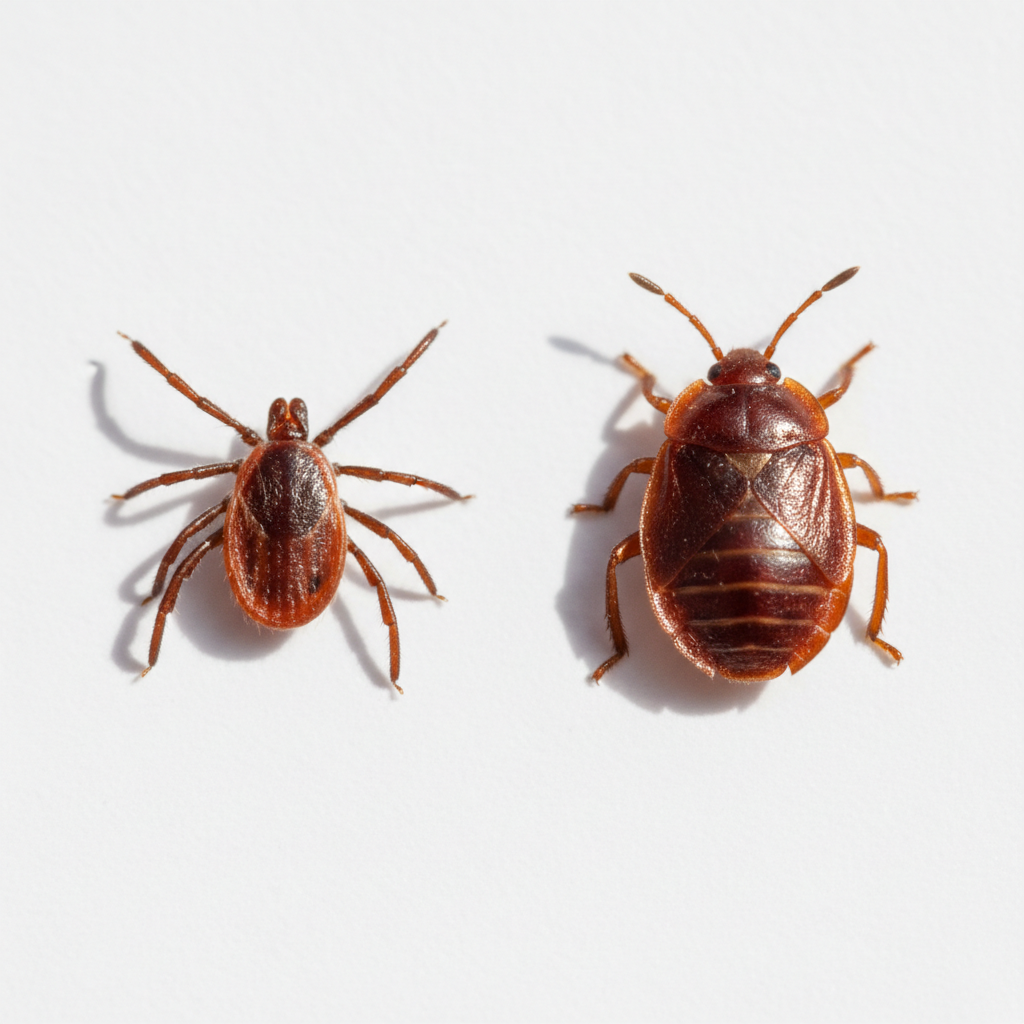
Understanding the fundamental biology of ticks and bed bugs is the secret to telling them apart. Ticks are not insects; they are arachnids, closely related to spiders and mites. This means they have eight legs in their adult stage, not six. Their bodies are typically oval-shaped, unsegmented, and flattened before feeding, becoming engorged and more spherical afterward. Ticks are obligate parasites, meaning they must feed on blood to survive and progress through their life stages (larva, nymph, adult). They quest for hosts by waiting on vegetation, sensing exhaled carbon dioxide, body heat, and vibrations. Once attached, they can feed for several days. Their outdoor habitat preference means they usually enter homes on people or pets.
Bed bugs, on the other hand, are true insects with six legs, distinct antennae, and three body segments (head, thorax, abdomen). They have a flattened, oval-shaped body but are broader and brick-red to reddish-brown, especially after feeding. Unlike ticks, bed bugs spend almost their entire lives indoors, primarily in close proximity to their human hosts – beds, upholstered furniture, and cracks in walls. They are nocturnal feeders, emerging at night to bite exposed skin. While their bites cause itchy welts, bed bugs are not known to transmit diseases to humans. They multiply rapidly, with females laying several eggs daily, making early detection vital for containment. The key takeaway is: ticks are outdoor hitchhikers and disease vectors, while bed bugs are indoor colonizers and irritants.
Step-by-Step Fix
1. Capture the Suspect — Gently secure the pest without crushing it for identification.
- If it's on you or a pet, use fine-tipped tweezers to grasp the tick as close to the skin's surface as possible and pull upward with steady, even pressure. Do not twist or jerk.
- If found on bedding or furniture, carefully pick it up with tape, tweezers, or a damp paper towel. Place it in a sealed clear bag or a small container with a tiny piece of damp paper towel to keep it alive for identification.
- Safety Note: Never handle ticks with bare hands. Always use gloves or tweezers, especially if it appears engorged with blood.
2. Observe Overall Shape & Size — Note the general outline and dimensions of the creature.
- Tick: Ticks typically have an oval or tear-drop shape. Unfed adult ticks are often tiny, about the size of a sesame seed (1/8 inch), with nymphs being even smaller, like a poppy seed. Engorged ticks can swell to the size of a small grape (3/8 inch or larger).
- Bed Bug: Adult bed bugs are typically flatter, broader, and more uniformly oval, resembling an apple seed (about 3/16 inch). They become more elongated and reddish after feeding.
3. Count the Legs — This is a primary differentiator between insects and arachnids.
- Tick: Adult ticks have eight legs. Look closely at the sides of the body.
- Bed Bug: Adult bed bugs have six legs, clearly attached to their thorax.
4. Examine Head & Body Segmentation — Look for distinct body parts.
- Tick: Ticks have a fused head and body (cephalothorax and abdomen appear as one unit), with no apparent segmentation.
- Bed Bug: Bed bugs have a more distinct head and a segmented abdomen that can expand after feeding.
5. Note Color & Texture — Pay attention to the pest's hue and surface characteristics.
- Tick: Colors vary widely by species but often range from dark brown, reddish-brown, or black. Some have distinct markings or patterns on their backs (scutum). Their bodies can appear leathery or hard-shelled.
- Bed Bug: Unfed bed bugs are reddish-brown, almost mahogany. After feeding, they become dark red, shiny, and swollen. Their bodies are often described as having horizontal ridged segments.
6. Check for Wings or Antennae — These features are present on bed bugs, absent on ticks.
- Tick: Ticks do not have wings or prominent antennae.
- Bed Bug: Bed bugs are wingless. They have short, slender antennae projecting from their heads.
7. Consider Location of Discovery — Where you found the pest offers strong clues.
- Tick: More likely to be found after outdoor activity, on pets, or crawling up walls. They attach and feed for days. They prefer secluded body parts like the hairline, behind ears, armpits, or groin.
- Bed Bug: Most commonly found in or around beds, mattresses, bed frames, headboards, nightstands, and upholstered furniture. They hide in cracks and crevices and bite exposed skin during the night.
8. Analyze Bite Patterns (If Applicable) — While not definitive, patterns can suggest one over the other.
- Tick Bites: Often a single bite, sometimes with a bull's-eye rash days or weeks later (Lyme disease). Bites can be relatively painless and go unnoticed for a considerable time during feeding.
- Bed Bug Bites: Often appear in lines or clusters (sometimes called
Related Articles
Keep troubleshooting with these hand-picked guides from FixlyGuide:
- The Secret to Lush Raised Beds? It's Not Just About How You Water — Smart irrigation for raised garden beds isn't just about automation; it's about delivering the right amount of water precisely when your pl…
- The Hidden Reason Your GFCI Trips (It's Not Always a Faulty Outlet) — A continuously tripping GFCI outlet is a critical safety warning, often indicating moisture, a faulty appliance, or a wiring problem that r…
- The 5 Essential Tools Every New Gardener Needs (And 3 You Can Skip) — Starting a garden doesn't require a huge investment in tools; savvy new gardeners can thrive with just a few key items and save money by kn…
- The 9 Sneaky Filters Stealing Your Home's Efficiency (And How to Fix It) — Unseen or neglected filters throughout your home can secretly inflate utility bills, degrade air quality, and lead to expensive appliance b…
- The Hidden Reason Your GFCI Trips (It’s Not Always a Bad Outlet) — A tripping GFCI outlet is a safety mechanism doing its job, often indicating a problem like moisture, a faulty appliance, or a wiring issue…
- Is That Hail Damage on Your Siding? 5 Hidden Signs Most Homeowners Miss — Discover how to inspect your siding for hidden hail damage, understand the different types, and navigate the repair or replacement process.
Repair or replace this system?
Plug in four numbers and see which choice holds up financially.
Free and instant. Educational guidance only — not a quote, inspection, or professional diagnosis.
Questions to ask before you sign
Ask every contractor the same questions and the cheapest bid stops looking cheapest. Check them off as you go — your progress is saved on this device.
Free, no signup. Bring this to every walkthrough so you compare bids on the same terms.
What should this project cost?
Enter your project details for a realistic cost range before you call anyone.
Cost depends heavily on which system turns out to be the source.
- Regional adjustment
- National average
- Labor share (typical)
- ~$1,620
- Quotes to collect
- 3 written estimates
Educational estimate based on national averages — not a binding quote. Always confirm with written local estimates.
Repair or replace?
Run the age, cost ratio, and repair history through the calculator before you commit.
- Estimate this projectGet a cost range for your scope and ZIP before you call anyone.Open
- Get local estimatesSend one request and compare written estimates from vetted pros.Open
Free, no signup required. Estimates are educational guidance, not a quote or an inspection.
This article was independently written by FixlyGuide based on the source topic.
Frequently asked questions
Can bed bugs transmit diseases like ticks?+
No, unlike ticks, bed bugs are not known to transmit diseases to humans. Their bites primarily cause itchy red welts and irritation.
Where are ticks most commonly found in a home?+
Ticks are typically carried into homes by people or pets after spending time outdoors. They don't infest homes in the same way bed bugs do but can be found crawling on surfaces, walls, or furniture after detaching from a host.
What's the quickest way to tell a tick from a bed bug?+
The quickest way is to count the legs: adult ticks have eight legs, while adult bed bugs have six. Also, ticks have a fused body, whereas bed bugs have a more distinct head and segmented abdomen.


Discussion
Loading comments…