- Inherited Properties: Clearing out a home from a previous generation often unearths decades of accumulated chemicals, pesticides, and old electronics from a time when disposal awareness was low.
- Product Upgrades: When you buy a new television, computer, or appliance, the old one becomes instant e-waste. Similarly, replacing a battery or tires creates immediate disposal needs.
- Lack of Awareness: Many people simply don't know that items like fluorescent bulbs or old thermostats contain mercury and require special handling. They get mixed in with general junk, only to be rejected by the removal crew.
Published August 7, 2026Last updated August 17, 2026
Tools & materials you'll need
Affiliate linksAs an Amazon Associate FixlyGuide earns from qualifying purchases — at no extra cost to you. Prices and availability are accurate as of publication and subject to change.
Quick Answer
Most junk removal companies refuse to take hazardous materials due to legal restrictions and safety risks. This includes items like wet paint, chemicals, asbestos, and batteries. Proper disposal requires using designated local drop-off sites, special recycling programs, or licensed abatement services.
The Problem
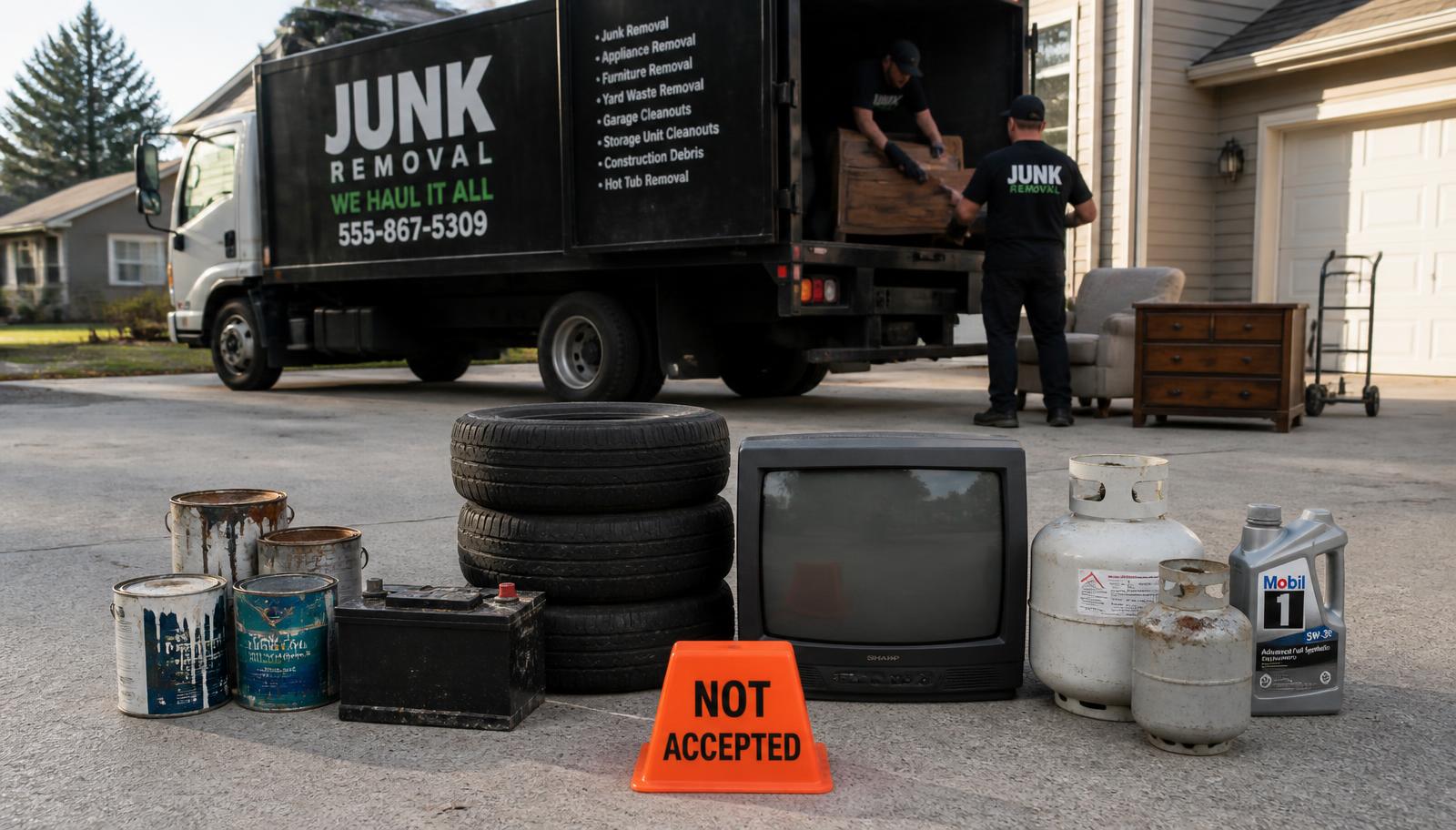
You've cleaned out the garage, basement, or a loved one's estate, and you’re left with a mountain of stuff. You make the smart call to hire a junk removal service to haul it all away. The crew arrives, and they start loading up old furniture, broken appliances, and bags of clutter. But then, they stop. They point to a few specific items: a half-used can of pesticide, a box of old oil-based paint, a broken television, and a stack of old tires. They politely inform you that they can't take these items. This scenario is incredibly common and leaves homeowners in a bind. You're left with the most difficult items to dispose of and no clear plan. Junk removal companies aren't being difficult; they are legally bound by local, state, and federal regulations that govern the transportation and disposal of hazardous and specialty waste. Taking prohibited items could result in hefty fines, loss of licenses, and serious safety risks to their employees and the environment. This leaves the responsibility on your shoulders to figure out the complex and often confusing world of specialty waste disposal.
How It Works
Junk removal services operate under a specific business model designed for efficiency and safety. Their primary function is to collect non-hazardous solid waste—what is officially known as Municipal Solid Waste (MSW)—and transport it to the appropriate facilities. These are typically transfer stations, recycling centers (for materials like cardboard, metal, and plastic), or landfills. Their trucks, equipment, and employee training are all geared towards handling common household bulk items like couches, mattresses, and construction debris. However, the moment an item is classified as "hazardous" or requires special handling, it falls outside their operational scope. The Department of Transportation (DOT) and the Environmental Protection Agency (EPA) have strict rules for transporting materials that are flammable, corrosive, reactive, or toxic. Junk haulers' standard trucks aren't equipped for this, lacking the required placards, containment systems, and spill-response kits. Furthermore, the landfills and transfer stations they use are often not licensed to accept hazardous waste. Attempting to mix prohibited items with general trash can lead to dangerous chemical reactions in the truck, contaminate entire loads of otherwise recyclable materials, and cause long-term environmental damage by leaching into soil and groundwater. Therefore, junk removal companies draw a hard line to protect their business, their workers, and the community. They are the experts in bulk, non-hazardous removal, leaving the disposal of regulated items to specialized services and government-run programs designed for that exact purpose.
Step-by-Step Fix
So, what do you do with the items the junk haulers left behind? Here’s a step-by-step guide to legally and safely disposing of common non-accepted items.
1. Identify & Separate Hazardous Waste — First, carefully sort the rejected items. Common categories include paints and solvents, automotive fluids (oil, antifreeze), pesticides and herbicides, household cleaners, batteries (especially lithium-ion and lead-acid), and fluorescent bulbs (which contain mercury). Create a designated "hazardous pile" on a stable, protected surface, away from children and pets.
2. Find Your Local HHW Facility — Your primary resource is your local Household Hazardous Waste (HHW) facility. Use search terms like "[Your City/County] household hazardous waste" or "HHW drop-off near me." Most municipal or county websites have a dedicated page with the facility's address, hours, and a list of accepted items. Many of these services are free for residents, though some may have small fees or quantity limits.
3. Dispose of Paints and Liquids — For oil-based paints, stains, and solvents, you must take them to an HHW facility. Never pour them down the drain or on the ground. For latex (water-based) paint, you may have another option: if it's a small amount, open the can in a well-ventilated area and let it dry out completely. You can add cat litter or paint hardener to speed up the process. Once it's a solid block, most municipal trash services will accept it with the lid off.
4. Handle Automotive Fluids and Batteries — Used motor oil and antifreeze are often accepted by auto parts stores like AutoZone or O'Reilly Auto Parts, who recycle them for free. Car batteries (lead-acid) can also be returned to the retailer where you bought your new one, or any store that sells them; a "core charge" often incentivizes this. For household batteries, many home improvement stores (like Lowe's or Home Depot) and electronics retailers (like Best Buy) have free drop-off bins.
5. Manage E-Waste Responsibly — Electronics (e-waste) like TVs, computers, and printers contain heavy metals and cannot go to a landfill. Many states have laws requiring e-waste recycling. Check with your local HHW facility, or look for special e-waste collection events in your community. Retailers like Best Buy and Staples have robust trade-in or recycling programs, sometimes offering store credit.
6. Deal with Tires — Landfills don't accept whole tires because they trap methane gas and don't compact. When you buy new tires, the tire shop will almost always take your old ones for a small fee (typically $3-$5 per tire). If you have extras, ask your local tire shop or your municipal public works department; they can direct you to a licensed tire recycler.
7. Address Asbestos and Moldy Materials — If you have materials you suspect contain asbestos (common in old insulation, vinyl flooring, and siding), do not touch them. This is not a DIY job. You must call a licensed asbestos abatement professional. They have the specialized training and equipment to handle and dispose of it safely. Similarly, for large amounts of mold-infested debris, it’s best to consult a mold remediation specialist, as improper handling can spread spores through your home.
8. Handle Propane Tanks and Fire Extinguishers — Empty propane tanks can often be exchanged at a retailer that offers a tank swap program (like Blue Rhino). Do not puncture them. For old fire extinguishers, contact your local fire department. They can often depressurize them for you or direct you to a certified service that can handle disposal.
9. Dispose of Medications — Do not flush old medications. They contaminate waterways. Many pharmacies, hospitals, and police departments have secure, anonymous drop-off boxes as part of the DEA's drug take-back program. This is the safest way to dispose of expired or unused prescriptions and over-the-counter drugs.
10. Plan for Construction & Demolition (C&D) Debris — While many junk removal companies take C&D debris, they may reject certain types or quantities of concrete, brick, or soil. For large renovation projects, it's often better to rent a specific C&D dumpster from a waste management company that will haul it directly to a specialized recycling facility.
Common Causes
Why do homeowners end up with these difficult items in the first place? The accumulation is often gradual and unintentional.
- Leftover Project Materials: The most frequent cause. A home painting project leaves a few half-full cans. A car oil change results in a gallon of used motor oil. These items get stored in the garage with good intentions, but are often forgotten.
- Inherited Properties: Clearing out a home from a previous generation often unearths decades of accumulated chemicals, pesticides, and old electronics from a time when disposal awareness was low.
- Product Upgrades: When you buy a new television, computer, or appliance, the old one becomes instant e-waste. Similarly, replacing a battery or tires creates immediate disposal needs.
- Lack of Awareness: Many people simply don't know that items like fluorescent bulbs or old thermostats contain mercury and require special handling. They get mixed in with general junk, only to be rejected by the removal crew.
- Misunderstanding Service Scope: Homeowners often assume a "junk removal" service means they will take absolutely everything. This misunderstanding of the business model is a primary reason for the surprise and frustration when items are rejected.
Common Mistakes
Disposing of rejected items can be tricky, and homeowners often make well-intentioned but dangerous mistakes. Avoid these common errors:
- Dumping Down the Drain: Never pour chemicals, paint, oil, or solvents down a sink or storm drain. This is illegal and severely pollutes local waterways, harming wildlife and potentially contaminating drinking water sources.
- "Hiding" Items in the Trash: Don't try to sneak prohibited items into your regular trash bin. Waste management workers can be injured, and compacting trucks can rupture containers, causing fires, explosions, or hazardous spills. Your trash service can also issue fines.
- Mixing Chemicals: A catastrophic mistake. Never mix different chemicals or cleaning products together. Combining ammonia and bleach, for example, creates toxic chloramine gas. Keep all hazardous materials in their original, labeled containers.
- Abandoning Items: Illegally dumping items on public land, in commercial dumpsters, or on the side of the road carries stiff penalties and harms the community and environment. Always use a designated facility.
- Storing Improperly: While you wait to dispose of them, don't leave hazardous materials in reach of children or pets, or in places with extreme temperatures. A hot shed can cause pressure to build in aerosol cans, and liquids can freeze and crack their containers.
- Breaking Fluorescent Bulbs: Breaking a CFL or fluorescent tube releases mercury vapor. If a bulb breaks, air out the room for 15 minutes and carefully scoop up the fragments using stiff paper—never a vacuum cleaner. Place the debris in a sealed glass jar and take it to an HHW facility.
Cost & Time Breakdown
Here is a realistic breakdown of the costs and time involved in disposing of items junk removal companies often reject. The "DIY Cost" is often zero for HHW facilities, but we include potential fees.
| Task | DIY Cost | Pro Cost | Time Commitment |
|---|---|---|---|
| Transporting to HHW Facility | $0 - $25 | N/A (service not offered) | 1 - 3 hours (driving & wait time) |
| Latex Paint Disposal (Hardening) | $0 - $15 (for hardener) | N/A | 24 - 48 hours (for drying) |
| E-Waste Recycling | $0 - $50 (some items have fees) | $50 - $150 (for specialty pickup) | 1 - 2 hours (drop-off) |
| Tire Disposal | $3 - $10 per tire | Included in new tire purchase | 30 minutes (at tire shop) |
| Propane Tank Exchange/Disposal | $0 - $20 | N/A | 30 minutes |
| Asbestos Abatement | N/A (Do Not DIY) | $500 - $3,000+ (for testing & removal) | 1 - 3 days |
Tips & Prevention
- Buy Only What You Need: For projects like painting, use an online paint calculator to estimate your needs accurately. Buying less means less leftover waste.
- Use Up Products Completely: Instead of storing a tiny bit of cleaner or solvent, try to use it up as intended. A completely empty container is often treated as regular trash.
- Look for "Take-Back" Programs: When you buy a new product, ask the retailer if they have a program to take your old one. This is standard for car batteries, common for electronics, and frequent for propane tanks.
- Schedule an HHW Day: Check your town’s calendar. Many communities have 1-2 special collection days per year where they make hazardous waste drop-off extra convenient. Mark it on your calendar and save your items for that day.
- Ask Before You Hire: When you call for a junk removal quote, be upfront. Ask them: "What items do you not take?" This avoids surprises and allows you to make a separate disposal plan in advance.
- Give Away Usable Items: If you have usable paint, chemicals, or other materials, offer them for free on local community groups like Facebook Marketplace or Buy Nothing. Your leftover supplies could be perfect for someone else's small project.
When to Call a Professional
While you can handle most common household waste yourself, certain situations absolutely require a specialist. The line between DIY and professional help is drawn by safety and regulation. The most critical example is asbestos. If you suspect any material in your home contains asbestos—often found in insulation, vinyl floor tiles, "popcorn" ceilings, and siding in homes built before 1980—do not disturb it. Handling it yourself can release microscopic fibers into the air that, when inhaled, can cause serious long-term lung diseases. You must hire a state-licensed asbestos abatement contractor. They will test the material and, if positive, use highly controlled methods and specialized equipment to remove and dispose of it according to federal law. Similarly, for large-scale mold problems (covering more than 10 square feet), a mold remediation specialist is necessary to prevent cross-contamination. For scenarios involving large quantities of unknown, unlabeled chemicals, or potentially reactive materials (like old pool chemicals), call your local fire department or an environmental waste company for guidance. These professionals have the training and protective gear to assess and manage high-risk situations safely.
Should you do this yourself?
Answer five quick questions before you start. Safety outranks savings every time.
Your experience with work like this
How high do you have to work?
Does the job involve any of these?
Will it need a permit?
Specialty tools
Free and instant. Educational guidance only — not a quote, inspection, or professional diagnosis.
Estimate your own project cost
National averages are a starting point. Enter your details for a range that fits your house.
Interior paint estimator
- Paint$96
- Supplies (tape, rollers, drop cloth)$35
- Estimated total (DIY)$131
Hiring a pro? Add roughly $1.50–$4.00/sq ft for labor depending on prep work and trim detail.
Educational estimate only — always confirm with written local bids.
What should this project cost?
Enter your project details for a realistic cost range before you call anyone.
Cost depends heavily on which system turns out to be the source.
- Regional adjustment
- National average
- Labor share (typical)
- ~$1,620
- Quotes to collect
- 3 written estimates
Educational estimate based on national averages — not a binding quote. Always confirm with written local estimates.
Before you start
Check the difficulty, permits, and safety risk — then decide whether to call a pro.
Free, no signup required. Estimates are educational guidance, not a quote or an inspection.
Frequently asked questions
Why won't junk removal companies take paint?+
Junk removal companies won't take wet, oil-based paint because it is considered hazardous material. It's flammable and contains chemicals that are harmful to the environment if disposed of in a standard landfill. They are not licensed to transport or dispose of hazardous waste. However, some may take completely dried-out latex paint.
Can I put a TV out for a junk removal service?+
Most junk removal companies will take TVs but may charge an extra fee. TVs are e-waste and contain hazardous materials like lead and mercury, requiring special recycling. Some states prohibit them from landfills, so the junk service must take them to a designated e-waste facility, incurring extra costs that they pass on to you.
How do I get rid of an old propane tank?+
Never throw a propane tank in the trash or with a junk hauler. The best method is to take it to a propane tank exchange location, such as a gas station or grocery store with a Blue Rhino or similar service. They will take your old tank when you purchase a new one. Some municipal HHW facilities also accept them.
What is the most common item junk removal services refuse?+
The most common rejected items are liquids and chemicals. This includes wet paint, solvents, pesticides, herbicides, automotive fluids (oil, antifreeze), and harsh cleaners. These are all classified as household hazardous waste (HHW) and cannot be legally transported by standard junk removal trucks.
Is it illegal to put batteries in the trash?+
In some states, like California, it is illegal to put any type of battery in the trash. In other areas, only rechargeable and car batteries are banned. Regardless, it's always best practice to recycle all batteries, as they contain corrosive materials and heavy metals. Use drop-off bins at home improvement or electronics stores.
Discussion
Loading comments…