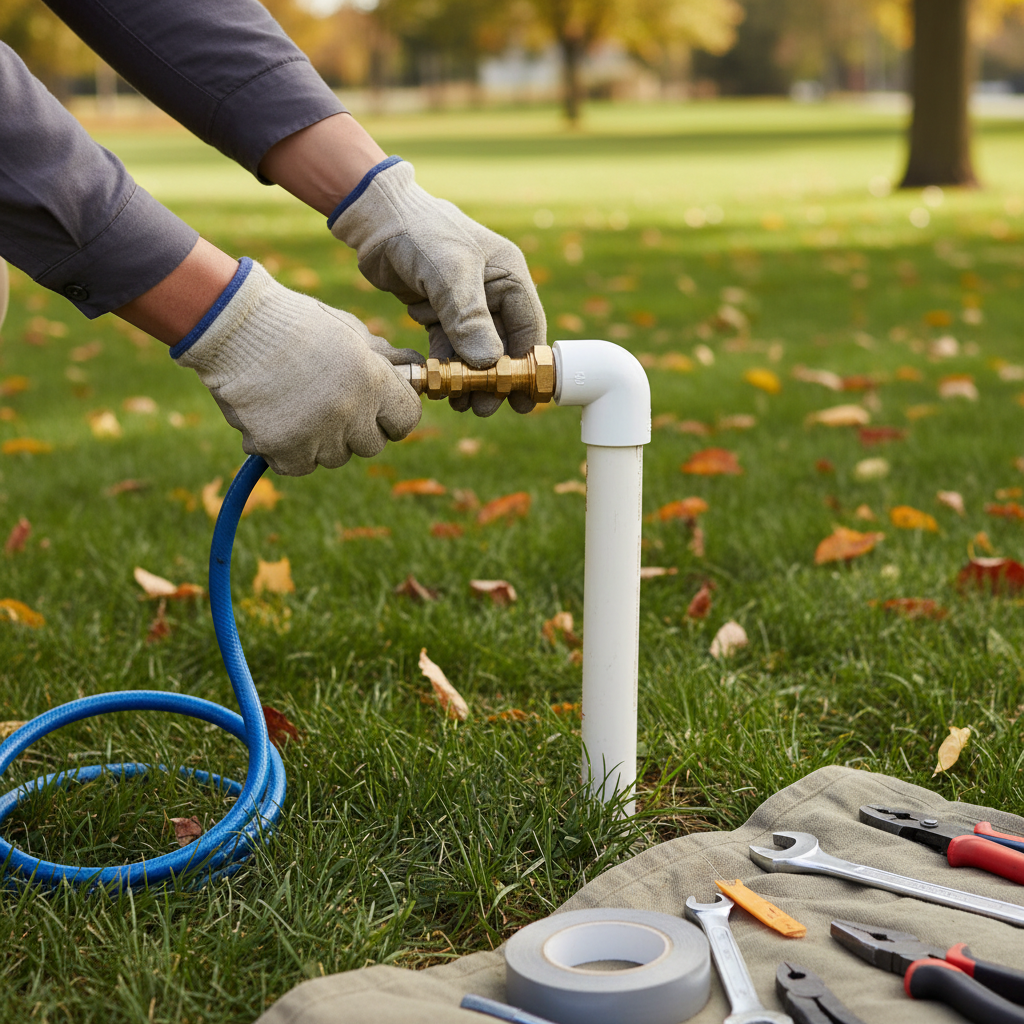
- The 1 Sprinkler Winterization Mistake That Leads to $1,000s in Damage — Discover the crucial mistake many homeowners make when winterizing sprinklers and how to properly blow out your system to prevent costly fr…
- The 1 Sprinkler Winterizing Mistake That Leads to $1,000s in Damage — Discover the crucial mistake homeowners make when winterizing sprinkler systems and how to avoid costly freeze damage with a simple, effect…
- The 1 Sprinkler Winterizing Mistake That Leads to $1,000s in Damage — Learn how to properly winterize your sprinkler system and avoid costly damage from freezing temperatures with this comprehensive guide.
- The 1 Sprinkler Winterization Mistake That Leads to $1,000s in Damage — Learn the critical step most homeowners miss when winterizing their sprinkler system to avoid costly freeze damage and burst pipes.
- The 1 Mistake Homeowners Make Winterizing Sprinklers (And How to Avoid Burst Pipes) — Discover the crucial mistake homeowners make when winterizing sprinkler systems and learn the correct way to prevent costly burst pipes thi…
Plumbing · Leak
| Project category | Plumbing |
|---|---|
| Problem type | Leak |
| Trade required | Plumbing |
| Urgency | Emergency — act now |
| Safety risk | High safety risk |
| DIY suitability | DIY for experienced homeowners |
| Cost category | Low cost |
| Typical timeline | Shut water off now; repair usually same or next day |
| Contractor type | Licensed plumber |
Repair option
Isolate at the shutoff, replace the failed component, and dry the cavity fully.
Replacement option
Repipe the run or the branch when corrosion is widespread.
Common causes
- Failed supply line or shutoff valve
- Worn washers, cartridges, or P-trap connections
- Pinhole corrosion in older copper
Relevant tools:emergency checklistdiy or hire a pro
Published May 20, 2026Last updated August 17, 2026
Tools & materials you'll need
Affiliate links- AmazonAir compressor1 · Minimum 5-10 CFM, ideally 10-20 CFM for larger systems. Regulator essential.
- AmazonAir hose1 · Appropriate length for your compressor and system.
- AmazonAdjustable wrench1 · For backflow preventer test cocks, if not slotted.
- AmazonScrewdriver set1 · For backflow preventer test cocks and general adjustments.
- AmazonSafety glasses1
- AmazonWork gloves1
- AmazonCompressor to irrigation fitting1 · Often a quick-connect or threaded adapter. Check your system's connection point.
As an Amazon Associate FixlyGuide earns from qualifying purchases — at no extra cost to you. Prices and availability are accurate as of publication and subject to change.
Quick Answer
To prevent costly freeze damage, the most critical step in winterizing your sprinkler system is to ensure all water is completely removed from the irrigation lines. This is best achieved using an air compressor to blow out each zone individually, starting with the highest pressure-rated components. Overlooking even small pockets of water, particularly in low-lying sections of the system, can lead to burst pipes, sprinkler heads, or backflow preventers when temperatures drop below freezing. A systematic approach, coupled with proper safety precautions, will protect your investment.
The Problem
As colder weather approaches, any water remaining in your underground sprinkler system, including the pipes, valves, and sprinkler heads, becomes a ticking time bomb. When water freezes, it expands with immense force, easily rupturing plastic pipes, cracking brass fittings, and destroying delicate internal components of sprinkler heads and backflow preventers. The cost of repairing a freeze-damaged system can range from a few hundred dollars for a single burst pipe to several thousand for extensive damage involving the main lines or the backflow assembly. For many homeowners, the thought of this annual chore is daunting, and often, critical steps are missed or shortcuts are taken, leading to expensive repairs come spring. The core problem isn't just emptying the system; it's ensuring complete emptiness, even in the system's most vulnerable parts.
How It Works
An irrigation system is designed to deliver water efficiently to your lawn and garden. It typically consists of a main water supply line, a backflow prevention device (to stop irrigation water from re-entering your potable water supply), a series of zone valves, buried PVC or polyethylene pipes, and various sprinkler heads or drip emitters. When you activate a zone, water flows from the main supply, through the backflow preventer, through the open zone valve, and out to the designated sprinkler heads. The system is pressurized, meaning water constantly fills the lines up to the zone valves. Gravity plays a significant role in how water drains, or doesn't drain, from the system. Even after shutting off the main water supply and opening drain valves (if your system has them), residual water will invariably remain in the lines, especially in dips, low spots, and within the sprinkler heads themselves. This is where compressed air comes in. By introducing high-volume, low-pressure air into the system, you force this remaining water out through the sprinkler heads, effectively 'drying' the lines. The key is to use enough air volume to push the water, but not so much pressure that you damage components.
Step-by-Step Fix
1. Shut Off Water Supply – Turn off the main water valve to your irrigation system.
Locate the main shut-off valve for your sprinkler system. This is usually near your home's main water meter or where the irrigation line branches off from your house water supply. Turn it completely off. If your system has a separate shut-off valve for the backflow preventer, close that as well. Disconnect the main irrigation supply line from the backflow preventer if your manufacturer recommends it, or if you have a valve specifically for winterizing the backflow preventer. This ensures no new water enters the system during the blowout process.
2. Drain Backflow Preventer – Carefully open the test cocks on your backflow device.
Your backflow preventer (e.g., PVB, RPZ) is particularly susceptible to freeze damage due to its internal components and brass construction. Locate the test cocks (small, usually slotted or square-headed valves) on the backflow preventer. Slowly open these cocks, one at a time, to allow any standing water to drain. Be prepared for a small amount of water to come out. Leave these cocks open at a 45-degree angle or fully open (depending on manufacturer instructions) for the duration of the blowout and through the winter. Some systems have a main drain valve on the supply side of the backflow preventer; open this if available. Safety Note: If your backflow preventer is connected with unions, you might also consider slightly loosening them, but only after all pressure has been released. Consult your specific backflow preventer's manual.
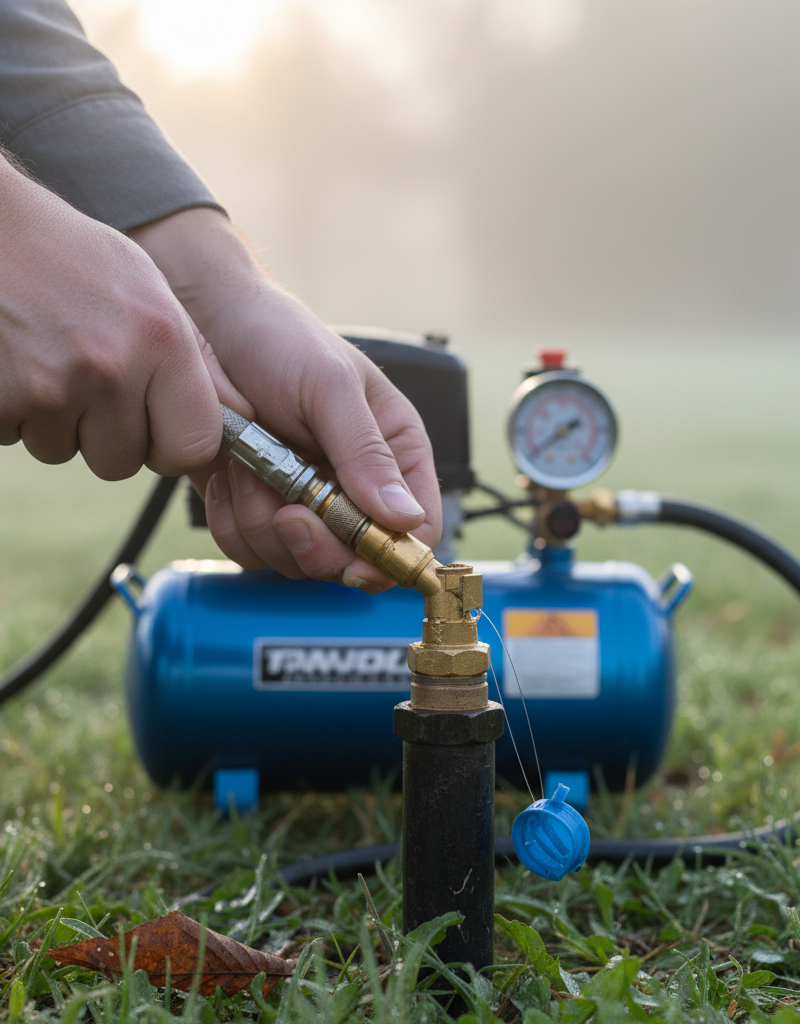
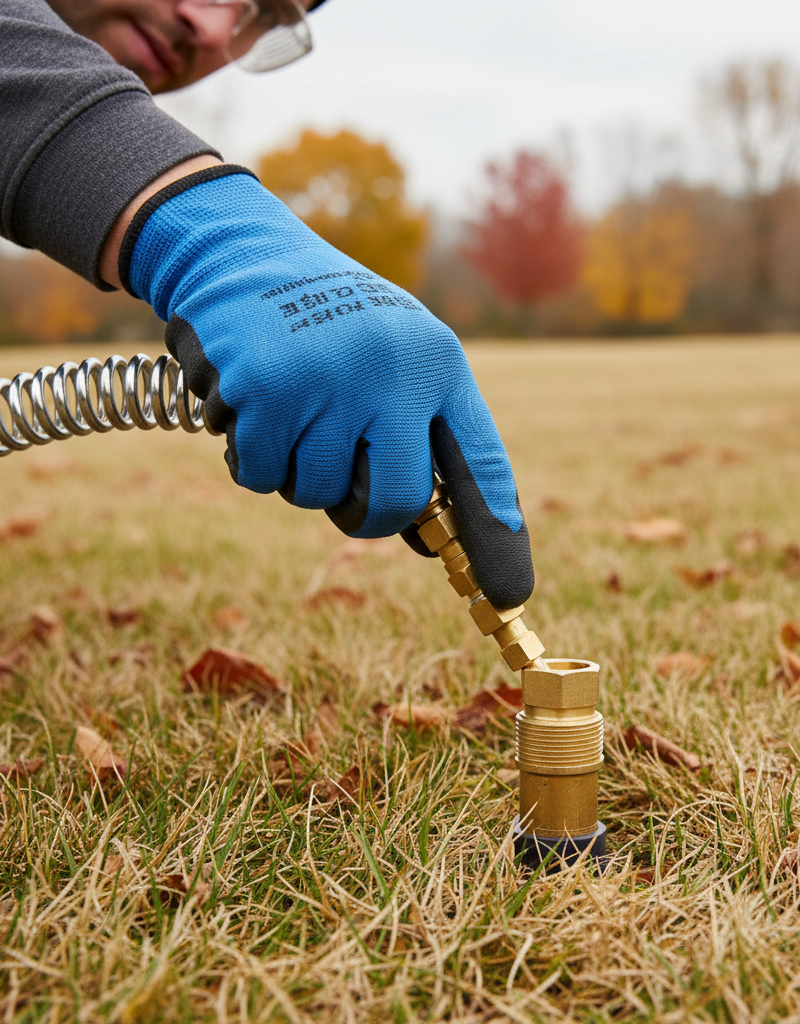
3. Connect Air Compressor – Attach your air compressor to the main irrigation line.
Locate the compressor connection point, usually a quick-connect fitting or a threaded cap, on the main line past the backflow preventer (on the irrigation system side). Connect your air compressor hose to this fitting. Ensure the connection is secure. Set your air compressor regulator to 30-50 PSI for PVC systems and 50-80 PSI for polyethylene (black flexible pipe) systems. Never exceed 80 PSI for any irrigation system. Start with a lower PSI and increase only if absolutely necessary to clear the lines. Use an air compressor with a CFM (Cubic Feet per Minute) rating of at least 5-10 CFM for smaller systems, and 10-20 CFM for larger systems with more zones or longer runs. A higher CFM ensures sufficient volume to push water effectively.
4. Open Furthest Zone Valve – Manually open the irrigation zone valve furthest from the compressor connection.
Begin the blowout process with the zone valve located furthest from your compressor connection. This allows the air to push water through the longest run of pipe first. Manually open this zone valve at the controller. If your system allows for manual operation at each individual valve, open it there. Do not open more than one zone at a time during the blowout. Activating multiple zones simultaneously can reduce air pressure and prevent thorough water removal.
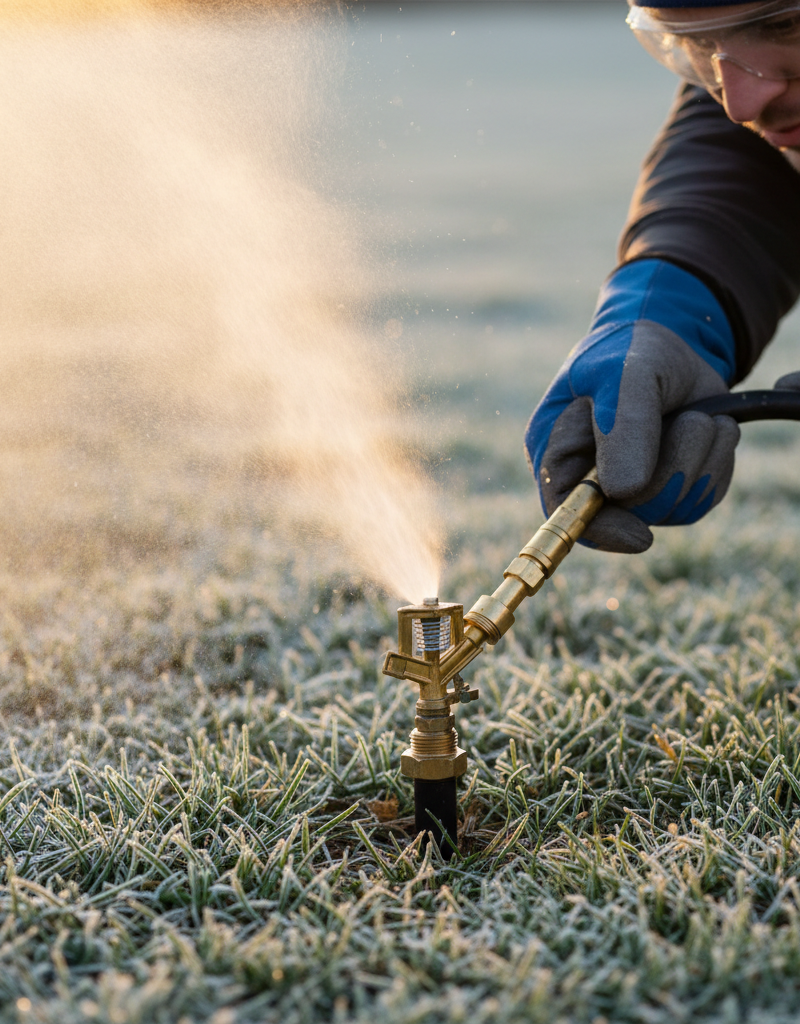
5. Blow Out the Zone – Gradually introduce compressed air until only mist emerges from sprinkler heads.
Slowly open the air compressor's main valve to introduce air into the system. Watch the sprinkler heads in the activated zone. They will pop up, and water will begin to spray out, followed by a mixture of water and air, and eventually, a fine mist or just air. Allow the compressor to run for 1-2 minutes after only mist is visible from all heads in that zone. It’s crucial that you see mist from every head, indicating the line is clear. Repeat this process 2-3 times per zone, allowing the compressor's tank to refill completely between cycles. This on-and-off cycling helps to create surges of air that can dislodge stubborn water pockets. Safety Note: Stand clear of sprinkler heads during the blowout; debris can be ejected.
6. Repeat for All Zones – Move systematically through each remaining zone, blowing them out.
Once the furthest zone is completely dry, close its valve. Then move to the next furthest zone and repeat step 5. Continue this methodical process until every irrigation zone has been blown out thoroughly. Always ensure only one zone is open at any given time. Pay extra attention to any zones that have extremely low-lying heads or significant elevation changes, as water can easily collect there. If you have drip irrigation lines, treat them as a separate zone and ensure they are also cleared of water.
7. Disconnect Compressor and Relieve Pressure – Shut off air, disconnect hose, and release any residual system pressure.
After all zones are dry, turn off your air compressor and disconnect the hose from the irrigation system's connection point. Before completely packing up, ensure any remaining air pressure in the irrigation line is released. You can do this by momentarily opening one of the zone valves or by slowly loosening the compressor connection point. This prevents any trapped air from potentially causing issues.
8. Open System Drain Valves (If Present) – Open any manual drain valves at low points in your system.
Some older or custom-installed sprinkler systems may have manual drain valves located at the lowest points of the main line or specific zone lines. If your system includes these, open them now, if you haven't already. While the air blowout is the primary method, these drains can help ensure any final drips of water escape.
9. Turn Off Controller – Switch off your irrigation controller.
Finally, turn your irrigation controller to the
Related Articles
Keep troubleshooting with these hand-picked guides from FixlyGuide:
- The #1 Sprinkler Winterization Mistake That Leads to $1,000s in Damage — Discover the crucial mistake many homeowners make when winterizing sprinklers and how to properly blow out your system to prevent costly fr…
- The #1 Sprinkler Winterizing Mistake That Leads to $1,000s in Damage — Discover the crucial mistake homeowners make when winterizing sprinkler systems and how to avoid costly freeze damage with a simple, effect…
- The #1 Sprinkler Winterizing Mistake That Leads to $1,000s in Damage — Learn how to properly winterize your sprinkler system and avoid costly damage from freezing temperatures with this comprehensive guide.
- The #1 Sprinkler Winterization Mistake That Leads to $1,000s in Damage — Learn the critical step most homeowners miss when winterizing their sprinkler system to avoid costly freeze damage and burst pipes.
- The #1 Mistake Homeowners Make Winterizing Sprinklers (And How to Avoid Burst Pipes) — Discover the crucial mistake homeowners make when winterizing sprinkler systems and learn the correct way to prevent costly burst pipes thi…
- The 5-Minute Trick to Restore Your Kitchen Sink Sprayer's Lost Pressure — Restore your kitchen sink sprayer's low pressure with a quick, simple trick that often takes less than five minutes and requires no special…
Should you do this yourself?
Answer five quick questions before you start. Safety outranks savings every time.
Your experience with work like this
How high do you have to work?
Does the job involve any of these?
Will it need a permit?
Specialty tools
Free and instant. Educational guidance only — not a quote, inspection, or professional diagnosis.
Questions to ask before you sign
Ask every contractor the same questions and the cheapest bid stops looking cheapest. Check them off as you go — your progress is saved on this device.
Free, no signup. Bring this to every walkthrough so you compare bids on the same terms.
What should this project cost?
Enter your project details for a realistic cost range before you call anyone.
Common repairs run $150–$650; repipes and water-heater replacements reach $1,500–$4,500.
- Regional adjustment
- National average
- Labor share (typical)
- ~$754
- Quotes to collect
- 3 written estimates
Educational estimate based on national averages — not a binding quote. Always confirm with written local estimates.
Fixly Project Decision Box
- DIY difficulty
- Moderate
- Estimated time
- 30 minutes – half a day
- Cost level
- Moderate
Main tools / materials
- Adjustable wrench
- Plunger or drain auger
- Bucket and towels
- Thread tape
When to stop and call a pro
- Water you cannot shut off at the fixture or main
- Sewage backing up into more than one fixture
- Water near electrical panels or outlets
- Gas water heater work beyond relighting a pilot
Need professional help?
Get a Licensed PlumberHandle this before it gets worse
First steps that limit damage, then a way to reach a qualified pro.
- Emergency repair checklistThe first steps that limit damage before a pro arrives.Open
- Get local estimatesSend one request and compare written estimates from vetted pros.Open
- Estimate this projectGet a cost range for your scope and ZIP before you call anyone.Open
Free, no signup required. Estimates are educational guidance, not a quote or an inspection.
Frequently asked questions
What PSI should I use to blow out my sprinkler system?+
For most PVC sprinkler systems, set your air compressor regulator to 30-50 PSI. For systems with polyethylene (black flexible) pipes, you can go slightly higher, up to 50-80 PSI. Never exceed 80 PSI, as excessive pressure can damage system components. Start low and only increase if necessary to clear the water.
Do I need an air compressor to winterize my sprinkler system?+
Yes, an air compressor is the most effective and recommended tool for thoroughly removing water from your sprinkler lines, especially in regions with hard freezes. While some systems have manual drains, they don't guarantee complete water removal, leaving your system vulnerable to freeze damage. A compressor ensures all water is forced out.
Can I use my shop vac to blow out my sprinkler system?+
No, a shop vacuum typically does not provide enough continuous air pressure (PSI) or volume (CFM) to effectively clear water from an entire sprinkler system. Its primary function is suction, not high-volume air output for blowing. Using a shop vac is not an adequate substitute for a proper air compressor and will likely leave water in the lines.
How long does it take to winterize a sprinkler system?+
For an average residential sprinkler system with 3-6 zones, the hands-on winterization process, primarily blowing out the lines with an air compressor, typically takes 1-2 hours. Larger systems with more zones or longer runs may take slightly longer, while very small systems might be done in under an hour.
What if water keeps coming out of a sprinkler head when blowing it out?+
If water continues to emerge from a sprinkler head after several minutes of blowing, it could indicate a low point in the line where water is pooling, an issue with the zone valve not fully closing, or insufficient air volume/pressure from your compressor. Try cycling the air on and off more aggressively. If it persists, you may need a higher CFM compressor or a professional assessment to identify persistent low spots or valve issues.
Discussion
Loading comments…