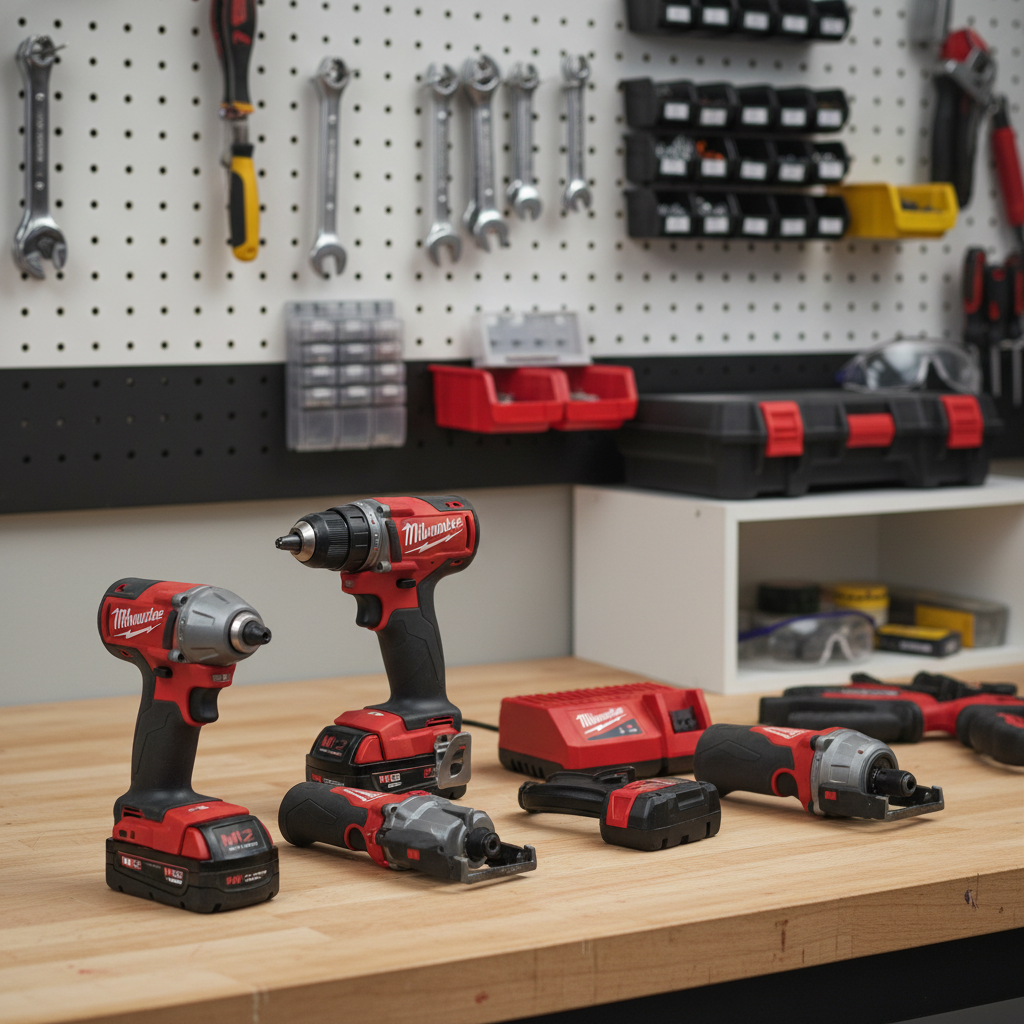
- Start with a Combo Kit — This is almost always the cheapest way in. Look for a kit that includes a drill/driver, an impact driver, at least two batteries (preferably one 2.0Ah and one 4.0Ah), and a charger.
- Why: Buying these pieces separately costs a lot more. A basic drill/impact combo kit usually runs $150–$200 on sale, and it covers the core tools for 80% of household jobs.
- If you already have a full M18 setup: You might just buy bare M12 tools (without batteries/charger) if you’re only after a few compact pieces to round out your main kit.
Published July 29, 2026Last updated August 17, 2026
Tools & materials you'll need
Affiliate linksAs an Amazon Associate FixlyGuide earns from qualifying purchases — at no extra cost to you. Prices and availability are accurate as of publication and subject to change.
Quick Answer
Look, I’ve been on job sites for going on three decades, and I’ve watched tools come and go. When it comes to homeowner-friendly power, portability, and plain old handiness, it’s tough to beat the Milwaukee M12 line. For most DIYers, the core cordless tools—your drill, impact driver, multi-tool, and maybe a Hackzall—are absolute game-changers. They’re strong enough for just about anything you’ll do around the house, without the bulk of the bigger M18 stuff. Really, don’t overspend on tools you won’t use. Start with the workhorses first.
The Problem
Walk into any big box store or start clicking around Amazon, and you’ll get buried under hundreds of tool options. Milwaukee alone has a pile of M12 tools, and it’s real easy to get talked into buying a whole lineup that ends up gathering dust in your garage. Homeowners usually make two big mistakes: they either buy cheap, underpowered tools that frustrate them and die early, or they go all-in on professional-grade, high-dollar gear they’ll use once a year. The trick is figuring out which tools actually help your DIY projects and which ones are just shiny distractions for your wallet.
How It Works
The Milwaukee M12 system runs on a 12-volt lithium-ion battery platform. Unlike the beefier 18-volt (M18) tools pros drag around for heavy-duty, all-day work, the M12 line leans hard into compact size, lighter weight, and a heck of a lot of power for the footprint. Here’s the simple version: a typical M12 battery, whether it’s the compact 2.0 Ah or the extended capacity 4.0 Ah, fits any M12 tool. So you buy into the battery ecosystem once, then swap that same battery between your drill, multi-tool, impact driver, and whatever else makes sense.
The real difference shows up in the brushless motors on a lot of the newer M12 tools. Brushed motors have carbon brushes that wear down over time and make friction, which steals power as heat. Brushless motors use electronics to generate magnetic fields instead, so you get more power, longer runtimes (often 30-50% longer per charge), and a tool that’ll usually last a whole lot longer. That means less cussing at the bench and better performance when you’re trying to sink deck screws or scrape up old caulk.
Most M12 tools are made for one-handed use, and they fit into tight spots that bigger 18V tools just can’t get into. The smaller battery packs charge fast too—often in less than an hour for a 2.0 Ah battery—so you’re not standing around twiddling your thumbs. I remember one job in an old Victorian in Alameda where I was trying to run new electrical in a cramped attic. My M18 drill barely fit, and it felt like I was wrestling a brick. One of the new guys had an M12 drill and was popping through joists with spade bits like it was nothing. That’s when I really sold myself on the M12 for tricky, confined spaces, and it clicked that it’s perfect for the kind of stuff homeowners run into all the time.
Step-by-Step Fix: Building Your Essential M12 Kit
Building a tool kit ought to be a thought-out move, not a bunch of impulse buys. Here’s how I tell homeowners to build out their M12 setup without wasting cash.
-
Start with a Combo Kit — This is almost always the cheapest way in. Look for a kit that includes a drill/driver, an impact driver, at least two batteries (preferably one 2.0Ah and one 4.0Ah), and a charger.
- Why: Buying these pieces separately costs a lot more. A basic drill/impact combo kit usually runs $150–$200 on sale, and it covers the core tools for 80% of household jobs.
- If you already have a full M18 setup: You might just buy bare M12 tools (without batteries/charger) if you’re only after a few compact pieces to round out your main kit.
-
Add the Oscillating Multi-Tool — This is probably the single most useful tool you can own. It cuts, sands, grinds, scrapes, and removes grout.
- Task: Swapping baseboards, trimming door jambs, cutting drywall for outlets, scraping off old paint or caulk, sanding in tight corners. I’ve pulled this thing out on hundreds of jobs where nothing else would fit or work as cleanly.
- Tip: Spend the money on a decent blade assortment. The cheap ones go dull fast.
-
Get a Hackzall Reciprocating Saw — Don’t mix this up with a full-size Sawzall. The Hackzall is a compact, one-handed bruiser for demo and rough cuts.
- Use Cases: Pruning small branches, cutting PVC pipe, rough-cutting small pieces of wood, light demo work like tearing out an old vanity. It’s lighter and way easier to handle than a big recip saw.
- Safety First: Wear safety glasses every time you use any saw, and make sure whatever you’re cutting is secured. No dice otherwise.
-
Consider the M12 Inflator — This one might sound like a weird add to a tool kit, but trust me, it’s a lifesaver for tires, sports gear, and inflatables.
- Convenience: You won’t need to drag out a big air compressor or run to the gas station for a slow leak. Set the PSI, hit the button, and it shuts off on its own. I’ve bailed a few homeowners out of a jam who had a tire leaking slow on a Sunday and just needed 15 PSI to make it to the shop Monday morning.
- Note: It’s not for seating new tubeless tires or running air tools, but for top-offs it’s money.
-
Think about the M12 Rotary Tool — If you do a lot of detail work, crafting, or small grinding and sanding, this is a lot more capable than a Dremel in a lot of cases.
- Versatility: Engraving, polishing, grinding metal, cutting small bolts, sharpening blades.
- Attachment Compatibility: A lot of Dremel accessories will fit, so you’re not boxed in.
-
Skip the M12 Band Saw (unless you're a plumber/electrician) — This one’s a niche tool for cutting conduit, Unistrut, or threaded rod quietly and cleanly. Most homeowners just won’t need it.
- Pro Use: Great for repetitive, clean cuts on metal stock.
- Homeowner Reality: You’ll probably grab a hacksaw or an angle grinder the rare time you need to cut metal, or you’ll just buy pre-cut lengths and call it a day.
-
Hold off on the M12 Fuel 1/2-inch High-Torque Impact Wrench — Sure, it’s powerful, but for most home auto repairs or deck building, it’s serious overkill.
- Power: Delivers upwards of 250 ft-lbs of breakaway torque. Good for rusted lug nuts or suspension work.
- Homeowner Use Case: For changing car tires or basic household assembly, the M12 impact driver (from your combo kit) is plenty. You’ll probably rarely need this much grunt, and it costs a fair bit.
-
Don't buy any tool just because it's on sale. — This is the biggest mistake I see. People get swept up in a
Related Articles
Keep troubleshooting with these hand-picked guides from FixlyGuide:
- The 5 Essential Tools Every New Gardener Needs (And 3 You Can Skip) — Starting a garden doesn't require a huge investment in tools; savvy new gardeners can thrive with just a few key items and save money by kn…
- The 4 Critical Power Tools Every New Homeowner FORGETS to Buy (Don't Be One of Them) — New homeowners often overlook essential power tools that make common home repairs and maintenance tasks significantly easier. Learning whic…
- The One Item Every DIYer Needs (And Why You're Probably Using the Wrong Kind) — Unlock comfort and prevent long-term joint damage with the right knee pads for every home project, from gardening to flooring installation.
- The 4 Critical Dimensions of a Bluebird House (Most DIYers Miss One) — Discover the four often-overlooked dimensions crucial for a successful bluebird house, ensuring your avian residents thrive season after se…
- The $15 Secret to a Clutter-Free Gaming Setup (Your Controllers Will Thank You) — Reclaim your gaming space with a simple, custom-built controller stand that's both functional and stylish using common materials.
- The 7 Critical Yard Prep Steps Smart Homeowners Never Skip After Winter — Don't just rake! Learn the essential, often-missed steps to prepare your yard for a lush, healthy spring and summer.
Should you do this yourself?
Answer five quick questions before you start. Safety outranks savings every time.
Your experience with work like this
How high do you have to work?
Does the job involve any of these?
Will it need a permit?
Specialty tools
Free and instant. Educational guidance only — not a quote, inspection, or professional diagnosis.
What should this project cost?
Enter your project details for a realistic cost range before you call anyone.
Cost depends heavily on which system turns out to be the source.
- Regional adjustment
- National average
- Labor share (typical)
- ~$1,620
- Quotes to collect
- 3 written estimates
Educational estimate based on national averages — not a binding quote. Always confirm with written local estimates.
Before you start
Check the difficulty, permits, and safety risk — then decide whether to call a pro.
- Estimate this projectGet a cost range for your scope and ZIP before you call anyone.Open
- Get local estimatesSend one request and compare written estimates from vetted pros.Open
Free, no signup required. Estimates are educational guidance, not a quote or an inspection.
Get the print-ready PDF of this guide
A clean, ad-free, printable version you can keep on your phone or pin to the workshop wall. Free with a FixlyGuide account.
- Print-optimized layout
- Tools, materials & every step included
- Saved to your account
This article was independently written by FixlyGuide based on the source topic.
Frequently asked questions
What's the difference between M12 and M18?+
M12 tools are 12-volt, designed for compactness, lighter weight, and getting into tight spaces. M18 tools are 18-volt, offering more power and longer runtimes for heavier, all-day professional use. For most homeowners, M12 offers plenty of power without the bulk.
Can I use M12 batteries with M18 tools?+
No, Milwaukee M12 batteries are not compatible with M18 tools, and vice-versa. They are completely different battery platforms and have different connectors. You need specific batteries for each line.
Are brushless M12 tools worth the extra cost?+
Absolutely. Brushless motors offer significantly more power, longer runtimes per charge (up to 50% more), and a much longer tool lifespan because there are no brushes to wear out. For tools you'll use frequently, the investment pays off quickly.
What's the first Milwaukee M12 tool I should buy?+
My top recommendation is a drill/impact driver combo kit. This gives you two of the most versatile tools for home projects, along with at least two batteries and a charger, often at a substantial discount compared to buying them individually.
How long do M12 batteries last?+
The lifespan of an M12 battery depends on its capacity (Ah) and how hard you're working the tool. A compact 2.0Ah battery might last 20-30 minutes of continuous drilling, while a 4.0Ah battery could give you 40-60 minutes. Keep a spare charged for longer projects.
Can I use aftermarket batteries with Milwaukee M12 tools?+
While aftermarket batteries exist, I strongly advise against them. They often don't provide the same power or run time, can void your tool's warranty, and in some cases, can even damage the tool or pose a fire risk. Stick with genuine Milwaukee batteries.
What's a 'bare tool'?+
A 'bare tool' means just the tool itself, without any batteries or a charger. These are great if you already own Milwaukee M12 batteries and chargers from a previous kit and just want to expand your collection selectively.
Is M12 powerful enough for deck building?+
For most deck projects, especially fastening deck screws, a Milwaukee M12 impact driver is surprisingly capable. I've built entire sections of decks with them. For cutting thicker lumber or driving big lag bolts, you might want to borrow or rent an M18 circular saw or impact wrench, but the M12 handles most of it just fine.
What's the best way to store M12 batteries?+
Store M12 batteries in a cool, dry place, out of direct sunlight. Avoid extreme temperatures. It's best to leave them with a partial charge (around 50%) if you're storing them for an extended period, rather than fully charged or fully depleted, to maximize their lifespan.
What kind of lighting options does M12 offer?+
Milwaukee has a few M12 lighting solutions, from compact work lights to floodlights. They're excellent for illuminating dark crawl spaces, attics, or under-sink areas where a headlamp just isn't cutting it. I always keep one in my truck; it's saved my bacon on plenty of dark job sites.


Discussion
Loading comments…