- "Bigger is always better." A lot of first-time buyers figure 18 volts has to beat 12 volts at everything. Then they buy a heavy M18 drill to hang curtain rods, when a lighter M12 would’ve been quicker and a lot less tiring.
- Analysis Paralysis. There are a ton of tools—over 150 for M12, over 250 for M18—and that can freeze folks up. They get stuck trying to plan for every possible project instead of just looking at what they’ve got going on right now.
- Ignoring Ergonomics. People stare at specs online and never think about how the tool actually feels in the hand. Weight and balance matter just as much as torque, especially if you’re doing precise work or holding the tool overhead.
- Falling for a "Good Deal." A store might throw out a killer sale on a huge M18 7-tool combo kit. Looks like a steal. But if you only ever use the drill and the light, you’ve bought a bunch of tools that’ll sit there collecting dust.
Published October 18, 2026Last updated October 18, 2026
Tools & materials you'll need
Affiliate linksAs an Amazon Associate FixlyGuide earns from qualifying purchases — at no extra cost to you. Prices and availability are accurate as of publication and subject to change.
Quick Answer
Milwaukee's M12 system runs on a 12-volt battery, so the tools stay lighter, more compact, and a whole lot nicer in tight spaces or up on a ladder. The M18 system uses an 18-volt battery, and that extra juice gives you the torque and runtime you need for rougher stuff like drilling into concrete or ripping through thick lumber. For most homeowners, the M12 line has plenty of muscle for everyday repairs and renovations, while the M18 is the better fit for demanding, construction-grade work.
The Problem
You're standing in the tool aisle, ready to sink money into a cordless system that'll hang around for years. You’ve settled on Milwaukee—a good call, in my book. But now you’re stuck on the real question: M12 or M18? The boxes look nearly the same, the red-and-black branding is the same, but the voltage isn't, and neither is the price.
Picking the wrong system can get expensive fast. If you grab M18 for simple around-the-house jobs, you might pay for power you’ll never really use and end up dragging around a heavier tool than you need. On the flip side, if you buy M12 for a big deck build, you may find out real quick that the tool just doesn’t have the guts to drive screws into dense lumber. Then you’re stopping mid-project to buy the stronger one anyway. And remember, you’re not just buying a drill—you’re buying into a whole battery family. That’s a long-term commitment.
How It Works
At the most basic level, it’s just physics. Voltage is electrical potential, or pressure if you want the plain-English version. The higher the voltage, the more push a battery can give the tool’s motor.
-
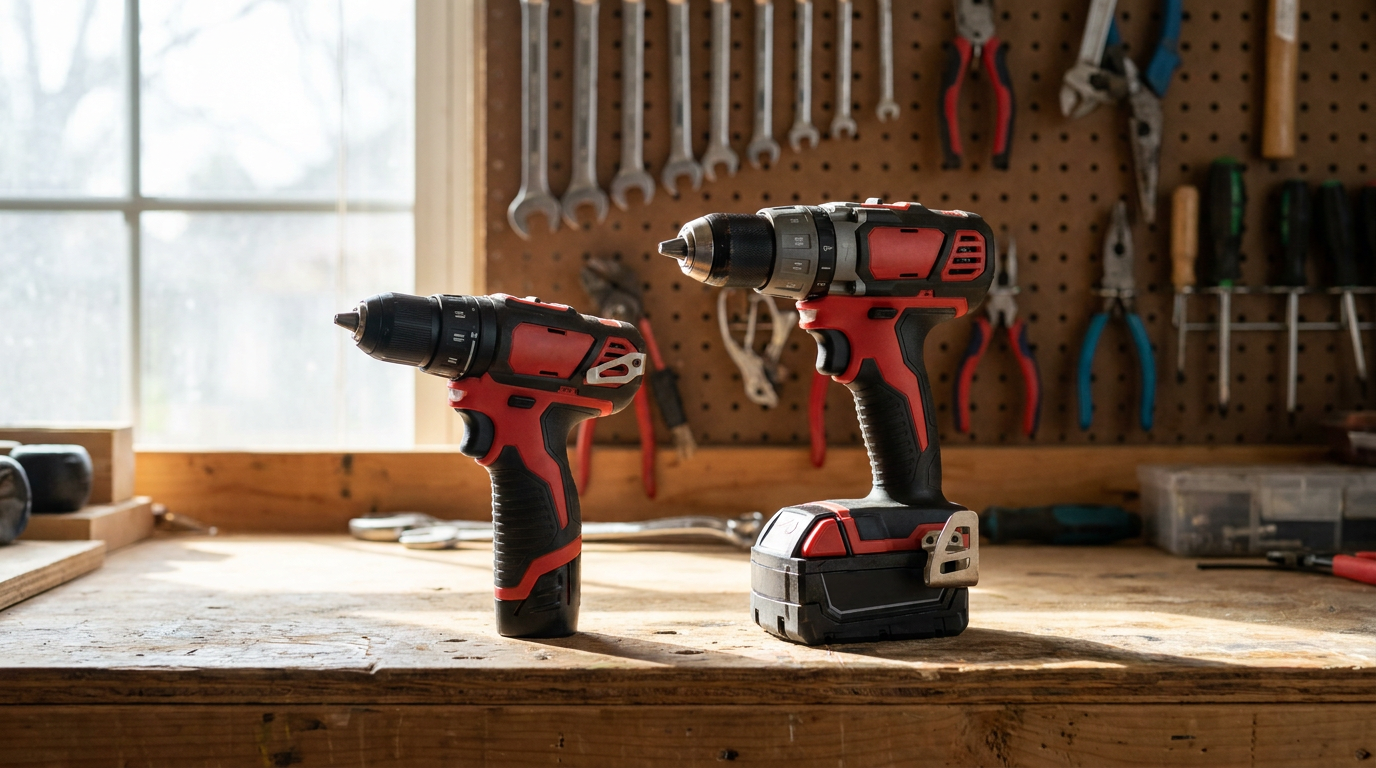
M12 (12-Volt System): This system uses a compact, cylinder-shaped battery that slides up into the handle of the tool. That’s a big reason M12 tools stay so slim and light. Think of it like a sports car—quick, nimble, and easy to thread into tight spots, like under a sink or inside a cabinet. It’s got more than enough power for driving screws, drilling pilot holes in drywall or pine, and cutting PVC pipe. The smaller battery cells mean less weight and a better feel in the hand, which makes a real difference when you’re working overhead or grinding through a long afternoon.
-
M18 (18-Volt System): This system uses a larger, rectangular "slide-on" battery that locks onto the base of the tool. That bigger footprint holds more, and bigger, battery cells, so you get a noticeable bump in power. If M12 is the sports car, M18 is the pickup truck. It’s got the raw torque for tougher jobs: drilling into concrete with a hammer drill, making long cuts in 2x10 lumber with a circular saw, or breaking loose rusted bolts with an impact wrench. All that power does come with a tradeoff—M18 tools are heavier and bulkier. The higher voltage lets the motor push through more resistance without bogging down, and that matters when you’re doing professional-grade work.
Milwaukee also sells different battery capacities, measured in Amp-hours (Ah). A higher Ah rating, like 5.0Ah vs 2.0Ah, means the battery runs longer on a charge, but it doesn’t make the tool hit harder.
Step-by-Step Fix
Choosing the right system isn’t really a "fix" in the usual sense, but it is a decision you want to get right the first time. Here’s how I’d sort it out for your setup.
-
Assess Your Most Common Projects — Be honest about what you actually do. Don’t buy for the one giant project you might do five years from now. Are you mostly putting together furniture, hanging pictures, and fixing leaky faucets? Or are you building sheds, framing basements, and taking on major renovations?
-
Handle the Tools in Person — Go to a store. Pick up an M12 drill. Then pick up an M18 drill. You’ll feel the difference right away. Weight, balance, all of it. Picture holding each one above your head for two minutes. Which one feels easier to live with? For a lot of homeowners, that M12 feel is a big selling point.
-
Evaluate the "Core Four" Tools — For most DIYers, the must-have cordless tools are a drill/driver, an impact driver, a multi-tool, and a compact saw, like a circular saw or reciprocating saw. Compare the M12 and M18 versions of those exact tools. The M12 drill is a workhorse for 90% of household screw-driving and drilling. The M18 version makes more sense if you’re regularly using big hole saws or auger bits.
-
Consider Specialty Tools — This is where the two ecosystems start to split. Browse Milwaukee's website. The M12 line has a surprisingly deep lineup of compact, trade-specific tools you don’t see everywhere else: a PVC shear, a soldering iron, an underhood light for working on cars, and a heated jacket. The M18 line is where the heavy hitters live: a 1-inch impact wrench, a deep-cut band saw, a 10-inch miter saw, and even a cordless table saw.
- If you need: Tight-pack portability and oddball sub-trade tools, lean M12.
- If you need: Raw power for construction or landscaping (like blowers and string trimmers), lean M18.
-
Think About Yard Work — Milwaukee's outdoor power equipment—string trimmers, leaf blowers, hedge trimmers, and even lawn mowers—runs exclusively on the M18 platform. If you want one battery system for the shop and the yard, M18 is your only play.
-
Don't Underestimate the Impact Driver — For a lot of homeowners, the smartest starting point is an M12 FUEL Impact Driver. It’s compact as heck, but it still packs more than enough power, up to 1,300 in-lbs of torque, to drive 3-inch deck screws all day long. It’ll run circles around a basic M18 drill/driver for fastening work, and it’s a lot less likely to chew up screw heads.
-
Analyze the Cost — M12 tools and batteries usually cost less than M18 gear. A typical M12 two-tool combo kit, drill and impact driver, might land around $179–$229. A similar M18 kit will often run $249–$399, especially if you’re looking at the brushless FUEL versions. And don’t forget the cost of future "bare tool" buys.
-
Make the Call: Start with M12 — For most homeowners, M12 is the smarter place to start. It gives you a good mix of power, compact size, and lower cost, which covers a huge chunk of home repair and improvement work. If a bigger, hungrier project comes up later, you can always add an M18 tool down the road. Owning both systems is common—you’ll just need two chargers.
Common Causes
So why do people pick the "wrong" system? Usually, it comes down to a few familiar mistakes.
- "Bigger is always better." A lot of first-time buyers figure 18 volts has to beat 12 volts at everything. Then they buy a heavy M18 drill to hang curtain rods, when a lighter M12 would’ve been quicker and a lot less tiring.
- Analysis Paralysis. There are a ton of tools—over 150 for M12, over 250 for M18—and that can freeze folks up. They get stuck trying to plan for every possible project instead of just looking at what they’ve got going on right now.
- Ignoring Ergonomics. People stare at specs online and never think about how the tool actually feels in the hand. Weight and balance matter just as much as torque, especially if you’re doing precise work or holding the tool overhead.
- Falling for a "Good Deal." A store might throw out a killer sale on a huge M18 7-tool combo kit. Looks like a steal. But if you only ever use the drill and the light, you’ve bought a bunch of tools that’ll sit there collecting dust.
Common Mistakes
- Using a Drill Instead of an Impact Driver. Driving long screws with a drill, especially a lower-voltage one, can beat up both the motor and your wrist. An impact driver uses rotational impacts to do the hard part, so it’s way more efficient for fasteners.
- Buying Non-FUEL When You Need the Power. Milwaukee's "FUEL" line uses a brushless motor, which means more power, better runtime, and longer life. If you go M12 but know you’ll push it hard, springing for the M12 FUEL versions is the smart move. They often hang right there with standard M18 tools.
- Using the Wrong Battery. Put a small, 1.5Ah M18 battery on a high-draw tool like a circular saw and you’ll have heat issues and cutoff problems. You’ve got to match the battery capacity (Ah) to what the tool is asking for.
- Forgetting About the Charger. If you wind up owning both M12 and M18 tools, you’ll need separate chargers, or a multi-bay charger. Small thing, sure. Still matters.
Cost & Time Breakdown
This isn't a repair, but here’s a rough look at the money you’re likely to spend if you’re starting with a basic set of tools.
| Tool Kit | DIY Cost (Typical Sale Price) | Pro Cost (Individual Bare Tools) | Best For... |
|---|---|---|---|
| M12 Drill/Driver & Impact Kit | $129–$199 | $250+ | General home maintenance, furniture assembly |
| M12 FUEL Drill & Impact Kit | $179–$229 | $350+ | Advanced DIY, frequent use, light pro work |
| M18 Drill/Driver & Impact Kit | $199–$279 | $400+ | Home renovation, decking, occasional heavy use |
| M18 FUEL Drill & Impact Kit | $349–$399 | $500+ | Professional construction, daily demanding use |
Tips & Prevention
- Look for "Free Tool" Promos. Retailers like Home Depot run these all the time. Buy a battery starter kit—something like two M12 batteries and a charger for $199—and you’ll often get a free bare tool from a set list. That’s about as good a value as you’ll find.
- Register Your Tools. Get them registered on Milwaukee's website. That kicks in your warranty, usually 5 years on tools and 2-3 years on batteries, and it makes the whole service process way less of a headache if something dies.
- Don't Store Batteries Fully Drained. Lithium-ion batteries last longest when they’re stored at a partial charge, around 40-50%. If you’re not going to use a tool for a few months, don’t leave the battery dead flat or parked on the charger the whole time.
- Keep Battery Contacts Clean. Every so often, wipe the metal contacts on the battery and tool with a clean, dry cloth so you get a solid connection. Gunk and dust can mess with power delivery.
- Start with a Combo Kit. It’s almost always cheaper to buy a kit with two tools, two batteries, and a charger than to piece it all together one item at a time.
When to Call a Professional
Even though this article is about picking tools, the "when to call a pro" rule still applies to the jobs you’ll use them for. No matter which system you own, stop and call a licensed professional if you run into major electrical, plumbing, or structural trouble. That new M18 FUEL hammer drill gives you the ability to drill into your foundation, but it doesn’t give you the judgment to know where it’s safe to do it. Never use power tools on work that needs a permit and inspection unless you’ve got the training and the proper permits in hand. That includes work on your main electrical panel, moving gas lines, or changing load-bearing walls. A strong tool in the wrong hands can make an expensive mess in a hurry.
Repair or replace this system?
Plug in four numbers and see which choice holds up financially.
Free and instant. Educational guidance only — not a quote, inspection, or professional diagnosis.
Questions to ask before you sign
Ask every contractor the same questions and the cheapest bid stops looking cheapest. Check them off as you go — your progress is saved on this device.
Free, no signup. Bring this to every walkthrough so you compare bids on the same terms.
What should this project cost?
Enter your project details for a realistic cost range before you call anyone.
Cost depends heavily on which system turns out to be the source.
- Regional adjustment
- National average
- Labor share (typical)
- ~$1,620
- Quotes to collect
- 3 written estimates
Educational estimate based on national averages — not a binding quote. Always confirm with written local estimates.
Repair or replace?
Run the age, cost ratio, and repair history through the calculator before you commit.
- Estimate this projectGet a cost range for your scope and ZIP before you call anyone.Open
- Get local estimatesSend one request and compare written estimates from vetted pros.Open
Free, no signup required. Estimates are educational guidance, not a quote or an inspection.
Get the print-ready PDF of this guide
A clean, ad-free, printable version you can keep on your phone or pin to the workshop wall. Free with a FixlyGuide account.
- Print-optimized layout
- Tools, materials & every step included
- Saved to your account
This article was independently written by FixlyGuide based on the source topic.
Frequently asked questions
Can I use M18 batteries on M12 tools?+
No, the two systems are not compatible. M18 batteries are a completely different size and shape and operate at a higher voltage. You must use M12 batteries for M12 tools and M18 batteries for M18 tools.
What does "FUEL" mean on a Milwaukee tool?+
FUEL is Milwaukee's top-tier line, indicating the tool has a brushless motor. Brushless motors are more efficient, more powerful, and have a longer lifespan than the standard brushed motors found in less expensive tools. They deliver better performance and longer battery runtime.
Is the M12 system powerful enough for building a deck?+
For most of the work, yes. An M12 FUEL impact driver is excellent for driving deck screws. However, for drilling large holes for carriage bolts or making long cuts in thick decking with a circular saw, the M18 system would provide more power and speed.
What's a better first tool: a drill/driver or an impact driver?+
For a homeowner, an impact driver is often more useful as a first tool. It excels at driving screws and lag bolts without stripping them, which is a very common task. A drill/driver is better for drilling precise, clean holes.
How long do Milwaukee batteries last before they need to be replaced?+
With normal homeowner use, you can expect a Milwaukee REDLITHIUM battery to last for 3 to 5 years or several hundred charge cycles. Professional use might wear them out faster. You'll know it's time for a replacement when it no longer holds a charge for a useful amount of time.
Are M12 tools just for small jobs?+
Not at all. Many trade professionals, especially electricians and plumbers, use M12 tools as their primary set because they are lightweight and fit into tight spaces. The M12 FUEL line in particular offers performance that rivals many 18-volt tools from other brands.
Should I buy the cheapest M12 kit I can find?+
Be careful with the cheapest kits. They often include the older, non-FUEL brushed tools and the most basic, low-capacity (1.5Ah) batteries. It's often worth spending $30-$50 more to get a kit with brushless tools and higher capacity (2.0Ah or 3.0Ah) batteries for much better performance.
Can I use my Milwaukee tools for automotive work?+
Absolutely. Both the M12 and M18 lines are extremely popular for auto repair. The M12 line offers compact ratchets, stubby impact wrenches, and underhood lights perfect for engine bay work. The M18 line has high-torque impact wrenches capable of removing stubborn lug nuts and suspension bolts.



Discussion
Loading comments…