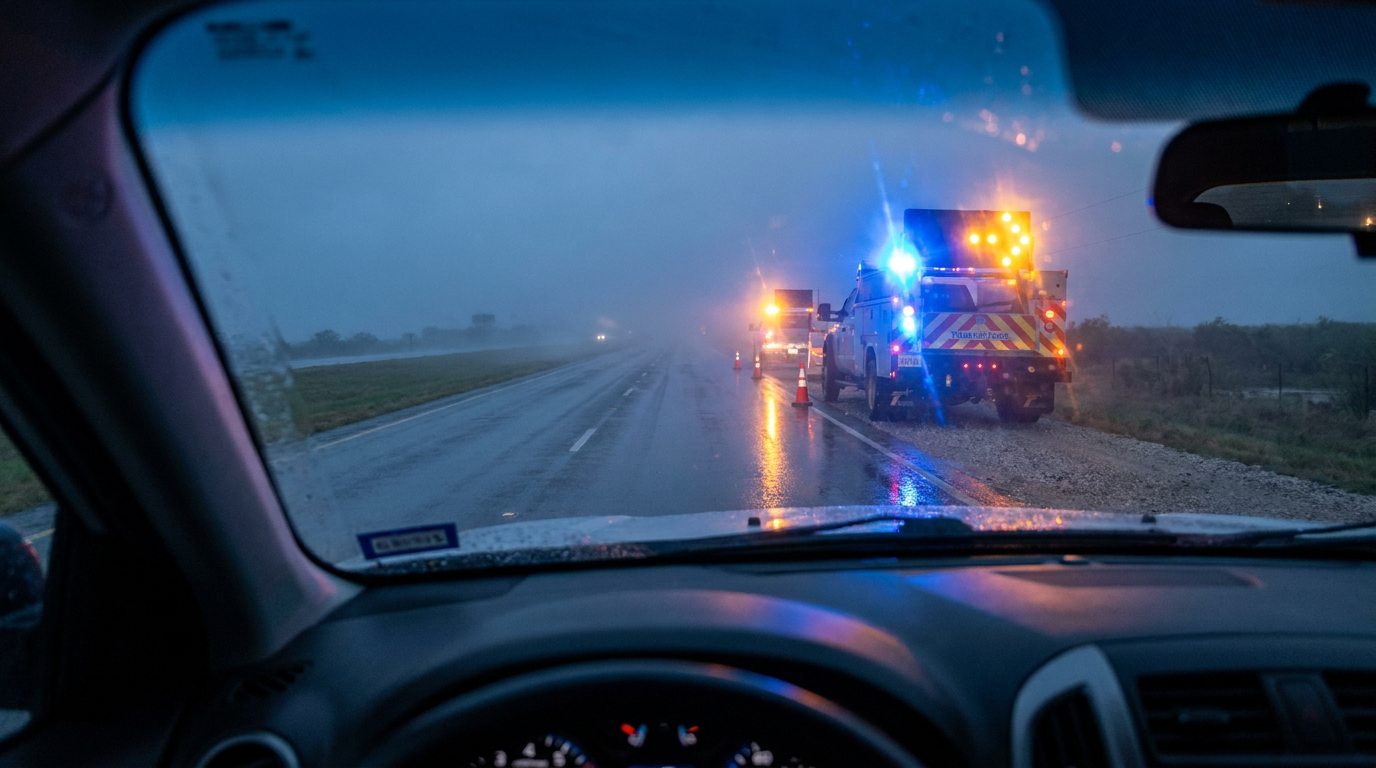
- Amber & White: Standard issue for construction, utility, and tow vehicles. Means caution, slow-moving, or stopped vehicle.
- Blue & Amber: More and more common on DOT trucks and snowplows. The blue cuts through snow and fog better than amber by itself. High-visibility caution, plain and simple.
- Red & Amber: Sometimes you’ll see this on specialty rigs, like wreckers clearing a big crash scene. Red says the scene’s dangerous right now, and amber warns traffic coming up behind it.
- Green & Amber: Often used on escort vehicles for wide loads, mixing the “watch out” of amber with the “follow my lead” signal of green.
Roofing · Flashing failure
| Project category | Roofing |
|---|---|
| Problem type | Flashing failure |
| Trade required | Roofing |
| Urgency | Soon — within weeks |
| Safety risk | Moderate safety risk |
| DIY suitability | Pro recommended |
| Cost category | Low cost |
| Typical timeline | Usually a half-day repair |
| Contractor type | Licensed roofing contractor |
Repair option
Replace the boot or step flashing and re-weave shingles around it.
Replacement option
Address during a full replacement when several details have failed at once.
Common causes
- Cracked pipe boots — the single most common roof leak source
- Rusted step flashing at walls and chimneys
- Sealant used as a substitute for proper metal
Relevant tools:project cost estimatordiy or hire a pro
Published October 18, 2026Last updated October 18, 2026
Tools & materials you'll need
Affiliate linksNo materials required.
As an Amazon Associate FixlyGuide earns from qualifying purchases — at no extra cost to you. Prices and availability are accurate as of publication and subject to change.
Product review and recommendation articles in this story are primarily created by the editorial team and include affiliate links. When you make a purchase through these links, we may earn a commission, but this does not influence our editorial guidance or product recommendations.
Quick Answer
Blue flashing lights on a non-police vehicle — like a construction truck or utility rig — usually mean there’s a hazard, but not an emergency. Could be a slow-moving unit, a wide load, or a crew working near traffic. You don’t have to yank over the way you would for a cruiser, but you should ease off the gas, leave yourself more space, and get ready to change lanes if you need to.
The Problem
You’re driving at night and spot flashing lights ahead. It’s not the usual red-and-blue from a patrol car, not the red of a fire engine, and not the yellow you see on a tow truck. Instead, it’s blue, green, or even purple on what looks like a construction truck or an escort vehicle for a wide load. That’ll make anybody hesitate. Do you pull over? Is it an emergency? Are you breaking some rule you don’t know about by just keeping on rolling? That kind of uncertainty can lead to dumb moves — either slamming on the brakes for no good reason or blowing past a hazard too fast.
How It Works
Warning-light rules are set state by state, but they generally follow the same playbook, based on Federal Highway Administration (FHWA) guidance and industry standards. The idea’s pretty simple: use colors like a language so drivers can tell how urgent a situation is at a glance. Emergency vehicles — police, fire, ambulance — get the colors that demand immediate action, mostly red and blue. The rest are there to say, “heads up.”
Here’s the breakdown:
- Red & Blue: This combo is almost always for law enforcement. If you see it, especially with a siren, you’ve got to yield the right-of-way. That means safely pulling to the right and stopping until the vehicle goes by. No dice on just cruising along like nothing’s happening.
- Red Only: Mostly fire departments and EMS rigs. That’s an active emergency signal, and you should yield just like you would for a police car.
- Amber/Yellow: This is the caution color. You’ll see it on tow trucks, DOT maintenance vehicles, snowplows, garbage trucks, and construction equipment. It means “watch out.” The vehicle may be moving slow, parked in a bad spot, or creating a lane problem. You don’t need to stop, but you do need to slow down and give it room.
- Blue: This one trips people up. In a lot of states, including Texas, blue lights are allowed on highway maintenance and utility vehicles. They usually mean a non-emergency but still hazardous situation. I pulled a water heater in Frisco last month behind a TxDOT truck running blue lights in a shadow convoy — they were protecting a striping crew, and you sure could’ve missed that setup if you weren’t paying attention. Blue can cut through fog and rain better than amber alone. That said, some states also use blue for volunteer firefighters and EMTs, and that does mean you yield. Context matters: is it on a marked fire unit or a dump truck?
- Green: Usually a command signal inside a convoy or at a job site. For example, a lead escort vehicle hauling a massive oversized load might use green to tell the driver it’s clear to proceed through an intersection. Some states also allow green on Department of Homeland Security vehicles or to mark a mobile command post.
- White: This one’s a helper light more than a signal. You’ll see it on emergency and utility vehicles to boost visibility, but it doesn’t mean much by itself. A lot of police cars use flashing white “wig-wag” headlights or strong alley lights to light up the roadside.
- Purple/Magenta: This is the newer kid on the block. It’s mostly used by funeral escort vehicles. Some states are also starting to allow it for hazardous materials transport because it stands out so clearly from the rest.
All of this is built to stack the urgency. Red and blue mean “stop now.” Amber means “slow down and be careful.” And blue, green, or purple on a non-law-enforcement vehicle means “pay attention — something odd is going on.”
Understanding the Signals: A Step-by-Step Guide for Drivers
When you see flashing lights ahead, don’t get jumpy. Take it one step at a time. Here’s how I’d size it up on the road.
-
Identify the Color—Fast. First thing you do is sort the light. Is it red/blue, amber, or something else? That quick read tells you what you’re supposed to do next.
-
Red and/or Blue Lights Approaching? Yield Immediately. — If it’s a police car, fire truck, or ambulance with sirens and flashing red or blue lights, your move is clear. Signal, get into the right lane, and pull over safely as far onto the shoulder as you can. Don’t stab the brakes or stop in a spot that blocks an intersection. Wait until the emergency vehicle(s) pass before you merge back in.
-
Amber/Yellow Lights Ahead? Slow Down and Prepare to Move Over. — That’s the caution signal. Tow trucks, DOT rigs, and construction vehicles use it. You’re not required to stop. In most “Move Over” laws, you’re supposed to slow down a good bit below the speed limit and, if you can, shift over a full lane to give them breathing room. If you can’t move over, crawl through it safely.
-
Encountering Solid Blue Lights? Assess the Vehicle. — This is the one that makes folks squint. First, look at the vehicle itself. Is it a marked police car or maybe a volunteer firefighter’s personal vehicle with a dashboard light? If so, treat it like an emergency and yield. If the blue light’s on a big construction truck, a TxDOT unit, or a snowplow, it’s a caution signal. Slow down, open up your following distance, and watch for lane changes or slow traffic. The blue is there for visibility, especially in lousy weather.
-
Seeing Green Lights? Look for a Convoy. — Green usually means a command vehicle. You’ll often spot it on the lead escort for an oversized load. That green light may be telling the truck behind it when it’s clear to move. Your job is simple: stay sharp. Oversized loads are a headache if you get too close, so give the whole convoy plenty of room and don’t try to squeeze between escort vehicles.
-
Spotting Purple/Magenta Lights? Be Respectful and Patient. — If you see purple or magenta lights, you’re probably looking at a funeral procession. It’s not a law everywhere, but it’s common courtesy — and the law in some places like Texas — to yield to the procession. Don’t cut into the line. If they’re moving through an intersection, just wait until the whole convoy clears.
-
Notice White Flashing Lights? Look for the Primary Color. — White lights are usually just extra visibility. They’re there to help you see the vehicle, but they don’t mean anything by themselves. If you see white flashers, look for the real color on the vehicle — red, blue, or amber — and react to that.
-
Always Check Your Surroundings. — Before you slow down, stop, or change lanes, check your mirrors and blind spots. The biggest problem here isn’t always the hazard vehicle. It’s the other driver beside you or behind you who didn’t get the memo. A hard stop can get you rear-ended. A sloppy lane change can cause a sideswipe. Signal what you’re doing.
Common Light Combinations and What They Mean
- Amber & White: Standard issue for construction, utility, and tow vehicles. Means caution, slow-moving, or stopped vehicle.
- Blue & Amber: More and more common on DOT trucks and snowplows. The blue cuts through snow and fog better than amber by itself. High-visibility caution, plain and simple.
- Red & Amber: Sometimes you’ll see this on specialty rigs, like wreckers clearing a big crash scene. Red says the scene’s dangerous right now, and amber warns traffic coming up behind it.
- Green & Amber: Often used on escort vehicles for wide loads, mixing the “watch out” of amber with the “follow my lead” signal of green.
Common Mistakes Drivers Make
- Ignoring Amber Lights: A lot of drivers see yellow flashers and barely let off the gas. Bad move. “Move Over” laws keep getting tougher, and cops are writing tickets when folks don’t slow down and/or change lanes for vehicles with amber lights. A tow truck driver on the shoulder is sitting in a very exposed spot.
- Panicking at Blue Lights: If you see blue on a construction truck and stand on the brakes, that’s risky. Read the vehicle first. If it’s not a police unit, it’s a caution signal — not a command to stop. A sudden stop can pile everybody up.
- Cutting into Convoys: Trying to slip between escort vehicles on an oversized load or a funeral procession is dangerous and, in the funeral case, flat-out disrespectful. Those convoys work as one unit. Let the whole group pass.
- Rubbernecking: Once you’ve spotted the hazard and handled it — slowed down, moved over, whatever’s needed — get your eyes back where they belong. Staring at the accident or the work zone is how secondary crashes happen.
- Forgetting to Signal: If you change lanes or pull over, signal it. The people behind you can’t read your mind. You’ve got to let them know what you’re doing.
Cost & Time Breakdown
Understanding roadside lights doesn’t cost you anything but attention. The cost of not understanding them, however, can be significant.
| Violation | Potential DIY Cost (Fine) | Potential Pro Cost (Legal Fees) | Time Impact |
|---|---|---|---|
| Ignoring a "Move Over" Law | $200–$500+ | $1,000–$4,000+ | Points on license, insurance increase |
| Failing to Yield to Emergency Vehicle | $250–$750+ | $1,500–$5,000+ | License suspension possible |
| Causing an Accident Near a Scene | Deductible + massive insurance spike | $5,000–$100,000+ | Months or years of legal issues |
| Speeding in a Work Zone | Fines are often doubled ($300–$1,000) | $1,000–$4,000+ | Significant insurance increase |
Tips for Safe Driving Near Roadside Work
- Stay Alert, Ditch Distractions: Put the phone down. Driving near a work zone takes your full attention. Things can change in a blink.
- Increase Following Distance: As soon as you see flashing lights of any color, double your following distance from the car ahead. You’ll buy yourself time.
- Look for Workers: Flashing lights usually mean people are out of their vehicles. Keep an eye out for folks on or near the road.
- Follow Temporary Signage: Orange signs with black lettering are the map. They’ll tell you about lane closures, speed changes, and detours. Those signs aren’t suggestions; they’re the rules.
- Merge Early: If you see a “Lane Closed Ahead” sign, merge as soon as it’s safe. Don’t race down the open lane to the very end and force your way in. Some traffic folks call that a late merge — maybe it has its place on paper, but out on the road it can spark road rage and ugly braking.
- Expect the Unexpected: A construction truck might back up without warning. A worker might step out from behind a trailer. Drive like the worst-case scenario could happen next.
When to Pull Over vs. When to Slow Down
This is the decision point that trips people up. It’s a pretty simple split, but folks still get mixed up on it.
Pull Over and Stop For:
- Any vehicle with flashing red AND blue lights. (Police)
- Any vehicle with flashing red lights and a siren. (Fire, Ambulance)
- A school bus with its red lights flashing and stop arm extended. (This is a complete stop, regardless of your direction of travel unless there is a physical median).
- As directed by a police officer or flagger.
Slow Down, Be Cautious, and Move Over For:
- Any vehicle with flashing AMBER/YELLOW lights. (Tow trucks, construction vehicles, utility trucks, garbage trucks)
- A non-law enforcement vehicle with flashing BLUE lights. (Snowplows, DOT trucks)
- Any vehicle with flashing GREEN or PURPLE lights. (Escort vehicles, funeral processions)
Think of it this way: Red means stop because of a life-or-death emergency. Amber and the other colors mean slow because there’s a potential hazard up ahead. Getting that right keeps you safe, keeps workers safe, and keeps you from getting written up.
Related Articles
Keep troubleshooting with these hand-picked guides from FixlyGuide:
- The Secret to Lush Raised Beds? It's Not Just About How You Water — Smart irrigation for raised garden beds isn't just about automation; it's about delivering the right amount of water precisely when your pl…
- The One Mistake DIYers Make with Old Paint (It Could Cost You Your Health) — If your home was built before 1978, disturbing old paint during DIY projects can release dangerous lead dust. Learn how to protect your fam…
- The 1978 Homeowner's Mistake: How to Safely Handle Lead Paint — Many homes built before 1978 contain lead-based paint, posing serious health risks if disturbed during DIY projects.
- The Hidden Reason Your GFCI Trips (It's Not Always a Faulty Outlet) — A continuously tripping GFCI outlet is a critical safety warning, often indicating moisture, a faulty appliance, or a wiring problem that r…
- The Hidden Reason Your GFCI Trips (It’s Not Always a Bad Outlet) — A tripping GFCI outlet is a safety mechanism doing its job, often indicating a problem like moisture, a faulty appliance, or a wiring issue…
- The $5 Secret to Silencing That Annoying Dripping Faucet (Single-Handle Fix) — Stop a dripping single-handle faucet with a simple and inexpensive DIY fix by replacing a worn-out o-ring or washer.
What should this project cost?
Enter your project details for a realistic cost range before you call anyone.
Cost depends heavily on which system turns out to be the source.
- Regional adjustment
- National average
- Labor share (typical)
- ~$1,620
- Quotes to collect
- 3 written estimates
Educational estimate based on national averages — not a binding quote. Always confirm with written local estimates.
Decide what your roof needs
Two minutes of questions turns "something is wrong up there" into a clear next step.
- Repair or replace your roof?Answer 10 questions about age, leaks, and damage to get a clear next step.Open
- Compare contractor quotesScore up to four bids on price, warranty, licensing, and timeline.Open
- Get local estimatesSend one request and compare written estimates from vetted pros.Open
Free, no signup required. Estimates are educational guidance, not a quote or an inspection.
This article was independently written by FixlyGuide based on the source topic.
Frequently asked questions
Do I have to pull over for a truck with flashing blue lights?+
Generally, no. If it's a construction or utility vehicle, the blue light is a high-visibility caution signal. You should slow down and move over if possible, but you are not legally required to stop as you would for a police car.
What's the difference between amber and blue flashing lights?+
Amber lights are the universal signal for caution. Blue lights, when used on non-police vehicles, are a more intense, attention-grabbing caution signal, often used in poor weather because the color cuts through fog and snow effectively.
Is it illegal to have blue lights on your personal car?+
Yes, in nearly every state it is illegal for a private citizen to mount blue lights on their personal vehicle. These colors are reserved for law enforcement and authorized emergency or utility vehicles only. Doing so can result in significant fines.
Why do some snowplows have green lights?+
Green lights are often used in a convoy situation. A lead plow might use a green light to signal to other plows in the formation. It's a way for them to communicate visually in loud, harsh conditions.
What does a flashing purple light mean?+
A flashing purple or magenta light is most commonly used by vehicles escorting a funeral procession. It's a newer color intended to be unique and easily identifiable. Treat it with respect and do not cut into the procession.
What is the 'Move Over' law?+
The 'Move Over' law requires drivers to slow down and, if safe, move over one lane when approaching any stationary vehicle with flashing lights, including police, fire, tow trucks, and construction vehicles. The specifics vary by state, but the intent is to protect roadside workers.
Can I get a ticket for not moving over for a tow truck?+
Yes. 'Move Over' laws apply to all vehicles with flashing warning lights, including tow trucks with amber lights. Failing to slow down and change lanes can result in a costly ticket and points on your license.
Are the rules for warning light colors the same in every state?+
While they are very similar and follow federal guidelines, there can be minor variations from state to state. For example, the specific rules for volunteer firefighter lights or the use of blue lights on utility trucks can differ. However, the core principles (red/blue for emergency, amber for caution) are universal.
Discussion
Loading comments…