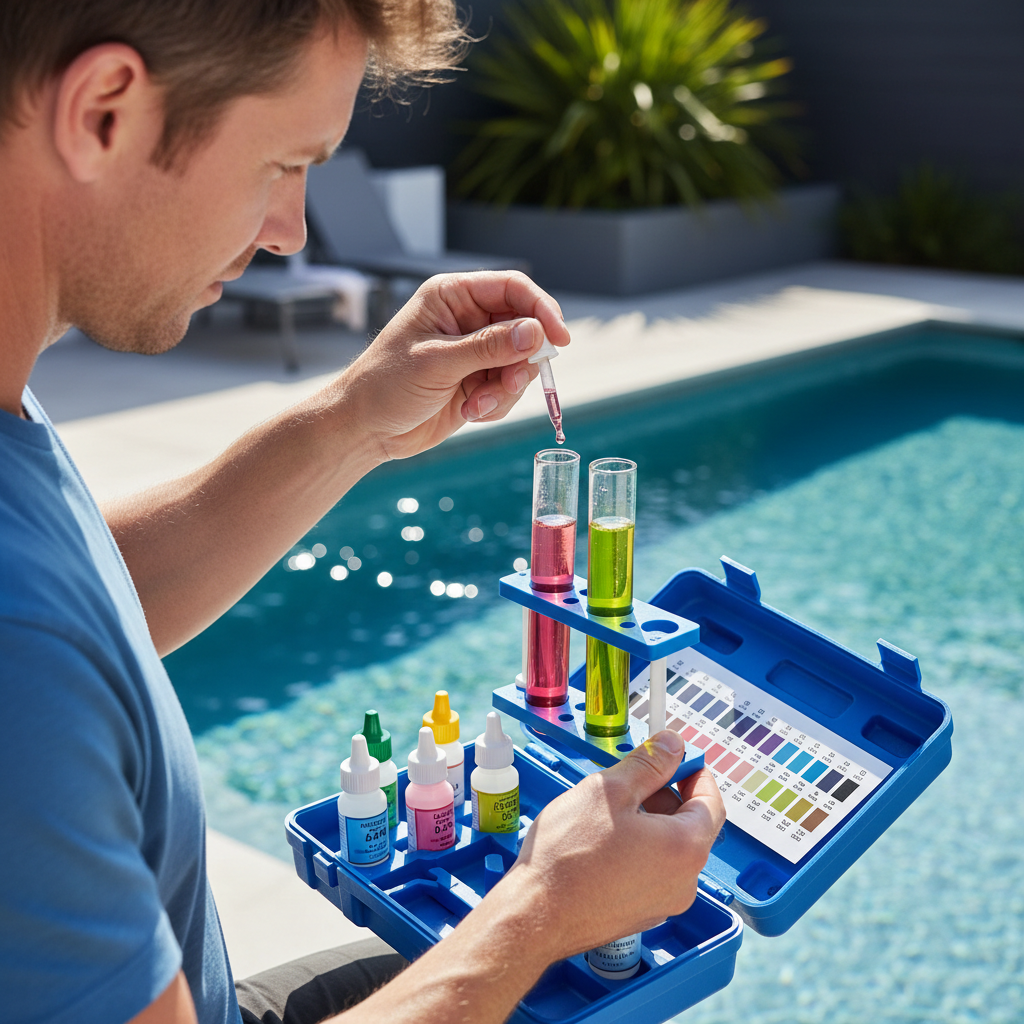
- Tools: High-quality liquid reagent test kit or digital tester. Test strips are a quick check but often less accurate.
- Method: Collect a water sample from elbow-depth, away from skimmers or returns. Follow your kit's instructions precisely for each parameter (pH, Free Chlorine, Total Alkalinity, Calcium Hardness, Cyanuric Acid).
- If this doesn't work: If your test kit is old, reagents may be expired, leading to false readings. Always check reagent expiration dates and store kits in a cool, dark place.
Published June 1, 2026Last updated August 17, 2026
Tools & materials you'll need
Affiliate links- AmazonLiquid reagent pool test kitAccurate readings for pH, chlorine, alkalinity, etc.
- AmazonPool brushFor brushing pool walls and floor
- AmazonTelescopic poleFor brush and vacuum head
- AmazonGarden hose with high-pressure nozzleFor cleaning filter cartridges or backwashing
- AmazonSafety goggles
- AmazonChemical-resistant gloves
As an Amazon Associate FixlyGuide earns from qualifying purchases — at no extra cost to you. Prices and availability are accurate as of publication and subject to change.
Quick Answer
Cloudy pool water is a frustrating and common issue for homeowners, but it's rarely a single problem. Most often, the cloudiness points to one of three core issues: a filtration system that isn't working efficiently, water chemistry that's out of whack (beyond just pH), or an overload of tiny particles and contaminants that the filter can't catch. Pinpointing the exact cause requires a good understanding of your pool's systems and accurate water testing.
The Problem
You're standing by your pool, eager for a refreshing dip, but instead of sparkling blue, you're greeted by a hazy, dull, or even milky white expanse. Cloudy pool water isn't just unsightly; it can indicate underlying issues that compromise swimmer comfort, promote algae growth, and even lead to expensive equipment damage if left unaddressed. It makes the pool feel less inviting and signals that something isn't quite right with your pool's health.
How It Works
Understanding how your pool should work helps diagnose why it's not. A healthy pool relies on a delicate balance between mechanical filtration and chemical sanitation. Water is drawn from the pool through skimmers and main drains by the pump, which then pushes it through a filter designed to trap physical debris. Filter types vary: sand filters use layers of sand, DE (diatomaceous earth) filters use a fine powder coating internal grids, and cartridge filters use pleated fabric. Each type has different maintenance needs and filtration capabilities. After filtration, the water is heated (if applicable) and returned to the pool.
Concurrently, chemicals maintain water quality. Sanitizers like chlorine or bromine kill bacteria and algae. pH (potential hydrogen) measures acidity or alkalinity; ideal is 7.4-7.6. Total alkalinity (TA) acts as a buffer, stabilizing pH, with a target of 80-120 ppm (parts per million). Calcium hardness (CH) prevents corrosion and scaling, ideally 200-400 ppm. Cyanuric acid (CYA) stabilizes chlorine from UV degradation, with a target of 30-50 ppm. When any of these parameters are off, the water's clarity and safety are compromised.
Suspended particles, whether microscopic algae, dirt, skin cells, or chemical precipitates, scatter light, making the water appear cloudy. If the filter isn't fine enough, running long enough, or is dirty itself, these particles recirculate. If the sanitizer level is too low, organic matter thrives and causes cloudiness. If pH or alkalinity are too high, minerals can precipitate out, forming a milky haze. A holistic approach to testing and addressing both filtration and chemistry is key to clear water.
Step-by-Step Fix
1. Test Your Water Thoroughly — A full chemical profile is your diagnostic starting point. Without accurate testing, you're just guessing.
- Tools: High-quality liquid reagent test kit or digital tester. Test strips are a quick check but often less accurate.
- Method: Collect a water sample from elbow-depth, away from skimmers or returns. Follow your kit's instructions precisely for each parameter (pH, Free Chlorine, Total Alkalinity, Calcium Hardness, Cyanuric Acid).
- If this doesn't work: If your test kit is old, reagents may be expired, leading to false readings. Always check reagent expiration dates and store kits in a cool, dark place.
2. Adjust pH and Total Alkalinity First — These two parameters establish the foundation for effective sanitation and clarity.
- Safety: Wear gloves and eye protection when handling pool chemicals.
- Adjusting pH: If high, add muriatic acid (carefully!) or a pH decreaser. If low, add soda ash (sodium carbonate) or a pH increaser. Add in small increments, waiting 4-6 hours, and retest before adding more.
- Adjusting TA: If low, add sodium bicarbonate (baking soda). If high, add muriatic acid (often lowers pH and TA simultaneously, so adjust pH first if it's already low). Again, small increments are key.
3. Boost Your Sanitizer Level (Shock) — Often, cloudiness is an early sign of insufficient chlorine to combat contaminants.
- Product: Use a granular shock treatment (calcium hypochlorite, sodium dichlor, or non-chlorine shock like potassium monopersulfate).
- Application: Add shock at dusk or night to minimize UV degradation. Dilute granular shock in a bucket of pool water before slowly pouring into the pool, according to manufacturer instructions. Run the filter continuously.
- Readings: Check Free Chlorine levels after 8-12 hours. Do not swim until chlorine levels return to safe range (1-4 ppm).
4. Run Your Filter Continuously and Backwash/Clean It — A dirty or undersized filter is a major culprit for cloudy water.
- Duration: Run your pool pump and filter for 18-24 hours continuously when the water is cloudy, even if you normally run it less.
- Backwashing (Sand/DE): When pressure gauge is 7-10 psi above clean operating pressure, backwash until water runs clear. Recharge DE filters with new DE powder.
- Cartridge Cleaning: Remove cartridges and clean thoroughly with a high-pressure hose. Consider a filter cleaner chemical every few months to remove oils and calcification.
5. Consider a Clarifier or Flocculant — These products help tiny particles clump together so your filter can catch them.
- Clarifiers: Coagulate small particles. Add according to instructions and run your filter. They are generally safe for all filter types.
- Flocculants: Cause particles to settle to the bottom. Add according to instructions, then turn off your pump for 8-12 hours to let debris settle. You'll then need to manually vacuum the settled debris to waste (not back through your filter).
- Important: Know your filter type. Flocculants are generally not recommended for cartridge filters, as they can quickly clog them.
6. Address Calcium Hardness if Too Low or Too High — Extreme calcium levels can lead to cloudiness.
- Low Calcium: Can cause etching and equipment corrosion, leading to dissolved metals that can cloudy water. Add calcium chloride slowly, diluted in a bucket, to raise levels.
- High Calcium: Leads to scaling and can cause a milky haze, especially with high pH. Reducing calcium hardness typically requires partial draining and refilling with fresh, lower-calcium water, or specialized chelating agents.
7. Check for Algae Bloom — Even microscopic algae can cause a green or grayish cloudiness.
- Signs: Beyond cloudiness, look for slippery surfaces, a faint greenish tint, or a musty odor.
- Treatment: Shock the pool heavily (superchlorinate) and brush all surfaces. Run the filter continuously. An algaecide can be used as a supplement, but proper chlorine levels are the primary defense.
8. Vacuum and Skim Frequently — Regular physical removal of debris prevents organic load.
- Method: Manually vacuum the pool floor regularly, especially if you've flocculated. Skim floating debris daily. Empty skimmer and pump baskets to maintain flow.
Common Causes
- Improper Filtration: Dirty filter, worn-out filter media (sand that's channeling), insufficient run time, or a pump that's too small.
- Imbalanced Water Chemistry: Low free chlorine, high pH, high total alkalinity, or high calcium hardness leading to mineral precipitation. Low cyanuric acid can also allow chlorine to dissipate too quickly.
- Organic Contaminants: Algae (even microscopic), pollen, leaves, insect debris, sunscreen, body oils, and pet dander.
- Non-Organic Contaminants: Dirt, dust from construction, rain runoff, or dissolved metals from source water or corroding equipment.
- Poor Circulation: Clogged skimmers/returns, incorrect jet direction, or a malfunctioning pump leading to
Related Articles
Keep troubleshooting with these hand-picked guides from FixlyGuide:
- The Hidden Reason Your GFCI Trips (It's Not Always a Faulty Outlet) — A continuously tripping GFCI outlet is a critical safety warning, often indicating moisture, a faulty appliance, or a wiring problem that r…
- The 9 Sneaky Filters Stealing Your Home's Efficiency (And How to Fix It) — Unseen or neglected filters throughout your home can secretly inflate utility bills, degrade air quality, and lead to expensive appliance b…
- The Secret to Lush Raised Beds? It's Not Just About How You Water — Smart irrigation for raised garden beds isn't just about automation; it's about delivering the right amount of water precisely when your pl…
- The 5 Essential Tools Every New Gardener Needs (And 3 You Can Skip) — Starting a garden doesn't require a huge investment in tools; savvy new gardeners can thrive with just a few key items and save money by kn…
- The 4-Hour — Transform your garden into a self-sufficient oasis with smart strategies for watering, weeding, and pest control, minimizing your effort.
- The #1 Sprinkler Winterization Mistake That Leads to $1,000s in Damage — Discover the crucial mistake many homeowners make when winterizing sprinklers and how to properly blow out your system to prevent costly fr…
Should you do this yourself?
Answer five quick questions before you start. Safety outranks savings every time.
Your experience with work like this
How high do you have to work?
Does the job involve any of these?
Will it need a permit?
Specialty tools
Free and instant. Educational guidance only — not a quote, inspection, or professional diagnosis.
What should this project cost?
Enter your project details for a realistic cost range before you call anyone.
Cost depends heavily on which system turns out to be the source.
- Regional adjustment
- National average
- Labor share (typical)
- ~$1,620
- Quotes to collect
- 3 written estimates
Educational estimate based on national averages — not a binding quote. Always confirm with written local estimates.
This article was independently written by FixlyGuide based on the source topic.
Frequently asked questions
How long does it take to clear a cloudy pool?+
The time it takes to clear a cloudy pool varies depending on the severity of the problem and the steps you take. Minor cloudiness from recent use might clear in 24-48 hours with increased filtration and a small chemical adjustment. More severe issues, like significant algae blooms or severe chemical imbalances, could take 3-5 days or even longer with multiple treatments and continuous filtration.
Can I swim in cloudy pool water?+
It is generally not recommended to swim in cloudy pool water. Cloudiness often indicates an imbalance in water chemistry, especially low sanitizer levels, which means bacteria, viruses, and algae could be thriving, posing a health risk. Additionally, low visibility in cloudy water can be a safety hazard, especially for children, as it's harder to spot the bottom or anyone in distress.
What's the difference between a pool clarifier and a flocculant?+
Both clarifiers and flocculants help clear cloudy water, but they work differently. A clarifier causes tiny suspended particles to clump into larger ones that the filter can more easily capture. A flocculant, on the other hand, makes particles heavy enough to settle to the bottom of the pool, where they must then be vacuumed to waste. Flocculants are generally stronger but require more manual effort (vacuuming to waste) and are often not suitable for cartridge filters, which can clog easily.


Discussion
Loading comments…