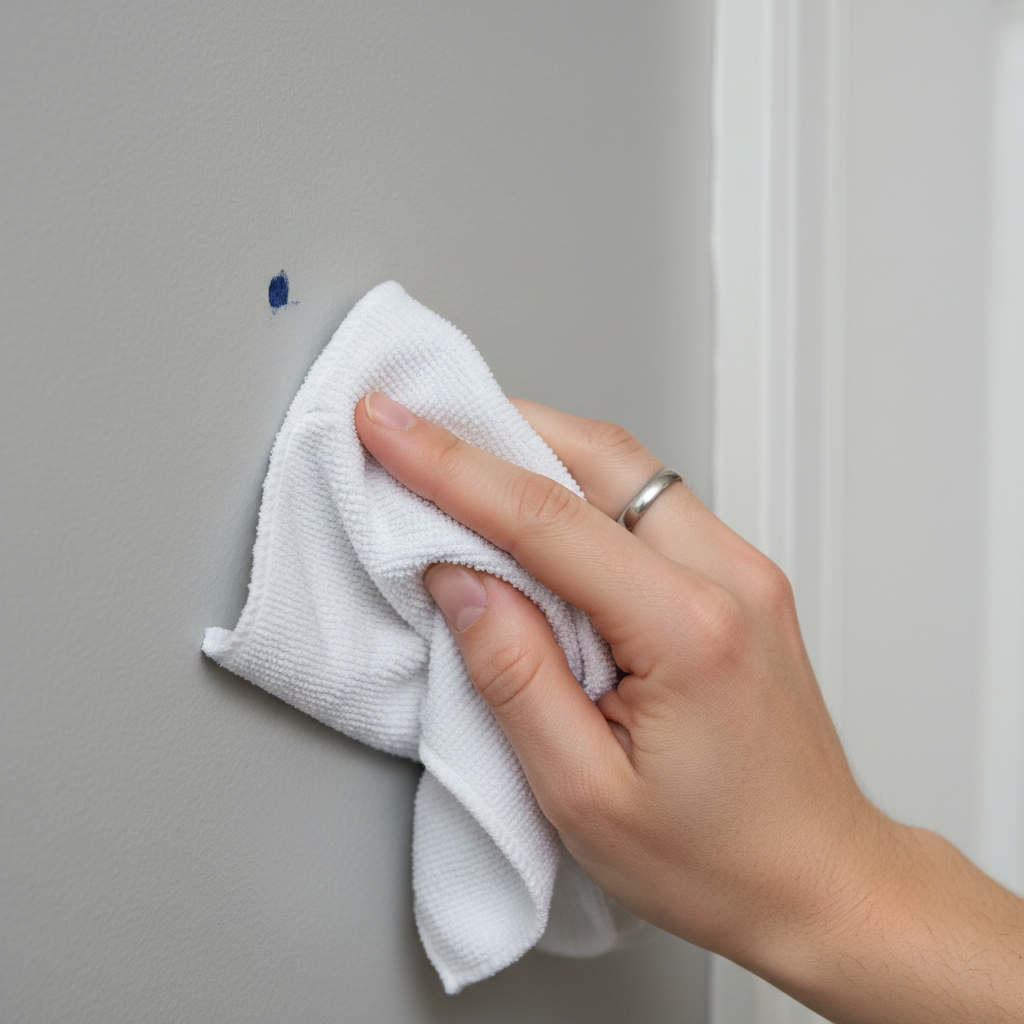
- 70% Isopropyl Alcohol: The primary solvent for breaking down the ink.
- Mr. Clean Magic Eraser: A gentle micro-abrasive for the first attempt.
- White Microfiber Cloths (3-4): Essential for applying solvent and cleaning. Must be white to prevent dye transfer.
- Dawn Dish Soap: A gentle surfactant for the final cleanup.
- Small Bowl: For holding the alcohol or soapy water.
Published June 3, 2026Last updated August 17, 2026
Tools & materials you'll need
Affiliate linksAs an Amazon Associate FixlyGuide earns from qualifying purchases — at no extra cost to you. Prices and availability are accurate as of publication and subject to change.
Quick Answer
To remove ballpoint pen ink from a painted wall, start with the gentlest method, such as a damp Mr. Clean Magic Eraser, using light pressure. If the stain persists, escalate to a white microfiber cloth lightly dampened with 70% isopropyl alcohol. Dab, don’t rub, the ink mark to lift it, then wipe the area with a clean, water-dampened cloth to remove any residue.
Why This Works
Successfully removing a ballpoint pen mark from a painted wall is a delicate dance between chemistry and technique. It’s not about scrubbing harder; it’s about using the right agent to dissolve the ink without destroying the paint surface beneath. Ballpoint ink is typically composed of dye or pigment particles suspended in an oil-based solvent, often containing oleic acid. This mixture is designed to be viscous and dry quickly on paper, but on a less porous surface like a painted wall, it sits right on top, waiting for the right solvent to break it down.
Our multi-step approach works by escalating the intensity of the cleaning agent. We start with the mildest and move up, ensuring we use only as much power as is necessary.
-
Micro-Abrasives (The Physical Approach): The Mr. Clean Magic Eraser is our first choice after water fails. It’s made of melamine foam, which, when wet, acts as an incredibly fine-grit sandpaper. The foam’s microstructure is extremely hard and scrapes away the ink stain at a microscopic level. The water acts as a lubricant, and the foam’s open-cell structure helps lift and trap the dislodged ink particles. However, because you are physically removing a minuscule layer of the wall's surface, it's crucial to use gentle pressure. You are essentially "sanding" away the ink along with a nearly invisible layer of paint. Overly aggressive rubbing can burnish or dull the paint’s sheen, creating the dreaded "halo" effect.
-
Solvents (The Chemical Approach): When a Magic Eraser isn’t enough, we turn to a solvent: isopropyl alcohol (rubbing alcohol). Alcohol is a polar solvent, but it has nonpolar characteristics, allowing it to effectively dissolve the oil-based solvents and fatty acids in the ballpoint ink. The principle is "like dissolves like." The alcohol gets in between the ink molecules, breaking them apart from each other and from the wall surface. Dabbing is critical here. Rubbing simply smears the semi-dissolved ink across a wider area and grinds it into the paint's micropores. Dabbing applies the solvent and then lifts it—along with the dissolved ink—straight up into the fibers of your microfiber cloth. We use a white cloth to prevent any dye transfer from the cloth to the wall and to clearly see when the ink is being successfully lifted.
Finally, cleaning with a mild soap (like Dawn) and water neutralizes and removes any leftover alcohol solvent or eraser residue, restoring the wall to a clean, uniform surface. This step ensures that no lingering chemical can affect the paint over time.
What You Need
- 70% Isopropyl Alcohol: The primary solvent for breaking down the ink.
- Mr. Clean Magic Eraser: A gentle micro-abrasive for the first attempt.
- White Microfiber Cloths (3-4): Essential for applying solvent and cleaning. Must be white to prevent dye transfer.
- Dawn Dish Soap: A gentle surfactant for the final cleanup.
- Small Bowl: For holding the alcohol or soapy water.
- Nitrile Gloves: To protect your hands from the drying effects of alcohol.
- Water: For dampening cloths and the Magic Eraser.
Step-by-Step Method
-
Safety and Spot Test First — Before you touch the visible mark, identify a hidden spot on the same wall. Behind a couch, in a closet, or below a light switch plate are great options. You will test every step here first to ensure your paint doesn't discolor or lose its sheen. Put on your nitrile gloves.
-
The Water-Only Attempt — Dampen a white microfiber cloth with plain water and squeeze it out thoroughly. Gently blot the ink mark. This almost never works for ballpoint ink but is the safest possible first action and a necessary baseline.
-
Introduce the Magic Eraser — Fully wet a Mr. Clean Magic Eraser and squeeze out all excess water until it's just damp. With very light pressure, gently rub the ink mark in small, overlapping circles. Let the foam do the work; don’t scrub. The goal is to lift the ink sitting on the surface.
-
Wipe, Dry, and Assess — After a few gentle passes with the eraser, use a clean, water-dampened microfiber cloth to wipe the area clean of any foam residue. Let it dry completely for at least 10-15 minutes. If the mark is gone and the paint finish looks uniform, you’re done! If it’s faded but still visible, proceed to the solvent phase.
-
Prepare the Isopropyl Alcohol — Pour a small amount of 70% isopropyl alcohol into your small bowl. Do not use 91% or higher, as the increased alcohol concentration raises the risk of damaging the paint. The 30% water content in 70% isopropyl alcohol actually helps it dissolve things more effectively and slows evaporation.
-
Dab the Ink with Alcohol — Fold a fresh white microfiber cloth into a small square. Dip a corner into the alcohol, blotting excess on the side of the bowl. The cloth should be damp, not dripping. Carefully dab the ink stain. Do not rub. Press the damp cloth onto the mark for a second and lift it straight up.
-
Rotate the Cloth and Repeat — Look at your cloth; you should see a spot of blue or black ink. Turn the cloth to a clean, fresh section and repeat the dabbing motion. Using a clean section each time is crucial to prevent re-depositing the ink you just lifted back onto the wall. Continue this process until the mark is no longer visible.
-
Address Faint Residual Lines — If a very faint shadow of the mark remains, you can try one or two very quick, light swipes with the alcohol-dampened cloth. This is a slightly more aggressive move, so be cautious. Immediately follow with a dab to lift any smeared ink.
-
Perform a Neutralizing Wash — Once the ink is completely gone, it’s vital to remove the alcohol residue. Mix one or two drops of Dawn dish soap into a cup of warm water. Submerge a new, clean microfiber cloth, wring it out, and gently wash the entire area, extending an inch or two beyond the original spot to help blend the finish.
-
Rinse and Final Dry — Using a final, clean cloth dampened with only plain water, wipe the area to rinse away any soap residue. Let the wall air dry completely. Inspect it from multiple angles to ensure the ink is gone and the paint’s sheen is uniform.
-
Paint Touch-Up (If Necessary) — In the rare case that the paint's sheen was affected (most common on flat or matte finishes), the only way to achieve a perfect finish is a paint touch-up. Using the original wall paint and a very small artist's brush, carefully dab a tiny amount of paint over the affected area to restore a seamless look.
Common Mistakes
- Rubbing Vigorously Instead of Dabbing: This is the most common error. Rubbing smears the ink, enlarges the stain, and can burnish the paint, creating a shiny or dull spot (a "halo") that is more noticeable than the original ink mark.
- Using the Wrong Solvent: Never use acetone (nail polish remover), paint thinner, or bleach. These are far too aggressive and will strip latex and acrylic paint from the drywall instantly, creating a much bigger problem that requires significant patching and repainting.
- Skipping the Hidden Spot Test: Every paint and wall is different. A method that works perfectly on one wall might damage another. Failing to test in an inconspicuous area first is a gamble that can lead to visible, irreversible damage.
- Applying Alcohol Directly to the Wall: Pouring or spraying alcohol directly onto the wall provides no control. It can drip down, creating streaks, and over-saturates the area, increasing the likelihood of paint damage. Always apply the solvent to your cloth first.
- Using a Colored or Dirty Cloth: A colored cloth can transfer its own dyes to the wall, especially when used with a solvent like alcohol. A dirty cloth can grind in old grit or redeposit stains. Always use clean, white cloths.
- Not Removing Solvent Residue: Alcohol is a chemical. If left to dry on the paint, it can slowly degrade the finish over time. The final wash with gentle soap and a water rinse is a critical step to ensure the long-term integrity of your paint job.
Cost & Time Breakdown
| Task | DIY Cost | Professional Cost | Time |
|---|---|---|---|
| Supplies | $5 - $20 (for alcohol & Magic Eraser if not on hand) | N/A | 15 minutes |
| Spot Testing | $0 | N/A | 10 minutes (includes drying) |
| Cleaning (per mark) | $0 | $75 - $150 (as part of a minimum service call) | 15-20 minutes |
| Paint Touch-Up (if needed) | $5 - $15 (for a sample pot of paint) | $100 - $250+ (minimum charge for a painter) | 30 minutes + drying time |
| Total | $5 - $35 | $100 - $250+ | 30 - 60 minutes |
Prevention & Maintenance
- Create "No Pen" Zones: The easiest solution is prevention. Designate areas, especially playrooms or home offices, where pens are kept in holders and away from walls.
- Opt for Washable Art Supplies: For households with children, actively choose washable markers, crayons, and paints for art projects. These are designed to be cleaned from surfaces like painted walls with just soap and water.
- Choose a More Durable Paint Sheen: When you next paint, consider a satin or eggshell finish for high-traffic areas. Flat and matte paints are porous and absorb stains, while higher-sheen paints create a more sealed, wipeable surface that resists marking and is easier to clean.
- Act Immediately: Fresh ink is significantly easier to remove than ink that has had days or weeks to cure and set into the paint. Address any new marks as soon as you spot them.
- Keep a Small Cleaning Kit: Store a Magic Eraser and a small bottle of 70% isopropyl alcohol in your cleaning caddy. Having them ready to go means you can tackle an ink mark in seconds rather than letting it set.
- Educate Your Household: Gently remind family members, especially kids, that walls aren't for writing and show them where they can draw and write instead.
When to Call a Professional
While this DIY method is highly effective for most common situations, there are times when calling a professional painter is the smarter, faster, and ultimately better choice. If you're facing a large, scribbled area of ink, the risk of creating a massive, blotchy patch on your wall is high. A professional has the tools and experience to properly sand, prime (with a stain-blocking primer like Kilz or Zinsser), and repaint the section for a truly seamless result.
Similarly, if the ink is on a wall with a delicate or expensive finish—such as Venetian plaster, a faux finish, or wallpaper—do not attempt this method. These surfaces require specialized care, and using alcohol or abrasives will almost certainly cause permanent damage. If the ink has seeped into very porous flat or matte paint and has been there for months or years, it may have penetrated too deeply to be removed by surface methods. Lastly, if your own attempts have already resulted in a large, shiny, or dull "halo" on the wall, it's time to stop. A painter can fix the original mark and your repair attempt at the same time, restoring the wall to its original pristine condition.
What should this project cost?
Enter your project details for a realistic cost range before you call anyone.
Cost depends heavily on which system turns out to be the source.
- Regional adjustment
- National average
- Labor share (typical)
- ~$1,620
- Quotes to collect
- 3 written estimates
Educational estimate based on national averages — not a binding quote. Always confirm with written local estimates.
Get the print-ready PDF of this guide
A clean, ad-free, printable version you can keep on your phone or pin to the workshop wall. Free with a FixlyGuide account.
- Print-optimized layout
- Tools, materials & every step included
- Saved to your account
Frequently asked questions
Can I use nail polish remover (acetone) to remove ink from a wall?+
No, you should never use acetone or nail polish remover on painted drywall. Acetone is a very powerful solvent that will dissolve and strip latex or acrylic paint almost instantly, creating a much larger and more difficult problem to fix than the original ink stain.
Does this method work on all paint sheens?+
This method is safest on satin, eggshell, and semi-gloss sheens, which are more durable and less porous. You must be extremely careful with flat or matte finishes, as they are very porous and not very durable. The abrasive action of a Magic Eraser or the solvent action of alcohol can easily damage the finish. Always test in a hidden spot first.
What if the ink is from a gel pen or a permanent marker?+
This guide is specifically for oil-based ballpoint pen ink. Gel pens often use water-based pigments that can be easier to remove, but some can stain deeply. Permanent markers like Sharpies are a completely different challenge, as their ink is designed to be waterproof and aggressive. Removing permanent marker almost always requires priming over the stain with a product like Kilz or Zinsser and then repainting.
Why shouldn't I use a colored cloth?+
Solvents like isopropyl alcohol can break down not only the ink on the wall but also the dye in a colored cloth. This can lead to dye transfer from your cloth to the wall, creating a new, larger, and often more colorful stain that can be very difficult to remove.


Discussion
Loading comments…