- Confirm Dimmer Compatibility – Not all dimmers play nice with LEDs.
- Tools: Screwdriver set, voltage tester, lineman's pliers.
- Safety: Turn off the breaker for the light and verify there’s no power with a voltage tester before you touch any wiring.
- If still flickering: Even with an LED-compatible dimmer, some bulb and dimmer combos just don’t get along. Try another brand of ‘dimmable’ LED bulb and see if the problem follows the bulb or stays put.
General remodeling · Renovation planning
| Project category | General remodeling |
|---|---|
| Problem type | Renovation planning |
| Trade required | General contracting |
| Urgency | Planned project |
| Safety risk | Low safety risk |
| DIY suitability | Pro recommended |
| Cost category | Major investment |
| Typical timeline | Design and permitting often 2–4 months before work starts |
| Contractor type | General contractor |
Repair option
Phase the work and fix the building envelope first.
Replacement option
Full renovation with permits, design, and a general contractor.
Common causes
- Space no longer fits how the household lives
- Resale preparation
- Deferred maintenance stacking up
Relevant tools:project cost estimatorcompare quoteshome improvement material prices
Published July 27, 2026Last updated August 17, 2026
Tools & materials you'll need
Affiliate linksAs an Amazon Associate FixlyGuide earns from qualifying purchases — at no extra cost to you. Prices and availability are accurate as of publication and subject to change.
Quick Answer
If you’re constantly swapping out LED bulbs that swear they’ll last 25,000 hours but quit after a year or two, don’t hang the whole thing on the bulb just yet. Most of the time, the real trouble’s hiding in your home’s wiring or right inside the fixture. I’m talking heat, voltage swings, the wrong bulb in the wrong spot — the usual suspects. Get that sorted out, and you’ll stop feeding the hardware store your money.
The Problem
I hear this one all the time: “My old incandescent bulbs lasted forever, but these new LEDs burn out constantly!” Folks buy these energy-saving bulbs expecting years of service, then they end up back in the lighting aisle so often they ought to have a rewards card. It’s aggravating. Feels like a scam, honestly. You bought LEDs to save money and headaches, not create a new chore every few months.
I’ve pulled and replaced hundreds of these things over the years. Fancy recessed lights in a new build out in Farmington, old farmhouse work in Colchester with knob-and-tube that somehow still had juice — I’ve seen the whole circus. And what I’ve learned is this: when an LED dies early, it’s usually not some random defect in the bulb. More often, it’s a symptom. Something in the lighting setup is cooking it, starving it, or beating it up until it gives up. Same idea as a truck that keeps eating tires because the alignment’s out. You can keep buying tires, but that thing’s still gonna chew them up until you fix the root cause.
How It Works
Before we start fixing anything, let’s talk about how an LED bulb is supposed to work, and why it’s so different from the old glass bulbs we grew up with. Incandescents were dead simple: electricity heats a filament until it glows. LEDs are a different animal. Inside that frosted plastic or glass shell, there’s a semiconductor chip — the “Light Emitting Diode” part — that makes light when current runs through it. Problem is, those chips hate heat and they hate bad voltage.
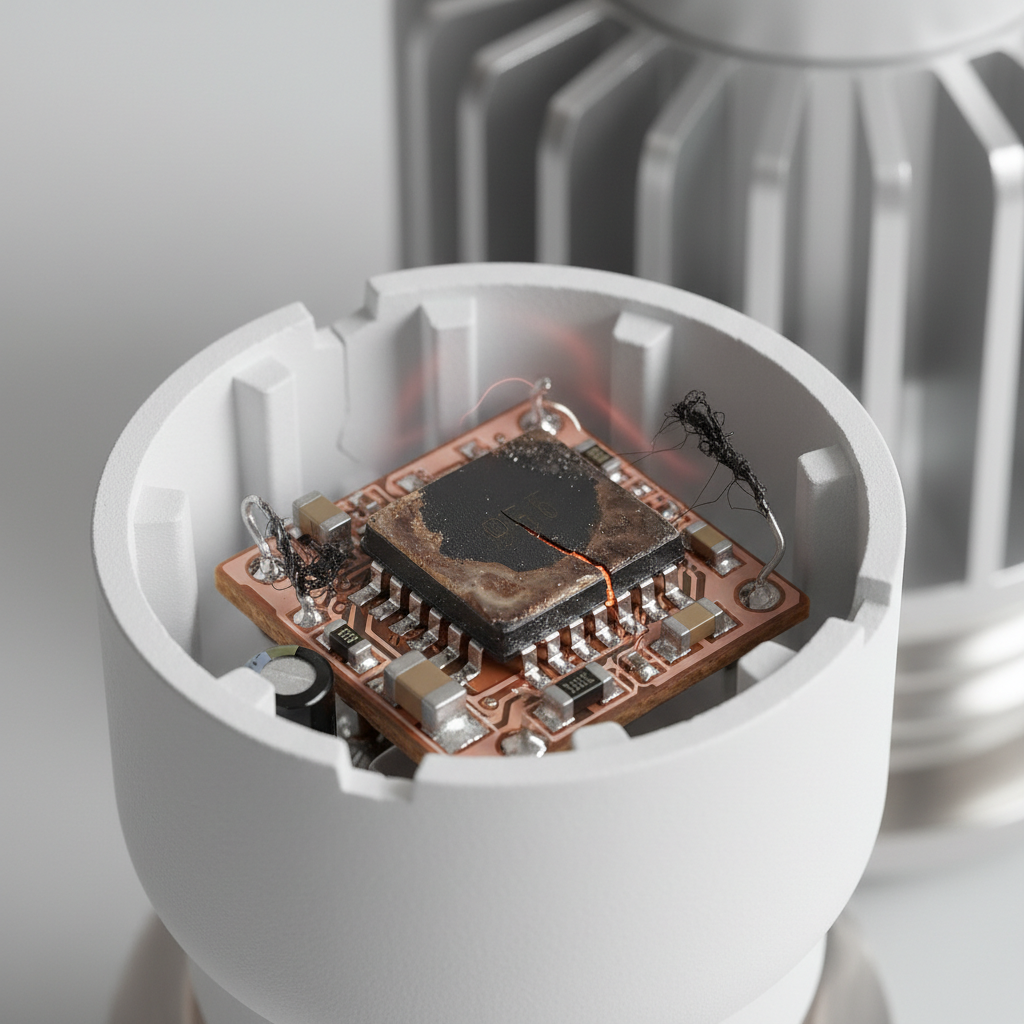
And it gets a little trickier, because an LED bulb isn’t just the diode. There’s also a driver inside, which is basically a tiny power supply. It takes your home’s AC (alternating current) and turns it into the DC (direct current) the LED chip wants, while keeping the voltage and current in line. That driver is often the weak spot. It makes heat. If it gets too hot, or the voltage is bouncing around, it starts failing — and it can take the LEDs with it. That’s why flickering often shows up before total failure. The driver’s waving a white flag. Picture a little computer crammed into a tiny box. It wants stable power and decent airflow, or it goes sideways.
Old bulbs made light and dumped a pile of heat by design. They were built for that. LEDs are efficient because they turn most of that energy into light instead of heat. But the heat they do make still has to go somewhere. Usually that’s through heat sinks built into the base or body of the bulb. If that heat gets trapped, it stacks up fast and fries the sensitive parts inside. So yeah, an LED dying early is often a heat death, not just the “light” part quitting.
Step-by-Step Fix
Alright, let’s roll up our sleeves and figure out what’s really going on with those bulbs that keep kicking the bucket. We’ll start simple, then dig deeper if we have to. No sense making a mountain out of it.
-
Check the Fixture Rating – Is your bulb trapped in a heat-trap? — First thing I ask is whether the fixture is enclosed. Recessed cans, sealed globes, ceiling fan lights with a tight cover — those setups trap heat like a lunch cooler in August. A lot of LED bulbs say right on the box, “Not for use in enclosed fixtures.” If you stuff a regular LED into one of those spots, it’s gonna run hot and die early. Look for a warning on the fixture or the bulb packaging. If you need to replace it, use LEDs marked “enclosed fixture safe” or “rated for enclosed luminaires.” Those usually have better heat handling built in.
-
Verify Voltage at the Socket – Is your electrical system playing tricks? — Unsteady voltage is murder on LED drivers. In most homes, you’re aiming for around 120V AC. If it’s regularly climbing over 125V or dipping below 110V, those bulbs are getting worked over. First, shut off the circuit at the breaker. Use a non-contact voltage tester to make sure it’s dead, then use a multimeter set to AC voltage to test at the socket. Put the probes in the hot and neutral slots. If the numbers are swinging all over the place, or sitting way outside 110-125V, you’ve got a bigger problem. Could be a loose connection in the panel, heavy appliances sharing the circuit, or even a utility-side issue. That’s electrician territory, not a weekend guessing game. A transient voltage surge protector on the main panel can help with smaller spikes if things are mostly stable but a little rowdy.
-
Inspect the Socket and Wiring – Loose connections are bad news for everything. — A sloppy connection in the socket or fixture wiring can cause arcing and on-off power, and LEDs do not like that one bit. First, kill the power at the breaker. Seriously. Then shine a flashlight into the socket. Are the metal tabs inside making solid contact with the bulb base? You can gently bend the center tab out a hair with a small screwdriver — with the power OFF — if it’s lost tension. Check for black marks or discoloration too. That’s usually heat from a poor connection. If you can safely see the wiring, make sure the wire nuts are tight and there aren’t any frayed conductors poking out. If it’s burnt, melted, or ugly-looking, don’t nurse it along. Replace the socket or the whole fixture.
-
Confirm Dimmer Compatibility – Not all dimmers play nice with LEDs. — This one bites a lot of people. Old incandescent dimmers chop up the AC waveform in a way that worked fine for filament bulbs, but it can make LED drivers flicker, buzz, or fail early. You need a dimmer rated for LEDs, usually one marked “LED compatible” or sometimes “ELV” (Electronic Low Voltage) or “MLV” (Magnetic Low Voltage) compatible. If you’ve got dimmable LEDs on an old dimmer, there’s a good chance that’s your trouble. Swap the dimmer. It’s usually a simple job, but again — breaker off, tester in hand. * Tools: Screwdriver set, voltage tester, lineman's pliers. * Safety: Turn off the breaker for the light and verify there’s no power with a voltage tester before you touch any wiring. * If still flickering: Even with an LED-compatible dimmer, some bulb and dimmer combos just don’t get along. Try another brand of ‘dimmable’ LED bulb and see if the problem follows the bulb or stays put.
-
Check for Overlamping – It’s not just for incandescents anymore. — LEDs pull a lot less wattage, sure, but heat still matters. Some fixtures have a maximum wattage rating. Putting a “60W equivalent” LED — which might only pull 10W — into a fixture rated for a maximum of 40W incandescent usually isn’t a problem from an electrical-load standpoint. But if the fixture is lousy at shedding heat, even a low-wattage LED can cook itself in there. Pay attention to any temperature limits or bulb-type restrictions stamped on the fixture. If multiple bulbs keep failing in the same fixture, especially an older one with poor ventilation, I’d start looking at replacing the fixture or stepping down to a lower-wattage, lower-heat LED.
-
Assess Ambient Temperature – Is your garage light in a sauna? — LEDs have operating temperature ranges. They don’t like too much internal heat, and they also don’t love being baked in hot spaces day after day. Think attics, unvented garages in summer, or outdoor fixtures sitting in direct sunlight all afternoon. If your bulbs keep dying in those spots, make sure they’re rated for the conditions they’re living in. “Damp rated” or “wet rated” covers moisture, but check the package for operating temperature if you’re dealing with a rough environment. A cheap bulk pack of LEDs might be fine in a kitchen, and useless in a hot soffit.
-
Consider Vibration – Ceiling fans are shakers. — It’s not as common with solid-state LEDs as it was with old filament bulbs, but constant vibration can still beat up solder joints and tiny components over time. If bulbs only fail in ceiling fan lights, especially on older fans that wobble a bit, that’s worth looking at. Some manufacturers sell “rough service” or “vibration resistant” LEDs, though they’re not as common as they used to be. Make sure the fan’s balanced and secured too. A shaky fan’ll rattle more than just the bulb.
Common Causes
Here’s the short version of why those LEDs might be dying before their time:
- Overheating (Number one killer): This is the big one. Enclosed fixtures, lousy heat sink design, or hot ambient temps keep the heat from getting out, and that cooks the driver and other internal parts.
- Voltage Fluctuations: Spikes, sags, or just messy voltage from your wiring or the utility can stress the LED’s sensitive driver. I had a client in Avon whose porch lights kept dropping like flies, and the problem turned out to be a tired utility transformer sending ugly voltage to the house.
- Incompatible Dimmer Switches: Running a standard incandescent dimmer with LED bulbs is asking for flicker, poor performance, and early failure. The dimmer’s behavior just isn’t built for LED electronics.
- Loose Connections: Arcing, intermittent power, or sloppy wiring at the socket creates heat and electrical stress. Bulbs don’t last long under that kind of abuse.
- Poor Quality Bulb: Not the main culprit most of the time, but cheap LEDs with weak drivers or skimpy heat sinks just don’t hold up. You usually get what you pay for.
- Fixture-specific issues: Sometimes the fixture itself — especially older ones — runs too hot or has internal wiring problems that keep chewing through bulbs.
Common Mistakes
Here are the classic mistakes I see homeowners make that end up killing LED bulbs:
- Ignoring 'Enclosed Fixture' Ratings: Just because the bulb fits doesn’t mean it belongs in a sealed fixture. Read the box. It matters.
- Substituting Bulb Types Recklessly: Not every “Edison base” bulb is a straight swap. PAR-style bulbs, like PAR38 or PAR20, are built for directional light and can run differently than A-style bulbs. Use the bulb type the fixture calls for.
- Leaving Old Dimmers in Place: This one’s huge. “But it says dimmable!” Yeah, but if the dimmer isn’t LED-compatible, you’re still gonna have trouble. It can cook the bulb’s electronics.
- Overlooking Environmental Factors: Assuming a bulb made for a living room will survive a 110°F attic or a ceiling fan that shakes like a screen door in the wind. They’ve got limits.
- Buying the Cheapest Bulbs: There’s a reason some 6-packs are $8 and others are $25. The bargain stuff usually cuts corners on the driver and heat sink, and you pay for it later in replacements.
- Not Testing the Socket First: People rush out and buy new bulbs without checking the socket or wiring. That’s like changing a tire before pulling out the nail.
Cost & Time Breakdown
Here’s a quick look at what you’re usually dealing with on cost and time:
| Task | DIY Cost | Pro Cost | Time (DIY) |
|---|---|---|---|
| Replace standard LED bulb | $3–$10 | N/A | 1 minute |
| Replace enclosed-rated LED bulb | $8–$25 | N/A | 1 minute |
| Replace old dimmer with LED dimmer | $20–$50 | $150–$300 | 15–30 minutes |
| Troubleshooting socket/wiring | $0 (multimeter) | $100–$250 (diag.) | 5–20 minutes |
| Replace a faulty light socket | $5–$15 | $100–$200 | 30–60 minutes |
| Replace entire light fixture | $20–$200+ | $150–$400+ | 30 min – 2 hours |
Tips & Prevention
- Match the Bulb to the Fixture: Always check the packaging for “enclosed fixture safe” or damp/wet location ratings. Saves a lot of grief down the road.
- Upgrade Old Dimmers: If you’re moving to LEDs, swap out the old incandescent dimmers for modern LED-compatible ones. Cheap insurance.
- Buy Quality: If you can swing it, stay away from the bargain-bin LEDs. Brands with decent warranties and solid reviews usually spend more on the driver and heat management. I’ve had good luck with Cree and Philips for general lighting over the years. They cost a little more up front, but they hold up.
- Check for Loose Connections Annually: Any time you change a bulb, take a quick look at the socket. Are the contacts still grabbing the bulb base properly? That little check can save you later. Power off first, obviously.
- Monitor Voltage (If Suspect): If you think your house has voltage issues, a simple plug-in voltage monitor can give you some peace of mind or point to a real electrical problem that needs a pro. You can find them for about $15-20 online.
- Consider a Whole-House Surge Protector: If you’re dealing with repeated voltage spikes, a whole-house surge protector at the main panel can help protect all your electronics, including finicky LED drivers. That’s electrician work. I’ve seen lightning do more than knock out TVs; it can mess up a whole electrical system. Good surge protection is cheap insurance.
When to Call a Professional
If you’ve worked through these steps and your LED bulbs are still dropping early, especially after ruling out enclosed fixtures and dimmer problems, it’s time to bring in a licensed electrician. They can check your wiring, panel, and fixture connections for deeper issues like loose neutrals, overloaded circuits, or voltage swings a homeowner might miss — or shouldn’t touch in the first place. Any burning smell, visible charring, or flickering across multiple fixtures on different circuits means you need a pro right now to keep the fire risk down and prevent more damage. Don’t fool around with main electrical issues. It’s not worth it.
My buddy, an electrician from East Hartford, once opened up an old ceiling junction box that was basically a fire waiting to happen — loose wires, cracked insulation, the whole mess — and the homeowner had just kept buying new bulbs. Don’t be that guy.
FAQ
Q: How long should an LED bulb actually last? A: Most decent LED bulbs are rated for 15,000 to 25,000 hours, and some go even longer. If you’re running them about 3 hours a day, that can work out to 15-25 years. If yours are dying in a year or two, something’s off.
Q: Can a power surge kill an LED bulb? A: Yep. LEDs are touchy about voltage changes, and a big surge can blow out the driver inside pretty quick. Sometimes it fails outright. Sometimes it just shortens the life a lot.
Q: Why do my LED bulbs flicker before they die? A: Flickering usually means the internal driver is struggling or failing. Heat, a bad dimmer, or unstable voltage are the usual reasons.
Q: What does 'enclosed fixture rated' mean for an LED? A: It means the bulb was built with better heat handling so it can run safely in fixtures that trap heat without failing early.
Q: Is it safe to use a higher wattage equivalent LED bulb in an old fixture? A: Usually, yes. LEDs draw way less actual wattage than their incandescent equivalents. For example, a ‘100W equivalent’ LED might only use 15W. That’s well under the typical 60W or 100W maximum rating on most older fixtures, so electrically it’s fine. You still need to watch heat buildup in enclosed fixtures, though.
Q: Why do some LED bulbs buzz or hum? A: That usually points to an incompatibility. Most often, it’s an LED bulb trying to work with an older dimmer that isn’t LED-compatible. The dimmer’s electronics can make the bulb’s components vibrate.
Q: Can dust or insects inside the fixture affect LED bulb life? A: Sure can. Heavy dust can act like insulation and trap heat around the bulb, especially in enclosed fixtures. Big insect nests can block airflow too, which doesn’t help.
Q: Are outdoor LED lights more prone to failure? A: They can be, mostly because they’re dealing with heat, cold, and moisture. Make sure outdoor LEDs are rated for the conditions — like ‘wet rated’ for direct rain — and check the operating temperature range for your climate.
Related Articles
Keep troubleshooting with these hand-picked guides from FixlyGuide:
- The Tiny Gap That Wastes Energy: Why Your Baseboards Pull Away (And the Simple, Permanent Fix) — Baseboards separating from walls are a common issue, often indicating underlying problems with moisture or house settling, but are typicall…
- The 7 Critical Home Inspection Checks Most Homeowners Miss (And How to Spot Them) — Discover the crucial annual home inspection checks often overlooked by homeowners, and learn how to identify potential issues before they b…
- The #1 Backsplash Mistake Most DIYers Make (And How to Fix It Before It's Too Late) — Discover the most overlooked mistake in beginner backsplash installations and how to prevent or fix it for a professional-looking finish.
- Your Windows Are Crying? The Hidden Cause of Condensation — Window condensation isn't just a harmless annoyance; it's a clear signal that your home's indoor humidity is too high, potentially leading…
- The #1 Mistake Homeowners Make When Diagnosing Low Water Pressure (It's Not Your City's Fault) — Before you blame your municipal water supply for low water pressure, learn the most common overlooked culprit inside your home.
- Why Does Only One Room Have Flickering Lights? The Real Culprit Isn't Always the Bulb — Flickering lights in a single room often point to a localized issue, ranging from a loose bulb to a faulty switch or wiring problem.
What should this project cost?
Enter your project details for a realistic cost range before you call anyone.
Cost depends heavily on which system turns out to be the source.
- Regional adjustment
- National average
- Labor share (typical)
- ~$1,620
- Quotes to collect
- 3 written estimates
Educational estimate based on national averages — not a binding quote. Always confirm with written local estimates.
Fixly Project Decision Box
- DIY difficulty
- Professional Recommended
- Estimated time
- Diagnosis 1–2 hours
- Cost level
- Moderate
Main tools / materials
- Non-contact voltage tester
- Outlet tester
- Flashlight
When to stop and call a pro
- Burning smell, scorch marks, or a warm outlet or switch plate
- A breaker that trips again right after being reset
- Any work inside the service panel
- Aluminum wiring or cloth-insulated wiring
Need professional help?
Talk to a Licensed ElectricianGet the print-ready PDF of this guide
A clean, ad-free, printable version you can keep on your phone or pin to the workshop wall. Free with a FixlyGuide account.
- Print-optimized layout
- Tools, materials & every step included
- Saved to your account
Recommended for DIYers & woodworkers
Sponsored
The Top 20 Tools for Workshops of Any Budget
No stationary machines or power tools required — plus 3 fundamental tools that can't be bought at any price.
Get the free guide
Ted's Woodworking — The #1 Woodworking Resource
Detailed instructions, dimensioned drawings, materials & cutting lists, and 3D schematics for every skill level.
See the plansSponsored: links above are affiliate links. FixlyGuide may earn a commission on qualifying purchases — at no extra cost to you.
Frequently asked questions
How long should an LED bulb actually last?+
Most quality LED bulbs are rated for 15,000 to 25,000 hours of use, sometimes even more. This often translates to 15-25 years if used about 3 hours a day. If yours are failing in a year or two, something's definitely wrong.
Can a power surge kill an LED bulb?+
Absolutely. LEDs are sensitive to voltage fluctuations, and a significant power surge can easily overload and blow out the delicate driver components inside, leading to instant failure or significantly shortened life.
Why do my LED bulbs flicker before they die?+
Flickering is often a sign that the LED's internal driver is struggling or failing. It could be due to heat stress, incompatible dimmer switches, or unstable voltage supply to the bulb.
What does 'enclosed fixture rated' mean for an LED?+
It means the bulb has been specifically designed with enhanced heat dissipation mechanisms to operate safely and effectively in light fixtures that trap heat, preventing premature failure from overheating.
Is it safe to use a higher wattage equivalent LED bulb in an old fixture?+
Yes, generally. LEDs consume much less actual wattage than their incandescent equivalents. For instance, a '100W equivalent' LED might only draw 15W. This is well below the typical 60W or 100W maximum rating of most old fixtures, so it won't overload the fixture electrically. However, you still need to watch for heat buildup if the fixture is enclosed.
Why do some LED bulbs buzz or hum?+
This usually points to an incompatibility issue. Most often, it's an LED bulb trying to work with an older, non-LED-compatible dimmer switch. The dimmer's attempt to regulate power can create an audible vibration in the bulb's electronic components.
Can dust or insects inside the fixture affect LED bulb life?+
While minor, yes. Heavy dust buildup can act as insulation, further trapping heat around the LED bulb, especially in enclosed fixtures. Large insect nests could also obstruct airflow, contributing to overheating.
Are outdoor LED lights more prone to failure?+
They can be, primarily due to exposure to environmental extremes like heat, cold, and moisture. Ensure any outdoor LEDs are rated for the conditions (e.g., 'wet rated' for direct rain exposure) and consider their operating temperature range for your climate.


Discussion
Loading comments…