- Alkyd/Oil-Based Paint: The fundamental cause. The binders and drying oils in the paint oxidize over time, and this chemical reaction inherently produces a yellow hue.
- Absence of UV Light: The yellowing is most pronounced in areas shielded from sunlight, as UV rays have a bleaching effect that counteracts the process. This is why closets and trim behind paintings yellow faster.
- Heat Exposure: Proximity to heat sources like radiators, baseboard heaters, and even south-facing window casings can accelerate the oxidation and yellowing.
- Airborne Contaminants: Grease from cooking, nicotine from smoking, and even chemical fumes from some household cleaners (especially those containing ammonia) can react with the paint surface and cause discoloration.
- Bleed-Through: If a previous painter simply put a coat of latex paint over old oil-based trim without a proper stain-blocking primer, the oils from the lower layer will eventually migrate through and turn the top coat yellow.
General remodeling · Renovation planning
| Project category | General remodeling |
|---|---|
| Problem type | Renovation planning |
| Trade required | General contracting |
| Urgency | Planned project |
| Safety risk | Low safety risk |
| DIY suitability | Pro recommended |
| Cost category | Major investment |
| Typical timeline | Design and permitting often 2–4 months before work starts |
| Contractor type | General contractor |
Repair option
Phase the work and fix the building envelope first.
Replacement option
Full renovation with permits, design, and a general contractor.
Common causes
- Space no longer fits how the household lives
- Resale preparation
- Deferred maintenance stacking up
Relevant tools:project cost estimatorcompare quoteshome improvement material prices
Published June 4, 2026Last updated August 17, 2026
Tools & materials you'll need
Affiliate linksAs an Amazon Associate FixlyGuide earns from qualifying purchases — at no extra cost to you. Prices and availability are accurate as of publication and subject to change.
Quick Answer
White painted trim yellows primarily because it was painted with an alkyd (oil-based) paint, whose oils and resins naturally oxidize and yellow with age, a process that accelerates in the absence of sunlight. To permanently fix this, you must clean and scuff the surface, then apply a solvent-based stain-blocking primer—either shellac-based or oil-based—to seal the old paint before top-coating with a modern, non-yellowing water-based acrylic enamel.
The Problem
It’s a frustratingly common homeowner scenario: the brilliant, crisp white trim you so carefully painted (or paid to have painted) a few years ago now looks dingy, dated, and distinctly yellow. It’s especially noticeable on baseboards behind furniture, the inside of a closet door, or the crown molding in a hallway with little natural light. This yellowing effect makes your entire color scheme look "off" and can give a room a grimy, aged appearance, no matter how clean it is. You may notice it stands in stark contrast to the still-bright white of the ceiling paint or the color on the walls. This isn't a result of poor cleaning or a bad paint job; it's a chemical process that was locked into the paint the day it was applied.
How It Works
The culprit behind yellowing trim is almost always the choice of paint: traditional alkyd, or oil-based, enamel. For decades, oil-based paint was the go-to standard for trim, doors, and cabinetry because it offered superior leveling for a brush-stroke-free finish and cured to an incredibly hard, durable surface. However, the very chemistry that provides this hardness is also its greatest long-term aesthetic flaw.
Alkyd paints are made of resins (the "alkyd") and drying oils, such as linseed or soybean oil, suspended in a solvent. When the solvent evaporates, the oils and resins react with oxygen in the air in a process called oxidation. This is the "curing" process that creates the hard, protective film. Unfortunately, this oxidation doesn't just stop once the paint is dry. It continues for years, and as the oil molecules break down and change, they naturally take on a yellow hue.
A fascinating and counter-intuitive factor accelerates this process: darkness. The yellowing of alkyd resins is partially bleached by ultraviolet (UV) light from the sun. This phenomenon is called "photo-bleaching." This is why the trim in a sun-drenched room might remain relatively white, while the baseboard hidden behind your sofa or the trim inside a windowless pantry turns a deep cream or yellow color. It’s not your imagination; the lack of light is speeding up the visible yellowing. Other factors like heat from nearby heating vents or exposure to airborne contaminants like cooking grease or ammonia-based cleaning fumes can also hasten the chemical reaction.
In contrast, modern high-quality water-based paints (often called acrylics or latex enamels) use acrylic binders that are chemically stable and do not oxidize in the same way. They are "non-yellowing" by design, which is why they have become the professional standard for trim work today.
Step-by-Step Fix
To stop your painted trim from yellowing, you must isolate and seal the old oil-based paint with a specific type of primer before repainting. Simply putting a new coat of white paint over top—even a high-quality one—will not work; the oils will eventually "bleed through" and turn the new layer yellow from behind.
-
Safety First & Ventilation: Before starting, protect yourself. If working around outlets, turn off the corresponding circuit breaker. The primers required for this job have very strong fumes. Wear a NIOSH-approved respirator with organic vapor cartridges. Open windows and use fans to create cross-ventilation. Wear safety glasses and chemical-resistant gloves.
-
Protect the Area: Lay down canvas or rosin paper drop cloths to protect your floors. Apply high-quality painter's tape (like FrogTape or 3M Blue) along the wall edge and/or floor for a clean line. This step seems tedious but is essential for a professional-looking result.
-
Clean the Trim Thoroughly: The trim surface is covered in years of grime, oils from hands, and cleaning residues. This must be removed for the primer to adhere. Use a robust degreasing cleaner like Trisodium Phosphate (TSP) or a TSP substitute. Mix according to the directions, and use a sponge or rag to scrub down every inch of the trim. Follow with a clean water rinse to remove all residue.
-
Scuff Sand the Old Paint: You do not need to strip the old paint. The goal is to "de-gloss" the surface to create a microscopic texture, or "tooth," for the primer to grip mechanically. Use a 120-grit or 150-grit sanding sponge or sandpaper. The sponge is ideal as it conforms to the curves of the trim. The finish should look uniformly dull and matte, not shiny.
-
Remove All Sanding Dust: Vacuum the trim and surrounding area with a brush attachment. Then, wipe the trim with a tack cloth or a lint-free rag lightly dampened with water. Any remaining dust will create a gritty, rough finish. The surface must be perfectly clean and dust-free.
-
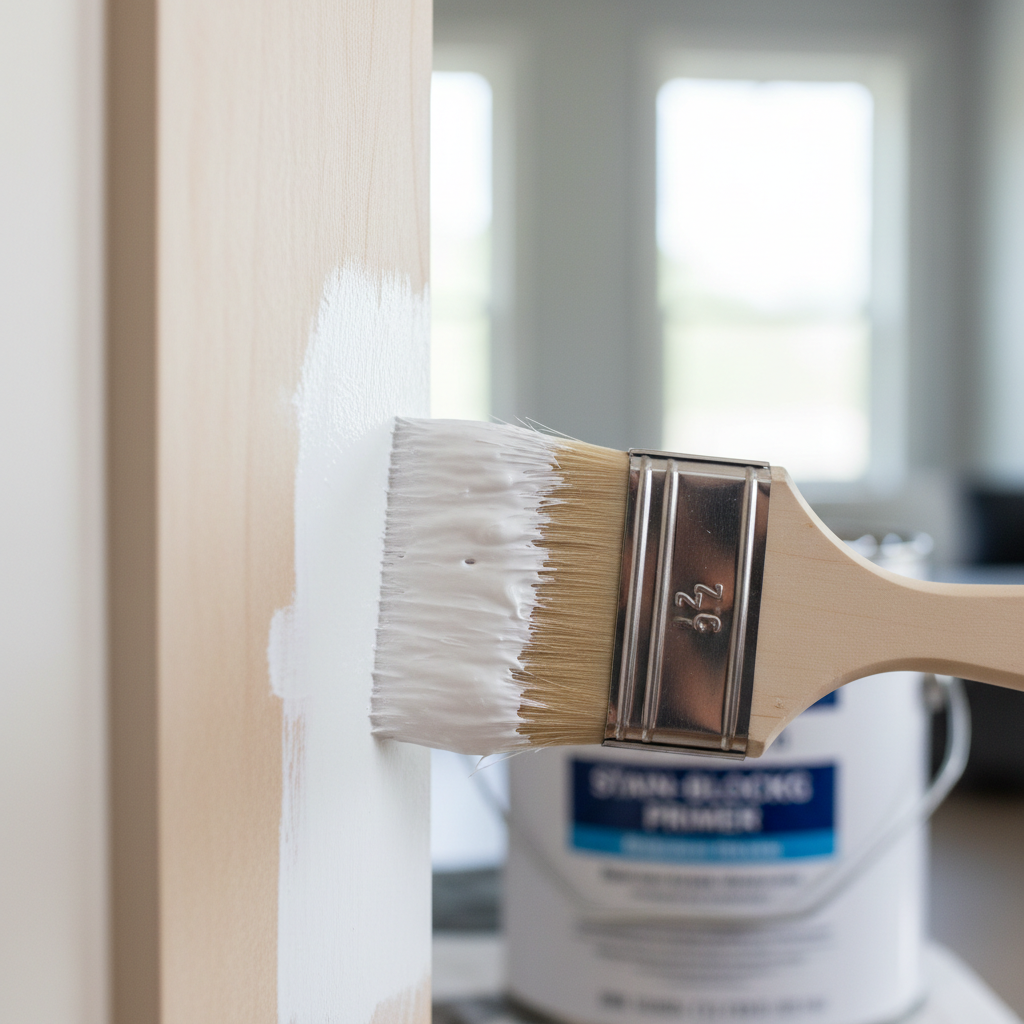
Choose the Correct Pro-Level Primer: This is the most critical step. A standard water-based latex primer will fail. You need a solvent-based stain-blocking primer to permanently block the oils.
- Shellac-Based Primer (e.g., Zinsser B-I-N): This is the ultimate "nuclear option" for stain blocking. It is alcohol-based, dries incredibly fast (often ready to paint in 45-60 minutes), and will seal absolutely anything—oils, tannins, smoke, etc. Its downside is the intense alcohol fume and the need for denatured alcohol for cleanup.
- Oil-Based Primer (e.g., Kilz Original, Zinsser Cover Stain): Also an excellent choice for blocking yellowing. It is solvent-based (mineral spirits for cleanup), has a slightly longer working time than shellac, and levels out very nicely. The fumes are also strong but different from shellac.
-
Apply a Thin Coat of Primer: Using a high-quality 2" or 2.5" angled sash brush, apply a thin, even coat of your chosen primer to the trim. The goal is a complete seal, not necessarily a solid white finish. Don't overload your brush. Work in manageable sections, maintaining a "wet edge" to minimize brush marks.
-
Lightly Sand the Primer: Once the primer is fully dry (check the can’s instructions for recoat time), it may have a slightly rough feel. For a glass-smooth final finish, lightly sand the primed surface with a fine 220-grit sanding sponge. This will knock down any minor imperfections.
-
Final Dust Removal: Once again, use a tack cloth or a clean, damp rag to remove every speck of sanding dust from the primed surface.
-
Select Your Top Coat Paint: The best choice is a premium, water-based (acrylic) trim enamel. Look for products labeled "Urethane Reinforced" or "Waterborne Alkyd," like Sherwin-Williams Emerald Urethane Trim Enamel or Benjamin Moore Advance. These combine the hardness and self-leveling properties of oil paint with the non-yellowing stability and easy cleanup of water-based paint. A satin or semi-gloss finish is standard for trim.
-
Apply the First Top Coat: Using a new, high-quality angled brush, apply your first coat of acrylic enamel. Use long, smooth strokes and avoid over-brushing. The leveling properties of these advanced paints will work best if you apply the paint and leave it alone.
-
Apply the Second Top Coat & Finish: Wait for the first coat to dry completely, as per the manufacturer's instructions (typically 2-4 hours). Apply a second, final coat for maximum durability and color depth. While the second coat is still wet but not dripping, carefully pull the painter's tape off at a 45-degree angle. This breaks the paint film cleanly and leaves a razor-sharp edge.
Common Causes
- Alkyd/Oil-Based Paint: The fundamental cause. The binders and drying oils in the paint oxidize over time, and this chemical reaction inherently produces a yellow hue.
- Absence of UV Light: The yellowing is most pronounced in areas shielded from sunlight, as UV rays have a bleaching effect that counteracts the process. This is why closets and trim behind paintings yellow faster.
- Heat Exposure: Proximity to heat sources like radiators, baseboard heaters, and even south-facing window casings can accelerate the oxidation and yellowing.
- Airborne Contaminants: Grease from cooking, nicotine from smoking, and even chemical fumes from some household cleaners (especially those containing ammonia) can react with the paint surface and cause discoloration.
- Bleed-Through: If a previous painter simply put a coat of latex paint over old oil-based trim without a proper stain-blocking primer, the oils from the lower layer will eventually migrate through and turn the top coat yellow.
Common Mistakes
- Using the Wrong Primer: Applying a standard water-based (latex/acrylic) primer over old oil paint will do nothing to stop the yellowing and can lead to peeling, as water-based paints don't adhere well to un-sanded oil surfaces.
- Painting on a Dirty Surface: Skipping the crucial degreasing step means the primer is trying to stick to grime, not the paint, leading to poor adhesion and future chipping.
- Skipping Scuff Sanding: Primer cannot form a strong mechanical bond with a glossy, slick surface. Without sanding, the new paint system is prone to scratching and peeling off easily.
- Painting Latex Directly Over Unprepared Oil Paint: This is a classic painting failure. The latex paint will not bond properly and will often peel away in sheets within months. It also won't stop the yellowing.
- Applying Coats Too Thickly: Overloading the brush with primer or paint leads to drips, sags, and an "orange peel" texture. Multiple thin coats are always superior to one thick coat.
- Not Allowing Proper Cure Time: While modern paints dry to the touch in hours, they can take 3-4 weeks to reach maximum hardness or "full cure." During this time, the finish is susceptible to damage.
Cost & Time Breakdown
This estimate is for a standard 12' x 15' room with baseboards, one door casing, and one window casing.
| Task | DIY Cost | Pro Cost | Time |
|---|---|---|---|
| Prep: Cleaners, Tape, Drop Cloths | $25 | Included | 1-2 hours |
| Sanding Supplies | $15 | Included | 1 hour |
| Primer: 1 Qt Shellac/Oil-Based | $25 | $150–$200 | 2-3 hours (incl. dry time) |
| Paint: 1 Qt Premium Trim Enamel | $35 | $250–$400 | 4-6 hours (incl. 2 coats + dry time) |
| Total | ~$100 | $400 - $600 | 1-2 Days |
Tips & Prevention
- Start With the Right Foundation: For any new trim installation or repaint, always start with a high-quality primer. If painting over existing oil paint, it must be a shellac or oil-based stain blocker.
- Invest in a Quality Top Coat: Use a 100% acrylic or urethane-modified acrylic enamel for your trim. The added cost upfront (e.g., $35/quart vs $20/quart) is minimal compared to the labor of redoing the job when cheaper paints fail.
- Test for Oil vs. Latex: If you're unsure what kind of paint is on your trim, put some rubbing alcohol or acetone on a cotton ball and rub a small, inconspicuous area. If the paint comes off, it’s latex. If it only cleans the surface with no color transfer, it’s oil-based, and you need a stain-blocking primer.
- Gentle Cleaning: Clean your painted trim with a soft cloth and a pH-neutral cleaner (a drop of dish soap in water). Avoid ammonia-based products like Windex, which can affect the paint over time.
- Let It Cure: After painting, be gentle with your trim for the first few weeks. Avoid harsh scrubbing or impact that could compromise the still-hardening finish.
When to Call a Professional
While this is a manageable DIY project for a patient homeowner, there are several situations where hiring a professional painter is the smarter choice. If your home was built before 1978, the existing trim paint may contain lead. A professional certified in lead-safe work practices is required for safe removal or encapsulation, as sanding lead paint creates hazardous dust. For very large projects, like an entire house full of yellowing trim, a professional crew can complete the job with far greater efficiency. Furthermore, if you are sensitive to the strong VOCs and solvent fumes from oil and shellac primers, a pro has the equipment and experience to manage the environment safely. Finally, if you desire a perfect, flawless "factory finish," a pro can spray the trim, which produces a result that is nearly impossible to replicate with a brush.
Should you do this yourself?
Answer five quick questions before you start. Safety outranks savings every time.
Your experience with work like this
How high do you have to work?
Does the job involve any of these?
Will it need a permit?
Specialty tools
Free and instant. Educational guidance only — not a quote, inspection, or professional diagnosis.
Estimate your own project cost
National averages are a starting point. Enter your details for a range that fits your house.
Interior paint estimator
- Paint$96
- Supplies (tape, rollers, drop cloth)$35
- Estimated total (DIY)$131
Hiring a pro? Add roughly $1.50–$4.00/sq ft for labor depending on prep work and trim detail.
Educational estimate only — always confirm with written local bids.
What should this project cost?
Enter your project details for a realistic cost range before you call anyone.
Cost depends heavily on which system turns out to be the source.
- Regional adjustment
- National average
- Labor share (typical)
- ~$1,620
- Quotes to collect
- 3 written estimates
Educational estimate based on national averages — not a binding quote. Always confirm with written local estimates.
Get the print-ready PDF of this guide
A clean, ad-free, printable version you can keep on your phone or pin to the workshop wall. Free with a FixlyGuide account.
- Print-optimized layout
- Tools, materials & every step included
- Saved to your account
Recommended for DIYers & woodworkers
Sponsored
The Top 20 Tools for Workshops of Any Budget
No stationary machines or power tools required — plus 3 fundamental tools that can't be bought at any price.
Get the free guide
Ted's Woodworking — The #1 Woodworking Resource
Detailed instructions, dimensioned drawings, materials & cutting lists, and 3D schematics for every skill level.
See the plansSponsored: links above are affiliate links. FixlyGuide may earn a commission on qualifying purchases — at no extra cost to you.
Frequently asked questions
Can I just paint over the yellowed trim with new white paint?+
No. If the yellowing is from old oil-based paint, the oils will eventually migrate through the new paint layer and turn it yellow from behind. You must seal the old paint with a shellac-based or oil-based stain-blocking primer first.
How can I tell if my trim is painted with oil or latex paint?+
Dab a cotton ball with acetone (nail polish remover) or denatured alcohol and rub it on an inconspicuous spot. If paint color comes off onto the cotton ball, it's latex/water-based. If the cotton ball stays clean or just removes surface grime, it's oil-based.
Is oil-based paint bad? Why was it used so much?+
Oil-based paint isn't 'bad,' but it has been largely replaced by modern formulas. For decades, it was prized for its exceptional durability, rock-hard finish, and excellent self-leveling properties, which eliminated brush strokes. Its tendency to yellow and strong odor are its primary downsides.
Will a water-based stain-blocking primer work instead?+
While some high-end acoustic-ceiling-tile primers may work, most water-based stain blockers are not robust enough to permanently block oil bleed-through. For guaranteed success on yellowing alkyd paint, a solvent-based (shellac or oil) primer is the professional standard and the safest bet.
Discussion
Loading comments…