- Using Metal Scrapers: Never use a putty knife, screwdriver, or steel wool to try and scrape off the ring. These tools are much harder than porcelain and will leave permanent, ugly gray scratches that are impossible to remove.
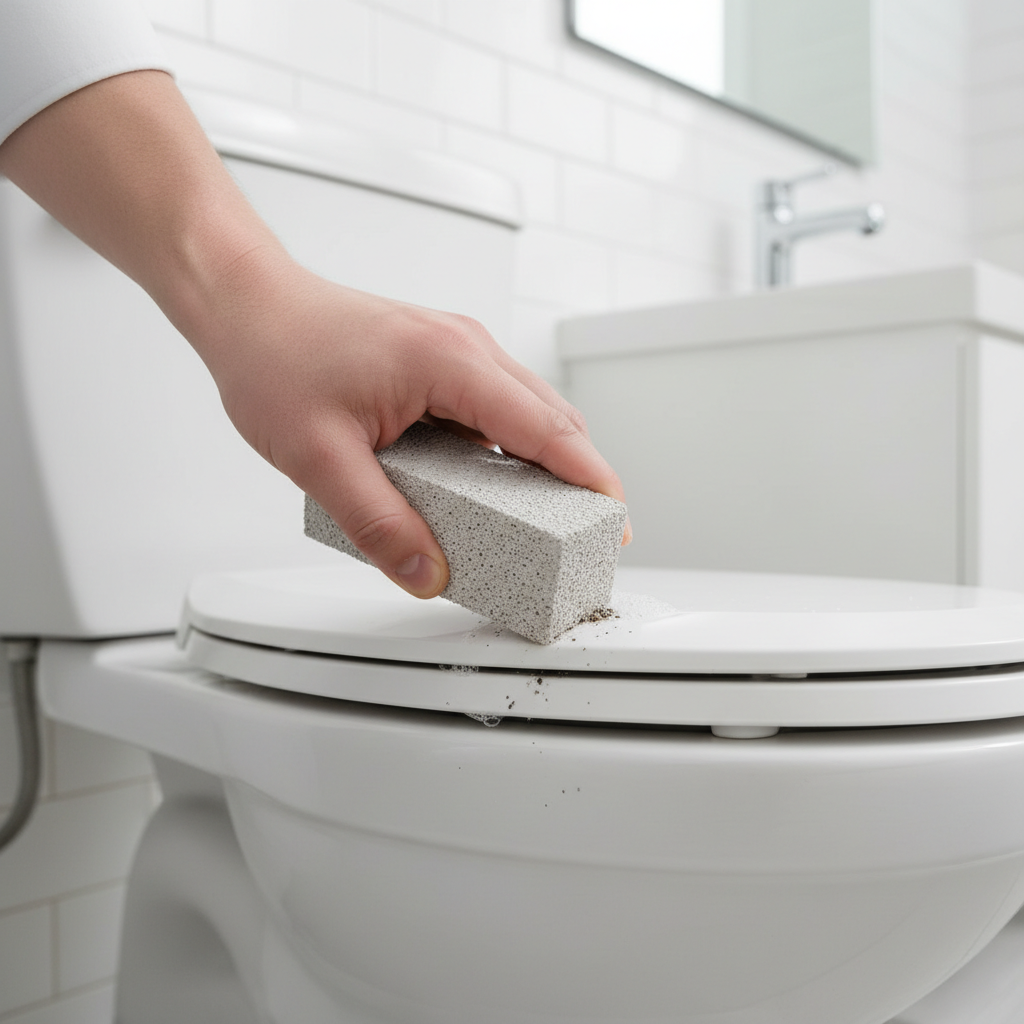
- Using a Dry Pumice Stone: We can't repeat this enough. A dry pumice stone on dry porcelain can cause scratching. Both surfaces must be wet to create the lubricating paste that allows the process to work safely.
- Giving Up Too Soon: If a ring is particularly thick, it may not come off with just a few swipes. It can take 10-15 minutes of steady, patient scrubbing to physically abrade a thick layer of limescale. Don't get discouraged.
- Not Lowering the Water Level: Trying to scrub a ring that is underwater is ineffective. The water acts as a barrier, and you won't be able to apply the direct, physical pressure needed. You must work on a dry surface (with a wet tool).
Published June 11, 2026Last updated August 17, 2026
Tools & materials you'll need
Affiliate linksAs an Amazon Associate FixlyGuide earns from qualifying purchases — at no extra cost to you. Prices and availability are accurate as of publication and subject to change.
Quick Answer
That stubborn ring at your toilet's waterline is a mineral deposit called limescale, left behind by hard water. As water in the bowl evaporates, it leaves behind dissolved minerals like calcium and magnesium carbonate, which build up in layers to form a noticeable, crusty ring. The most effective and surprisingly gentle way to remove this ring is to use a pumice stone. Pumice is a type of volcanic rock that is abrasive enough to grind away the mineral deposits but softer than the vitreous china of your toilet, meaning it can erase the ring without scratching the bowl—provided you keep both the stone and the surface wet during the process.
The Problem
It’s a frustratingly common sight in bathrooms everywhere: a persistent, ugly, brownish or yellowish ring right at the water’s surface in an otherwise clean toilet bowl. You can scrub with your regular toilet brush and cleaner until your arm is sore, but the ring remains, mocking your efforts. It looks dirty, unhygienic, and can be a source of embarrassment when you have guests. This ring isn’t a sign of poor cleaning habits; it’s a geological problem playing out in miniature inside your bathroom.
The ring is often rough to the touch, feeling like a thin layer of cement has been applied to the porcelain. Its color can vary from a light tan to a dark, rusty brown, depending on the specific mineral content of your water. It’s most noticeable in guest bathrooms or toilets that aren’t flushed multiple times a day, because the longer water sits undisturbed, the more evaporation can occur, accelerating the buildup. This isn't dirt or waste; it’s a rock-hard mineral deposit that has chemically bonded with the surface of your toilet bowl, and it requires a specific, physical approach to remove.
How It Works
To understand the fix, you first need to understand the science behind the stain. The culprit is "hard water," a term for a water supply with a high concentration of dissolved minerals—primarily calcium (Ca) and magnesium (Mg). The vast majority of American homes, over 85%, have some degree of hard water.
Here's the process: Every time you flush, your toilet bowl refills with fresh water containing these invisible dissolved minerals. Between flushes, the water sits, and a small amount constantly evaporates from the surface. Water molecules (H2O) turn into vapor and enter the air, but the heavier mineral ions (like calcium carbonate, CaCO3) are left behind. At the edge of the water surface, where evaporation is most pronounced, these minerals precipitate out of the solution and begin to crystallize directly onto the smooth porcelain surface. This deposit is known as limescale.
Over weeks and months, with each cycle of sitting and evaporation, new microscopic layers of limescale are deposited on top of the old ones. This gradual accumulation creates the visible, crusty ring you see. The ring’s color is often a dirty brown not just because of the minerals themselves, but because the porous, rough surface of the limescale is an ideal place for ambient dirt, dust, and other particles to get trapped, further discoloring it.
So, why does a pumice stone work where chemical cleaners fail? It’s a matter of hardness, measured on the Mohs scale. The porcelain of your toilet bowl is essentially a form of glass (vitreous china) and is very hard, rating around 5.5 to 7 on the Mohs scale. The limescale deposits are hard, too—harder than a nylon toilet brush—rating around 3 to 4. The secret lies with pumice, a volcanic rock so porous and lightweight it floats. Pumice rates around 5 on the Mohs scale. It’s harder than the limescale ring but softer than the porcelain. This means it has the abrasive power to physically grind away the mineral deposit layer by layer, but it lacks the hardness to permanently scratch the solid porcelain fixture. When you scrub, you’re essentially sanding off the rock deposit with another, slightly harder rock, without damaging the surface underneath.
SAFETY NOTE: Always keep the pumice stone and the porcelain surface wet. The water creates a fine abrasive paste (a slurry) that helps the process and, most importantly, lubricates the work, further protecting the porcelain from any potential scratching.
Step-by-Step Fix
Follow these steps precisely for a perfect, scratch-free finish.
-
Suit Up for Safety — Em-dash, put on a pair of rubber or nitrile gloves. This protects your hands from toilet germs and any cleaning agents you might be using. It’s a non-negotiable first step for any toilet-related task.
-
Perform a Preliminary Clean — Em-dash, grab your standard toilet brush and give the bowl a thorough scrubbing with a bit of toilet bowl cleaner. This removes any surface-level grime and biofilm, exposing the true enemy: the hard water ring itself. Flush the toilet.
-
Empty the Bowl — Em-dash, this is the most critical step for success. You need to get the water level below the ring you want to remove. First, find the water shut-off valve on the wall behind the toilet and turn it clockwise until it stops. Flush the toilet once; the tank will empty, but it won’t refill, dropping the water level in the bowl significantly. You may need to use a small cup or a sponge to bail out the remaining water until the entire ring is high and dry.
-
Saturate Your Weapon — Em-dash, take your pumice stone (often sold as a "Pumie Stick" or "scouring stick" in the cleaning aisle) and hold it under running water until it is completely saturated. Do not, under any circumstances, use a dry pumice stone, as this increases the risk of scratching the porcelain.
-
Test in a Hidden Area — Em-dash, even with the right technique, it’s always wise to be cautious. Find an inconspicuous spot on the toilet that is normally underwater and gently rub the wet pumice stone on it. If you see any gray marks or scratches, stop immediately (though this is highly unlikely if the stone is wet).
-
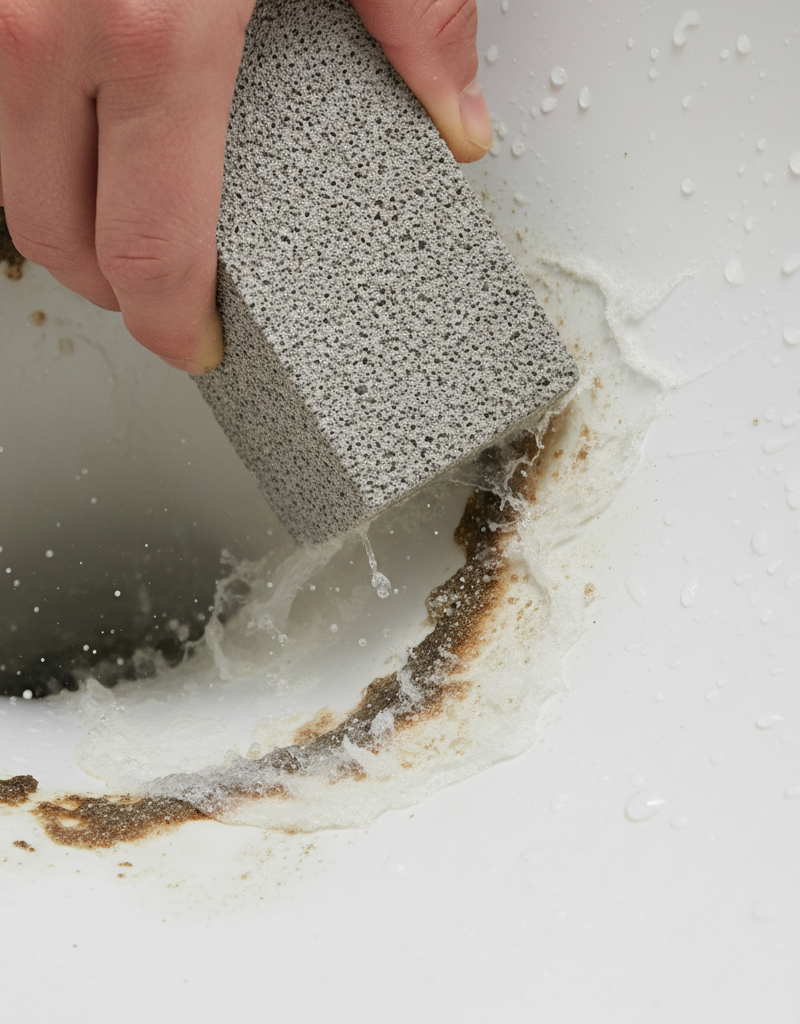
Begin the Erasure — Em-dash, apply the wet pumice stone directly to the hard water ring. Using gentle but firm pressure, rub the ring with back-and-forth or small circular motions. You will quickly notice a paste forming, which is a mixture of water and fine pumice and limescale particles. This paste is what does the work.
-
Work Methodically — Em-dash, focus on a small 2-3 inch section of the ring at a time. Continue scrubbing until that section of the ring has vanished. You may need to periodically dip the pumice stone back into the toilet water (or a separate cup of water) to keep it well-lubricated.
-
Tackle Stubborn Deposits — Em-dash, for very thick, old rings, this process will take time and some elbow grease. You are physically grinding away months or years of mineral buildup. Be patient and continue with gentle, steady scrubbing rather than trying to force it off with excessive pressure.
-
Restore the Water Flow — Em-dash, once the entire ring is gone, it’s time to bring your toilet back to life. Turn the water supply valve counter-clockwise to its original position. The tank will begin to fill.
-
The Final Flush — Em-dash, once the tank is full, give the toilet a flush. This will rinse away all the pumice paste and debris, revealing a sparkling, clean, ring-free bowl. You can use your toilet brush for a final swish to ensure everything is rinsed away completely.
Common Causes
- Hard Water: This is the number one cause. If your home has hard water, you are predisposed to this problem. You can often get a free water quality report from your local municipal utility to see the exact hardness level in your area, measured in Grains Per Gallon (GPG). Anything over 3.5 GPG is considered moderately hard.
- Infrequent Flushing: Toilets in guest rooms, basements, or secondary bathrooms that are not used daily are prime candidates for rings. The longer the water sits stagnant, the more time there is for evaporation and mineral concentration.
- Low-Flow Toilets: While excellent for conserving water, some older models of low-flow toilets can have a smaller "water spot" or surface area. This can lead to more of the bowl being exposed and prone to stain lines where water might have previously sat.
- Well Water: Private wells are not treated by a municipality and often have extremely high mineral content, including iron (which causes red/rust-colored rings) in addition to calcium and magnesium. This makes ring formation almost inevitable without some form of water treatment.
Common Mistakes
- Using Metal Scrapers: Never use a putty knife, screwdriver, or steel wool to try and scrape off the ring. These tools are much harder than porcelain and will leave permanent, ugly gray scratches that are impossible to remove.
- Using a Dry Pumice Stone: We can't repeat this enough. A dry pumice stone on dry porcelain can cause scratching. Both surfaces must be wet to create the lubricating paste that allows the process to work safely.
- Mixing Chemical Cleaners: In a desperate attempt to find a solution, homeowners sometimes pour multiple chemicals into the bowl. Never mix cleaners, especially bleach and ammonia-based products, which can create toxic chloramine gas. Stick to one method at a time.
- Relying on Bleach: Chlorine bleach is excellent for disinfecting and removing organic stains, but it has almost no effect on mineral deposits. It may whiten the stain temporarily, but the rough mineral ring will remain, ready to capture new discoloration.
- Giving Up Too Soon: If a ring is particularly thick, it may not come off with just a few swipes. It can take 10-15 minutes of steady, patient scrubbing to physically abrade a thick layer of limescale. Don't get discouraged.
- Not Lowering the Water Level: Trying to scrub a ring that is underwater is ineffective. The water acts as a barrier, and you won't be able to apply the direct, physical pressure needed. You must work on a dry surface (with a wet tool).
Cost & Time Breakdown
This table outlines the potential costs and time associated with tackling a toilet bowl ring, from the direct fix to long-term prevention.
| Task | DIY Cost | Pro Cost | Time Investment |
|---|---|---|---|
| Pumice Stone Cleaning | $3 - $7 for a pumice stick | $75 - $150 (as part of house cleaning) | 20-40 minutes |
| Regular Weekly Cleaning | $5 - $20 (for brush & cleaner) | N/A | 5 minutes per week |
| Preventative Vinegar Soak | $1 - $3 (for a jug of vinegar) | N/A | 8 hours (overnight soak) |
| Hard Water Toilet Cleaner | $5 - $10 per bottle | N/A | 10 minutes per use |
| Whole-House Water Softener | $800 - $3,500+ (for unit & parts) | $1,500 - $5,000+ (installed) | Full system solution |
Tips & Prevention
Once your bowl is sparkling, you’ll want to keep it that way. Preventing the ring is easier than removing it.
- The Vinegar Trick: Acetic acid in white vinegar is great at dissolving mineral deposits before they can build up. Once a week, before heading to bed, pour 1-2 cups of plain white vinegar into the toilet bowl. Don’t flush; let it sit overnight. The mild acid will work to dissolve any fledgling mineral deposits.
- Choose the Right Cleaner: Switch your regular toilet cleaner to one specifically formulated for hard water. Look for products containing acids like hydrochloric acid (HCl), but use them with caution and exactly as directed, ensuring good ventilation. These are powerful and should not be your first line of defense.
- Increase Flush Frequency: For guest or basement toilets, make it a point to flush them at least once every day or two. Keeping the water moving is a simple but effective way to combat the evaporation and concentration cycle.
- Clean Regularly: A quick swish with a toilet brush every few days can physically dislodge mineral particles before they have a chance to bond to the porcelain surface. This five-minute task can save you an hour of scrubbing later.
- The Ultimate Solution: Water Softener: If you have hard water, the only way to truly solve the problem at its source is with a whole-house water softener. This system is installed at your home's water main and uses a process called ion exchange to remove calcium and magnesium minerals from all the water entering your home. It’s a significant investment, but it will not only prevent toilet rings but also reduce limescale buildup in your pipes, coffee maker, dishwasher, and faucets, and even make your laundry softer.
When to Call a Professional
While removing a toilet ring is a classic DIY task, there are times when a pro is needed. If you’ve scrubbed with a pumice stone for an extended period and a stain remains, it could be a different type of stain or a sign that the porcelain’s glaze has been damaged in the past, allowing stains to penetrate the porous material underneath. If the stains are a deep, rusty red, especially if you have older galvanized pipes, it could indicate pipe corrosion that requires a plumber’s diagnosis. You should also call a certified plumber for the sizing and installation of a whole-house water softener system. For the cleaning itself, if you are physically unable to perform the task or simply prefer to have it handled, a professional cleaning service can often perform this service, but expect to pay a premium for what is ultimately a simple, albeit tedious, job.
Should you do this yourself?
Answer five quick questions before you start. Safety outranks savings every time.
Your experience with work like this
How high do you have to work?
Does the job involve any of these?
Will it need a permit?
Specialty tools
Free and instant. Educational guidance only — not a quote, inspection, or professional diagnosis.
What should this project cost?
Enter your project details for a realistic cost range before you call anyone.
Common repairs run $150–$650; repipes and water-heater replacements reach $1,500–$4,500.
- Regional adjustment
- National average
- Labor share (typical)
- ~$754
- Quotes to collect
- 3 written estimates
Educational estimate based on national averages — not a binding quote. Always confirm with written local estimates.
Fixly Project Decision Box
- DIY difficulty
- Moderate
- Estimated time
- 30 minutes – half a day
- Cost level
- Moderate
Main tools / materials
- Adjustable wrench
- Plunger or drain auger
- Bucket and towels
- Thread tape
When to stop and call a pro
- Water you cannot shut off at the fixture or main
- Sewage backing up into more than one fixture
- Water near electrical panels or outlets
- Gas water heater work beyond relighting a pilot
Need professional help?
Get a Licensed PlumberGet the print-ready PDF of this guide
A clean, ad-free, printable version you can keep on your phone or pin to the workshop wall. Free with a FixlyGuide account.
- Print-optimized layout
- Tools, materials & every step included
- Saved to your account
Frequently asked questions
Will a pumice stone really not scratch my toilet bowl?+
It will not scratch the porcelain as long as you adhere to one critical rule: keep both the pumice stone and the bowl surface wet at all times. Pumice is softer than porcelain but harder than the mineral ring. The water provides essential lubrication for the abrasive action.
Can I just use the pumice stone I have for my feet?+
Technically yes, as the material is the same. However, for hygiene reasons, it is strongly recommended that you purchase a new pumice stone or a scouring stick specifically for cleaning tasks and dedicate it solely to the toilet.
What if the ring comes back quickly?+
If the ring reappears within a few weeks, it's a clear sign you have significantly hard water. You should implement preventative measures like weekly overnight vinegar soaks and consider investing in a whole-house water softener for a permanent solution.
Are there any cleaners that can dissolve the ring without scrubbing?+
There are powerful acid-based cleaners (like those containing hydrochloric acid) that can dissolve light mineral buildup. However, for thick, established rings, physical removal with a pumice stone is far more effective and often necessary. Always use extreme caution with strong acid cleaners, ensure ventilation, and follow directions.
Discussion
Loading comments…