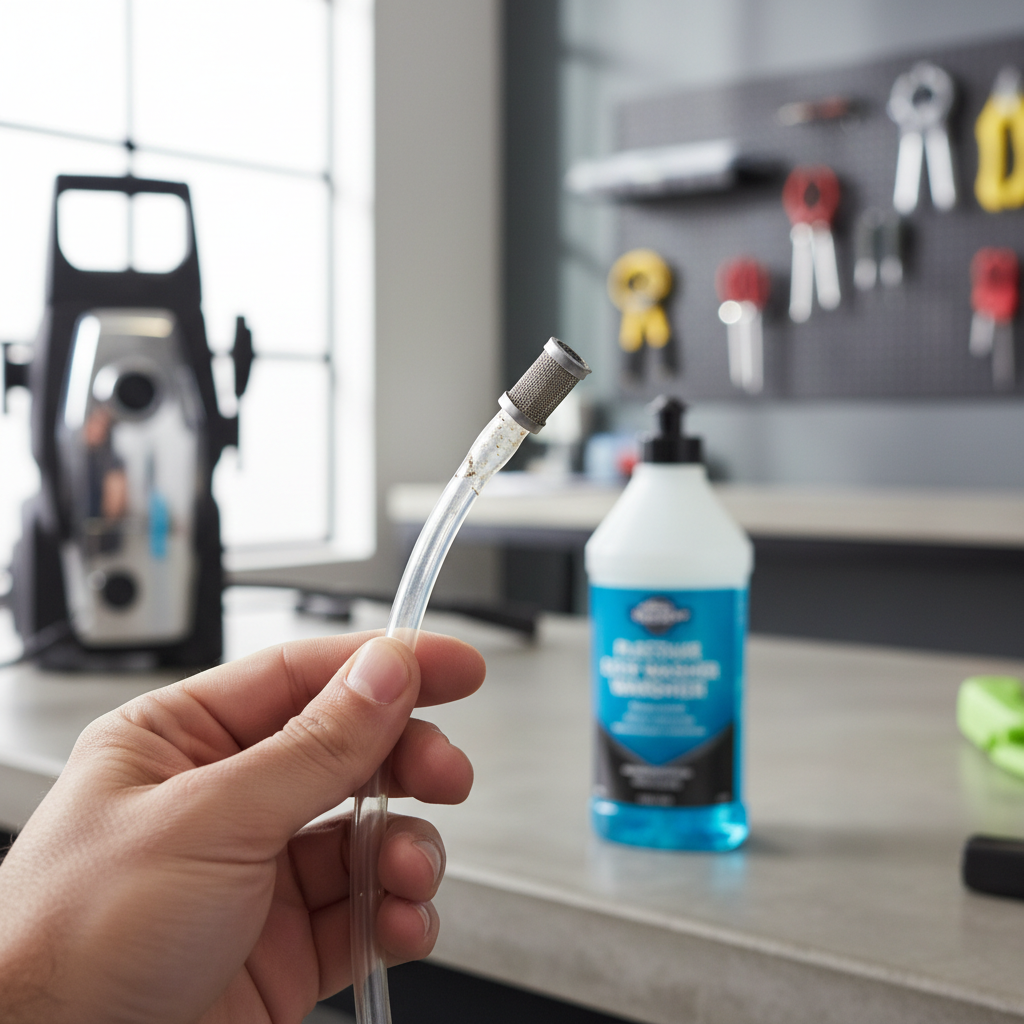
- Check Your Detergent and Siphon Hose — Start with the basics
- First thing, make sure you’re using a pressure washer-specific detergent. Dish soap’s too thick and can mess with your pump or just flat-out refuse to siphon.
- Is the detergent bottle empty? Happens more than people admit.
- Pro Tip: If you’re dealing with a really thick concentrate, try thinning it a little with water (e.g., 10-20% water). Sometimes that’s all it takes to get it moving.
Plumbing · Clog
| Project category | Plumbing |
|---|---|
| Problem type | Clog |
| Trade required | Plumbing |
| Urgency | Soon — within weeks |
| Safety risk | Low safety risk |
| DIY suitability | DIY friendly |
| Cost category | Low cost |
| Typical timeline | Same-day DIY attempt; pro visit within a day or two |
| Contractor type | Licensed plumber |
Repair option
Plunger, hand auger, or trap cleanout before chemicals.
Replacement option
Line replacement when clogs return in the same spot repeatedly.
Common causes
- Hair and soap buildup in the trap
- Grease cooling in the branch line
- Flushed wipes or foreign objects
Relevant tools:diy difficultydiy or hire a pro
Published August 1, 2026Last updated August 17, 2026
Tools & materials you'll need
Affiliate linksAs an Amazon Associate FixlyGuide earns from qualifying purchases — at no extra cost to you. Prices and availability are accurate as of publication and subject to change.
Quick Answer
Listen, I’ve seen this a thousand times. You’ve got your electric pressure washer humming along, ready to knock the grime off a deck, but when you switch over to soap, nothing. Zip. Zero suds. Most of the time, your problem isn’t a dead machine; it’s a blocked soap injector, a compromised siphon hose, or plain old wrong soap or wrong setting. Don’t get too spun up about it. Usually, it’s a pretty straightforward fix.
The Problem
There’s nothing more aggravating than trying to deep-clean something and your pressure washer just won’t cooperate. You’ve got the power, you’ve got the water, but the critical ingredient for cutting through grease and grime – the soap – isn’t making it to the nozzle. Instead of a thick, cleaning lather, you’re just getting plain old high-pressure water. That leaves you scrubbing by hand or, worse, thinking you wasted money on a machine that’s only half-working. I had a homeowner in Gresham last spring, Mrs. Henderson, convinced her brand-new machine was a lemon because it wouldn’t pull soap. Turned out she’d missed a tiny plastic plug still sitting in the siphon hose from the factory. Easy catch once we cracked it open and looked.
How It Works
Let’s talk about how these electric pressure washers actually get soap out there. It’s not as complicated as folks make it sound. Most electric models use what’s called a downstream injector system. That means the soap gets introduced after the pump, not before. Why after? Because most detergents aren’t meant to run through the high-pressure pump itself; they can chew up seals and internal parts over time.
Here’s the rundown:
- The Pump: This is the heart of the pressure washer. It takes water from the garden hose and kicks the pressure way up, pushing it through the system at anywhere from 1,500 to 2,500 PSI for most electric units.
- The Venturi Effect: This is the little trick that pulls soap. Inside the pressure washer, usually where the high-pressure hose connects, or sometimes built into the pump manifold, there’s a small chemical injector or soap injector. When high-pressure water blasts past a tiny opening in that injector, it creates a vacuum – a drop in pressure. That vacuum literally sucks the soap from your detergent tank or siphon hose.
- The Siphon Hose: This is the small tube that runs from the soap injector straight into your detergent bottle. It’s the path the soap takes to get to the injector.
- The Low-Pressure Nozzle: Here’s the catch. For the venturi effect to work and pull soap, the water pressure has to drop a lot at the nozzle. That’s why you must use a low-pressure tip – usually a black or sometimes a white wide-spray tip – when you want to apply soap. If you’re using a high-pressure blasting tip (like a 0-degree red tip or a 15-degree yellow tip), the pressure stays too high, the venturi effect doesn’t happen, and the machine won’t pull soap. No dice.
So, in plain English: the pump makes pressure, the high-pressure water creates a vacuum in the injector, the vacuum pulls soap through the siphon hose, and the low-pressure nozzle lets the whole thing work by dropping the outlet pressure. If any link in that chain goes sideways, you’re not getting suds.
Step-by-Step Fix
Alright, let’s get your suds back. Before you start, always unplug your electric pressure washer and disconnect the water supply. Safety first. Always.
-
Check Your Detergent and Siphon Hose — Start with the basics
- First thing, make sure you’re using a pressure washer-specific detergent. Dish soap’s too thick and can mess with your pump or just flat-out refuse to siphon.
- Is the detergent bottle empty? Happens more than people admit.
- Look over the siphon hose. Is it kinked? Pinched under the machine? Is there still a cap or plug on the end? I’ve seen factory plugs left in there more times than I can count. Trim off any crimped ends if they look beat up. Make sure the hose reaches the bottom of your soap container.
- Pro Tip: If you’re dealing with a really thick concentrate, try thinning it a little with water (e.g., 10-20% water). Sometimes that’s all it takes to get it moving.
-
Inspect the Siphon Filter — A common choke point
- At the end of your siphon hose, there’s usually a small filter or strainer. That little thing can get packed with gunk, sediment, or dried soap if the machine wasn’t rinsed out after the last job.
- Pull the filter off the hose (it usually just slides or unscrews).
- Clean it with an old toothbrush and some warm, soapy water. Rinse it clean. If it’s really crusted up or cracked, replace it. They’re cheap online or at the local hardware store.
-
Clean the Soap Injector — The heart of the problem
- This is often the main culprit. The soap injector is usually located near where the high-pressure hose connects to the machine, or sometimes right on the pump housing itself. It’s often a small brass or plastic fitting with an inlet for the siphon hose.
- Disconnect the siphon hose from the injector.
- You might need a small pick or a paperclip to clear out dried soap or debris from the tiny opening in the injector. Take it easy; you don’t want to gouge anything. Flush it with water.
- For a deeper clean, you can mix equal parts white vinegar and warm water. Attach a small length of clear tubing to the injector inlet, if you can, and try to run the vinegar solution through it by hand, or even briefly turn on the pressure washer without the siphon hose attached and see if any air is pulled through the injector. Caution: Only do this for a few seconds, since running the pump dry isn’t good for it.
- Some injectors come out. Check your owner’s manual for the exact steps on your model.
-
Verify Low-Pressure Nozzle Use — The setting matters most
- This is probably the biggest miss I see. You absolutely must use a low-pressure nozzle for your pressure washer to draw soap. On most electric units, that’s the black (soap) nozzle or sometimes a wide-angle white tip.
- If you’re using a red 0-degree tip, a yellow 15-degree tip, or a green 25-degree tip, it won’t pull soap. Period. The high pressure from those tips keeps the venturi effect in the injector from working.
- Put on the correct soap nozzle and try again. Half the time, that’s the whole fix.
-
Check for Air Leaks — Air is the enemy of suction
- Any air leak in the siphon hose system will kill the suction.
- Inspect the whole length of the siphon hose for cracks, cuts, or loose connections. Even a pinhole can ruin the vacuum.
- Make sure the connection where the siphon hose attaches to the injector is tight and airtight. If the fit’s loose, a simple hose clamp can help.
-
Test the Injector with Water — A quick sanity check
- Disconnect the siphon hose from the detergent bottle.
- Submerge the end of the siphon hose (with its filter) into a clean bucket of water.
- Turn on your pressure washer (with the low-pressure nozzle attached) and trigger the spray gun. If the system’s working, you should see water in the bucket getting sucked up through the hose. If it does, your issue is with the detergent itself or the filter.
-
Ensure Adequate Water Supply — Not enough water, not enough suction
- Your pressure washer needs a good, steady water supply to work right, including pulling soap.
- Make sure your garden hose is fully open at the spigot.
- Check that your garden hose isn’t kinked or too long, because either one can choke off flow. A minimum flow rate of 3-4 gallons per minute (GPM) is usually needed for decent pressure washer performance.
-
Rinse After Every Use — Prevention is key
- After you’re done spraying soap, always run clean water through the siphon hose and injector system for a few minutes.
- Submerge the siphon hose in a bucket of clean water and run the pressure washer with the low-pressure nozzle until only clear water comes out. That flushes out leftover detergent that can dry up and clog the system. I tell all my clients to do this, and it saves them a pile of headaches later.
Common Causes
When your electric pressure washer decides to go on a suds strike, it’s usually one of these usual suspects:
- Clogged Siphon Filter/Hose: This is, by far, the most common issue. Dirt, dried soap, or even factory debris can block the tiny filter or the hose itself, stopping detergent dead in its tracks.
- Blocked Soap Injector: The small opening in the venturi injector can get gummed up fast with concentrated, dried detergent if nobody rinses the system after use.
- Wrong Nozzle in Use: Trying to apply soap with a high-pressure (e.g., red or yellow) nozzle will never work. The machine needs that low-pressure tip to make the vacuum.
- Air Leaks in the Siphon System: Any crack or loose connection in the siphon hose or at the injector will let air in instead of pulling detergent, which breaks the vacuum effect.
- Incorrect Detergent or Consistency: Using regular dish soap or a detergent that’s too thick for your machine can stop it from siphoning right. Stick with pressure washer detergents.
- Insufficient Water Supply: If your garden hose isn’t feeding enough water volume, the pressure washer can’t perform like it should, and that can affect the soap-siphoning setup.
Common Mistakes
I’ve seen homeowners make the same few mistakes over and over when their pressure washer isn’t pulling soap. Here’s what to avoid:
- Using High-Pressure Tips for Soap: Classic mistake. Folks think the stronger spray will somehow help, but it won’t. You need the low-pressure tip or the soap won’t draw.
- Forgetting to Rinse the System: Leave detergent in there and it’ll dry like concrete. Then you’re right back to a clogged injector.
- Assuming the Machine Is Broken: A lot of people jump straight to “the washer’s toast” before checking the hose, filter, and nozzle. Most times, it’s something simple.
- Using the Wrong Soap: Not every liquid cleaner belongs in a pressure washer. Some are too thick, some foam too much, and some just don’t siphon worth a lick.
- Cranking on a Loose Connection: If the hose isn’t seated right, or there’s a cracked fitting, no amount of waiting is going to fix the suction.
If you’re still having trouble after all that, I’d start looking at the injector assembly itself or the pump internals — and at that point, it may be smarter to call in a pro than keep guessing.
Related Articles
Keep troubleshooting with these hand-picked guides from FixlyGuide:
- The Hidden Culprit Behind Your AC Not Cooling (and How to Find It) — If your central AC isn't cooling your home, the issue often stems from a surprisingly simple problem that's easy to overlook. Learn how to…
- Is a Wall-Mounted Pressure Washer Right for Your Garage? The Unvarnished Truth — Discover if a wall-mounted pressure washer is the right cleaning solution for your home, offering a powerful and space-saving alternative t…
- The Hidden Reason Your AC Isn't Cooling (And 7 Fixes Homeowners Miss) — If your central AC isn't cooling your home, the culprit often lies in an overlooked issue that's simple to fix, preventing costly professio…
- The Hidden Reason Your AC Isn't Cooling (And Why Most Homeowners Get It Wrong) — When your central AC unit isn't cooling, the culprit often isn't what you think, leading to frustration and unnecessary repair calls.
- The Surprising Reason Your House Ticks and Pops At Night (And What It Means) — That unsettling ticking or popping sound in your house at night is usually normal thermal expansion and contraction, but sometimes it signa…
- Is a Tiny Clog Halving Your Toilet's Flush Power? The Hidden Fill Valve Secret — A slow-filling toilet tank is a common, frustrating issue often caused by a restricted fill valve, easily fixed with basic tools.
What should this project cost?
Enter your project details for a realistic cost range before you call anyone.
Cost depends heavily on which system turns out to be the source.
- Regional adjustment
- National average
- Labor share (typical)
- ~$1,620
- Quotes to collect
- 3 written estimates
Educational estimate based on national averages — not a binding quote. Always confirm with written local estimates.
Fixly Project Decision Box
- DIY difficulty
- Professional Recommended
- Estimated time
- Diagnosis 1–2 hours
- Cost level
- Moderate
Main tools / materials
- Non-contact voltage tester
- Outlet tester
- Flashlight
When to stop and call a pro
- Burning smell, scorch marks, or a warm outlet or switch plate
- A breaker that trips again right after being reset
- Any work inside the service panel
- Aluminum wiring or cloth-insulated wiring
Need professional help?
Talk to a Licensed ElectricianGet the print-ready PDF of this guide
A clean, ad-free, printable version you can keep on your phone or pin to the workshop wall. Free with a FixlyGuide account.
- Print-optimized layout
- Tools, materials & every step included
- Saved to your account
This article was independently written by FixlyGuide based on the source topic.
Frequently asked questions
Why won't my electric pressure washer pull soap?+
The most frequent reasons are a clogged soap injector, a kinked or blocked siphon hose, using the wrong low-pressure nozzle, or incorrect detergent. Always start by checking your siphon hose and filter, then move to the injector.
Do all pressure washers use a special soap nozzle?+
Yes, nearly all pressure washers require a specific low-pressure nozzle (often black or a wide-angle white tip) to create the vacuum needed to draw detergent. High-pressure nozzles will not allow the machine to siphon soap.
Can I use dish soap in my electric pressure washer?+
No, it's not recommended. Dish soap is often too thick for the siphon system and can contain ingredients that damage pump seals. Always use detergents specifically formulated for pressure washers to ensure proper function and machine longevity.
How do I clean the soap injector on my pressure washer?+
First, disconnect the siphon hose. You can use a small pick or paperclip to gently clear any visible debris from the tiny opening. For a deeper clean, flush it with a vinegar and warm water solution. Refer to your owner's manual for specific instructions on your model.
My siphon hose has no filter. Is that a problem?+
While some older or very basic models might omit a filter, most modern pressure washers include a small filter or strainer on the end of the siphon hose to prevent debris from entering and clogging the injector. If yours is missing, it's a good idea to get a universal replacement to protect your machine.
How often should I rinse the soap system?+
You should rinse the soap system with clean water immediately after every use with detergent. This prevents dried soap residue from clogging the siphon hose and injector, which is one of the most common causes of soap-drawing problems.
What if my pressure washer has an onboard detergent tank instead of a siphon hose?+
The principles are largely the same. The tank will feed into an injector. Check the tank's filter, ensure the cap is properly sealed (no air leaks), and clean any internal lines or the injector where the tank connects to the pump. The low-pressure nozzle requirement still applies.
How do I know if my detergent is too thick?+
If your pressure washer struggles to pull soap, and you've checked all other components, try diluting a small amount of the detergent (e.g., 1 part detergent to 4 parts water) in a separate container and testing it. If it pulls soap after dilution, your original detergent was likely too thick.
Discussion
Loading comments…