- The Big Rig Mystery: Why Those Wheel Spikes Aren't What You Think — Ever wondered about those intimidating spikes on big truck wheels? They're not for defense, but they do tell us something about basic vehic…
- The 3 Hidden Ways Your — Uncover the surprising habits and hidden household issues that are silently increasing your homeownership costs and learn how to fix them.
- Traffic Light Has a Yellow Border? Here’s What It Means for Drivers — Ever notice a traffic light with a bright yellow border? It's not just decoration—it’s a visibility feature with a specific purpose for roa…
- The Surprising Reason Your House Ticks and Pops At Night (And What It Means) — That unsettling ticking or popping sound in your house at night is usually normal thermal expansion and contraction, but sometimes it signa…
- 7 Hidden Equity Drains Costing You Thousands Annually — Your home is an asset, but silent problems like minor leaks, poor insulation, and deferred maintenance can drain its value. Discover the se…
Published October 28, 2026Last updated October 28, 2026
Tools & materials you'll need
Affiliate links- AmazonTraffic safety cones4–6 · to mark curb delivery perimeter
- AmazonHeavy-duty box cutter or utility knife1 · to inspect shrink-wrapped pallets
- AmazonHigh-visibility safety vest1 · for directing roadside delivery traffic
- AmazonPallet jack or compact tractor with forks1 · if no liftgate is provided
- AmazonExterior-grade 3/4-inch plywood sheets2–4 sheets · for turf and paver ground protection
As an Amazon Associate FixlyGuide earns from qualifying purchases — at no extra cost to you. Prices and availability are accurate as of publication and subject to change.
Quick Answer
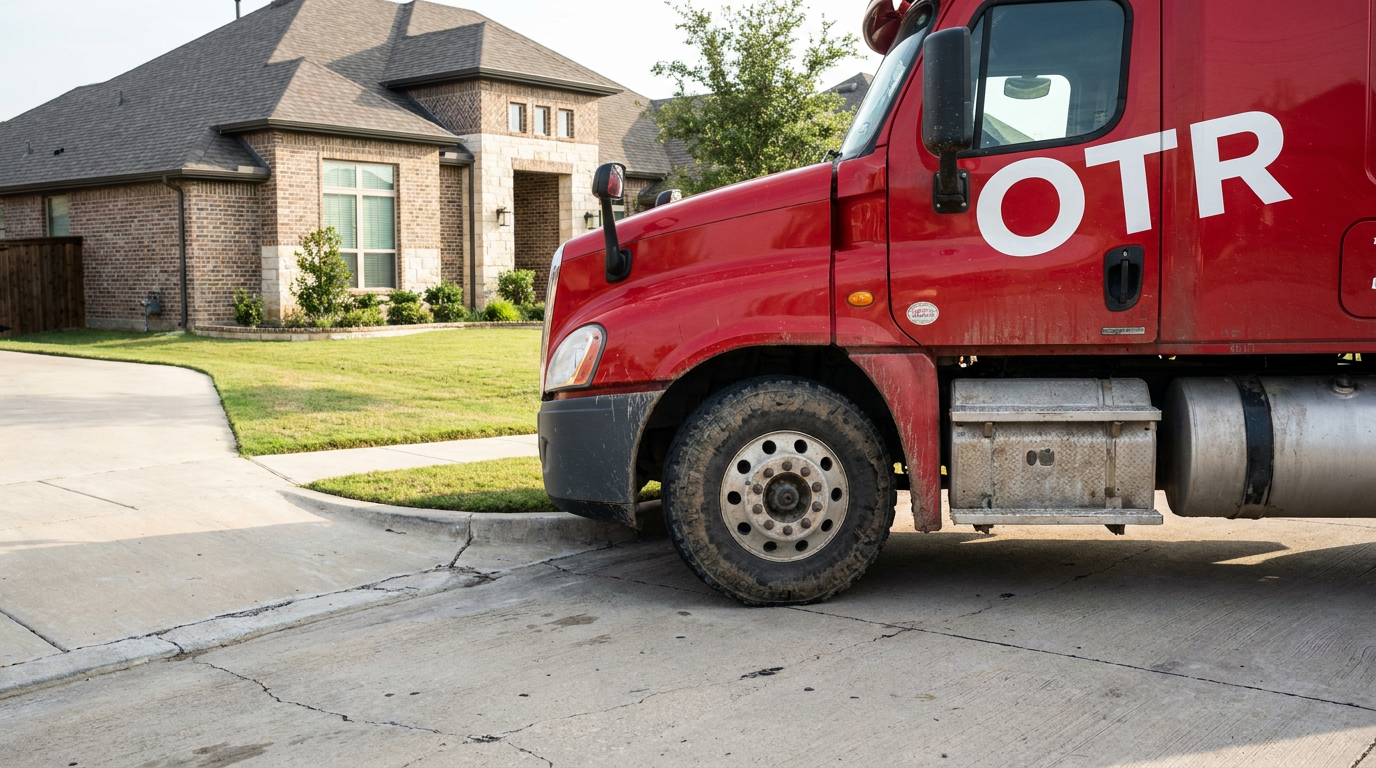
When you see "OTR" stamped, stickered, or painted on a freight cab, it stands for Over-The-Road. In freight logistics, that means a Class 8 long-haul tractor-trailer hauling heavy freight across interstate corridors, not running local milk runs. For homeowners, that matters a whole lot if you’ve got lumber bundles, palletized sod, or a prefabricated shed showing up at your place on one of these rigs. You’ve got to think about 80,000-pound axle limits, a 53-foot trailer swinging like a barn door, and what that kind of weight does to a driveway before that truck even hits your street.
The Problem
Most homeowners don’t think twice about commercial freight until a 70-foot-long semi hauling pallets of natural stone gets wedged across a residential cul-de-sac. I’ve seen that movie, and it never ends pretty.
You ordered bulk materials online—maybe quartz slabs, hardwood flooring, or 12 pallets of turf for your backyard renovation. The vendor quoted standard freight shipping. What they didn’t tell you is they booked a commercial OTR (over-the-road) carrier instead of a regional box truck with a hydraulic liftgate.
When an OTR tractor-trailer turns down a typical 28-foot-wide suburban street, things go sideways fast. These trucks can weigh up to 80,000 lbs fully loaded. Their trailers run 53 feet long with zero rear-wheel steer. Low-hanging utility drops, HOA parking restrictions, tight turn radiuses, and standard 4-inch residential concrete driveways just don’t mix with interstate logistics equipment. If the driver tries to roll onto your apron, your concrete cracks, your yard gets rutted down to bare clay, and you’re the one dealing with a towing bill or a roadside unloading mess. No dice.
How It Works
Freight transport breaks into three main tiers: local/last-mile, regional (LTL or less-than-truckload), and OTR long-haul. Once you understand the mechanical and legal realities of an OTR rig, it gets a lot easier to protect your property.
A standard OTR setup pairs a three-axle sleeper tractor with a 53-foot dry van, flatbed, or refrigerated reefer unit. Total gross vehicle weight rating (GVWR) under Federal Highway Administration regulations tops out at 80,000 lbs across five axles. That works out to roughly 12,000 lbs on the front steer axle and up to 34,000 lbs on both tandem drive and trailer axle groups.
Residential asphalt and concrete driveways are built for light passenger vehicles weighing 4,000 to 6,000 lbs. They’re usually poured at a modest 3.5 to 4 inches thick over compacted base, with compressive strengths around 3,000 to 3,500 PSI. An OTR truck's tandem dual wheels exert point contact pressures between 85 and 105 PSI per tire patch. When that concentrated mass rolls off the crowned municipal street and hits your unreinforced driveway apron, the shear stress blows past the concrete's tensile capacity. The slab snaps along its subgrade voids.
I pulled a water heater in Frisco last month that had exactly this kind of freight issue out front—driver barely tapped a weak apron and the homeowner thought the whole thing was cursed. It wasn’t cursed. It was overloaded.
And here's the other catch: OTR drivers are tightly regulated by electronic logging devices (ELDs), which restrict them to strict 11-hour driving windows within a 14-hour workday. They can’t sit idling on your curb for three hours while you hunt down a neighbor with a tractor to unload their flatbed.
Step-by-Step Fix
When you’ve got a residential freight delivery arriving via an OTR carrier, take these steps to manage the staging, unloading, and site protection without wrecking your infrastructure.
-
Verify the Bill of Lading (BOL) Specifications — Check your order confirmation right after purchase for terms like "OTR", "FTL" (Full Truckload), or "Common Carrier". Call the logistics broker or supplier and confirm trailer dimensions, gross dispatch weight, and whether the service includes inside drop or "curbside delivery" only.
- If the BOL says standard OTR flatbed or dry van without liftgate service, call customer support right away and try to modify the dispatch tier.
-
Inspect Neighborhood Access Clearances — Walk the route from the nearest commercial collector road all the way to your driveway with a measuring wheel or just eyeball the sightline. You need a minimum vertical clearance of 14 feet to clear the standard 13-foot-6-inch trailer roof, safe clearance past low-hanging fiber/cable wires, and at least a 50-foot turning radius at intersections.
- Look for low-hanging branches on city trees and parked neighborhood vehicles that squeeze the street down below 22 feet of clear passage.
-
Stage an Off-Street Curb Drop Zone — Pick an unloading staging point along the public curb instead of letting the rig enter your driveway. Mark off an 80-foot parallel curb strip using bright traffic cones 24 hours before delivery.
- Let your immediate neighbors know so parked cars aren’t blocking the street when that long-haul sleeper comes through.
-
Prepare Ground Armor for Staging Machinery — If an off-truck piggyback forklift (such as a Moffett) will unload the freight, put protective runners over your turf and decorative pavers. Lay down 3/4-inch exterior-grade plywood or high-density polyethylene (HDPE) ground mats along the planned route between the street and your garage.
- Standard plywood sheets spread point tire loads pretty well and keep the forklift's deep-tread pneumatic tires from chewing up the yard.
-
Establish Direct Phone Contact with the Dispatcher — Ask for the freight carrier's tracking pro-number and the driver's cell phone number 48 hours before delivery. OTR drivers often show up outside rigid appointment windows because of DOT weigh stations and interstate traffic delays.
- Ask the dispatcher straight up: "Does this rig feature a liftgate, or do I need independent material-handling equipment on-site?"
-
Coordinate Mechanical Offloading Equipment — Line up a skid steer, compact tractor with pallet forks, or an engine crane if the supplier is shipping via a standard non-liftgate OTR van. Most OTR drivers are contractually forbidden from touching cargo beyond releasing the load straps or opening trailer swing doors.
- Make sure your forklift or tractor attachment is rated for the specific pallet load (typically 2,000 to 4,500 lbs per pallet).
-
Direct the Driver's Approach and Halt Driveway Entry — Stand at the curb in a high-visibility safety vest as the semi approaches so you can guide the driver toward your designated curb pull-off. Tell the driver, plainly, that under no circumstances should the tractor or trailer back onto your concrete driveway apron.
- If the driver refuses street unloading because of municipal traffic concerns, send the rig to a nearby commercial strip mall or park-and-ride lot where cargo can safely transload to a pickup truck.
-
Inspect the Shipment Before Signing the Delivery Receipt — Cut away the stretch wrap and check the shipping manifests before you sign the driver's delivery paper or electronic tablet. Look for crushed crate corners, wet packaging, broken strapping, or shifted bands.
- Note any visual damage on the physical slip with exact wording ("received damaged, pallet crushed") before the driver departs; without that written exception, freight claims are almost always denied.
Common Causes
Why do massive OTR trucks end up stuck in quiet suburban subdivisions in the first place? Usually it comes down to a few logistics disconnects:
- E-Commerce Freight Automation: A lot of national building material platforms automatically push dispatch orders into wholesale freight exchanges. The algorithm grabs the lowest bidder, which is often an interstate OTR long-haul flatbed carrier instead of a regional "hotshot" or box-truck service built for residential neighborhoods.
- Ambiguous Delivery Tier Terminology: Consumers assume "curbside freight delivery" means a manageable box truck with a motorized pallet jack. Freight companies define curbside as the edge of the municipal roadway right behind whatever trailer size they dispatched.
- Misunderstanding of Municipal Weight Bans: Residential subdivisions commonly carry local street gross weight limits of 10,000 to 20,000 lbs, excluding municipal garbage and fire equipment. OTR dispatchers rarely cross-check neighborhood-level ordinances before plotting interstate routes.
- Last-Mile Subcontracting Gaps: Regional transfer terminals sometimes hand freight straight to long-haul owner-operators passing through the metro corridor instead of cross-docking the cargo onto smaller 26-foot straight trucks.
Common Mistakes
- Letting the rig back into your driveway apron. Homeowners think, "It's just for five minutes." Don't do it. A loaded tandem axle carries up to 34,000 lbs. That kind of weight will fracture unreinforced 4-inch residential concrete, snap hidden irrigation pipes underneath, and crack plastic drain lines buried in the subbase. Keep the tractor on the public street.
- Assuming the driver will unload your pallets. OTR drivers are long-haul operators, not moving labor. Their main legal duty ends at popping the trailer door locks and handing you a clipboard. If you don’t have a forklift, tractor forks, or a crew of four capable adults ready to hand-unload, the driver will issue an "attempted delivery" charge ($150–$350) and drive off.
- Forgetting vertical clearance checks. Suburban oak, maple, and pine canopies regularly hang lower than 12 feet. An OTR trailer stands at 13 feet, 6 inches. If that trailer catches an overhead branch, or worse, tears down your neighbor's overhead telecom or electrical drops, now you’re in the middle of liability fights and emergency utility repair fees.
- Signing the bill of lading before inspecting. Once you sign clean on an interstate BOL, the long-haul trucking company is legally off the hook for cargo damage. Tear off the outer black plastic shrink-wrap. Open the crate lid. If the cast stone fireplace mantle is snapped in half inside, write "Damaged in Transit" clearly across the signature line.
- Failing to check neighborhood parking rules. Many suburban HOAs and city municipalities issue immediate fines for blocking traffic lanes or parking commercial commercial vehicles over 26 feet long. Check local street parking codes and coordinate with neighbors before the truck pulls in.
Cost & Time Breakdown
| Task | DIY Cost | Pro Cost | Time |
|---|---|---|---|
| Jobsite ground protection (plywood sheets & mats) | $60–$120 | $200–$350 | 30–45 mins |
| Skid-steer / rough-terrain forklift day rental | $250–$400 | $500–$850 | 1–2 hours |
| Liftgate service dispatch upgrade fee | $75–$150 | $150–$250 | 15 mins (phone) |
| Concrete apron repair (if crushed by semi-truck) | $400–$800 (patch) | $1,800–$4,500 (pour) | 1–3 days |
| Offloading labor (crew of two helpers) | $0 (sweat equity) | $120–$250 | 1–2 hours |
Tips & Prevention
- Insist on Liftgate and "Final Mile" Delivery Upgrades: When you’re checking out online for heavy home items (saunas, timber packs, flooring), pay the extra $50 to $125 fee for guaranteed "liftgate delivery via straight truck." That pushes the broker to cross-dock the goods onto a 24-to-28-foot local delivery vehicle.
- Monitor Driveway Subbase Conditions in Wet Seasons: Saturated clay soil loses structural bearing capacity fast. A standard single-axle delivery truck that rolls safely across your driveway in dry August heat can sink through the concrete in rainy March or April.
- Set Up a Secondary Staging Base: If your home sits on a steep hill, dead-end cul-de-sac, or narrow mountain road, arrange with an industrial warehouse, landscape yard, or commercial store parking lot down the highway to accept the OTR delivery. Then transload the items into your utility trailer or pickup bed in manageable trips.
- Keep Heavy Hand Tools at the Curb: Have industrial tin snips, utility knives, and crowbars ready at the curbside so you can break down overbuilt wooden crates fast if the materials have to be hand-carried out of the trailer piece by piece.
When to Call a Professional
If an OTR truck has already damaged your property, step back from the DIY toolset. Call a licensed civil concrete contractor and your home insurance adjuster if a semi has cracked your driveway apron, crushed deep municipal culvert pipes, or buckled retaining walls along your frontage.
More urgently, if a tractor-trailer clips an overhead power line, low-hanging service drop, or municipal water meter vault while maneuvering on your street, do not touch the wire or go near the puddle. Keep everyone 35 feet back and call 911 immediately along with your local power utility's emergency dispatch. High-voltage utility drops can energize the entire truck frame or the surrounding damp soil with fatal potential. Let line crews and certified municipal workers isolate the hazard before anyone messes with the freight.
Frequently Asked Questions
What does OTR stand for in trucking?
OTR stands for Over-The-Road. It designates commercial truck drivers and long-haul freight carriers who haul cargo across state lines, regions, or nationwide corridors, spending days or weeks at a time living inside sleeper cab tractors.
Can an OTR semi-truck drive on my residential street?
Most cities and residential subdivisions post gross vehicle weight limits (typically 10,000 to 20,000 lbs) that prohibit commercial 80,000-pound Class 8 trucks from driving on neighborhood streets unless they’re making a direct, necessary delivery. Even then, tight street radiuses, parked cars, and low tree branches can make neighborhood transit physically impossible or dangerous.
Will an OTR truck ruin my concrete driveway?
Yes. Residential driveways are typically poured 4 inches thick with a compressive rating between 3,000 and 3,500 PSI, designed to hold standard 4,000-to-6,000-pound passenger vehicles. An 80,000-pound tractor-trailer exerts concentrated tire point pressures exceeding 100 PSI, which will crack, snap, and permanently sink standard residential slabs.
What is the difference between OTR and LTL delivery?
OTR refers to long-haul full truckload transit across broad highway distances. LTL stands for "Less-Than-Truckload," where cargo from multiple customers is combined into one trailer. LTL deliveries are often cross-docked at regional distribution centers onto smaller 26-foot straight trucks equipped with hydraulic liftgates suited for residential curbside drops.
Does an OTR truck driver have to help unload my materials?
No. Standard freight contracts stipulate curbside freight delivery, meaning the driver is only responsible for safely driving to the property line and unlocking the cargo bay doors. Moving pallets off the flatbed or out of the dry van is the homeowner's responsibility unless white-glove inside delivery was explicitly purchased beforehand.
What should I do if an OTR truck gets stuck on my street?
Do not attempt to pull or tow a Class 8 commercial tractor with a consumer pickup truck or SUV—you will ruin your transmission or snap recovery straps dangerously. The driver must contact their carrier's logistics dispatch to call a heavy-duty commercial wrecker equipped with hydraulic underlifts.
How much overhead clearance does an OTR trailer need?
Standard dry vans and refrigerated trailers stand 13 feet, 6 inches tall. You need a minimum clearance of 14 feet to safely clear utility lines, tree branches, and decorative neighborhood gateway arches without snagging overhead infrastructure.
Can I refuse an OTR freight delivery if the truck cannot access my road?
Yes. If the driver cannot safely access your curb without risking damage to property, trees, or utility lines, you can tell the driver that access is impossible. The carrier will hold the goods at their nearest regional freight terminal, where you can either pick them up using your own trailer or arrange for a smaller last-mile shuttle truck.
Related Articles
Keep troubleshooting with these hand-picked guides from FixlyGuide:
- The Big Rig Mystery: Why Those Wheel Spikes Aren't What You Think — Ever wondered about those intimidating spikes on big truck wheels? They're not for defense, but they do tell us something about basic vehic…
- The 3 Hidden Ways Your — Uncover the surprising habits and hidden household issues that are silently increasing your homeownership costs and learn how to fix them.
- Traffic Light Has a Yellow Border? Here’s What It Means for Drivers — Ever notice a traffic light with a bright yellow border? It's not just decoration—it’s a visibility feature with a specific purpose for roa…
- The Surprising Reason Your House Ticks and Pops At Night (And What It Means) — That unsettling ticking or popping sound in your house at night is usually normal thermal expansion and contraction, but sometimes it signa…
- 7 Hidden Equity Drains Costing You Thousands Annually — Your home is an asset, but silent problems like minor leaks, poor insulation, and deferred maintenance can drain its value. Discover the se…
- Driveway Expansion Joint Cracking? 11 Steps to Reseal It for Good — Stop weeds, water erosion, and winter frost heave by replacing failed concrete expansion joints with commercial-grade polyurethane and clos…
What should this project cost?
Enter your project details for a realistic cost range before you call anyone.
Cost depends heavily on which system turns out to be the source.
- Regional adjustment
- National average
- Labor share (typical)
- ~$1,620
- Quotes to collect
- 3 written estimates
Educational estimate based on national averages — not a binding quote. Always confirm with written local estimates.
Get the print-ready PDF of this guide
A clean, ad-free, printable version you can keep on your phone or pin to the workshop wall. Free with a FixlyGuide account.
- Print-optimized layout
- Tools, materials & every step included
- Saved to your account
This article was independently written by FixlyGuide based on the source topic.
Frequently asked questions
What does OTR stand for in trucking?+
OTR stands for Over-The-Road. It designates commercial truck drivers and long-haul freight carriers who haul cargo across state lines, regions, or nationwide corridors, spending days or weeks at a time living inside sleeper cab tractors.
Can an OTR semi-truck drive on my residential street?+
Most cities and residential subdivisions post gross vehicle weight limits (typically 10,000 to 20,000 lbs) that prohibit commercial 80,000-pound Class 8 trucks from driving on neighborhood streets unless they are making a direct, necessary delivery. Even then, tight street radiuses, parked cars, and low tree branches can make neighborhood transit physically impossible or dangerous.
Will an OTR truck ruin my concrete driveway?+
Yes. Residential driveways are typically poured 4 inches thick with a compressive rating between 3,000 and 3,500 PSI, designed to hold standard 4,000-to-6,000-pound passenger vehicles. An 80,000-pound tractor-trailer exerts concentrated tire point pressures exceeding 100 PSI, which will crack, snap, and permanently sink standard residential slabs.
What is the difference between OTR and LTL delivery?+
OTR refers to long-haul full truckload transit across broad highway distances. LTL stands for "Less-Than-Truckload," where cargo from multiple customers is combined into one trailer. LTL deliveries are often cross-docked at regional distribution centers onto smaller 26-foot straight trucks equipped with hydraulic liftgates suited for residential curbside drops.
Does an OTR truck driver have to help unload my materials?+
No. Standard freight contracts stipulate curbside freight delivery, meaning the driver is only responsible for safely driving to the property line and unlocking the cargo bay doors. Moving pallets off the flatbed or out of the dry van is the homeowner's responsibility unless white-glove inside delivery was explicitly purchased beforehand.
What should I do if an OTR truck gets stuck on my street?+
Do not attempt to pull or tow a Class 8 commercial tractor with a consumer pickup truck or SUV—you will ruin your transmission or snap recovery straps dangerously. The driver must contact their carrier's logistics dispatch to call a heavy-duty commercial wrecker equipped with hydraulic underlifts.
How much overhead clearance does an OTR trailer need?+
Standard dry vans and refrigerated trailers stand 13 feet, 6 inches tall. You need a minimum clearance of 14 feet to safely clear utility lines, tree branches, and decorative neighborhood gateway arches without snagging overhead infrastructure.
Can I refuse an OTR freight delivery if the truck cannot access my road?+
Yes. If the driver cannot safely access your curb without risking damage to property, trees, or utility lines, you can tell the driver that access is impossible. The carrier will hold the goods at their nearest regional freight terminal, where you can either pick them up using your own trailer or arrange for a smaller last-mile shuttle truck.


Discussion
Loading comments…