- High Approach Speeds: On roads posted at 45 mph or higher, drivers just don’t have much time to react. The backplate helps the signal show up sooner.
- Visual Clutter: The signal sits in a noisy visual zone with competing lights from businesses, ads, and streetlights.
- Unexpected Signal Location: It might be the first traffic signal after a long stretch of open road, or one sitting just over a hill or around a curve.
- History of Red-Light Running: If crash data shows a pattern of drivers blowing the red at a certain intersection, a backplate’s a solid countermeasure.
- Skewed or Offset Intersections: At oddball, five-point, or offset intersections, it can be tough to tell which signal controls which lane. The backplate helps clear that up.
Published October 14, 2026Last updated October 14, 2026
Tools & materials you'll need
Affiliate linksAs an Amazon Associate FixlyGuide earns from qualifying purchases — at no extra cost to you. Prices and availability are accurate as of publication and subject to change.
Quick Answer
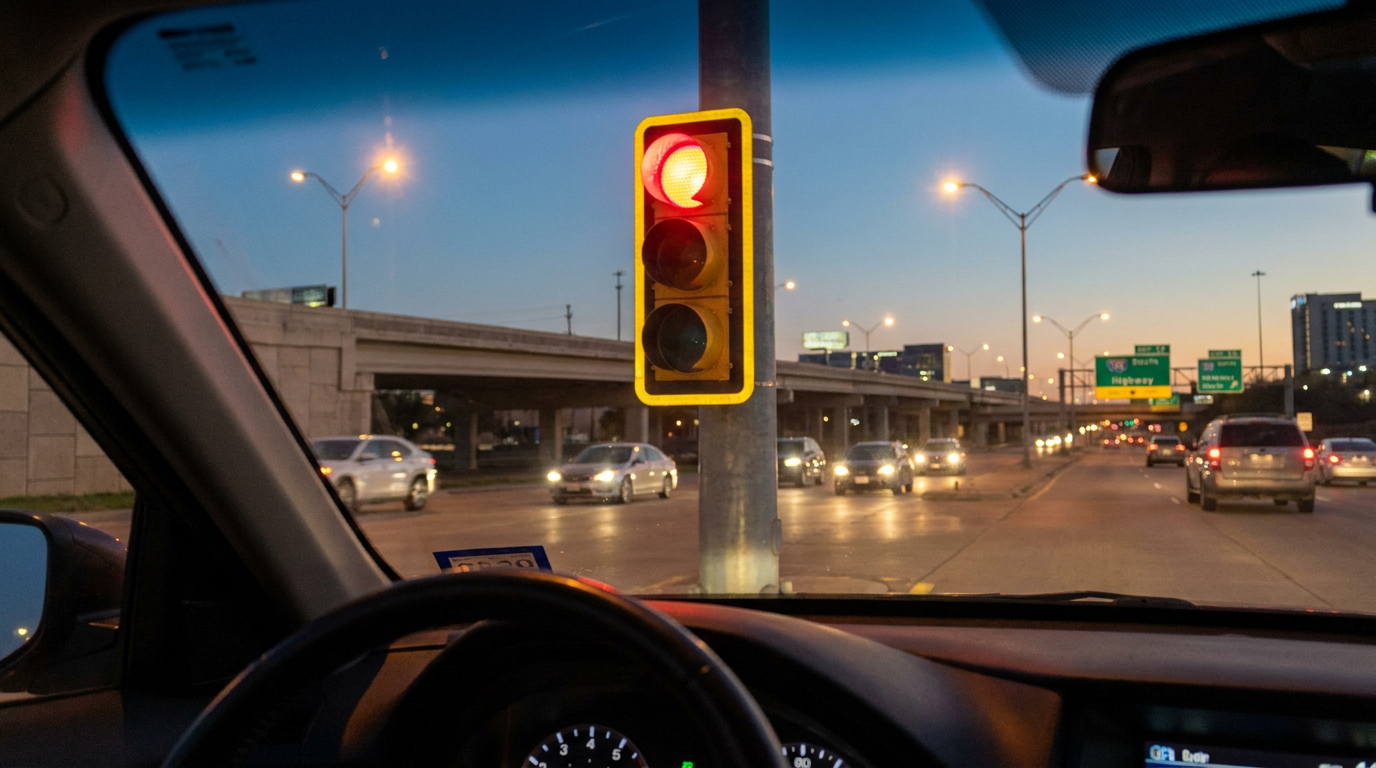
A yellow border on a traffic light is a retroreflective backplate. Its whole job is to make the signal easier to see for drivers, especially in messy visual conditions, at night, or when the weather turns ugly with rain or fog. That bright reflective frame helps you pick out the active light from farther back, which cuts down the odds of blowing through a red.
The Problem
You’re rolling down a road you don’t know, maybe near dusk or in a hard rain. The street’s lit up with storefronts, brake lights, and a pile of other distractions. Up ahead, the traffic signal gets lost in all that clutter. Did it just change? Was it green a second ago? That split-second doubt—folks call it "signal blindness"—is a real hazard.
At 60 mph, your car travels 88 feet per second. So if you take two seconds to recognize a red light, you’ve gone more than half a football field before your foot even gets to the brake. Intersections with crash history, poor sight lines, or fast approaches need something extra to grab your attention. Just making the light brighter doesn’t always do the trick, especially against a bright sky or a busy urban background. The real issue is conspicuity—making the signal stand out when it counts.
How It Works
A traffic light with a yellow border uses a pretty simple but effective setup: a retroreflective backplate. That’s not just yellow paint; the border’s covered with a reflective material, usually 3M's Diamond Grade reflective sheeting, with microscopic beads or prisms in it. Unlike a mirror, which throws light off at an angle, retroreflective material sends the light right back to where it came from—in this case, your headlights.
Think of it like the reflective strips on a firefighter’s coat or the markers along the highway. At night, your headlights hit that yellow frame and the whole signal assembly looks like it’s glowing. That gives you a big, high-contrast target your eyes can lock onto, even from a quarter-mile away. The yellow border basically acts like a high-visibility "picture frame" for the signal, pulling it out of the visual noise behind it.
The Federal Highway Administration (FHWA) looked at these backplates pretty hard. Their research found that retroreflective backplates can reduce total crashes at signalized intersections by 15%. For injury and fatal crashes at night, the drop is even better. That’s why you’ll usually see them at intersections with certain risk factors: high-speed approaches (over 45 mph), tricky signal timing (like a 5-way intersection or a left-turn arrow), or a history of red-light-running incidents.
Step-by-Step Fix
You can’t go out and install a yellow-bordered traffic light yourself, but knowing how to react to one is still a kind of fix for your driving habits. The idea is to use the extra information and be a steadier, safer driver.
1. Register the Signal Early
- As you roll toward the intersection, start scanning for the light. That yellow border is your cue to spot it sooner than you normally would. Notice it. Clock the color. Do it early.
2. Anticipate Higher Risk
- A bordered signal usually means the intersection’s considered high-risk. Maybe it’s a fast road, a confusing layout, or a spot with a crash record. Ease off a little and cover your brake, especially if the light’s been green for a while.
3. Reduce Distractions
- This is one of those moments where you need to stay on task. If you see a yellow-bordered signal ahead, that’s your sign to set the coffee down, end the hands-free call, or pause the talk with your passenger. Give that intersection your full attention.
4. Check for Complex Phasing
- Yellow-bordered signals often come with trickier light patterns. Watch for protected left-turn arrows (green arrows), flashing yellow arrows, or signals that only apply to certain lanes. The border’s telling you to pay closer attention to which light belongs to you.
5. Be Vigilant in Bad Weather
- In rain, fog, or snow, that retroreflective border is worth its weight in gold. Your headlights light it up, and the signal stays visible when it might otherwise disappear into the gray. Trust that glowing frame to pull your focus.
6. Never Assume It's a 4-Way Stop
- If a signal with a yellow border goes completely dark—a power outage—don’t treat it like a suggestion. Texas law, like most states, says a completely dark signal gets treated as an all-way stop. Come to a full stop before the white line, then proceed while yielding to whoever got there first.
7. Adjust Your Night Driving
- At night, that glowing border can look surprisingly bright. That’s the point. Let it grab your eye, verify the signal color, then shift your attention back down the road and watch for pedestrians or cross-traffic.
8. Report Malfunctions
- If the lights are working but the backplate’s damaged, peeling, or blocked, report it to the local traffic authority—usually the Public Works or Transportation department for the city or county. It’s a safety feature, and if it’s trashed, it’s not doing anybody any favors.
Common Causes
Why do some intersections get these backplates and others don’t? It isn’t random. Traffic engineers put them in for specific reasons:
- High Approach Speeds: On roads posted at 45 mph or higher, drivers just don’t have much time to react. The backplate helps the signal show up sooner.
- Visual Clutter: The signal sits in a noisy visual zone with competing lights from businesses, ads, and streetlights.
- Unexpected Signal Location: It might be the first traffic signal after a long stretch of open road, or one sitting just over a hill or around a curve.
- History of Red-Light Running: If crash data shows a pattern of drivers blowing the red at a certain intersection, a backplate’s a solid countermeasure.
- Skewed or Offset Intersections: At oddball, five-point, or offset intersections, it can be tough to tell which signal controls which lane. The backplate helps clear that up.
- High Volume of Truck or Older Driver Traffic: Studies show these backplates especially help heavy vehicle operators and older drivers, who may need a little more time to react.
Common Mistakes
Even with the extra visibility, drivers still make mistakes at these signals.
- Ignoring the Warning: They see the yellow frame but don’t treat it like a heads-up for a higher-risk intersection. That’s backward. You should tighten up your awareness, not relax.
- Target Fixation: They stare at the bright bordered light and forget to scan for pedestrians, cyclists, or cross-traffic that might not be stopping.
- Misinterpreting a Flashing Yellow Arrow: These show up a lot with bordered signals. A flashing yellow arrow means you may turn left, but you’ve still got to yield to oncoming traffic. It’s not a protected turn.
- Power Outage Confusion: During an outage, the signal goes dark. The yellow frame is still there, but the lamps aren’t. Some drivers panic. Others just roll through. No dice. A dark signal is a stop sign.
- Assuming All Signals Have Them: Folks get used to the high visibility of bordered signals, then get sloppy at older intersections that don’t have them. Don’t do that. Treat every intersection like it could bite you.
Cost & Time Breakdown
For a municipal traffic department, upgrading a signal is a planned job. A homeowner isn’t footing the bill directly, but this gives you an idea of what taxpayers are paying for this safety upgrade.
| Task | DIY Cost | Pro (Municipal) Cost | Time |
|---|---|---|---|
| Material (Single Backplate) | N/A | $100–$250 | N/A |
| Full Signal Head Upgrade | N/A | $3,000–$5,000 per head | 2–4 hours |
| Intersection Study & Design | N/A | $5,000–$15,000 | 2–6 months |
| Full Intersection Retrofit | N/A | $20,000–$50,000+ | 1–3 days |
Tips & Prevention
As a homeowner and driver, you can use this stuff to make your own road time a little safer.
- Advocate for Safety: If there’s a dangerous intersection in your neighborhood that feels hard to see, call your city’s traffic engineering or public works department. If you use the phrase "retroreflective backplates," they’ll know you’ve done your homework.
- Clean Your Headlights: The whole setup only works if your headlights are clean and aimed right. Hazy, yellowed headlight lenses can cut light output by up to 70%, which makes reflective signs and backplates a whole lot less effective.
- Check Your Vision: If night driving’s getting tough, maybe it’s time for an eye exam. Vision changes with age, and the right lenses can make a big difference.
- Educate Teen Drivers: Point out these yellow-bordered signals to new drivers. Tell them what they mean, where to look, and how the different phases work, including flashing yellow arrows.
- Practice Defensive Driving: The main idea is simple: expect other drivers to make mistakes. That yellow border is basically a reminder that you’re in a spot where mistakes happen more often. Stay sharp.
When to Call a Professional
As a driver, your job ends at reporting the problem. Don’t try to mess with or repair a traffic signal or any of its parts. Call a professional—in this case, the city or county—when you see:
- A traffic signal that’s completely dark (power outage).
- A signal stuck on one color or flashing red in all directions.
- Physical damage to the signal pole, mast arm, or the signal head itself, for instance after a vehicle collision.
- A backplate that’s peeling, covered in graffiti, or blocked by a tree branch, so it can’t do its job.
Most cities have a 311 service or a direct phone number for the Public Works or Transportation department to report this kind of issue. Have the exact intersection ready to go, like "the corner of Main Street and Oak Avenue".
Related Articles
Keep troubleshooting with these hand-picked guides from FixlyGuide:
- The Shocking Truth About GFCIs vs. AFCIs: Are You Really Protected? — GFCIs prevent electrocution from ground faults, while AFCIs stop fires from dangerous electrical arcs. Understanding their distinct roles i…
- The Big Rig Mystery: Why Those Wheel Spikes Aren't What You Think — Ever wondered about those intimidating spikes on big truck wheels? They're not for defense, but they do tell us something about basic vehic…
- Paint Peeling in an Old House? Lead Dust Safety for DIY Repairs — If your home was built before 1978, repairs that disturb painted surfaces can create hazardous lead dust—here's how to test and work safely.
- The Surprising Reason Your House Ticks and Pops At Night (And What It Means) — That unsettling ticking or popping sound in your house at night is usually normal thermal expansion and contraction, but sometimes it signa…
- The Single Cedar Board Secret to Attracting Bluebirds to Your Yard — Discover how to construct an ideal bluebird nesting box using just one cedar board, providing a safe and inviting habitat for these cherish…
- The 3 Lies Your Carpet Cleaner Tells You (And Why Your Carpet Stinks) — Ever notice those 'cleaned' carpet stains pop right back up, or a lingering funk that just won't quit? It's not bad luck; it's bad science.
Should you do this yourself?
Answer five quick questions before you start. Safety outranks savings every time.
Your experience with work like this
How high do you have to work?
Does the job involve any of these?
Will it need a permit?
Specialty tools
Free and instant. Educational guidance only — not a quote, inspection, or professional diagnosis.
What should this project cost?
Enter your project details for a realistic cost range before you call anyone.
Cost depends heavily on which system turns out to be the source.
- Regional adjustment
- National average
- Labor share (typical)
- ~$1,620
- Quotes to collect
- 3 written estimates
Educational estimate based on national averages — not a binding quote. Always confirm with written local estimates.
Decide what your roof needs
Two minutes of questions turns "something is wrong up there" into a clear next step.
- Repair or replace your roof?Answer 10 questions about age, leaks, and damage to get a clear next step.Open
- Compare contractor quotesScore up to four bids on price, warranty, licensing, and timeline.Open
- Get local estimatesSend one request and compare written estimates from vetted pros.Open
Free, no signup required. Estimates are educational guidance, not a quote or an inspection.
This article was independently written by FixlyGuide based on the source topic.
Frequently asked questions
What is the official name for the yellow border on a traffic light?+
The official term is a "retroreflective backplate." It's a panel installed behind the traffic signal lamps that has a strip of retroreflective material, typically 1 to 3 inches wide, around its perimeter.
Why are some traffic light backplates black and others yellow-bordered?+
A standard black backplate helps the signal stand out against a bright or sky-filled background. The yellow-bordered version is an enhancement used in high-risk locations, such as on high-speed roads or in visually cluttered environments, to provide superior visibility, especially at night.
Does a yellow border mean the traffic light has a camera?+
No, a yellow border is not an indicator of a red-light camera. They are two separate systems. The purpose of the yellow border is solely to increase the signal's visibility to prevent accidental red-light running, not to enforce traffic laws.
Are these yellow-bordered traffic lights a new thing?+
While they've become much more common in the last 10-15 years, the concept has been around for decades. Their widespread adoption is based on extensive studies by the Federal Highway Administration (FHWA) that proved their effectiveness in reducing crashes.
Do I have to do anything different when I see a yellow border?+
Yes. You should recognize it as a sign that you're approaching a higher-risk intersection. This is your cue to reduce distractions, be more vigilant for cross-traffic and pedestrians, and be prepared for a potentially complex signal pattern (like a flashing yellow arrow).
What if a traffic signal with a yellow border is dark or blacked out?+
If the signal is dark, you must treat the intersection as an all-way stop. The retroreflective border doesn't work without a light source, but the rule of the road is clear: a non-functioning signal requires a full stop before you can proceed safely.
Is the yellow border fluorescent or does it glow on its own?+
It is not fluorescent and does not generate its own light. The border is retroreflective, meaning it's made with special prismatic material that reflects your car's headlight beams directly back at you, the driver. This makes it appear to glow brightly at night.
Can I request a yellow-bordered signal for an intersection in my neighborhood?+
Yes, you can. Contact your city or county's Public Works or Transportation department. You can voice your concerns about a specific intersection's safety and suggest that they conduct a traffic study to see if retroreflective backplates are warranted.

Discussion
Loading comments…