- Spillovers: The most common culprit. Sauces, cheeses, and pie fillings that bubble over the side of a dish.
- Grease Splatter: Roasting meats, especially at high temperatures, creates a fine mist of grease that coats the oven's interior.
- Sugary Bakes: Sugars caramelize and then quickly carbonize, creating a notoriously tough-to-clean, blackened mess.
- Infrequent Wiping: Small splatters that aren’t wiped up when the oven is cool will bake on further with each subsequent use, making them much harder to remove later.
General remodeling · Renovation planning
| Project category | General remodeling |
|---|---|
| Problem type | Renovation planning |
| Trade required | General contracting |
| Urgency | Planned project |
| Safety risk | Low safety risk |
| DIY suitability | Pro recommended |
| Cost category | Major investment |
| Typical timeline | Design and permitting often 2–4 months before work starts |
| Contractor type | General contractor |
Repair option
Phase the work and fix the building envelope first.
Replacement option
Full renovation with permits, design, and a general contractor.
Common causes
- Space no longer fits how the household lives
- Resale preparation
- Deferred maintenance stacking up
Relevant tools:project cost estimatorcompare quoteshome improvement material prices
Published June 8, 2026Last updated August 17, 2026
Tools & materials you'll need
Affiliate links- AmazonSpray Bottle1 · For applying the vinegar-water solution.
- AmazonRubber Gloves1 pair · To keep your hands clean.
- AmazonMicrofiber Cloths3 · At least 2-3 for wiping and drying.
- AmazonNon-Scratch Scrub Pad1 · For stubborn, caked-on spots.
- AmazonPlastic Scraper1 · Helpful for gently lifting thick, burnt-on debris.
- AmazonSmall Bowl1 · For mixing the baking soda paste.
As an Amazon Associate FixlyGuide earns from qualifying purchases — at no extra cost to you. Prices and availability are accurate as of publication and subject to change.
Quick Answer
The high-heat self-clean cycle on modern ovens can destroy its own electronic control board. The intense temperatures, often exceeding 900°F (500°C), can fry sensitive electronic components, leading to a costly repair. A much safer and surprisingly effective alternative is to manually clean your oven with a simple, inexpensive paste of baking soda and water. This method avoids the risk of thermal shock to your appliance's electronics, saves you from a potential $200-$600 repair bill, and costs less than a dollar in materials. It's a non-toxic, fume-free process that, while requiring more hands-on time, guarantees your oven will live to bake another day.
The Problem
You pull a bubbling, cheesy lasagna out of the oven, and it's perfect. The only problem? A good portion of that cheese and sauce has bubbled over the side of the dish and is now a blackened, carbonized mess on the oven floor. Later, you notice the splatters from roasted chicken and the sugary drips from an apple pie. The thought of scrubbing all that baked-on grime is exhausting. Then, you remember those magic words: "Self-Clean."
It seems like the perfect solution. Lock the door, press a button, and a few hours later, all that mess is reduced to a fine white ash, ready to be wiped away. But this convenience comes with a significant, hidden risk. The oven self-clean cycle is one of the most common causes of catastrophic appliance failure, specifically the destruction of the electronic control board.
These control boards—the oven's "brain"—are packed with sensitive microprocessors, relays, and capacitors. While manufacturers install heat shields, they are not foolproof. The self-clean cycle operates at extreme temperatures, typically between 800°F and 1000°F (425°C to 540°C), to incinerate food residue. Over time, or even during a single aggressive cycle, this intense, prolonged heat can permeate the oven cavity and cook the very electronics that control it. Solder points can melt, components can degrade, and the board can fail entirely, leaving you with a dead oven and a hefty repair bill. The irony is brutal: the feature designed for ultimate convenience can permanently disable your appliance.
How It Works
Understanding why the self-clean cycle is so risky requires a look at how it functions versus the oven's normal operation.
During a standard baking or roasting process, your oven cycles the heating elements on and off to maintain a set temperature, say 350°F (175°C). The temperature is carefully regulated, and the oven is designed to operate in this range for thousands of hours.
The self-clean cycle is a completely different beast. It's an unregulated, brute-force blast of heat. Once initiated, the oven door automatically locks for safety, and the oven engages its heating elements at full power for two to six hours. The goal isn't to maintain a temperature, but to get as hot as possible to achieve pyrolysis—the thermal decomposition of organic material. This process is effective at burning off grease and sugar, but it pushes the appliance to its absolute thermal limits.
Modern ovens are marvels of complex electronics. They have digital displays, timers, pre-programmed settings, and convection fan controls, all managed by the main control board (often called an ERC or clock). This board is typically located at the top front of the oven, behind the display panel. While there's insulation and usually a cooling fan designed to protect it, the sheer radiative heat generated during a multi-hour, 900°F cycle is immense. The cooling fan can fail, or the insulation can prove insufficient. When the board's temperature exceeds its design limits (often around 185°F or 85°C), the components begin to fail. It's the equivalent of leaving your laptop in a sauna for three hours.
A manual clean, by contrast, works through chemistry and gentle abrasion, not extreme heat. By creating a basic (alkaline) paste with baking soda, you break down acidic grease molecules without any thermal stress on the oven's components. It's a safer, more controlled process that targets the grime without endangering the appliance itself.
Step-by-Step Fix: The Safer Manual Clean
This method requires patience but is incredibly effective and costs pennies. It uses no harsh fumes and won't risk damaging your oven.
SAFETY FIRST: Before you begin, ensure the oven is completely cool. For absolute safety, turn off the oven's power at the circuit breaker. This eliminates any risk of the oven accidentally turning on or you receiving an electrical shock.
Step 1: Gather Your Supplies Collect everything you need before you start: baking soda (a full box), water, a small bowl, a spray bottle, white vinegar, a non-scratch scrub pad or plastic scraper, several microfiber cloths, and rubber gloves.
Step 2: Empty the Oven Remove the oven racks, your pizza stone, the thermometer, and any large, loose pieces of burnt food from the bottom of the oven. Set the racks aside to be cleaned separately.
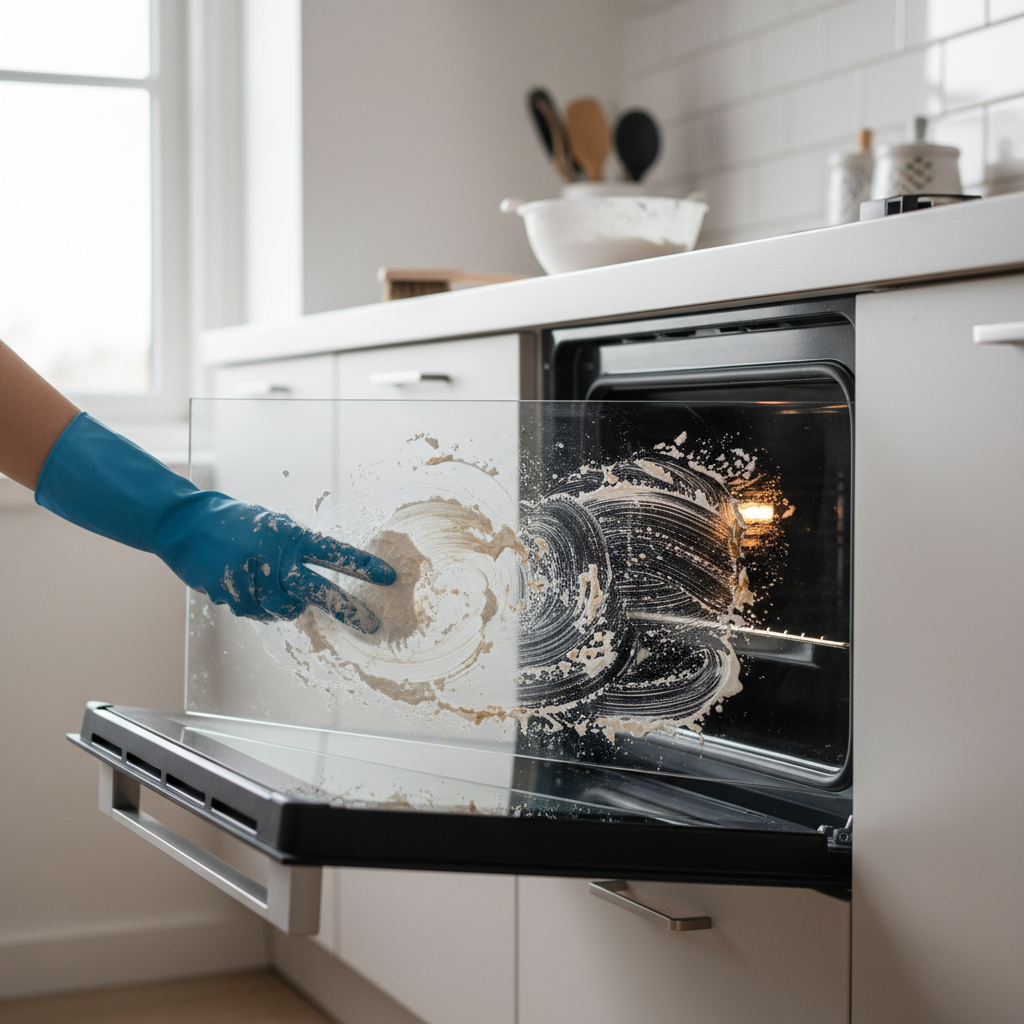
Step 3: Mix and Apply the Baking Soda Paste In the small bowl, mix about 1/2 cup of baking soda with a few tablespoons of water. Adjust the ratio until you have a thick, spreadable paste, similar in consistency to frosting. Don this mixture generously all over the interior surfaces of your oven—the sides, bottom, top, and back. Do not apply the paste to the heating elements or the gas inlet (on a gas oven). Wear gloves for this part, as it can get messy.
Step 4: Let It Dwell The magic happens over time. Close the oven door and let the baking soda paste sit for at least 12 hours, or overnight. The paste will slowly break down the baked-on grease and food, turning it soft and easy to remove.
Step 5: Wipe Out the Grime After the dwell time, put on your gloves again. Take a damp microfiber cloth and begin wiping out the paste. You’ll find that most of the grime comes away with it. For stubborn, caked-on spots, use a plastic scraper or a non-scratch scrub pad to gently dislodge the debris.
Step 6: The Vinegar Spray You will likely see a white, chalky residue left behind from the baking soda. Fill your spray bottle with a 50/50 solution of white vinegar and water. Lightly spray this solution on the residue. The vinegar (an acid) will react with the baking soda (a base), creating a gentle, bubbling foam. This reaction helps lift the final bits of residue.
Step 7: Final Rinse and Dry With a clean, damp cloth, wipe out the entire oven cavity one more time, rinsing your cloth frequently in clean water. The goal is to remove all traces of both the baking soda and vinegar. Finish by drying the interior thoroughly with a dry cloth.
Step 8: Clean the Oven Racks While the paste is dwelling in the oven, you can clean the racks. The easiest method is to lay them in an empty bathtub on old towels (to prevent scratching the tub). Sprinkle them generously with baking soda, then pour white vinegar over them. Once the foaming stops, fill the tub with hot water until the racks are submerged and let them soak for a few hours. Use a stiff brush to scrub away any remaining grime, then rinse and dry them completely.
Step 9: Reassemble and Admire Place the clean, dry racks back inside your sparkling clean oven. Turn the power back on at the breaker. Your oven is now clean, safe, and ready for your next culinary creation.
Common Causes of a Dirty Oven
- Spillovers: The most common culprit. Sauces, cheeses, and pie fillings that bubble over the side of a dish.
- Grease Splatter: Roasting meats, especially at high temperatures, creates a fine mist of grease that coats the oven's interior.
- Sugary Bakes: Sugars caramelize and then quickly carbonize, creating a notoriously tough-to-clean, blackened mess.
- Infrequent Wiping: Small splatters that aren’t wiped up when the oven is cool will bake on further with each subsequent use, making them much harder to remove later.
Common Mistakes to Avoid
- Running Self-Clean Before a Holiday: This is the most frequent horror story. Homeowners run the cycle a day or two before Thanksgiving or Christmas, only to have the control board fail, leaving them without an oven for the big event.
- Leaving Racks Inside: Standard oven racks are not designed to withstand self-clean temperatures. They can warp, and their chrome or nickel finish can be damaged, making them difficult to slide in and out.
- Using Commercial Oven Cleaners: Many aerosol oven cleaners contain extremely caustic chemicals like lye (sodium hydroxide). While effective, they produce noxious fumes that can be dangerous to inhale and can damage the oven's finish or even the heating elements if misapplied.
- Ignoring a Failed Self-Clean Cycle: If you run the cycle and the oven won't unlock or turn back on afterward, do not attempt to force the door or diagnose the electronics yourself. You are dealing with a high-voltage appliance.
Cost & Time Breakdown
| Task | Estimated Cost (DIY) | Estimated Cost (Professional) | Time Commitment |
|---|---|---|---|
| Manual Oven Cleaning | $1 - $3 (materials) | $75 - $150 | 30 min active, 12 hrs passive |
| Control Board Replacement | N/A | $200 - $600+ | 1-2 hours (for a pro) |
As you can see, the cost of a few preventative minutes and some baking soda pales in comparison to a professional repair call to replace a fried control board.
Tips & Prevention
- Clean Spills Immediately: Once the oven has cooled, wipe up any spills or splatters with a damp cloth. It’s exponentially easier to clean fresh grime than baked-on carbon.
- Use a Catch Pan: Place a large baking sheet or a dedicated oven liner on the lowest rack to catch any drips (never place it directly on the oven floor, as this can disrupt airflow and cause uneven baking).
- Cook in Larger Dishes: Use baking dishes and pans that have plenty of extra room to prevent bubbling over.
- Use Roasting Bags: For meats and poultry, using a roasting bag can dramatically cut down on the amount of grease that splatters onto your oven walls.
- Schedule Regular, Light Cleans: A quick wipe-down with the baking soda method once a month is much easier than a major deep clean once a year.
When to Call a Professional
While the manual cleaning process is a perfect DIY project, you must call a professional appliance technician if you experience any of the following:
- Your oven is completely dead after running the oven self-clean cycle.
- The oven door remains locked long after the cycle has finished and the oven has cooled.
- You see an error code on the oven's display.
- The oven functions sporadically or doesn't heat correctly after a self-clean attempt.
Pro Callout: Never attempt to replace an electronic control board yourself. It involves working with the appliance's high-voltage wiring and can be extremely dangerous. A licensed technician has the diagnostic tools to confirm the board is the issue and the expertise to install a new one safely. An improper installation could cause a short circuit, create a fire hazard, or permanently damage your new, expensive control board.
What should this project cost?
Enter your project details for a realistic cost range before you call anyone.
Cost depends heavily on which system turns out to be the source.
- Regional adjustment
- National average
- Labor share (typical)
- ~$1,620
- Quotes to collect
- 3 written estimates
Educational estimate based on national averages — not a binding quote. Always confirm with written local estimates.
Recommended for DIYers & woodworkers
Sponsored
The Top 20 Tools for Workshops of Any Budget
No stationary machines or power tools required — plus 3 fundamental tools that can't be bought at any price.
Get the free guide
Ted's Woodworking — The #1 Woodworking Resource
Detailed instructions, dimensioned drawings, materials & cutting lists, and 3D schematics for every skill level.
See the plansSponsored: links above are affiliate links. FixlyGuide may earn a commission on qualifying purchases — at no extra cost to you.
Frequently asked questions
Is it ever safe to use the self-clean feature?+
While many people use the feature without issue, the risk is always present and increases with the age of the oven. The potential cost of failure is so high ($200-$600+) compared to the low cost and safety of manual cleaning that we strongly recommend avoiding the self-clean cycle entirely.
Can I use chemical oven cleaner instead of baking soda?+
You can, but we don't recommend it. Most commercial oven cleaners contain harsh chemicals that produce strong, unpleasant fumes and require excellent ventilation. The baking soda and vinegar method is non-toxic, fume-free, and surprisingly effective.
How often should I manually clean my oven?+
A deep clean using the 12-hour paste method is needed only once or twice a year for most households. However, you can prevent the need for a deep clean by wiping up spills as they happen and doing a quick 15-minute wipe-down with a lighter baking soda solution every month.
What if my oven starts to smell like burning plastic during self-clean?+
If you ever smell burning plastic or witness smoke coming from the control panel area, cancel the self-clean cycle immediately. Turn the oven off at the breaker and call a professional appliance technician. This is a sign that the electronics are overheating and potentially melting.
Discussion
Loading comments…