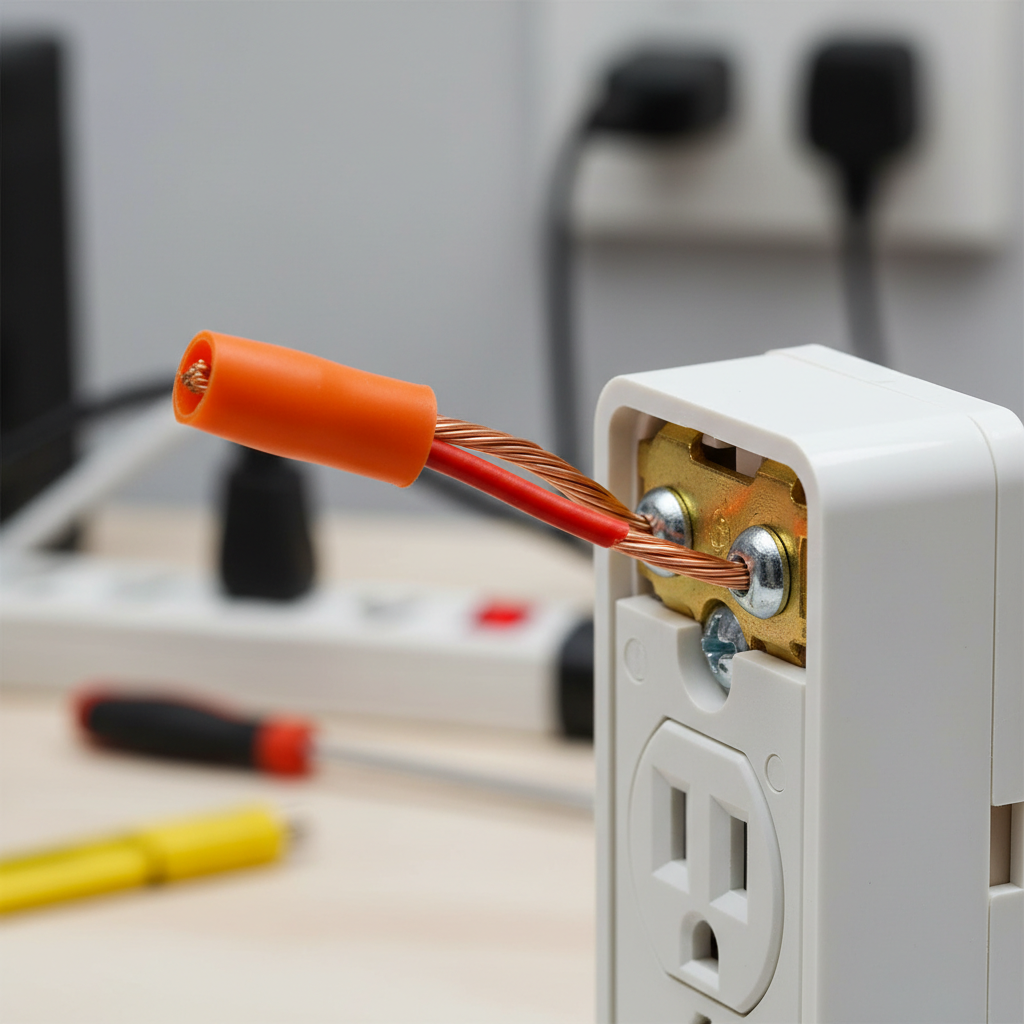
- Backstabbed Receptacles: The number one cause. The weak, high-resistance connection is a constant source of electrical noise that mimics a true arc fault.
- Worn or Aging Appliances: Older appliances with brushed motors (like vacuums, kitchen mixers, and power tools) can create small sparks during normal operation that are significant enough to trip a sensitive AFCI.
- Loose Screw-Terminal Connections: Even outlets wired to the side screws can cause trips if the screws were not properly tightened or have loosened over time due to vibration.
- Staple Driven Too Tight: If a Romex cable was stapled too tightly to a stud during construction, it can compress the wires, change the electrical characteristics, and lead to AFCI trips.
- Shared Neutrals: In some older wiring schemes, two different circuits might improperly share a single neutral wire. AFCIs cannot function correctly in this scenario.
Electrical · Breaker keeps tripping
| Project category | Electrical |
|---|---|
| Problem type | Breaker keeps tripping |
| Trade required | Electrical |
| Urgency | Urgent — within days |
| Safety risk | High safety risk |
| DIY suitability | Pro recommended |
| Cost category | Low cost |
| Typical timeline | Diagnosis in a single visit |
| Contractor type | Licensed electrician |
Repair option
Isolate the load, then repair the fault or replace the breaker.
Replacement option
New dedicated circuit when the load simply exceeds what the circuit was built for.
Common causes
- Genuine overload on a shared circuit
- Ground fault from moisture in an exterior box
- Failing breaker or a damaged appliance cord
Relevant tools:diy or hire a prodiy difficulty
Published June 5, 2026Last updated August 17, 2026
Tools & materials you'll need
Affiliate links- AmazonNon-Contact Voltage Tester1 · Crucial for verifying power is off.
- AmazonLineman's Pliers1 · For twisting wires together securely.
- AmazonWire Strippers1 · Sized for 12/14 gauge wire.
- AmazonScrewdriver Set1 · Phillips and flathead.
- AmazonOutlet Tester1 · For verifying correct wiring after installation.
As an Amazon Associate FixlyGuide earns from qualifying purchases — at no extra cost to you. Prices and availability are accurate as of publication and subject to change.
Quick Answer
Pigtailing outlets involves connecting incoming power, the outlet, and downstream wires with a short jumper wire and a wire nut. This creates a more secure, lower-resistance connection than "backstabbing," drastically reducing the tiny, harmless voltage fluctuations that fool sensitive Arc-Fault Circuit Interrupter (AFCI) breakers into nuisance tripping.
The Problem
You press the vacuum cleaner switch, and click—the circuit breaker trips, plunging the room into darkness. You reset it, but it happens again. This frustrating scenario is a modern nuisance for homeowners with Arc-Fault Circuit Interrupter (AFCI) breakers, which have been required by the National Electrical Code (NEC) in bedrooms since 2002 and most living spaces since 2008. These breakers are designed to detect and stop dangerous electrical arcs, a major cause of house fires. However, their extreme sensitivity often leads to "nuisance tripping" from perfectly safe devices. The culprit isn't always a faulty appliance; more often, it’s a high-resistance, unstable connection hidden right inside your walls, specifically at the electrical outlets.
The most common, builder-grade method for wiring outlets is called "daisy-chaining" using the push-in terminals on the back of the device—a technique known derisively by electricians as "backstabbing." All the current for the entire downstream circuit flows through the tiny, spring-loaded contacts inside that one outlet. Over time, these weak connections can loosen, oxidize, and create tiny, intermittent power fluctuations. While not dangerous arcs, these fluctuations mimic the electrical signature that AFCI breakers are designed to detect, leading to frustrating and unnecessary trips. This means your vacuum cleaner, treadmill, or even a simple phone charger can trigger a shutdown, not because they are faulty, but because they draw just enough current to expose the weakness in your home's wiring.
How It Works
To understand why pigtailing is so effective, you first need to understand how an AFCI breaker and a backstabbed outlet work. An AFCI breaker contains sophisticated electronic-s that constantly monitor the sine wave of the AC power. It’s looking for specific high-frequency noise patterns (typically in the 100 MHz range) that are characteristic of a dangerous parallel or series arc—the kind that happens when a wire is frayed or a connection is catastrophically failing. These are the arcs that can ignite wood framing or insulation.
A backstabbed outlet relies on small, spring-metal clips to hold the wire. When you push a 14-gauge solid copper wire into the hole, the clip bites into it. The problem is threefold. First, the contact area is minuscule, creating a point of relatively high resistance compared to a securely wrapped screw terminal. Second, these clips lose their tension over the years due to thermal cycling (heating up as current flows, cooling down when it stops), vibration, and oxidation. Third, and most critically for AFCI performance, the entire load of every outlet after it in the circuit runs through this one weak point. If you have five outlets on a circuit, the first outlet might be carrying the current for the other four, plus whatever is plugged into it.
This is where tiny, harmless micro-arcing occurs. As the connection degrades, the current has to "jump" across microscopic air gaps or layers of oxidation. This doesn’t produce enough heat to be a fire hazard, but it creates just enough high-frequency electrical "noise" to look like a dangerous arc to the sensitive AFCI. When you plug in a motor-driven appliance like a vacuum, the initial inrush of current amplifies these imperfections, pushing the signal over the AFCI’s trip threshold.
Pigtailing solves this problem by completely bypassing the outlet's internal contacts as a point of continuity for the rest of the circuit. By gathering the "hot" wires (black), "neutral" wires (white), and "ground" wires (bare copper) from the incoming and outgoing cables into three separate bundles, you create a solid, direct, low-resistance path using a wire nut. A short "pigtail" wire is then added to each bundle to connect to the outlet itself. Now, the outlet is just a spur off the main circuit. The current flowing to downstream outlets no longer passes through the receptacle’s weak internal tabs. It flows through the robust connection inside the wire nut. The result is a much cleaner, more stable power signal. The micro-arcing disappears, and the AFCI breaker no longer sees the false signature of a dangerous arc. This simple mechanical change dramatically improves the electrical stability of the circuit, virtually eliminating nuisance trips from motor loads and electronic devices.
Step-by-Step Fix
SAFETY FIRST: This project involves working with live electricity. Before you begin, go to your home’s main electrical panel and turn off the breaker for the circuit you will be working on. Use a non-contact voltage tester to confirm there is no power at the outlet before touching any wires.
-
Power Off and Verify — At your circuit breaker panel, switch the correct breaker to the "OFF" position. A piece of red tape over the breaker is a good visual reminder not to turn it back on. At the outlet, plug in a lamp you know works or use a non-contact voltage tester to double-check that the power is completely off. Test all parts of the outlet.
-
Unscrew and Remove the Outlet — Use a flathead or Phillips screwdriver to remove the faceplate screw and the faceplate itself. Then, unscrew the top and bottom mounting screws that hold the outlet (the "yoke") to the electrical box. Gently pull the outlet straight out from the box.
-
Inspect the Existing Wiring — Observe how the wires are connected. In a "backstabbed" setup, you will see the black and white wires pushed into small holes on the back of the outlet. Note if there is one or two sets of wires entering the box. If there are two (one for power in, one for power out), you need to pigtail.
-
Release the Backstabbed Wires — To release the wires, look for a small rectangular slot next to each push-in hole. Insert a small flathead screwdriver or a wire stripper’s tip into this slot and push firmly while pulling on the wire. The wire should come free. Do this for all connected wires.
-
Assess and Prepare the Wires — Examine the ends of the copper wires. The stripped ends are often nicked, bent, or scored from being held by the spring clip. It’s best to get a fresh connection. Use wire strippers to snip off the old ends and strip approximately 3/4-inch of new insulation from each wire.
-
Cut Your Pigtails — From your spool of 14-gauge or 12-gauge solid copper wire (match the gauge already in the box), cut three 6-inch sections: one black, one white, and one bare copper or green. Strip 3/4-inch of insulation from both ends of the black and white pigtails, and from one end of the ground pigtail.
-
Group and Twist the Wires — Group the wires by color. Take the black wire from the "power in" cable, the black wire from the "power out" cable, and your new black pigtail wire. Hold the ends together so the insulation is aligned. Using lineman's pliers, twist the copper ends together clockwise at least 3-4 times to create a mechanically secure connection.
-
Cap the Connection — Screw a new, properly sized wire nut onto the twisted copper wires. Continue twisting until it is snug and no bare copper is exposed below the skirt of the nut. A good rule of thumb is to twist until the wires outside the nut begin to twist together. Give it a firm tug to ensure it’s secure. Repeat this exact process for the white (neutral) wires and the bare copper (ground) wires.
-
Connect the Pigtails to the New Outlet — Now, take the free end of your black pigtail and wrap it clockwise around one of the brass-colored screw terminals on the new outlet. Tighten the screw firmly. Connect the white pigtail to one of the silver-colored screw terminals. Connect the ground pigtail to the green ground screw.
-
Fold and Reinstall the Outlet — Carefully fold the wires back into the electrical box in an accordion or "S" shape. This prevents stress on the connections. Push the new outlet into place, install the mounting screws, and attach the faceplate.
-
Power Up and Test — Go back to your breaker panel, remove your tape, and switch the breaker back to the "ON" position. Use an outlet tester to confirm the outlet is wired correctly (it will show correct polarity and ground).
-
Test the Load — Plug in the appliance (e.g., the vacuum cleaner) that was previously causing the nuisance trip. If the pigtailing was successful, the breaker should hold without issue.
Common Causes
- Backstabbed Receptacles: The number one cause. The weak, high-resistance connection is a constant source of electrical noise that mimics a true arc fault.
- Worn or Aging Appliances: Older appliances with brushed motors (like vacuums, kitchen mixers, and power tools) can create small sparks during normal operation that are significant enough to trip a sensitive AFCI.
- Loose Screw-Terminal Connections: Even outlets wired to the side screws can cause trips if the screws were not properly tightened or have loosened over time due to vibration.
- Staple Driven Too Tight: If a Romex cable was stapled too tightly to a stud during construction, it can compress the wires, change the electrical characteristics, and lead to AFCI trips.
- Shared Neutrals: In some older wiring schemes, two different circuits might improperly share a single neutral wire. AFCIs cannot function correctly in this scenario.
Common Mistakes
- Not Turning Off the Breaker: The most dangerous mistake. Always verify the power is off with a tester before touching a single wire.
- Using the Wrong Wire Gauge: Using a 14-gauge pigtail on a 20-amp circuit (which requires 12-gauge wire) is a serious code violation and fire hazard.
- Re-using Old Wire Nuts: Wire nuts are single-use items. The metal coil inside can become fatigued. Always use new ones for a reliable connection.
- Leaving Connections Loose: Both wire nut connections and screw terminal connections must be mechanically and electrically solid. A loose pigtail connection defeats the entire purpose.
- Stripping Too Much/Too Little Insulation: Exposing too much bare wire outside the wire nut or under the screw head is a shock and short-circuit hazard. Too little stripping results in a poor, high-resistance connection.
- Ignoring a Persistent Trip: If pigtailing one outlet doesn't solve the problem, the issue could be at another outlet on the circuit or be a genuine, dangerous arc fault. Do not ignore it; investigate further or call an electrician.
Cost & Time Breakdown
| Task | DIY Cost | Pro Cost | Time |
|---|---|---|---|
| Replace a single backstabbed outlet with a pigtail | $5 - $15 | $125 - $200 | 20-30 minutes |
| Replace 5 outlets on a single circuit | $25 - $50 | $300 - $500 | 1.5 - 2.5 hours |
| Materials (Spec-grade outlet, wire, nuts) | $4 per outlet | Included in labor | N/A |
| Electrician's Diagnostic Fee | N/A | $75 - $150 | N/A |
| Replacing a faulty AFCI Breaker | $50 - $70 | $150 - $250 | 30 minutes |
Tips & Prevention
- Use "Spec-Grade" Outlets: When replacing outlets, spend the extra dollar for "Specification Grade" or "Commercial Grade" receptacles. They have much better internal components and stronger screw terminals than cheap builder-grade versions.
- Torque Your Screws: When connecting the pigtail to the new outlet, make sure the screw is tight. A good rule of thumb is "farmer tight." Some electricians even use special torque screwdrivers set to the manufacturer's spec (usually 12-14 inch-pounds).
- Address the Whole Circuit: If one outlet is backstabbed, they probably all are. For best results, plan to pigtail every receptacle on the problematic circuit. Start with the one closest to the breaker panel and work your way to the end.
- Check for Downstream Loads: Before you start, unplug everything from the entire circuit. This ensures that an appliance fault isn't the real cause.
- Don't Overcrowd the Box: If the electrical box is already packed with wires, adding pigtails can make it even tighter. Make sure you can fold the wires back in without cramming them, which can damage connections. You may need to install a deeper box.
When to Call a Professional
While pigtailing an outlet is a manageable DIY task for a careful homeowner, there are clear signs you should call a licensed electrician. If you open the outlet box and see signs of melting, scorching, or charring on the wires or the old outlet, stop immediately. This indicates a more serious issue than a simple loose connection. If the wiring is aluminum instead of copper, do not touch it; aluminum wiring requires special techniques and connectors to be safe. If you pigtail all the outlets on a circuit and the AFCI breaker continues to trip, it’s time for a professional diagnosis. An electrician has advanced tools like a megohmmeter and a circuit tracer to identify the exact location of a fault, whether it’s a nail through a wire in the wall or a defect in the breaker itself.
Your seasonal maintenance checklist
The small jobs that prevent the expensive repairs. Tick them off — progress saves on this device.
Free, no signup. Skip anything that requires roof access or working near live electrical.
What should this project cost?
Enter your project details for a realistic cost range before you call anyone.
Outlet and switch work usually $150–$400; panel upgrades commonly $1,800–$4,200.
- Regional adjustment
- National average
- Labor share (typical)
- ~$709
- Quotes to collect
- 3 written estimates
Educational estimate based on national averages — not a binding quote. Always confirm with written local estimates.
Fixly Project Decision Box
- DIY difficulty
- Professional Recommended
- Estimated time
- Diagnosis 1–2 hours
- Cost level
- Moderate
Main tools / materials
- Non-contact voltage tester
- Outlet tester
- Flashlight
When to stop and call a pro
- Burning smell, scorch marks, or a warm outlet or switch plate
- A breaker that trips again right after being reset
- Any work inside the service panel
- Aluminum wiring or cloth-insulated wiring
Need professional help?
Talk to a Licensed ElectricianStay ahead of the next repair
Turn this guide into a schedule you will actually follow.
- Is this a safe DIY job?Check permits, tools, and risk before you start the steps below.Open
- Estimate this projectGet a cost range for your scope and ZIP before you call anyone.Open
Free, no signup required. Estimates are educational guidance, not a quote or an inspection.
Get the print-ready PDF of this guide
A clean, ad-free, printable version you can keep on your phone or pin to the workshop wall. Free with a FixlyGuide account.
- Print-optimized layout
- Tools, materials & every step included
- Saved to your account
Frequently asked questions
What is the difference between backstabbing and pigtailing an outlet?+
Backstabbing uses push-in terminals on the back of an outlet to pass power through to the next outlet, creating a weak link. Pigtailing connects all wires in a wire nut for a secure connection and uses a short jumper wire (a pigtail) to connect the outlet, making the circuit more reliable.
Is backstabbing outlets against the electrical code?+
No, it is not currently against the National Electrical Code (NEC) as long as the outlet is rated for it. However, it is widely considered bad practice by electricians due to its high failure rate and tendency to cause problems like AFCI nuisance tripping.
Can I pigtail a GFCI outlet?+
Yes, but you must be careful. A GFCI outlet has a "LINE" side (power in) and a "LOAD" side (which provides protection to downstream outlets). You should pigtail the incoming power wires to the "LINE" terminals only. If you connect the downstream wires to the "LOAD" terminals, they will be protected. If you pigtail all the wires together, the downstream outlets will NOT have GFCI protection.
How do I know what wire gauge to use for pigtails?+
You must match the gauge of the existing wire in the wall. Most residential lighting and outlet circuits are 15-amp and use 14-gauge wire. Kitchens, laundry rooms, and other 20-amp circuits use thicker 12-gauge wire. The gauge is often printed on the wire's sheathing.

Discussion
Loading comments…