- Moisture Intrusion: The most frequent cause, especially for outdoor, garage, and basement GFCIs. Rain, humidity, condensation, or even a plumbing leak can introduce enough moisture to create a path to ground.
- Worn-Out GFCI: GFCIs are electronic devices with a finite lifespan, typically around 10 to 15 years. Internal components can fail, making them overly sensitive or completely inoperable.
- Faulty Appliance: An appliance with a damaged power cord, worn insulation, or an internal electrical fault can leak current to its metal casing, triggering the GFCI as soon as it's plugged in or turned on.
- Ground Fault in Downstream Wiring: A staple piercing a wire, a screw making contact with a wire inside a wall, or a failing downstream outlet can all cause the protecting GFCI to trip.
- Dust and Debris: In workshops, garages, or older homes, a buildup of conductive dust (like drywall or metallic dust) inside the outlet box can create a small electrical leak.
Electrical · Panel or service upgrade
| Project category | Electrical |
|---|---|
| Problem type | Panel or service upgrade |
| Trade required | Electrical |
| Urgency | Planned project |
| Safety risk | High safety risk |
| DIY suitability | Licensed pro only |
| Cost category | High cost |
| Typical timeline | Permit plus utility scheduling, commonly 2–6 weeks |
| Contractor type | Licensed electrician |
Repair option
Add a subpanel when the main service is adequate.
Replacement option
Full service upgrade with utility coordination and permits.
Common causes
- Obsolete or recalled panel brands
- Service capacity too small for added loads
- No room for required AFCI/GFCI breakers
Relevant tools:project cost estimatorcompare quotes
Published June 4, 2026Last updated August 17, 2026
Tools & materials you'll need
Affiliate links- AmazonNon-Contact Voltage Tester1 · For verifying power is off before working.
- AmazonGFCI Outlet Tester1 · A plug-in device that checks wiring and tests the trip function.
- Amazon4-in-1 Screwdriver1 · For removing the faceplate and outlet screws.
- AmazonWire Strippers1 · May be needed if wire ends are damaged.
As an Amazon Associate FixlyGuide earns from qualifying purchases — at no extra cost to you. Prices and availability are accurate as of publication and subject to change.
Quick Answer
A Ground Fault Circuit Interrupter (GFCI) outlet doesn't trip for "no reason"—it trips because it has detected a ground fault, which is a dangerous leakage of electrical current. Even minute fluctuations, as small as 4-6 milliamps, will cause a trip to prevent electric shock. The most common culprits behind these phantom trips are moisture intrusion into the outlet box, accumulated dust and debris, an appliance with a faulty cord or internal wiring, or simply a worn-out GFCI device that has reached the end of its service life (typically 10-15 years). The solution involves a systematic process of elimination: testing the GFCI itself, inspecting the connected appliances, and examining the downstream circuit if the GFCI protects other outlets.
The Problem
You plug in the toaster, and click—the little button on the kitchen outlet pops out, shutting off the power. Or perhaps the bathroom outlet trips every time you use a hairdryer. Maybe it’s an outdoor or garage GFCI that seems to trip randomly, even when nothing is plugged in. This phenomenon, often called "nuisance tripping" or "phantom tripping," is more than just an annoyance. It’s a signal from a critical safety device that something is wrong with your electrical circuit. A GFCI that trips is doing its job, but when the cause isn't obvious, it points to a hidden, and potentially hazardous, electrical issue. Ignoring a frequently tripping GFCI outlet is a significant safety risk, as it indicates a potential for electric shock. The challenge is that the source of the ground fault isn't always the appliance you’re using; it can be the outlet itself, another outlet on the same circuit, or even moisture that has infiltrated the electrical box.
How It Works
A standard circuit breaker protects against overcurrents (too much power being drawn), but a GFCI protects people. It works by constantly monitoring the flow of electricity in a circuit. Inside every GFCI outlet is a small current transformer that measures the amperage flowing out on the "hot" wire and compares it to the amperage returning on the "neutral" wire. In a perfect world, these two currents are exactly equal. However, if there's a "ground fault"—meaning some of the electricity is leaking out of the circuit and finding an alternative path to the ground (like through a person, a puddle of water, or a faulty appliance component)—the GFCI detects this imbalance. When the discrepancy reaches a threshold of just 4 to 6 milliamps (a tiny fraction of the 15 or 20 amps the circuit is designed to handle), the GFCI’s internal switch trips in as little as 1/40th of a second. This action interrupts the power supply fast enough to prevent a serious or fatal electric shock. This is why GFCIs are required by the National Electrical Code (NEC) in "wet" locations like kitchens, bathrooms, garages, crawl spaces, and outdoor areas.
Step-by-Step Fix
SAFETY FIRST: Before beginning any diagnostic work, turn off the power to the GFCI outlet at your home's main electrical panel. Use a voltage tester to confirm there is no power at the outlet before touching any wires.
1. The Reset Test — First, let's establish a baseline. With the circuit breaker on, press the "RESET" button firmly on the GFCI outlet. It should click and stay in. If it immediately trips again with nothing plugged in, the problem is likely the GFCI itself or the downstream wiring it protects. If it stays reset, proceed to the next step.
2. The Appliance Isolation Test — Unplug every appliance from the GFCI outlet and any other outlets that may be on the same circuit (these are called "downstream" outlets and will lose power when the GFCI trips). Reset the GFCI. If it holds, the problem lies with one of the appliances. Plug them in one by one until the GFCI trips. The last appliance you plugged in is the culprit. Examine its cord for damage and consider that it may have an internal short.
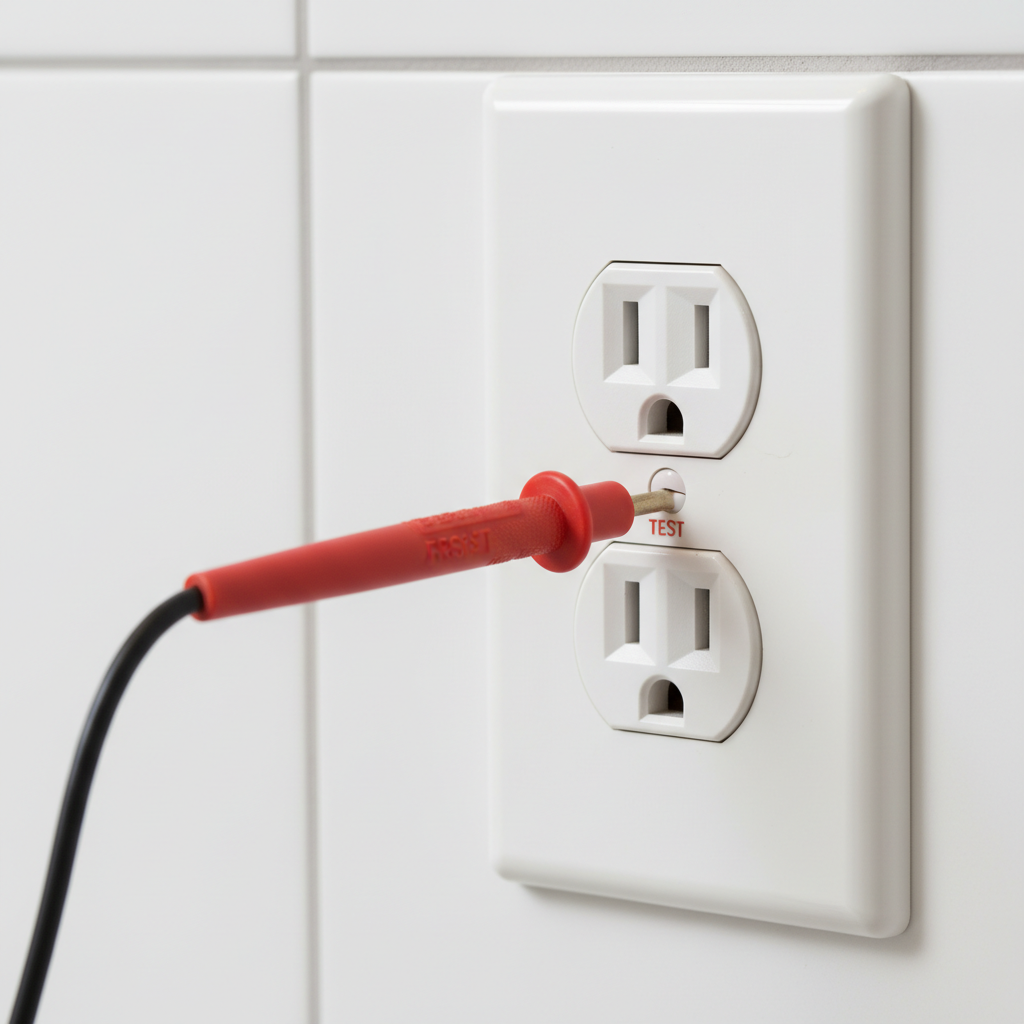
3. The Self-Test Diagnostic — Modern GFCIs have a built-in self-test feature. With the power on and the GFCI reset, press the "TEST" button. The "RESET" button should pop out with an audible click, cutting power. Now, press "RESET." It should restore power. If the "TEST" button does not trip the outlet, or if the "RESET" button won’t re-engage after the test, the GFCI device is faulty and must be replaced.
4. Visual Inspection of the Outlet — Turn off the power at the breaker. Use a screwdriver to remove the faceplate and then the screws holding the GFCI outlet in its box. Carefully pull the outlet out without disconnecting the wires. Look for any signs of moisture, rust, corrosion on the screw terminals, or an accumulation of dust and dirt. Any of these can create a micro-path for current to leak, causing a trip. Clean the inside of the box with a dry cloth or vacuum.
5. Checking for Loose Connections — With the outlet still pulled out (and power confirmed off), gently tug on each wire connected to the screw terminals. Loose connections can cause arcing and heat, which can sometimes lead to a GFCI trip. If you find a loose wire, use a screwdriver to tighten the terminal screw firmly. Ensure no stray wire strands are touching the side of the box or another terminal.
6. The Downstream Circuit Test — If the GFCI trips even with nothing plugged in (Step 2), and it passed the self-test (Step 3), the fault may be in the wiring downstream from the GFCI. This is more advanced. Turn off the breaker. Disconnect the wires from the "LOAD" terminals on the back of the GFCI. Cap these wires with wire nuts. Turn the breaker back on and reset the GFCI. If it now holds, the ground fault is somewhere in the wiring or another outlet connected to this GFCI. If it still trips, the GFCI itself is almost certainly bad.
7. Using a GFCI Outlet Tester — For a more definitive test, purchase a dedicated GFCI outlet tester ($10-$15). Plug it into the outlet. Its indicator lights will tell you if the outlet is wired correctly (e.g., correct hot/neutral/ground, no open ground, etc.). Press the test button on the tester; it should trip the GFCI. This confirms the trip function is working, which can help differentiate a faulty GFCI from a genuine ground fault.
8. Analyzing Environmental Factors — Consider external influences. For outdoor or garage GFCIs, heavy rain or snow can introduce moisture into the outlet box or cover, causing trips. In-use weatherproof covers are essential for outlets exposed to the elements. High humidity in a bathroom can also be a factor, causing condensation inside the electrical box over time.
9. Replacing the GFCI Outlet — If all tests point to a faulty or worn-out device, replacement is the only solution. Turn off the power at the breaker. Remove the old GFCI, taking careful note of which wires connect to the "LINE" (incoming power) and "LOAD" (outgoing power) terminals. Install the new GFCI, matching the wire connections exactly. A 15-amp GFCI costs about $15-$25.
Common Causes
- Moisture Intrusion: The most frequent cause, especially for outdoor, garage, and basement GFCIs. Rain, humidity, condensation, or even a plumbing leak can introduce enough moisture to create a path to ground.
- Worn-Out GFCI: GFCIs are electronic devices with a finite lifespan, typically around 10 to 15 years. Internal components can fail, making them overly sensitive or completely inoperable.
- Faulty Appliance: An appliance with a damaged power cord, worn insulation, or an internal electrical fault can leak current to its metal casing, triggering the GFCI as soon as it's plugged in or turned on.
- Ground Fault in Downstream Wiring: A staple piercing a wire, a screw making contact with a wire inside a wall, or a failing downstream outlet can all cause the protecting GFCI to trip.
- Dust and Debris: In workshops, garages, or older homes, a buildup of conductive dust (like drywall or metallic dust) inside the outlet box can create a small electrical leak.
- Shared Neutral Wires: In older homes, sometimes multiple circuits improperly share a single neutral wire. This can create an imbalance that a modern GFCI will interpret as a fault.
Common Mistakes
- Ignoring the Trip: The biggest mistake is assuming the outlet is just "sensitive" and repeatedly resetting it without investigation. A tripping GFCI is a safety warning.
- Replacing a GFCI with a Standard Outlet: This is a dangerous code violation that removes a critical safety feature from a circuit that requires it.
- Confusing LINE and LOAD Terminals: Incorrectly wiring a new GFCI is very common. The "LINE" terminals are for incoming power from the panel; "LOAD" terminals are for protecting downstream outlets. Reversing them will result in the GFCI not providing protection to the downstream outlets.
- Over-tightening Terminal Screws: This can damage the wire and the outlet, creating a new potential failure point. Screws should be snug, not forcefully cranked down.
- Forgetting to Use a Weather-Resistant (WR) GFCI Outdoors: Standard GFCIs are not built to withstand UV light, extreme temperatures, and moisture. WR-rated GFCIs are required for these locations.
- Resetting Without Unplugging: Failing to unplug all devices from the circuit before diagnosing makes it impossible to know if the fault is in an appliance or the circuit itself.
Cost & Time Breakdown
| Task | DIY Cost | Pro Cost | Time |
|---|---|---|---|
| GFCI Outlet Tester | $10 - $15 | N/A | 5 minutes |
| Replace a single GFCI Outlet | $18 - $30 (for the outlet) | $125 - $200 | 20-30 minutes |
| Diagnose Appliance Fault | $0 | $75 - $150 (service call) | 15-45 minutes |
| Trace & Repair Downstream Fault | $5 (for wire nuts/tape) | $200 - $450+ | 1-4 hours |
| Install Weatherproof Cover | $15 - $25 | $100 - $150 | 15 minutes |
Tips & Prevention
- Test Monthly: Press the "TEST" and "RESET" buttons on every GFCI in your home once a month to ensure they are functioning correctly.
- Use Weatherproof Covers: For all outdoor outlets, install "in-use" weatherproof covers that protect the outlet even when a cord is plugged in.
- Check Appliance Cords: Periodically inspect the power cords of appliances used in GFCI-protected areas, especially kitchen and bathroom gadgets. If a cord is frayed or damaged, discontinue use immediately.
- Don't Overload: While a GFCI doesn’t trip on overload, plugging too many high-power devices into one circuit can strain the system and may exacerbate underlying minor faults.
- Label Your Breakers: A clearly labeled electrical panel saves immense time and frustration, allowing you to quickly de-energize the correct circuit for testing or replacement.
When to Call a Professional
While a confident DIYer can safely test and replace a GFCI outlet, certain situations warrant a call to a licensed electrician. If the GFCI trips immediately, even with nothing plugged into it and the downstream "LOAD" wires disconnected, you may have an issue with the incoming power line. If your diagnostic points to a fault in the downstream wiring within the walls, tracing and fixing this requires professional expertise. Furthermore, if you encounter aluminum wiring, knob-and-tube wiring, or any signs of burning or melting at the outlet, stop immediately and call a pro. An electrician can use advanced tools like a megohmmeter (insulation resistance tester) to definitively identify and locate ground faults in wiring that a simple multimeter cannot find.
What should this project cost?
Enter your project details for a realistic cost range before you call anyone.
Outlet and switch work usually $150–$400; panel upgrades commonly $1,800–$4,200.
- Regional adjustment
- National average
- Labor share (typical)
- ~$709
- Quotes to collect
- 3 written estimates
Educational estimate based on national averages — not a binding quote. Always confirm with written local estimates.
Fixly Project Decision Box
- DIY difficulty
- Professional Recommended
- Estimated time
- Diagnosis 1–2 hours
- Cost level
- Moderate
Main tools / materials
- Non-contact voltage tester
- Outlet tester
- Flashlight
When to stop and call a pro
- Burning smell, scorch marks, or a warm outlet or switch plate
- A breaker that trips again right after being reset
- Any work inside the service panel
- Aluminum wiring or cloth-insulated wiring
Need professional help?
Talk to a Licensed ElectricianFrequently asked questions
Can a bad breaker cause a GFCI to trip?+
It's highly unlikely. A circuit breaker and a GFCI trip for different reasons. A breaker trips from an overcurrent (like a short circuit or overload), while a GFCI trips from a ground fault (current leakage). The GFCI is a much more sensitive device and will almost always trip long before the main breaker detects a problem.
Why does my GFCI trip when it rains?+
This is a classic sign of moisture intrusion. Rainwater is likely getting into the outlet box, either through a worn-out or improper weatherproof cover, or through cracks in the wall plate. This moisture creates an electrical path between the hot wire and the ground, causing a ground fault that trips the GFCI.
Do GFCI outlets go bad?+
Yes, absolutely. GFCIs are electronic safety devices with a limited lifespan, typically 10-15 years. Over time, the internal components can wear out, causing them to become overly sensitive and trip with no actual fault, or worse, fail to trip in a real emergency. This is why monthly testing is crucial.
What's the difference between the LINE and LOAD terminals?+
The LINE terminals are for the wires coming from the electrical panel, supplying power *to* the GFCI. The LOAD terminals are used to extend ground-fault protection *from* the GFCI to other standard outlets further down the circuit. If you are only replacing a single outlet and not protecting others, you will only use the LINE terminals.

Discussion
Loading comments…