- The Secret Culprit Behind Your AC Leaks: Why Most Homeowners Miss This Easy Fix — Discover the often-overlooked reason your AC is leaking water and learn how a simple, inexpensive fix can prevent costly damage and restore…
- The 1 Mistake Homeowners Make When Their AC Drain Clogs (And The $5 Fix) — Discover the most common error homeowners make when tackling a clogged AC drain line and learn a simple, inexpensive solution to prevent co…
- The $7 Secret Why Your AC is Leaking Water (And How to Fix It in 15 Minutes) — A clogged AC drain line is a common culprit for water leaks, but a simple and inexpensive fix can get your system running smoothly again.
- The 5-Minute Trick to Clear Any Shower Drain Clog (Without Nasty Chemicals) — Learn how to quickly and safely clear a shower drain clog using simple tools and techniques, avoiding harsh chemical drain cleaners.
- The 1 Mistake Homeowners Make with a Slow Kitchen Drain (and the Real Fix) — Before you reach for harsh chemicals, learn the right way to fix a slow kitchen sink drain and prevent future clogs.
Plumbing · Clog
| Project category | Plumbing |
|---|---|
| Problem type | Clog |
| Trade required | Plumbing |
| Urgency | Soon — within weeks |
| Safety risk | Low safety risk |
| DIY suitability | DIY friendly |
| Cost category | Low cost |
| Typical timeline | Same-day DIY attempt; pro visit within a day or two |
| Contractor type | Licensed plumber |
Repair option
Plunger, hand auger, or trap cleanout before chemicals.
Replacement option
Line replacement when clogs return in the same spot repeatedly.
Common causes
- Hair and soap buildup in the trap
- Grease cooling in the branch line
- Flushed wipes or foreign objects
Relevant tools:diy difficultydiy or hire a pro
Published August 1, 2026Last updated August 17, 2026
Tools & materials you'll need
Affiliate linksAs an Amazon Associate FixlyGuide earns from qualifying purchases — at no extra cost to you. Prices and availability are accurate as of publication and subject to change.
Quick Answer
Nobody wants a soggy mess around their furnace or, worse, water dripping through their ceiling. If your AC isn’t draining right and you’re seeing water where it doesn’t belong, odds are your condensate drain line’s clogged. Most of the time, it’s just a pileup of gunk—algae, slime, dust, and general crud that turns into a nasty blockage. You can usually knock this out yourself in about an hour with a few basic tools, either by sucking the blockage out with a wet/dry vac or flushing it through. I’ve cleared hundreds of these over the years, and nine times out of ten, it’s a DIY job.
The Problem
You fire up the AC on a hot summer day expecting that cool, dry air, but instead, you get...nothing. Or worse, you spot water pooling around your indoor unit, staining your ceiling, or even spilling out of the condensate pan. That’s the classic fingerprint of a clogged AC drain line. Here’s what’s going on: your air conditioner cools your home and pulls humidity out of the air. That moisture, called condensate, drips into a pan beneath your indoor coil and then runs out through a PVC pipe—your condensate drain line—to a nearby drain or outside. When that line gets packed with slime and debris, the water’s got nowhere to go. It backs up, fills the pan, and then starts hunting for another exit, usually onto your floor or through your ceiling. Not only can that cause real water damage and mold growth, it can also trip a safety switch in your AC unit and shut the whole system down so it doesn’t keep flooding. No cool air until you clear that blockage.
How It Works
Your air conditioning system is basically a giant dehumidifier. As warm, humid air from your home passes over the cold evaporator coil in your indoor unit—usually inside your furnace or air handler—the moisture in the air condenses into liquid water. Think of a cold glass of iced tea on a summer day; the outside gets wet. Same idea. That water drips into a sloped drain pan sitting right under the coil. From there, gravity does the work. The pan ties into a PVC pipe, typically 3/4-inch diameter, and that’s your condensate drain line. This line usually runs downhill, either into a floor drain, a utility sink, or straight out through the wall to the yard. A lot of systems also have a float switch in the condensate pan. Handy little piece right there. If the water level rises too high because of a clog, the float lifts and trips a switch that cuts power to your AC compressor. That keeps the pan from overflowing and wrecking drywall, but it also means your AC stops cooling until you clear the line. Some setups have a P-trap too, just like under your sink, which helps keep conditioned air from escaping and keeps sewer gases—if it drains into a sewer line—from sneaking into the house. Simple system. But once that dark, damp pipe turns into a breeding ground for algae, mold, and sludge, it’s only a matter of time before it chokes off the flow.
Step-by-Step Fix
First thing’s first: Safety. Before you touch anything, kill the power to your AC unit. Go to your thermostat and switch it off, then head to your electrical panel and flip the breaker labeled for your AC or furnace. You don’t want any surprises while you’re working around water and electrical parts.
1. Locate the Drain Line — Find the PVC pipe that’s causing trouble.
Your condensate drain line is usually a 3/4-inch PVC pipe, white or sometimes gray, coming out of your indoor AC unit. This is often the air handler or furnace in your basement, attic, or utility closet. Follow it from the unit; it’ll usually run to a floor drain, a utility sink, or punch through an exterior wall to drain outside. You’ll probably spot a small access point or a T-shaped vent cap on the line, usually covered by a rubber or PVC cap. That’s where you’ll do most of your work.
2. Check the Condensate Pan — See how bad the backup really is.
Look directly under your indoor coil. There’s a metal or plastic pan under there. If it’s full of water, you’ve got a clog, plain and simple. If it’s overflowing, bail out some of that water first. Use old towels or a wet/dry vac to get rid of the standing water before you start. That keeps the mess down and gives you room to work. I pulled a water heater in Frisco last month that had exactly this leak path—looked like a roof problem at first, but nope, it was just a backed-up drain line dumping water where it shouldn’t.
3. Clear the Line with a Wet/Dry Vac — This is often the quickest and most effective method.
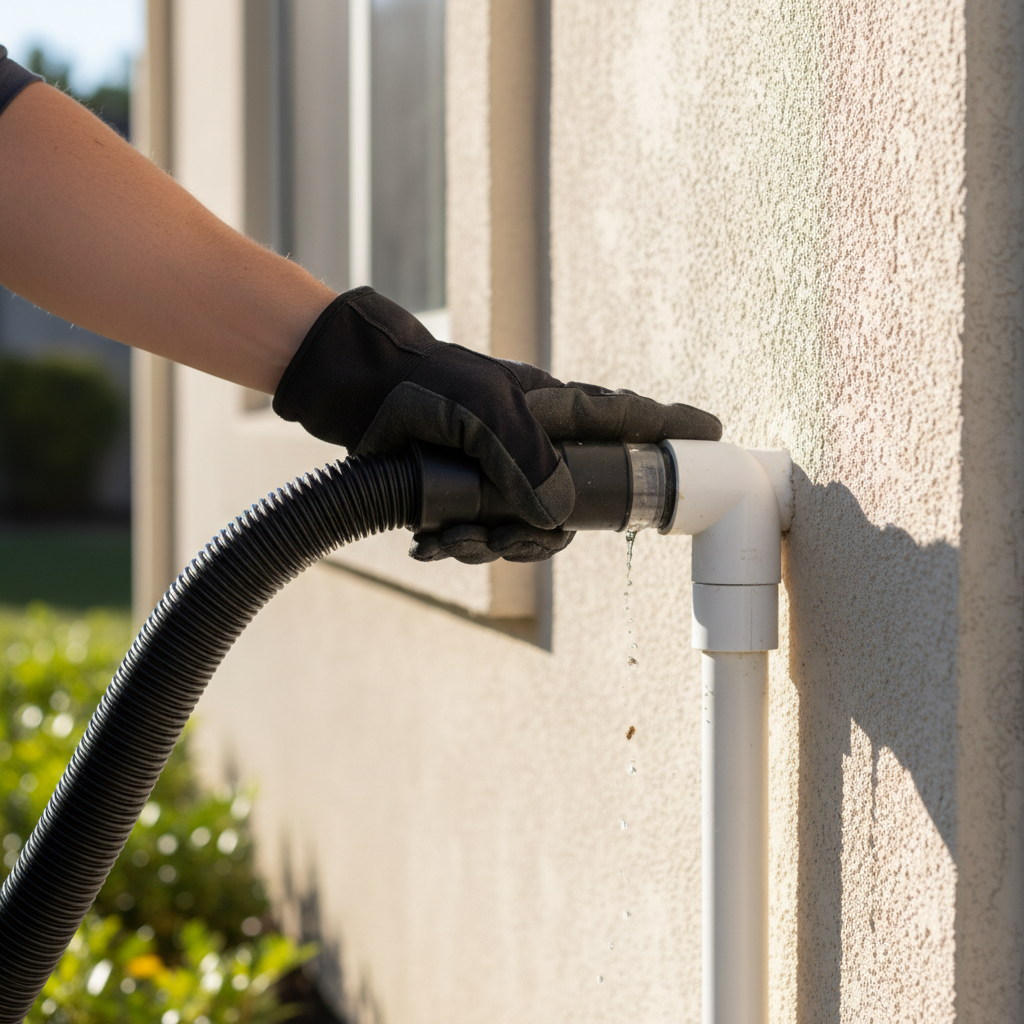
Go to the exterior end of your drain line—where the water’s supposed to come out. Securely attach the hose of your wet/dry vac to the end of the PVC pipe. You may need duct tape or an old rag to make a tight seal around the connection so you get good suction. Turn the vac on high and let it run for 2-3 minutes. You’ll often hear a nice glug or slurp as the clog gets yanked loose. I’ve pulled out thick black sludge, dead bugs, and even small frogs this way. Don’t act shocked when something ugly comes flying out.
4. Flush the Line with Vinegar — A powerful, natural cleaner for persistent clogs.
If the wet/dry vac didn’t fully clear it, or if you don’t have one, this is your next move. Go back to the indoor unit and find that access point on the drain line—the T-shaped vent or cap. Pop the cap off. Slowly pour about 1/4 to 1/2 cup of distilled white vinegar into the opening. Vinegar works because it’s acidic enough to break down algae and mold, but it won’t chew up your PVC pipes. Let it sit for about 30 minutes to an hour. If you’re dealing with a real nasty clog, follow it up with a cup of warm—not hot—water to help push things along.
5. Rinse with Water — Clear out any remaining vinegar and loosened debris.
After the vinegar’s had time to work, pour 1-2 cups of clean water into the same access point. That helps wash out any leftover vinegar and loosened junk. Go check the exterior drain outlet and see if water’s flowing freely now. If it is, you’re back in business.
6. Reassemble and Test — Put everything back and check your work.
Put any caps or plugs you removed back where they belong. Turn the power back on at your electrical panel and switch your thermostat back to 'Cool' mode. Let the AC run for at least 15-20 minutes. Then go back and check the condensate pan—it should be clear and dry, with water actively dripping into it and running out the drain line. You should also see water steadily dripping from the exterior drain outlet. If you don’t see water after a while, or if the pan starts filling again, you might be dealing with a tougher clog or another issue.
Common Causes
- Algae and Slime Buildup: This is the big one, hands down. The dark, damp environment inside the drain line is perfect for all kinds of algae, mold, and bacteria. Over time, they build a slimy film that narrows the pipe and eventually turns into a solid blockage.
- Dust and Debris: Even with decent filters, some dust, lint, pet hair, and other airborne junk can get past your AC filter, mix with the condensate water, and help build the sludge that makes clogs. I’ve seen insulation bits, dryer lint, and small dead insects in these lines.
- Negative Air Pressure: In some systems, especially older ones, the fan creates a slight negative pressure in the plenum. If the condensate drain line isn’t trapped right—with a P-trap—or if the vent cap’s missing, that pressure can actually keep water from draining and basically suck it back toward the pan.
- Improper Slope: The drain line needs a slight downward slope, usually about 1/8 to 1/4 inch per foot, so gravity can do its thing. If the line sags or gets installed without a proper slope, water can pool up, which leaves stagnant spots where algae thrives and debris settles.
- P-Trap Issues: If your system has a P-trap, it can dry out if the AC hasn’t run for a long time, like in winter. A dry P-trap can let air get pulled into the system and mess with drainage. More often, the trap itself turns into a collection spot for sediment.
Common Mistakes
- Ignoring the problem: A lot of homeowners just stick a bucket under the leak and hope it goes away. It won’t. Ignoring a clogged drain can lead to major water damage, mold, and pricey repairs later. Handle it as soon as you see the signs.
- Using harsh chemicals: Drain cleaners made for sinks, like Drano or Liquid Plumber, are a hard no for AC drain lines. Those chemicals can corrode your evaporator coil, damage the PVC pipe, or even hurt internal parts of your AC unit. Stick with vinegar or special AC drain tablets.
- Not checking the outdoor end: You’d be surprised how often I get called out for a drain line “problem” and the clog’s sitting right at the outlet outside, where leaves, dirt, or ants have packed it shut. Crack it open and look before you call it a day.
Related Articles
Keep troubleshooting with these hand-picked guides from FixlyGuide:
- The Secret Culprit Behind Your AC Leaks: Why Most Homeowners Miss This Easy Fix — Discover the often-overlooked reason your AC is leaking water and learn how a simple, inexpensive fix can prevent costly damage and restore…
- The #1 Mistake Homeowners Make When Their AC Drain Clogs (And The $5 Fix) — Discover the most common error homeowners make when tackling a clogged AC drain line and learn a simple, inexpensive solution to prevent co…
- The $7 Secret Why Your AC is Leaking Water (And How to Fix It in 15 Minutes) — A clogged AC drain line is a common culprit for water leaks, but a simple and inexpensive fix can get your system running smoothly again.
- The 5-Minute Trick to Clear Any Shower Drain Clog (Without Nasty Chemicals) — Learn how to quickly and safely clear a shower drain clog using simple tools and techniques, avoiding harsh chemical drain cleaners.
- The #1 Mistake Homeowners Make with a Slow Kitchen Drain (and the Real Fix) — Before you reach for harsh chemicals, learn the right way to fix a slow kitchen sink drain and prevent future clogs.
- The One Reason Your Refrigerator Fails (While the Freezer Doesn't) — If your freezer works but your refrigerator isn't cooling, the most common culprit is a blocked or malfunctioning defrost drain system.
Should you do this yourself?
Answer five quick questions before you start. Safety outranks savings every time.
Your experience with work like this
How high do you have to work?
Does the job involve any of these?
Will it need a permit?
Specialty tools
Free and instant. Educational guidance only — not a quote, inspection, or professional diagnosis.
Estimate your own project cost
National averages are a starting point. Enter your details for a range that fits your house.
HVAC replacement cost
- Equipment$2,200 – $3,800
- Installation labor$1,200 – $2,500
Always insist on a Manual J load calculation — sq-ft sizing is only a rough check. Federal heat-pump rebates may reduce cost significantly.
Educational estimate only — always confirm with written local bids.
What should this project cost?
Enter your project details for a realistic cost range before you call anyone.
Common repairs run $150–$650; repipes and water-heater replacements reach $1,500–$4,500.
- Regional adjustment
- National average
- Labor share (typical)
- ~$754
- Quotes to collect
- 3 written estimates
Educational estimate based on national averages — not a binding quote. Always confirm with written local estimates.
Fixly Project Decision Box
- DIY difficulty
- Advanced
- Estimated time
- Homeowner checks 20–30 minutes
- Cost level
- Moderate
Main tools / materials
- Clean air filter
- Garden hose for condenser coils
- Shop vac for the condensate line
When to stop and call a pro
- Burning smell, smoke, or a tripping breaker
- Refrigerant lines iced over or hissing
- Any work inside the sealed refrigerant circuit (EPA-licensed only)
- Gas smell near a furnace — leave and call the utility
Need professional help?
Find an HVAC Pro Near YouBefore you start
Check the difficulty, permits, and safety risk — then decide whether to call a pro.
Free, no signup required. Estimates are educational guidance, not a quote or an inspection.
Frequently asked questions
How often should I clean my AC drain line?+
I tell my clients to flush their AC drain line with a cup of distilled white vinegar every 3-4 months during the cooling season. If you live in a very humid area or have pets, you might want to do it quarterly. It's a cheap preventative measure that saves a lot of headaches.
What are the signs of a clogged AC drain line?+
The most obvious signs are water pooling around your indoor AC unit, water dripping from the ceiling (if your unit is in the attic), or the AC unit shutting off completely. You might also notice a musty smell if mold is growing in the standing water.
Can a clogged AC drain line cause mold?+
Absolutely. Standing water in the condensate pan or a continually damp drain line creates the perfect environment for mold and mildew to grow. This can lead to musty odors and, in some cases, can affect indoor air quality.
Is it safe to use bleach to clear an AC drain line?+
I generally advise against using bleach, even diluted. While it can kill algae, it's a harsh chemical that can release corrosive fumes, potentially damaging your evaporator coil over time. Stick with white vinegar—it's safer and just as effective for typical organic clogs.
Why does my AC drain line keep clogging?+
If your drain line keeps clogging, it could be due to a few reasons: insufficient slope in the pipe, a missing or improperly installed P-trap, or just a very humid environment that encourages rapid algae growth. Regular flushing is extra important in these cases.
What if my AC drain line doesn't have an access port?+
Some older or less common installations might not have an easily accessible T-shaped vent. In that case, you might need to carefully cut a section of the PVC pipe and install a new T-fitting with a removable cap. This is a bit more involved, and if you're uncomfortable, that's definitely a time to call a pro.
Can I use a plumbing snake for an AC drain line?+
You *can*, but I don't typically recommend it for the average homeowner unless it's a very flexible, small-diameter snake. The PVC pipe can be brittle, and you risk puncturing it or pushing the clog further in, making it worse. A wet/dry vac or vinegar flush is usually much safer and more effective for the common slime clogs.
How do I prevent my AC drain line from clogging?+
Prevention is all about routine. Regularly flush the line with 1/4 to 1/2 cup of distilled white vinegar every few months. Make sure your air filters are changed regularly (every 1-3 months) to reduce dust entering the system. Keeping the area around your outdoor unit clear can also help improve overall system performance.
Discussion
Loading comments…