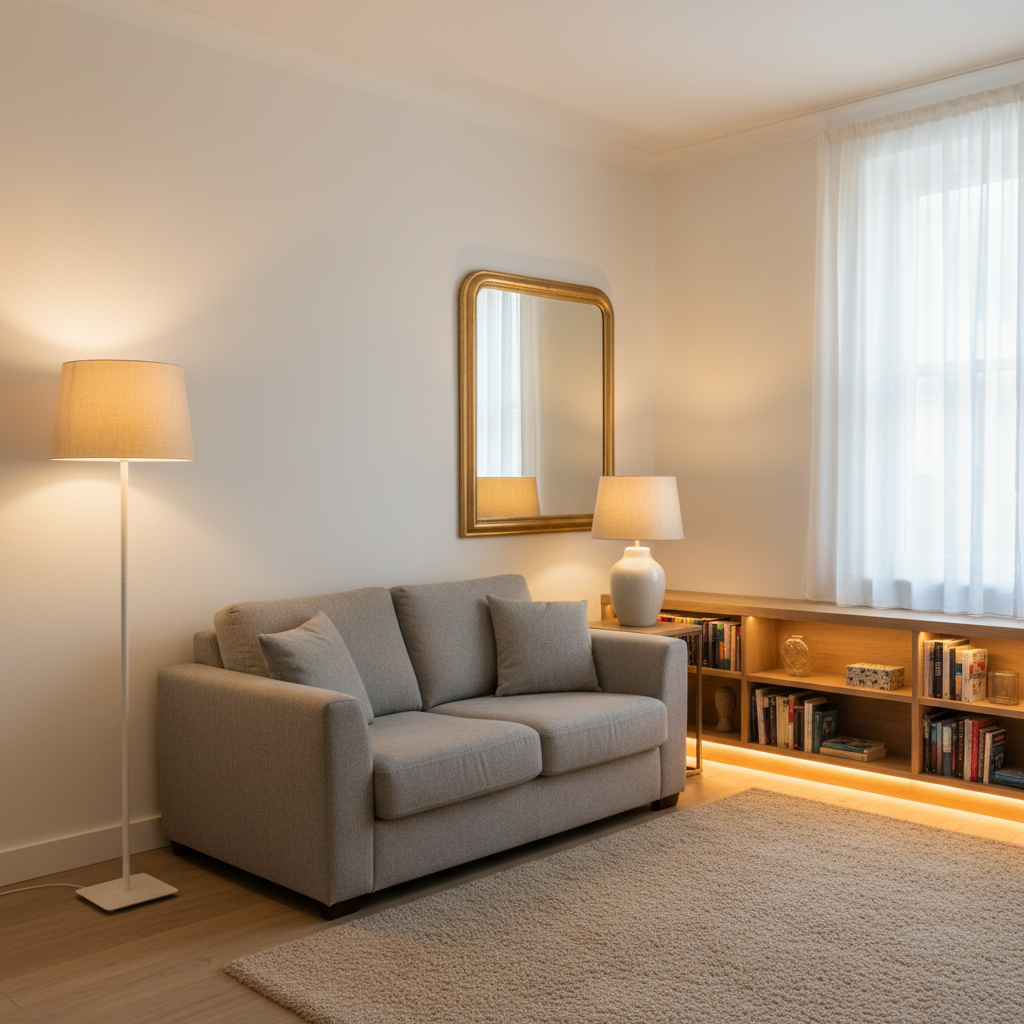
- Original Builder Skimping: Older homes, and even some newer ones, often get bare-bones lighting in certain rooms — looking at you, bedrooms. Builders assume you’ll just haul in lamps and make do.
- Overly Dark Decor: Dark walls, heavy draperies, and deep-colored furniture soak up light like a sponge. Looks sharp in a showroom. In your house? Sometimes it feels like a dungeon.
- Poor Lighting Placement: One central overhead light throws shadows and leaves corners and task areas ignored. It needs some help.
- Outdated Bulbs: Incandescent or old CFLs just don’t put out the same usable light per watt as modern LEDs, and the color can feel harsh or yellow.
- Obstructed Windows: Heavy blinds, thick curtains, or even overgrown landscaping outside can cut down the natural light coming into a room.
Electrical · Panel or service upgrade
| Project category | Electrical |
|---|---|
| Problem type | Panel or service upgrade |
| Trade required | Electrical |
| Urgency | Planned project |
| Safety risk | High safety risk |
| DIY suitability | Licensed pro only |
| Cost category | High cost |
| Typical timeline | Permit plus utility scheduling, commonly 2–6 weeks |
| Contractor type | Licensed electrician |
Repair option
Add a subpanel when the main service is adequate.
Replacement option
Full service upgrade with utility coordination and permits.
Common causes
- Obsolete or recalled panel brands
- Service capacity too small for added loads
- No room for required AFCI/GFCI breakers
Relevant tools:project cost estimatorcompare quotes
Published July 28, 2026Last updated August 17, 2026
Tools & materials you'll need
Affiliate links- AmazonMeasuring tapeFor planning lamp placement.
- AmazonLED bulbs3-5
- AmazonExtension cords1-2 · If outlets are far from desired lamp locations.
- AmazonCord covers/clips1 pack · For managing lamp cords safely.
- AmazonMedium-sized mirrorAt least 3x4 feet, ideally framed to match decor.
- AmazonFloor lamp1-2
- AmazonTable lamp1-2
- AmazonPlug-in wall sconce1-2 · Optional, but great for accent light.
As an Amazon Associate FixlyGuide earns from qualifying purchases — at no extra cost to you. Prices and availability are accurate as of publication and subject to change.
Quick Answer
Look, I get it. You’ve got a room that feels like a cave, but the idea of ripping open walls for new electrical runs? Nobody’s got time or money for that kind of headache. The good news is, you absolutely don’t need to. You can improve a room’s lighting a whole lot with a few smart, no-rewire tricks: plug-in fixtures placed where they actually help, smart bulbs, reflective surfaces, and a little furniture shuffling. It’s about working with what you’ve got and making it pull its weight — no electrician bill, no mess, no torn-up drywall.
The Problem
I’ve walked into plenty of homes over the years where folks are fighting a dark room. Maybe it’s a living room with only one overhead fixture, a bedroom where the builder somehow gave them zero ceiling lights, or a den that stays gloomy no matter how many table lamps they cram in. The complaint usually sounds something like, “It’s just so dark in here, Rob. But I don’t want to tear up my house.” And yeah, I hear that all the time. The usual fix — adding a new switch, a new ceiling box, or a new outlet — means fishing wires, patching drywall, painting, and then waiting on the invoice. That can easily run $500 to $1,500 per point of light. For most homeowners, that thing’s a hard no. They just want to read a book without squinting or quit kicking the coffee table after dark.
How It Works
Light isn’t just about throwing more of it at a room. It’s about where it lands and how it bounces around once it gets there. When an electrician adds a new light, they’re basically extending your home’s 120-volt AC power from an existing circuit — maybe an overhead junction box, an outlet, or even the main panel — to a new fixture location. That means running wire, usually 14-gauge or 12-gauge Romex for residential lighting, through wall cavities, ceilings, or attics, then tying it into a switch and the fixture itself. Permanent stuff. Clean, solid, but not cheap.
With the no-rewire approach, we’re getting light into those dark corners using the power you already have — mostly wall outlets. Instead of hardwiring, we lean on plug-and-play options. A floor lamp just plugs into an existing 15-amp or 20-amp general-purpose receptacle. Bulb output gets measured in lumens; a standard 60-watt equivalent LED throws around 800 lumens. The trick is spreading those lumens around in a useful way.
We also use reflection and diffusion. Lighter-colored walls reflect about 80% of light, while darker walls might only reflect 10-20%. Mirrors, metallic finishes, and even glossy paint can bounce light back into the room and make a small amount feel like a lot more. It’s a little like steering traffic instead of paving a new road. I had a client in the Riverbend neighborhood — Mrs. Henderson — who swore her kitchen needed new recessed lights. Nope. Her dark backsplash and cabinets were swallowing the light she already had. We repainted with an off-white, and the room opened right up. Same fixtures. Different game.
Step-by-Step Fix
Here’s how I handle a dim room without touching the electrical box.
-
Map Your Outlets & Problem Areas — Figure out where the power is and where the shadows live.
- Before you buy a thing, spend a few minutes in the room. Where are the wall outlets? Which ones are buried behind furniture? What corners feel like a black hole? Sketch a rough floor plan if that helps. You’ll want to think in layers: ambient light for the whole room, task light for reading or cooking, and accent light for art or features. Don’t forget outlets on a wall switch — those are gold for lamps.
-
Add Floor Lamps for Ambient Light — Get your general brightness up from the ground.
- Pick floor lamps that fit the room, sure, but don’t let looks outrank usefulness. I like lamps with an uplight component — bowl-shaped shades that throw light up at the ceiling because they bounce it back down soft and even. If your ceilings are white or light-colored, that works especially well. Put them in corners or near seating, aiming for a triangle of light coverage across the room. And get a sturdy base. A wobbly lamp is asking for trouble.
- Pro Tip: Look for lamps with multiple build-in brightness settings or add a dimmer switch adapter so you can dial it in.
-
Deploy Table Lamps for Task & Mid-Level Glow — Fill in the middle and light up the work zones.
- Table lamps are the workhorses. They’re great for task lighting and for warming up a room at eye level. Put them on end tables next to sofas, on bedside tables, or on a desk. Make sure the shade points light where you need it without blasting your eyes. For reading, the bottom of the lampshade should sit roughly at your eye level when you’re seated. That cuts glare and puts the light where the pages are.
- A small lamp on a bookshelf can help too — no fancy wiring, just a little common sense.
-
Embrace Plug-In Wall Sconces — Vertical light without breaking drywall.
- This is one of my favorite tricks. Plenty of sconces are sold as hardwired, but you can find loads of stylish ones that just plug into a standard outlet. A lot of them come with a cord cover, or you can tuck the cord behind furniture and call it a day. Put them on either side of a bed, above an armchair, or flanking a piece of art to add light at eye level. They break up a flat wall and make the room feel finished.
- Safety Check: Make sure the cord isn’t a trip hazard. Use cord clips or covers if you need to.
-
Utilize Strip Lights & Puck Lights — Hidden helpers for accent and under-cabinet light.
- Battery-operated or small plug-in LED strip lights can do a lot of heavy lifting. Stick them under kitchen cabinets for task lighting, inside bookshelves to show off collections, or along the top of crown molding for a soft indirect glow. Puck lights, usually battery-powered and motion-sensored, are great for closets or pantries where you only need light for a minute or two. They’re usually easy to mount with adhesive backing or a couple of small screws.
- I’ve used them in a pantry so tight you could barely turn around in it — worked like a charm.
-
Swap in Brighter, Smarter Bulbs — Fastest and cheapest win in the whole bunch.
- People overlook this one all the time. If you’re still running incandescent bulbs, you’re leaving light on the table. Modern LEDs are efficient and come in a huge range of color temperatures, from warm 2700K to cool 5000K. Go higher on lumens where you want more brightness — a 100-watt equivalent LED can give you around 1600 lumens for just 15 watts of power. Smart bulbs, controlled by an app or voice assistant, give you even more control, letting you change brightness and color temperature without touching a switch.
-
Harness Reflective Surfaces & Mirrors — Multiply the light without adding another fixture.
- This is where you can get a little crafty. A large mirror placed opposite a window or a light source will throw that light deep into the room. It’s basically free light, and who argues with that? Think about furniture with metallic accents, glass tabletops, or glossy finishes. Lighter paint on walls and ceilings will also make your existing light sources work harder by bouncing more of it around. A light-colored rug can help on a dark floor too.
- Recommendation: For maximum light reflection, aim for a mirror that's at least 3-4 feet tall and wide.
Common Causes
- Original Builder Skimping: Older homes, and even some newer ones, often get bare-bones lighting in certain rooms — looking at you, bedrooms. Builders assume you’ll just haul in lamps and make do.
- Overly Dark Decor: Dark walls, heavy draperies, and deep-colored furniture soak up light like a sponge. Looks sharp in a showroom. In your house? Sometimes it feels like a dungeon.
- Poor Lighting Placement: One central overhead light throws shadows and leaves corners and task areas ignored. It needs some help.
- Outdated Bulbs: Incandescent or old CFLs just don’t put out the same usable light per watt as modern LEDs, and the color can feel harsh or yellow.
- Obstructed Windows: Heavy blinds, thick curtains, or even overgrown landscaping outside can cut down the natural light coming into a room.
Common Mistakes
- Clustering Too Many Lamps: More light is good, but pile too many lamps into one spot and you get hot spots while the rest of the room stays dim. Spread ’em out.
- Ignoring Bulb Temperature: Using a
Related Articles
Keep troubleshooting with these hand-picked guides from FixlyGuide:
- The Secret to Saving 40% on Outdoor Power Tools (Even When There's No Sale) — Unlock deep discounts on outdoor power tools year-round, even without a major holiday sale, by leveraging strategic timing and smart shoppi…
- The Surprising Reason Your House Ticks and Pops At Night (And What It Means) — That unsettling ticking or popping sound in your house at night is usually normal thermal expansion and contraction, but sometimes it signa…
- The Surprising Trick to Cutting Your Dryer Bill By $100 Per Year — Installing a clothesline can significantly reduce your energy bills and add a fresh scent to your laundry. This guide covers how to choose…
- The 4 Critical Dimensions of a Bluebird House (Most DIY Plans Miss One) — Discover the precise measurements and often-overlooked design elements essential for building a bluebird house that truly attracts nesting…
- The Single Board Secret to Attracting Bluebirds: A Quick DIY House — Discover how to construct an ideal bluebird house using just one cedar board, providing a safe and inviting home for these cherished backya…
- Why Does Only One Room Have Flickering Lights? The Real Culprit — Flickering lights in a single room often point to loose connections, an overloaded circuit, or a failing light fixture, rather than a whole…
What should this project cost?
Enter your project details for a realistic cost range before you call anyone.
Outlet and switch work usually $150–$400; panel upgrades commonly $1,800–$4,200.
- Regional adjustment
- National average
- Labor share (typical)
- ~$709
- Quotes to collect
- 3 written estimates
Educational estimate based on national averages — not a binding quote. Always confirm with written local estimates.
Fixly Project Decision Box
- DIY difficulty
- Professional Recommended
- Estimated time
- Diagnosis 1–2 hours
- Cost level
- Moderate
Main tools / materials
- Non-contact voltage tester
- Outlet tester
- Flashlight
When to stop and call a pro
- Burning smell, scorch marks, or a warm outlet or switch plate
- A breaker that trips again right after being reset
- Any work inside the service panel
- Aluminum wiring or cloth-insulated wiring
Need professional help?
Talk to a Licensed ElectricianGet the print-ready PDF of this guide
A clean, ad-free, printable version you can keep on your phone or pin to the workshop wall. Free with a FixlyGuide account.
- Print-optimized layout
- Tools, materials & every step included
- Saved to your account
This article was independently written by FixlyGuide based on the source topic.
Frequently asked questions
Can I really brighten a whole room without calling an electrician?+
Absolutely! I’ve seen homeowners transform dark spaces using clever placement of plug-in lamps, reflective surfaces, and modern LED bulbs. You're working smarter, not harder, with the existing electrical setup.
What's the best type of bulb for brightening a dark room?+
Go for LED bulbs with a higher lumen output – think 800+ lumens for a standard bulb. For color temperature, I usually recommend something in the 3000K-4000K range. It's a crisp, natural light that doesn't feel too yellow or too blue.
How do mirrors help brighten a room?+
Mirrors are fantastic light multipliers. Place a large mirror opposite a window or another light source, and it will bounce that light deeper into the room, making the space feel larger and brighter. It’s like adding another window, but without the construction.
Are battery-operated lights powerful enough?+
For accent lighting, closets, or under-cabinet tasks, absolutely. Modern battery-operated LEDs are surprisingly bright and efficient. For general ambient light, however, you'll still want plug-in fixtures.
What's the deal with 'layers of light'?+
It's a pro trick. You want ambient light (general room illumination, often from overhead or uplights), task lighting (focused light for reading or cooking), and accent lighting (to highlight features). Combining these three layers makes a room feel balanced and well-lit.
Can paint color really make a difference?+
Huge difference! Lighter paint colors, especially off-whites, pale grays, or light blues, reflect a significant amount of light, making any existing light source more effective. Darker colors absorb light, which can make a room feel smaller and dimmer.
Are smart bulbs worth the investment?+
If you want maximum flexibility, absolutely. Smart bulbs let you control brightness, color temperature, and even schedule your lighting, all from your phone. It means you can fine-tune the light for any mood or time of day without changing a single fixture.
My landlord won't let me paint. Are there still options?+
Even without painting, you've got plenty of options. Focus on adding more plug-in fixtures, especially floor and table lamps, and strategically place large mirrors and other reflective decor. Light-colored rugs and furniture covers can also help bounce light around.
How many lamps do I need in a typically sized living room?+
For an average 12x15 foot living room, I'd aim for at least three distinct light sources, not including natural window light. That's usually an overhead, a floor lamp, and a table lamp, or some combination that provides ambient, task, and accent lighting.


Discussion
Loading comments…