
- What was happening when it tripped?
- Were multiple appliances operating?
- Did one particular appliance start?
- Was a portable heater running?
- Did something get plugged in?
Electrical · Breaker keeps tripping
| Project category | Electrical |
|---|---|
| Problem type | Breaker keeps tripping |
| Trade required | Electrical |
| Urgency | Urgent — within days |
| Safety risk | High safety risk |
| DIY suitability | Pro recommended |
| Cost category | Low cost |
| Typical timeline | Diagnosis in a single visit |
| Contractor type | Licensed electrician |
Repair option
Isolate the load, then repair the fault or replace the breaker.
Replacement option
New dedicated circuit when the load simply exceeds what the circuit was built for.
Common causes
- Genuine overload on a shared circuit
- Ground fault from moisture in an exterior box
- Failing breaker or a damaged appliance cord
Relevant tools:diy or hire a prodiy difficulty
Published September 11, 2026Last updated September 11, 2026
Tools & materials you'll need
Affiliate linksNo materials required.
As an Amazon Associate FixlyGuide earns from qualifying purchases — at no extra cost to you. Prices and availability are accurate as of publication and subject to change.
You're making dinner.
Microwave starts.
Air fryer is running.
Coffee maker is still plugged in.
Then—
CLICK.
Everything goes dark.
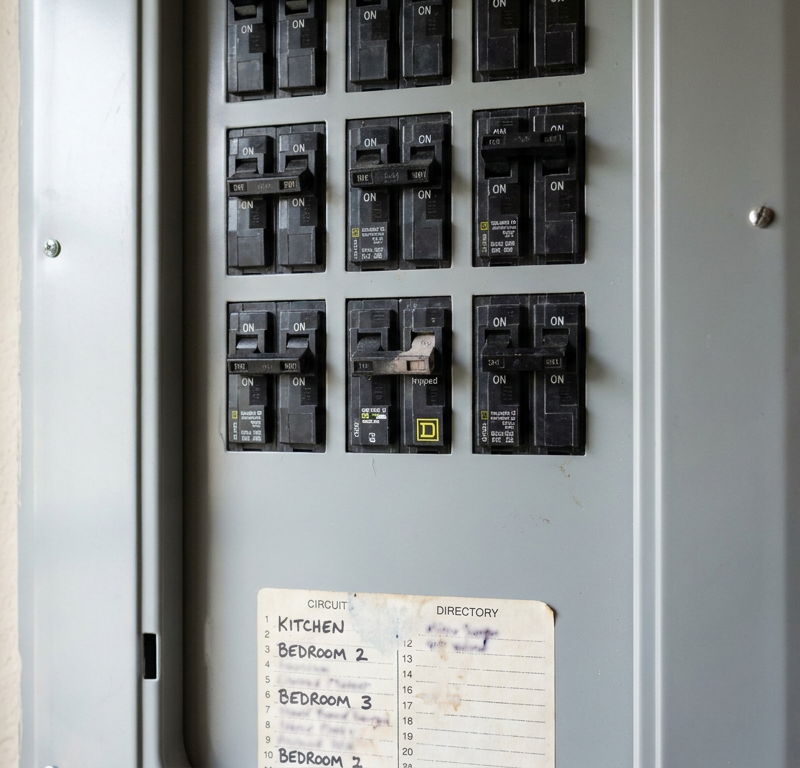
You walk to the electrical panel.
Find the tripped breaker.
Reset it.
Everything comes back.
Problem solved.
Right?
Maybe.
But then it happens tomorrow.
And again Saturday.
Eventually, resetting that breaker becomes part of your routine.
"Oh, that breaker always does that."
That's the sentence I'd like homeowners to stop saying.
A circuit breaker that repeatedly trips is telling you something.
It doesn't automatically mean your house is about to catch fire.
It doesn't automatically mean you need a new electrical panel.
And it doesn't automatically mean the breaker itself is defective.
But repeated tripping deserves investigation.
Because the breaker isn't simply an annoying switch.
It's part of your home's electrical protection system.
Here's what homeowners should know.
First: Why Does a Circuit Breaker Trip?
At the simplest level, a circuit breaker is designed to interrupt electrical current when certain unsafe or abnormal electrical conditions occur.
Depending on the circuit and protective device, tripping may be associated with conditions such as:
- Overcurrent
- Short circuits
- Ground faults
- Arc-fault conditions
- Or other electrical problems
Different breakers can provide different types of protection.
The important homeowner takeaway is:
The breaker may be doing exactly what it's supposed to do.
Repeatedly forcing it back on without understanding why it trips isn't fixing anything.
1. Too Many Things Are Running on the Same Circuit
This is one of the easiest situations to understand.
Imagine one kitchen circuit serving several high-demand appliances.
You run:
- Microwave
- Toaster
- Coffee maker
- Air fryer
At the same time.
Then:
CLICK.
Breaker trips.
You turn off the air fryer.
Reset the breaker.
Everything works.
That pattern may suggest the combined electrical load is exceeding what the circuit can safely supply.
But don't solve the problem by installing a larger breaker yourself.
That's important.
A breaker is selected to protect the circuit—not simply to prevent inconvenience.
Changing breaker size without determining whether the wiring and circuit are designed for it can create a serious hazard.
2. One Particular Appliance Causes the Trip
This is an excellent clue.
Suppose everything works normally.
Then every time you turn on one particular appliance:
CLICK.
The breaker trips.
Try to notice whether the pattern consistently follows that device.
Don't start disassembling the appliance or electrical system.
But tell the electrician:
"This breaker seems to trip whenever this appliance starts."
That's much more useful than:
"My electricity is messed up."
The problem could involve the appliance, circuit, connection, load or another electrical condition requiring diagnosis.
3. A Short Circuit May Be Occurring
A short circuit can create a high-current fault condition and should be taken seriously.
Homeowners shouldn't attempt to locate or repair wiring faults by opening electrical equipment without the appropriate knowledge and qualifications.
Possible circumstances vary widely.
The important point is:
A breaker that immediately trips again after being reset may be telling you the fault is still present.
Don't repeatedly force it back on.
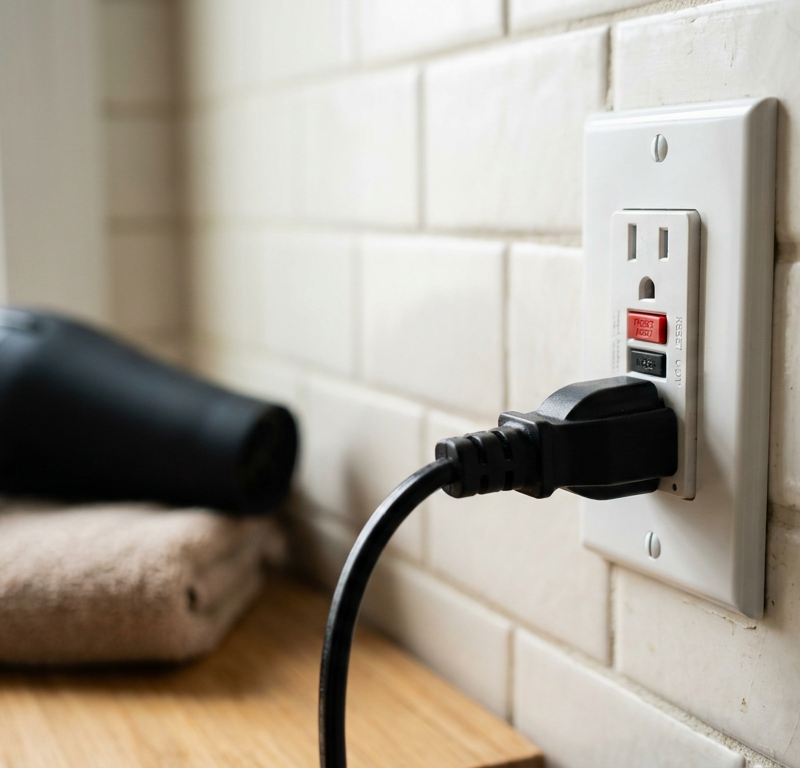
4. There May Be a Ground Fault
A ground fault involves electrical current taking an unintended path.
Certain circuits and locations use ground-fault circuit-interrupter protection because of increased shock hazards.
- Bathrooms
- Kitchens
- Garages
- Outdoor areas
Other locations may have GFCI protection depending on applicable requirements and the installation.
Sometimes homeowners think:
"The breaker is bad."
when another protective device may actually be responding to a fault.
Again:
Protection devices trip for a reason.
Find the reason.
5. An AFCI Breaker May Be Detecting a Problem
Many newer electrical installations use arc-fault circuit-interrupter protection in required locations.
AFCI devices are designed to detect certain electrical arcing conditions.
If an AFCI repeatedly trips, don't assume:
"These new breakers are just annoying."
There may be a legitimate electrical condition.
There can also be compatibility or equipment-related issues that require proper troubleshooting.
A qualified electrician can evaluate what's actually happening.
6. A Cord or Plug May Be Damaged
Take a look at the equipment you're using.
Without opening anything, inspect accessible cords and plugs.
Watch for:
- Fraying
- Cracking
- Exposed conductors
- Burn marks
- Melted areas
- Loose plug components
- Other visible damage
Damaged electrical cords shouldn't be treated as:
"I'll put some tape around it and keep using it."
Stop using visibly damaged equipment until it can be properly repaired or replaced as appropriate.
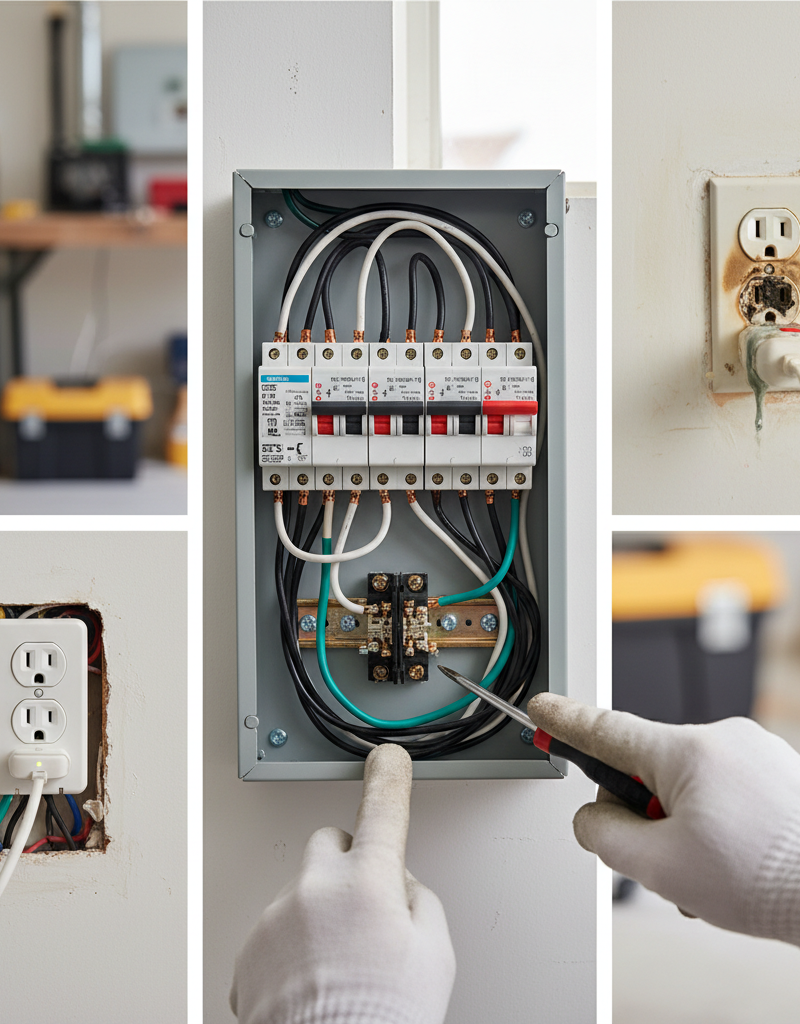
7. An Outlet or Switch May Be Showing Warning Signs
Sometimes the breaker isn't the only clue.
Pay attention to outlets and switches.
Concerning signs can include:
- Unusual warmth
- Burning odor
- Discoloration
- Scorching
- Buzzing
- Crackling
- Sparking
- Physical damage
These aren't symptoms I'd recommend ignoring while repeatedly resetting the breaker.
If you see or smell evidence of overheating or burning:
Stop treating this as a nuisance trip.
Get appropriate professional help.
8. Moisture May Be Involved
Electricity and water don't mix well.
If breaker problems began after:
- A leak
- Storm
- Flooding
- Plumbing problem
- Water intrusion
- Outdoor moisture
- Or another event involving water...
tell the electrician.
Don't handle wet electrical equipment.
And don't assume something is safe simply because the visible water is gone.
Moisture exposure can create conditions requiring proper evaluation.
9. The Breaker Itself Could Have a Problem
Yes, breakers can fail.
But this is where homeowners sometimes jump too quickly.
"The breaker keeps tripping, so the breaker must be bad."
Not necessarily.
The breaker may be responding correctly to a problem elsewhere.
Replacing the breaker without diagnosing the circuit can leave the real issue untouched.
Diagnose before replacing.
Sound familiar?
That's becoming a Fixly Guide rule for a reason.
10. There Could Be a Loose or Deteriorated Electrical Connection
Electrical connections matter.
A connection that is loose, damaged or deteriorated can create problems that aren't necessarily obvious to a homeowner.
This isn't an invitation to remove your electrical panel cover and start tightening things.
Please don't.
Electrical panels can contain energized components even when certain breakers are switched off.
Diagnosis and repair inside electrical equipment should be left to appropriately qualified people.
11. Your Home's Electrical System May Not Match Modern Demands
Think about what we ask houses to power today.
- Large televisions
- Computers
- Gaming systems
- Multiple refrigerators
- Microwaves
- Air fryers
- Hair dryers
- HVAC equipment
- Hot tubs
- Pool equipment
- EV chargers
- Workshops
- Home offices
- Portable heaters
Older homes weren't necessarily designed around today's electrical usage patterns.
That doesn't automatically mean:
"You need a new electrical panel."
But repeated overload issues may indicate that the home's electrical system or particular circuits deserve evaluation.
12. Someone May Have Modified the Electrical System Incorrectly
Homes change.
Previous owner installs something.
DIY remodel happens.
Garage gets converted.
New outlet gets added.
Appliance gets moved.
Electrical work gets modified.
Years later:
You inherit the result.
Most homeowners have no idea what's behind their walls.
If something doesn't make sense, don't assume it was installed correctly simply because:
"It's been like that for years."
Age doesn't prove safety.
What Should You Do When a Breaker Trips Once?
A single trip doesn't automatically mean you have a major electrical problem.
Start by asking:
- What was happening when it tripped?
- Were multiple appliances operating?
- Did one particular appliance start?
- Was a portable heater running?
- Did something get plugged in?
- Was there a storm?
- Did water get somewhere it shouldn't?
Then safely turn off or unplug appropriate loads if doing so doesn't expose you to an electrical hazard.
If there are no signs of burning, heat, moisture, damage or another unsafe condition, follow the breaker/panel manufacturer's appropriate operating guidance.
But if you're unsure:
Don't experiment.
When Should You STOP Resetting the Breaker?
This is probably the most important section of the article.
Don't keep resetting a breaker that:
- Trips immediately again
- Trips repeatedly without an obvious overload
- Is associated with a burning smell
- Is associated with smoke
- Is associated with buzzing or crackling
- Is associated with hot or scorched electrical components
- Began tripping after water exposure
- Appears associated with damaged wiring/equipment
- Produces unusual behavior when reset
Those situations deserve appropriate professional attention.
Never Hold a Breaker in the ON Position
If a breaker won't stay on:
- Don't force it
- Don't tape it
- Don't wedge it
- Don't hold it
- Don't repeatedly slam it back into position
The protective device is trying to interrupt the circuit.
Your job isn't to defeat it.
Your job is to determine:
Why?
Don't Replace a Breaker With a Larger One Just Because It Trips
This deserves repeating.
Suppose you have a breaker that keeps tripping.
Someone says:
"Just put a bigger breaker in."
That is not a casual homeowner fix.
Circuit protection needs to be properly matched to the conductors and equipment it protects.
Installing an improperly sized protective device can allow wiring to carry more current than intended.
That's potentially dangerous.
Breaker size is not a convenience setting.
Don't Keep Moving the Appliance to Random Outlets
Homeowner logic:
"That outlet trips the breaker, so I'll just plug the heater into this one."
Then:
Extension cord.
Different room.
Different circuit.
Problem solved?
Maybe you've simply moved the load.
High-demand appliances should be used according to manufacturer instructions and appropriate electrical requirements.
Don't create a new hazard trying to avoid an existing one.
Extension Cords Are Not a Permanent Electrical System
This becomes especially important with:
- Space heaters
- Window AC units
- Large appliances
- Power tools
- Other high-demand equipment
Extension cords have specific ratings and intended uses.
They shouldn't become permanent substitutes for adequate building wiring.
If your daily electrical setup requires a maze of extension cords:
It may be time to evaluate whether the home's electrical system actually supports how you're using the space.
Is the Electrical Panel Dangerous?
Not simply because a breaker tripped.
A breaker trip alone doesn't prove the panel needs replacement.
However, panel replacement or electrical upgrades may be appropriate in some situations based on:
- Condition
- Capacity
- Damage
- Equipment issues
- Project requirements
- Safety concerns
- Expansion needs
- Other electrical factors
If someone immediately says:
"Breaker tripped? You need a $6,000 panel."
ask:
"What specifically is wrong with my existing panel?"
Have them show you.
Understand the diagnosis.
Then make the decision.
Questions to Ask an Electrician
If you call an electrician because a breaker repeatedly trips, ask:
- What is causing the breaker to trip?
- Is the breaker operating correctly?
- Is the circuit overloaded?
- Is there evidence of a wiring fault?
- Is a particular appliance contributing?
- Is the circuit appropriate for what we're using?
- Are there any signs of overheating or damage?
- What needs to be repaired?
- Is anything else in the panel concerning?
- What should I do if it happens again?
A good electrician should be able to explain the problem in language you understand.
Give the Electrician Better Information
Before they arrive, write down:
- Which breaker trips
- What rooms/outlets lose power
- What was running
- How often it happens
- Whether it trips immediately or after several minutes
- Whether a particular appliance triggers it
- Whether weather or moisture was involved
- Any smells, heat, sounds or visible damage
That's useful diagnostic information.
Breaker Trips When the Microwave Runs
This is a common homeowner scenario.
Don't immediately conclude:
"Bad microwave."
Or:
"Bad breaker."
The useful clue is:
The trip occurs when the microwave operates.
An electrician can determine whether the issue involves the appliance, circuit loading, wiring, breaker or another condition.
Breaker Trips When the Space Heater Runs
Portable heaters can place substantial demand on a circuit.
If the breaker trips when a heater operates—particularly when other equipment is on the same circuit—stop repeatedly resetting it without considering the load.
And follow heater safety instructions carefully.
Portable heaters deserve respect.
Breaker Trips When It Rains
That's a very different clue.
If an electrical problem consistently appears during or after rain, moisture or exterior electrical components may need investigation.
Possible locations could involve:
- Outdoor receptacles
- Exterior lighting
- Equipment
- Wiring
- Other weather-exposed components
Don't open wet electrical equipment.
Call an appropriate professional.
Breaker Trips in the Middle of the Night
Ask what's operating automatically.
- HVAC?
- Water-heating equipment?
- Refrigerator?
- Freezer?
- Pool equipment?
- Scheduled devices?
- Exterior equipment?
The fact that everyone is asleep doesn't mean the house isn't using electricity.
Look for the pattern.
Breaker Trips but Nothing Is Plugged In
That's another situation where professional troubleshooting may be appropriate.
"Nothing plugged in" doesn't necessarily mean:
Nothing is connected to the circuit.
A circuit may supply:
- Lighting
- Hardwired equipment
- Hidden loads
- Other components
Don't assume the wiring is safe because the receptacles appear unused.
The Fixly Guide Breaker Test
When a breaker trips, ask:
- What was running?
- Did a particular device just turn on?
- Does the breaker trip immediately after reset?
- Has this happened before?
- Is anything unusually warm?
- Is there a burning smell, buzzing, scorching or smoke?
- Has water or moisture been involved?
If you answer yes to those last safety-related questions:
Stop troubleshooting casually.
What NOT to Do
This section is worth saving.
❌ Don't install a larger breaker just because the old one trips.
❌ Don't repeatedly reset a breaker that immediately trips again.
❌ Don't ignore burning odors.
❌ Don't keep using visibly damaged cords.
❌ Don't remove electrical-panel covers unless you're qualified to work around the hazards involved.
❌ Don't touch wet electrical equipment.
❌ Don't use extension cords as permanent wiring.
❌ Don't assume repeated tripping is "just something this house does."
When Is It an Emergency?
Electrical conditions involving:
- Smoke
- Fire
- Active sparking
- Strong burning odors
- Significant overheating
- Electrical equipment affected by substantial water exposure
may require urgent action.
If there is an active fire or immediate threat to people, leave the dangerous area and contact emergency services.
Don't risk personal safety trying to save an appliance or diagnose the electrical panel.
Should You DIY Electrical Repairs?
There are reasonable homeowner tasks around a house.
Opening electrical panels and troubleshooting energized wiring isn't where I'd recommend inexperienced homeowners learn through trial and error.
Electrical work also may be regulated by local codes, permits and licensing requirements.
The safest Fixly Guide principle is:
Observe what is happening.
Document the pattern.
Handle simple user-level equipment steps where appropriate.
Leave hazardous electrical diagnosis and repair to qualified professionals.
You don't need to know how to repair the electrical system.
You need to know when something isn't behaving normally.
The Expensive Mistake Isn't Always Calling an Electrician
Homeowners sometimes avoid service calls because:
"I don't want to pay somebody $200 just to tell me nothing is wrong."
Understandable.
But there's another side.
A recurring electrical problem that is ignored can become more complicated.
The goal isn't:
Call a contractor every time a breaker trips once.
It's:
Recognize patterns.
One unusual event?
Investigate what was happening.
Repeated event?
Pay closer attention.
Repeated event plus heat, burning, damage or moisture?
Escalate.
Frequently Asked Questions
Why does my breaker keep tripping?
Possible causes include circuit overload, appliance problems, short circuits, ground faults, arc-fault conditions, wiring issues, breaker problems or other electrical faults. Proper diagnosis depends on the circuit and circumstances.
Is it safe to keep resetting a tripped breaker?
Repeatedly resetting a breaker without understanding why it trips isn't a good solution. If it immediately trips again or there are signs of heat, burning, damage, moisture or other concerning conditions, stop and seek qualified assistance.
Does a tripping breaker mean the breaker is bad?
Not necessarily. The breaker may be operating correctly in response to a problem elsewhere in the circuit.
Can too many appliances trip a breaker?
Yes. A circuit can trip when the electrical load exceeds its designed capacity.
Why does my breaker trip when I use the microwave?
The microwave's operation may be contributing to circuit loading or revealing another electrical/appliance problem. An electrician can evaluate recurring trips.
Should I replace a tripping breaker with a larger breaker?
Not without a proper electrical evaluation. Circuit-breaker ratings must be appropriate for the circuit and equipment they protect.
Should I call an electrician if a breaker keeps tripping?
Repeated or unexplained tripping—especially when accompanied by heat, burning odors, buzzing, visible damage or moisture—is a good reason to seek qualified electrical evaluation.
Final Thought
Your circuit breaker isn't your enemy.
When it shuts off the power, it's easy to think:
"This stupid thing tripped again."
But that breaker may be doing exactly what it was designed to do.
So the next time you walk to the panel, reset the same breaker and think:
"It always does this."
Remember:
That's not a diagnosis.
Something is causing the protective device to operate.
Maybe you're simply asking too much from one circuit.
Maybe an appliance has a problem.
Maybe there's an electrical fault.
Maybe the breaker needs evaluation.
You don't know yet.
And that's okay.
You don't have to become an electrician.
You just need to recognize:
Repeated tripping deserves an explanation.
The Fixly Guide Bottom Line
Remember these three rules:
- A breaker that trips repeatedly is telling you something.
- Don't defeat the protection just to keep the power on.
- When electrical problems involve heat, burning, smoke, damage or water, take them seriously.
And above all:
Don't keep resetting the problem. Find out what's causing it.
🏠 Have one breaker in your house that "always trips"? Stop treating it as part of the personality of the house. Pay attention to what is operating when it happens, document the pattern, and have repeated or concerning electrical problems properly evaluated — find a vetted DFW electrician who can diagnose it safely.
More from Fixly Guide:
What should this project cost?
Enter your project details for a realistic cost range before you call anyone.
Outlet and switch work usually $150–$400; panel upgrades commonly $1,800–$4,200.
- Regional adjustment
- National average
- Labor share (typical)
- ~$709
- Quotes to collect
- 3 written estimates
Educational estimate based on national averages — not a binding quote. Always confirm with written local estimates.
Fixly Project Decision Box
- DIY difficulty
- Professional Recommended
- Estimated time
- Diagnosis 1–2 hours
- Cost level
- Moderate
Main tools / materials
- Non-contact voltage tester
- Outlet tester
- Flashlight
When to stop and call a pro
- Burning smell, scorch marks, or a warm outlet or switch plate
- A breaker that trips again right after being reset
- Any work inside the service panel
- Aluminum wiring or cloth-insulated wiring
Need professional help?
Talk to a Licensed ElectricianFrequently asked questions
Why does my breaker keep tripping?+
Possible causes include circuit overload, appliance problems, short circuits, ground faults, arc-fault conditions, wiring issues, breaker problems or other electrical faults. Proper diagnosis depends on the circuit and circumstances.
Is it safe to keep resetting a tripped breaker?+
Repeatedly resetting a breaker without understanding why it trips isn’t a good solution. If it immediately trips again or there are signs of heat, burning, damage, moisture or other concerning conditions, stop and seek qualified assistance.
Does a tripping breaker mean the breaker is bad?+
Not necessarily. The breaker may be operating correctly in response to a problem elsewhere in the circuit.
Can too many appliances trip a breaker?+
Yes. A circuit can trip when the electrical load exceeds its designed capacity.
Why does my breaker trip when I use the microwave?+
The microwave’s operation may be contributing to circuit loading or revealing another electrical/appliance problem. An electrician can evaluate recurring trips.
Should I replace a tripping breaker with a larger breaker?+
Not without a proper electrical evaluation. Circuit-breaker ratings must be appropriate for the circuit and equipment they protect.
Should I call an electrician if a breaker keeps tripping?+
Repeated or unexplained tripping—especially when accompanied by heat, burning odors, buzzing, visible damage or moisture—is a good reason to seek qualified electrical evaluation.
Discussion
Loading comments…