- Did the project stay reasonably close to budget?
- Did the crew show up when expected?
- How were changes handled?
- Was the site kept reasonably clean?
- Were there any problems after completion?
General remodeling · Renovation planning
| Project category | General remodeling |
|---|---|
| Problem type | Renovation planning |
| Trade required | General contracting |
| Urgency | Planned project |
| Safety risk | Low safety risk |
| DIY suitability | Pro recommended |
| Cost category | Major investment |
| Typical timeline | Design and permitting often 2–4 months before work starts |
| Contractor type | General contractor |
Repair option
Phase the work and fix the building envelope first.
Replacement option
Full renovation with permits, design, and a general contractor.
Common causes
- Space no longer fits how the household lives
- Resale preparation
- Deferred maintenance stacking up
Relevant tools:project cost estimatorcompare quoteshome improvement material prices
Published September 5, 2026Last updated September 5, 2026
Tools & materials you'll need
Affiliate linksAs an Amazon Associate FixlyGuide earns from qualifying purchases — at no extra cost to you. Prices and availability are accurate as of publication and subject to change.
Hiring a contractor can feel uncomfortable.
You may be preparing to spend $3,000. $15,000. $50,000. Or more.
And unless you work in construction, you may not know whether the person sitting across from you is giving you excellent advice... or simply an excellent sales pitch.
That doesn't mean you should assume every contractor is trying to take advantage of you. Most homeowners simply need a better way to evaluate the person they're about to trust with their home and money.
The good news? You don't need to become a construction expert. You just need to ask better questions.
Here are 20 of the most useful questions to ask before hiring a contractor.
1. Are You Licensed for This Work If My Area Requires It?
Licensing requirements vary by trade and location. Some work may require a state license. Other work may be regulated locally. Some trades may have no general statewide licensing requirement but still need permits, registrations or specialized credentials.
The important thing is not to assume.
Ask: "Is a license required for this work where I live, and if so, what is your license number?" Then verify it through the appropriate government source.
Don't rely only on: "Yes, we're licensed." Verify.
2. Do You Carry Insurance?
Ask what insurance the contractor carries. Depending on the company and project, that may include general liability insurance and workers' compensation coverage or equivalent arrangements where applicable.
Then ask: "Can you provide current proof?"
A professional contractor should understand why a homeowner would ask. Insurance requirements and coverage vary, so don't assume every policy protects you from every situation. For larger projects, consider discussing coverage concerns with your own insurance professional too.
3. How Long Have You Been Doing This Type of Work?
Notice the wording. Not: "How long have you been in business?"
Ask: "How long have you been doing THIS type of work?"
A company could have 20 years of experience in roofing and very little experience with a specialized remodeling project. Relevant experience matters. Ask for examples of similar work.
4. Can I See Recent Projects Similar to Mine?
Pictures are useful. But ask for projects that resemble your scope, your materials, your budget range, your type of house, and your desired result.
If you're planning a bathroom remodel, photos of driveways don't tell you much. You want to see evidence of the work you're actually considering.
5. Can I Speak With Recent Customers?
References can help. Ask for recent customers with similar projects. Then ask those customers questions like:
- Did the project stay reasonably close to budget?
- How was communication?
- Did the crew show up when expected?
- How were changes handled?
- Was the site kept reasonably clean?
- Were there any problems after completion?
- Would you hire them again?
The last question is especially useful.
6. Who Will Actually Be Doing the Work?
This is a great question. You may meet the owner. But who arrives Monday morning? Employees? Subcontractors? A project manager? Multiple crews?
There's nothing automatically wrong with subcontracting — construction frequently involves specialized trades. But you should understand who is responsible for the job, who supervises the work, and who you call if there's a problem.
7. Who Is My Main Point of Contact?
Don't wait until the project starts to discover this.
Ask: "If I have a question during the project, who exactly do I contact?" Owner? Project manager? Office? Crew leader? And how — phone, text, email, or a project management system?
Clear communication can prevent a lot of frustration.
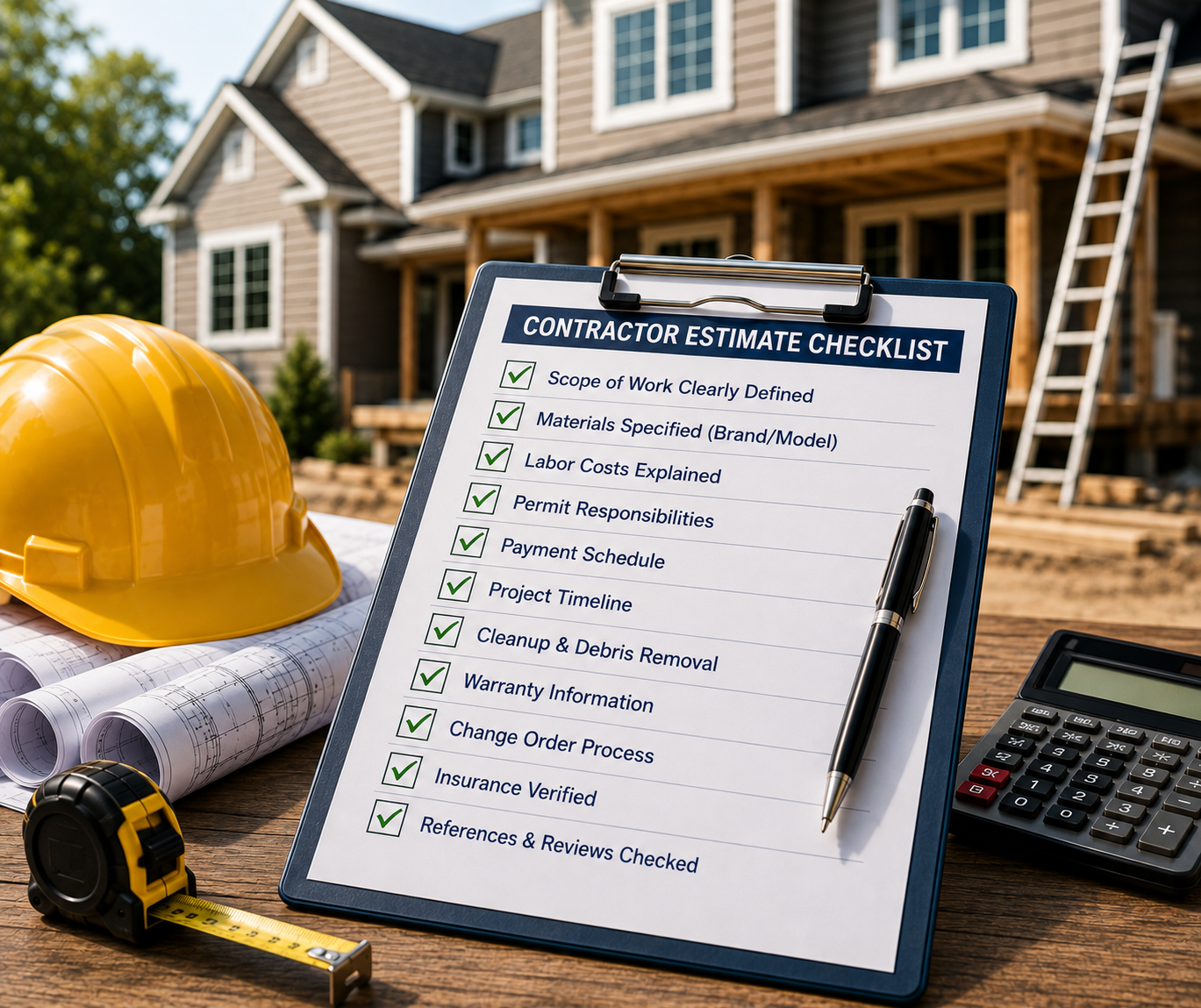
8. What Exactly Is Included in This Estimate?
A price without scope is almost meaningless.
Suppose Contractor A says $18,000 and Contractor B says $24,000. Which is cheaper? You don't know. Contractor B may include things Contractor A excluded.
Ask whether the estimate clearly states:
- Materials
- Labor
- Preparation
- Demolition
- Disposal
- Equipment
- Delivery
- Permits where applicable
- Cleanup
- Finishing
- Specific products
- Quantities
- Allowances
- Exclusions
Don't compare totals until you compare scopes.
9. What Is NOT Included?
This may be even more important than what's included.
Ask directly: "What could I reasonably expect to pay for that is NOT included in this quote?"
Possible examples might include hidden damage, structural repairs, electrical upgrades, plumbing changes, permit fees, material upgrades, painting, disposal, engineering, and unexpected site conditions.
Every project is different. The goal isn't to eliminate every possible surprise — it's to identify predictable ones before work begins.
10. Are These Materials Specifically Identified?
"New flooring" isn't specific. "New shingles" isn't specific. "New windows" isn't specific.
Where practical, the contract or proposal should identify important materials with enough detail that everyone understands what's being installed. That could include manufacturer, product line, model, color, size, grade, finish, and other relevant specifications.
The more expensive the project, the less you want to rely on: "We'll figure that out later."
11. Who Pulls the Permits?
Where permits are required, ask who is responsible. Don't automatically accept: "You should pull the permit because it'll be easier."
In some situations, homeowner-pulled permits can affect responsibilities or have legal implications. Rules vary by jurisdiction. Ask your local permitting authority what is required. A contractor should be able to explain the plan.
12. What Happens If You Discover Something Unexpected?
This is one of the best questions you can ask.
Suppose the crew opens a wall and finds rot, damaged framing, old wiring, plumbing problems, or moisture damage. Now what?
Ask: "What is your process if you find work that wasn't included in the original scope?"
You want to understand the change-order process BEFORE a change happens.
13. How Do Change Orders Work?
Get this clear. A change order should typically document changes to the agreed scope and price before additional work proceeds, except where emergency conditions or contract terms justify another process.
Ask:
- Will I receive the change in writing?
- Will it show the additional cost?
- Will it show schedule impact?
- Who must approve it?
- Can work proceed without my approval?
This is how a $30,000 project turns into a $45,000 project without the homeowner understanding how. Don't wait until that happens to ask.
14. What Payment Schedule Do You Require?
Ask before signing. Understand the deposit, progress payments, milestones, and final payment.
Don't just ask "How much upfront?" Ask: "What does each payment correspond to?" For example: material delivery, completion of a phase, inspection, or substantial completion.
Payment structures vary by project and state law. Avoid assumptions about a universal "correct" deposit percentage.
15. What Is the Expected Start Date?
Not: "We should be able to get to it soon."
Ask: "What start window should I realistically expect?"
Construction schedules can move because of weather, material delays, previous projects, inspections, labor, and unexpected site conditions. You don't need a promise that nothing will ever change. You need a realistic expectation.
16. How Long Should the Project Take?
Again, don't expect a perfect prediction. But ask: "Assuming there are no major surprises, what is the expected duration?"
Then ask: "What commonly causes delays on projects like this?" That second question may give you a more useful answer.
17. How Will You Protect My Home During the Work?
This is especially important for interior projects. Ask about:
- Dust control
- Floor protection
- Furniture protection
- Debris
- Access
- Pets
- Children
- Daily cleanup
- Security
- Bathroom use
- Work areas
A contractor can do excellent technical work and still make the experience miserable if jobsite management is poor.
18. What Warranty Do You Provide?
Ask for details. Not: "Yeah, we stand behind our work."
Ask:
- Is the warranty written?
- What does it cover?
- What doesn't it cover?
- How long does it last?
- Is labor covered?
- Are manufacturer warranties separate?
- What is the process if I have a problem?
Keep warranty paperwork after the project.
19. What Could Increase the Final Price?
Ask this exact question. It's powerful.
"What are the most common reasons a project like mine ends up costing more than the original estimate?"
An experienced contractor should have an answer. Maybe hidden rot, upgraded materials, homeowner-requested changes, structural issues, code-related corrections, or unknown site conditions.
That discussion gives you a better idea of how much contingency to keep in your budget.
20. If This Were Your House, What Would You Do?
This is my favorite question. Not because the contractor's answer should automatically become your decision, but because it changes the conversation.
Ask: "If this were your home and your money, what would you do?" Then listen.
Do they immediately recommend the most expensive option? Or do they explain what matters, what can wait, what they'd repair, what they'd replace, and what they wouldn't spend money on?
A professional who's willing to tell you "You probably don't need to do that yet" can earn a tremendous amount of trust.
The Question You Should Ask After EVERY Answer
Here's a bonus. When a contractor gives you an answer you don't understand, say: "Can you explain why?"
That's it. Not aggressively. Not suspiciously. Just: "Can you explain why you recommend that?"
A good contractor should be able to explain the reasoning behind a major recommendation. You don't need to understand every technical detail, but you should understand what you're paying for and why.
Don't Hire Based on Personality Alone
This is hard. You meet someone. They're friendly, confident, funny. You immediately think: "I trust this guy."
Maybe you should. But likability isn't a substitute for verification. Likewise, a contractor who isn't the world's greatest salesperson may be excellent at their trade.
Evaluate qualifications, scope, documentation, communication, references, experience, professionalism, price, contract terms, and your overall comfort level.
Don't Hire Based on Price Alone Either
The lowest bid can be the best bid. It can also be the worst. The highest bid isn't automatically better either.
The useful question is: what am I getting for this price?
Compare scope, materials, labor, warranty, timeline, exclusions, permits, cleanup, experience, and payment schedule. Then compare the price.
How Many Contractor Quotes Should You Get?
There isn't a magic number for every project. For a substantial non-emergency project, comparing multiple qualified contractors can help you understand pricing, scope differences, repair approaches, material options, and communication style.
But don't collect 12 bids just to grind everyone down to the lowest possible price. At some point you're wasting your time and theirs.
The goal is confidence — not finding somebody desperate enough to do it cheapest.
Watch for Estimates That Are Too Vague
Be cautious when an expensive project's description looks like: Bathroom remodel — $27,000. That's it.
What does that include? Tile? Fixtures? Plumbing? Electrical? Cabinetry? Permits? Demolition? Paint? Shower glass? Disposal? Who supplies materials?
A detailed scope protects both parties. The homeowner knows what they're buying, and the contractor has documentation showing what they agreed to provide.
What a Professional Contractor Should Want From YOU
This relationship goes both ways. Good contractors usually appreciate homeowners who:
- Communicate clearly
- Make decisions on time
- Understand the scope
- Don't change the project daily
- Provide access
- Respect agreed payment terms
- Ask questions early
- Don't interfere with unsafe work areas
- Treat workers respectfully
You want a professional contractor. Contractors want professional customers too. That can make the entire project run better.
Your Contractor Interview Scorecard
Instead of relying on gut feeling, rate each contractor.
Qualifications
- Appropriate licensing/credentials verified where required
- Insurance information reviewed
- Relevant experience
Scope
- Detailed written estimate
- Materials identified
- Exclusions explained
- Permit responsibilities clear
Money
- Payment schedule clear
- Change-order process clear
- Potential extra costs discussed
Communication
- Point of contact identified
- Questions answered clearly
- Timeline discussed realistically
Reputation
- Similar work reviewed
- References checked
- Business identity verified
Contract
- Written agreement
- Warranty information
- Scope matches what was discussed
- No important promises exist only verbally
Now you're comparing contractors using actual information.
Before You Sign Anything
Stop. Read the agreement. Yes, all of it.
Look specifically for scope of work, price, payment schedule, materials, change-order process, start/completion expectations, permit responsibility, warranty, cancellation provisions if applicable, dispute provisions, cleanup, exclusions, signatures, and other important terms.
If you don't understand something: ask before signing. The worst time to discover what your contract says is after there's already a disagreement.
Keep Everything
Create a project folder. Save:
- Contract
- Estimate
- Change orders
- Invoices
- Receipts
- Product selections
- Emails
- Important texts
- Photos
- Permits
- Inspection records
- Warranty information
- Before, progress, and after photos
If the project goes perfectly, great. If something becomes confusing later, documentation is extremely helpful.
A Good Contractor Shouldn't Be Afraid of Good Questions
Homeowners sometimes worry: "I don't want to offend them by asking too many questions."
Professional questions aren't disrespectful. You're hiring someone to work on one of your largest financial assets. It's reasonable to understand who they are, what they're doing, what it costs, how they'll do it, what happens if something changes, and what happens if there's a problem afterward.
The contractor is also evaluating you. A clear conversation before the project can prevent conflict during it.
Frequently Asked Questions
What should I ask a contractor before hiring?
Ask about relevant experience, licensing where required, insurance, project scope, materials, permits, payment schedule, timeline, change orders, warranty and who will manage the project.
Should I always get multiple contractor quotes?
For larger non-emergency projects, comparing multiple qualified contractors can help homeowners evaluate scope, pricing and approaches. There is no universal number required for every project.
Should I choose the cheapest contractor?
Price should be considered alongside scope, qualifications, materials, warranty, communication and reputation. A lower price is only meaningful when you're comparing similar work.
How much should I pay a contractor upfront?
There is no universal percentage appropriate for every project, and some jurisdictions regulate deposits. Review applicable local rules and understand exactly what the requested payment covers before paying.
What should be included in a contractor estimate?
For substantial projects, useful estimates often identify scope, significant materials, labor, price, exclusions and relevant assumptions. More complex projects usually benefit from greater detail.
Is it okay to ask a contractor for proof of insurance?
Yes. Asking about current insurance and documentation is a reasonable part of evaluating a contractor.
Final Thought
Hiring a contractor shouldn't feel like gambling.
You may never know everything about roofing, plumbing, electrical work, concrete, HVAC, remodeling, windows, or siding. And you don't need to.
The goal isn't to know more about the trade than the contractor. The goal is to know enough about the agreement to make a good decision.
Before you sign, make sure you understand: Who are you hiring? What exactly are they doing? What materials are they using? What will it cost? What can change the price? When do you pay? What happens if there's a problem? And what happens after the job is finished?
A homeowner who asks those questions isn't being difficult. They're being prepared. And the best contractors usually appreciate that.
Related Guides
Continue planning your project with these homeowner guides:
What should this project cost?
Enter your project details for a realistic cost range before you call anyone.
Cost depends heavily on which system turns out to be the source.
- Regional adjustment
- National average
- Labor share (typical)
- ~$1,620
- Quotes to collect
- 3 written estimates
Educational estimate based on national averages — not a binding quote. Always confirm with written local estimates.
Recommended for DIYers & woodworkers
Sponsored
The Top 20 Tools for Workshops of Any Budget
No stationary machines or power tools required — plus 3 fundamental tools that can't be bought at any price.
Get the free guide
Ted's Woodworking — The #1 Woodworking Resource
Detailed instructions, dimensioned drawings, materials & cutting lists, and 3D schematics for every skill level.
See the plansSponsored: links above are affiliate links. FixlyGuide may earn a commission on qualifying purchases — at no extra cost to you.
Frequently asked questions
What should I ask a contractor before hiring?+
Ask about relevant experience, licensing where required, insurance, project scope, materials, permits, payment schedule, timeline, change orders, warranty and who will manage the project.
Should I always get multiple contractor quotes?+
For larger non-emergency projects, comparing multiple qualified contractors can help homeowners evaluate scope, pricing and approaches. There is no universal number required for every project.
Should I choose the cheapest contractor?+
Price should be considered alongside scope, qualifications, materials, warranty, communication and reputation. A lower price is only meaningful when you’re comparing similar work.
How much should I pay a contractor upfront?+
There is no universal percentage appropriate for every project, and some jurisdictions regulate deposits. Review applicable local rules and understand exactly what the requested payment covers before paying.
What should be included in a contractor estimate?+
For substantial projects, useful estimates often identify scope, significant materials, labor, price, exclusions and relevant assumptions. More complex projects usually benefit from greater detail.
Is it okay to ask a contractor for proof of insurance?+
Yes. Asking about current insurance and documentation is a reasonable part of evaluating a contractor.

Discussion
Loading comments…