- "You have to sign right now."
- "My boss won't let me offer this tomorrow."
- "We have another customer waiting for this spot."
- "If I leave, the price goes up $5,000."
General remodeling · Renovation planning
| Project category | General remodeling |
|---|---|
| Problem type | Renovation planning |
| Trade required | General contracting |
| Urgency | Planned project |
| Safety risk | Low safety risk |
| DIY suitability | Pro recommended |
| Cost category | Major investment |
| Typical timeline | Design and permitting often 2–4 months before work starts |
| Contractor type | General contractor |
Repair option
Phase the work and fix the building envelope first.
Replacement option
Full renovation with permits, design, and a general contractor.
Common causes
- Space no longer fits how the household lives
- Resale preparation
- Deferred maintenance stacking up
Relevant tools:project cost estimatorcompare quoteshome improvement material prices
Published August 19, 2026Last updated August 19, 2026
Tools & materials you'll need
Affiliate links- AmazonRed-flag scorecard printout
As an Amazon Associate FixlyGuide earns from qualifying purchases — at no extra cost to you. Prices and availability are accurate as of publication and subject to change.
Quick Answer
Most contractor red flags come down to one thing: unwillingness to put details in writing. High-pressure "sign today" deadlines, an estimate thousands below everyone else with no explanation, advice to skip permits, cash-only demands, blank spaces in the contract, unverifiable insurance and vague exclusions all deserve another question before your money leaves your account. One warning sign rarely proves fraud. A pattern of them does.
The Sentence That Costs Homeowners the Most
The contractor seems great. Friendly, knowledgeable, on time. He walks your property and immediately seems to know exactly what needs to be done. Then he says:
"Normally this would be $18,000, but my crew is already working nearby. If you sign today, I can do it for $13,500."
That might be a genuine deal. Then comes the follow-up:
"I just need half upfront."
Now what?
This is where homeowners get into trouble — not because they're careless, but because bad contractors and outright scammers know how to make a questionable deal sound reasonable.
The problem is real. In May 2026 the National Insurance Crime Bureau warned homeowners about contractor fraud following tornadoes, wildfires and floods, and consumer agencies in several states issued fresh warnings during the 2026 remodeling season.
But here's something equally important: most contractors aren't scammers. Plenty of excellent contractors ask for deposits, advertise door-to-door, offer discounts and run small businesses without a fancy office. Sometimes the cheapest estimate really is the best deal.
So this guide isn't about making you paranoid. It's about recognizing patterns that deserve one more question.
Because the biggest contractor red flag usually isn't what someone says. It's what they won't put in writing.
Red Flag #1: "This Price Is Only Good Today"
There's nothing inherently suspicious about a real promotion. Material pricing changes, schedules fill up, suppliers run temporary deals. But there's a difference between a real deadline and manufactured pressure.
Be cautious when you hear:
- "You have to sign right now."
- "My boss won't let me offer this tomorrow."
- "We have another customer waiting for this spot."
- "If I leave, the price goes up $5,000."
The FTC specifically identifies pressure for an immediate decision as a warning sign associated with home-improvement scams.
A $20,000 roof isn't a cheeseburger. You should have enough time to understand what you're buying.
Fixly Guide rule: the larger the financial decision, the less comfortable you should be with anyone preventing you from thinking about it.
Red Flag #2: The Estimate Is Far Below Everyone Else
Imagine three roof estimates:
| Contractor | Bid |
|---|---|
| A | $17,800 |
| B | $18,900 |
| C | $10,400 |
Which one are you calling first? Probably C. That's fine. But the question shouldn't be "how quickly can you start?" It should be "why is your estimate $7,000–$8,000 lower?"
There may be an excellent explanation. The contractor might have lower overhead, better supplier pricing, deep specialization in that exact project, owned equipment or little advertising spend.
There may also be a different explanation: the estimates aren't quoting the same thing.
The Texas Attorney General advises homeowners to be wary of unusually low bids, noting they may involve missing work, inexpensive labor or lower-quality materials.
Don't automatically reject the lowest bid. Investigate it.
Red Flag #3: "Don't Worry About the Permit"
A contractor says: "Technically you're supposed to get a permit, but nobody around here bothers."
That isn't the contractor saving you money. That may be the contractor transferring risk to you.
Permit requirements vary enormously by project and jurisdiction. Small cosmetic work often doesn't need one. Structural work, electrical changes, plumbing modifications and additions frequently do.
Don't assume. Ask: "Does this project require a permit?" Then verify with your local building authority when it matters.
The FTC lists contractors asking homeowners to obtain required building permits themselves as a potential scam warning sign.
Red Flag #4: "Just Pay Me Cash"
Cash by itself isn't proof of wrongdoing. But cash only, plus a large deposit, plus no detailed receipt, plus no clear contract? Take that combination seriously.
The FTC advises consumers not to pay cash for home-improvement work and recommends written estimates and contracts.
For substantial projects, keep a payment trail that documents:
- How much you paid
- When you paid
- Who received it
- What the payment covered
Red Flag #5: A Huge Deposit With No Explanation
A large deposit isn't automatically a scam. If you're ordering $14,000 of custom windows built specifically for your home, that's a legitimate conversation.
But "give me $15,000 and we'll get everything started" isn't much of an explanation.
Ask:
- What does my deposit pay for?
- Which materials are being purchased?
- When are they being ordered?
- When is my next payment due, and what milestone triggers it?
The number matters. The explanation matters more.
Red Flag #6: The Contract Is Suspiciously Vague
Compare two scopes for the same bathroom:
Contract A: "Complete bathroom remodel — $21,500."
Contract B: demolition, disposal, plumbing modifications, waterproofing, tile allowance, vanity, fixtures, electrical work, painting, trim, cleanup, warranty.
Which gives you more protection? Obviously B. A vague contract leaves room for two people to remember the agreement very differently.
The Texas Attorney General recommends written contracts spelling out what will be done, project timing, and costs for materials and special orders.
Red Flag #7: There Are Blank Spaces in the Contract
Simple: don't sign it.
"I'll fill that in later." No. "We haven't decided yet." Then write down how the decision will be handled.
The Texas Attorney General explicitly warns homeowners not to sign contracts containing blanks, because terms can be added afterward.
Never sign a contract you wouldn't be comfortable receiving back exactly as it sits.
Red Flag #8: They Won't Provide Proof of Insurance
Ask. Don't feel awkward about it. Depending on the project you may want to verify:
- General liability insurance
- Workers' compensation where applicable
- Required trade licensing
- Business registration information
Requirements differ by state and trade. A plumber, electrician, roofer and general remodeler may operate under completely different licensing rules where you live.
The FTC recommends confirming required licenses with state or county government and asking contractors for proof of insurance. Don't rely on "yeah, we're insured."
Red Flag #9: They Can't Explain What's NOT Included
This might be the single best question to ask: "What isn't included in this price?"
A good contractor says something like: "If we open the wall and find damaged framing, that's not included, because we can't price damage we haven't seen. Here's how we'd handle it if it happens." That's transparency.
Another says: "Everything should be covered." Should be? You need more detail.
Common exclusions worth confirming:
- Permits
- Disposal
- Painting
- Electrical upgrades
- Plumbing changes
- Structural repair
- Material upgrades
- Landscaping repair
- Hidden damage
You don't need a contract that predicts the future. You need one that explains how the unknown will be handled.
Red Flag #10: "We Found More Damage" — But They Won't Show You
Hidden damage is real: rot, mold, termite damage, old wiring, plumbing problems, structural issues.
That doesn't mean your contractor is lying. But if you hear "we found another $6,000 of damage," your next words should be "show me."
Take photos. Ask questions. Get the additional scope and cost documented before approving extra work whenever it's practical. Don't turn a legitimate construction surprise into a financial guessing game.
Red Flag #11: They Push "Their Finance Guy" With No Comparison
Financing can be completely legitimate. It can also make an expensive project look deceptively affordable.
"Only $399 per month!" sounds manageable. But for how long? At what interest rate? What fees? What's the total repayment? Is the loan secured by your property?
The FTC warns about home-improvement loan scams in which homeowners are steered toward contractor-arranged financing and later discover unfavorable terms.
Shop financing separately from construction, and compare total cost — not monthly payment.
Red Flag #12: Payments Are Moving Faster Than the Construction
Monitor this throughout the job. Suppose you've paid $42,000 of a $50,000 remodel but the kitchen still looks like demo day.
There may be a legitimate reason — maybe $20,000 of cabinets and appliances are already purchased and stored. Fine. Ask.
The principle: know why your money is moving when it moves. Payments tied to clear milestones keep both sides honest about expectations.
Red Flag #13: The Contractor Disappears When You Ask a Hard Question
Before hiring, ask at least one uncomfortable question:
- "What happens if the project goes over budget?"
- "Tell me about a project that went wrong and how you handled it."
- "Why is your estimate higher than this other one?"
You're not trying to trap anyone. You're testing communication. Remodeling doesn't always go perfectly, and a contractor's ability to communicate when something goes wrong matters far more than their charm when everything is fine.
One "Red Flag" That Actually Isn't
A contractor making a profit is not a red flag.
Contractors carry payroll, insurance, trucks, fuel, equipment, taxes, office expenses, estimating costs, project management, advertising, warranty obligations, training, software and supplier expenses.
A contractor doesn't need to work for free to be trustworthy, and the one who charges more isn't automatically ripping you off. You're looking for value and transparency — not the person willing to make the least money.
Subcontractors Aren't Automatically a Problem Either
Many excellent general contractors use subcontractors for electrical, plumbing, HVAC, roofing, concrete and other specialty trades. That's normal.
The better question is: "Who is responsible for supervising the work?" You want accountability, not a particular org chart.
Door-to-Door Contractors: Scam or Legitimate?
Neither. Door-to-door selling is a sales method, not proof of fraud. Legitimate roofing and storm-restoration companies canvass neighborhoods after storms. Unfortunately, so do scammers.
The Texas Attorney General warns homeowners to be cautious with unsolicited door-to-door contractors, particularly after severe storms.
So if someone knocks after a hailstorm and says "I noticed damage on your roof," don't panic — and don't sign anything immediately either. Verify the company, research them, get another opinion, understand your insurance situation, then decide.
The Storm-Chaser Problem in 2026
Severe weather creates ideal conditions for contractor fraud: homeowners need repairs fast, insurance money is involved, out-of-town crews arrive, and everyone is overwhelmed. NICB warned this year that fraudsters specifically exploit communities after tornadoes, floods and wildfires.
After a storm, ask:
- Where is your company based?
- How long have you operated there?
- Who handles warranty work after your crew leaves?
- Can I verify your business?
Being from another city isn't automatically bad. But you should know who answers the phone six months later.
What Good Contractors Actually Look Like
We talk so much about red flags that homeowners forget what green flags look like:
- They tell you when you don't need something. "Your roof has a few years left. I'd repair this section instead." That's how trust gets built.
- They explain the estimate clearly, not defensively.
- They put promises in writing.
- They don't panic when you get another estimate.
- They identify uncertainty: "We won't know the condition of that framing until we open the wall."
- They explain cheaper alternatives.
- They communicate bad news quickly.
- They don't promise things they can't control.
None of that is a guarantee. All of it is a meaningful signal.
The 5-Minute Contractor Test
Before hiring, see whether you can answer these:
- Who am I actually hiring, and can I verify the business?
- Do they carry appropriate insurance?
- Are required licenses verified?
- What exactly are they doing?
- Which materials are being used?
- What's excluded?
- What do I pay upfront?
- When are later payments due?
- How are changes handled?
- What warranty am I receiving?
- Who handles problems after completion?
If you can't answer half of them, you aren't ready to sign. That doesn't mean the contractor is bad — it means you need more information.
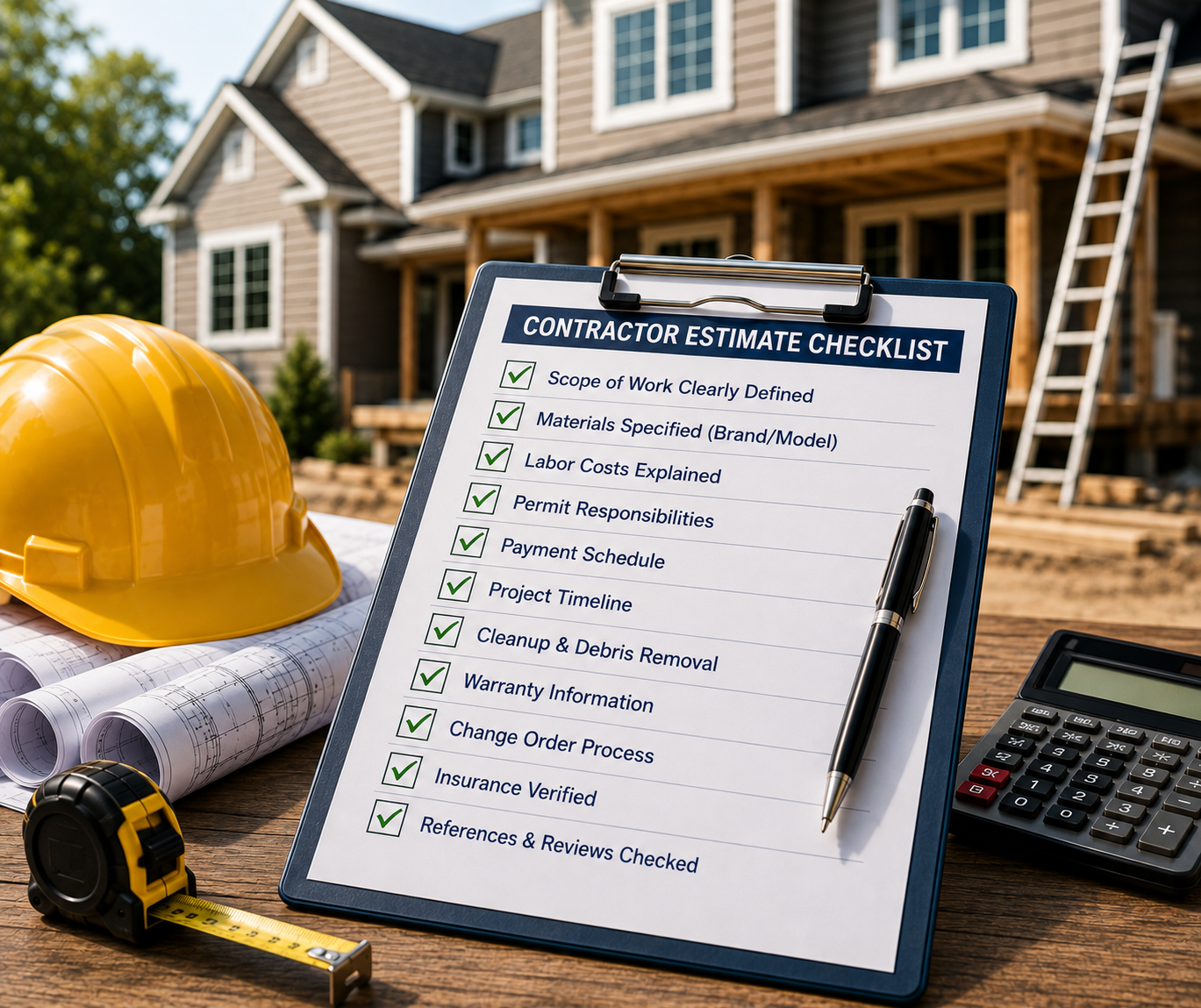
The Contractor Red-Flag Scorecard
Save this before your next estimate.
| Warning sign | Present? |
|---|---|
| Pressures me to sign immediately | ☐ |
| Estimate dramatically below others with no explanation | ☐ |
| Suggests avoiding required permits | ☐ |
| Wants a large cash payment without documentation | ☐ |
| Can't explain the deposit | ☐ |
| Contract is vague | ☐ |
| Contract contains blanks | ☐ |
| Insurance can't be verified | ☐ |
| Won't explain exclusions | ☐ |
| Won't document additional work | ☐ |
| Pushes financing without explaining terms | ☐ |
| Payments greatly outpace progress | ☐ |
| Avoids reasonable questions | ☐ |
One checked box doesn't make someone a scammer. Several checked boxes is when you slow way down.
What If You've Already Hired the Contractor?
It's not too late to protect yourself. Start documenting and keep:
- Contract and estimates
- Change orders
- Receipts and payment confirmations
- Emails and text messages
- Photos of progress and problems
- Material information
- Inspection records
If something changes, get it in writing. If there's a disagreement, communicate clearly and in writing. And if you believe you're dealing with fraud or serious misconduct, contact the appropriate consumer-protection, licensing or legal authorities in your jurisdiction.
Look for Patterns, Not Panic
This is the most important lesson in the article.
A contractor requests a deposit — not necessarily a problem. Uses subcontractors — normal. Costs less than competitors — could be great. Knocked on your door — proves nothing by itself.
Now imagine all of this at once: they knocked unexpectedly after a storm, want a large cash deposit tonight, won't provide a detailed contract, say permits aren't necessary, can't verify insurance, won't explain their business history, and the deal disappears if you don't sign immediately.
That's a pattern. That's what homeowners should learn to recognize.
Before You Hire
Your home will eventually need a roofer, plumber, electrician, HVAC tech, foundation company, remodeler, painter, flooring installer or concrete contractor. There are thousands of excellent contractors who take real pride in their work.
The goal isn't to avoid contractors. It's to become the kind of homeowner who can recognize a good one.
Ask better questions. Compare scope instead of price alone. Understand your contract. Control your payments. Verify what matters. And don't let anyone turn a major financial decision into a ten-minute deadline.
Because a trustworthy contractor doesn't need you to be uninformed to earn your business — they look better once you know what to ask.
So don't just ask "how much?" Ask: "Why should I trust you with my home?" A good contractor will have a strong answer.
What should this project cost?
Enter your project details for a realistic cost range before you call anyone.
Spot repairs commonly run $400–$1,800; full replacement typically $9,000–$18,000 for an average home.
- Regional adjustment
- National average
- Labor share (typical)
- ~$2,948
- Quotes to collect
- 3 written estimates
Educational estimate based on national averages — not a binding quote. Always confirm with written local estimates.
Fixly Project Decision Box
- DIY difficulty
- Professional Recommended
- Estimated time
- Inspection 1–2 hours · repairs 1–3 days
- Cost level
- High
Main tools / materials
- Binoculars for a ground-level look
- Flashlight for attic checks
- Moisture meter
- Roofing cement (temporary patch only)
When to stop and call a pro
- Active leak near lights, fans, or any wiring
- Sagging, bulging, or water-filled ceiling
- Steep, wet, or two-story roof — do not climb it
- Storm or hail damage you plan to claim on insurance
Need professional help?
Free roof assessment first — no phone calls until you ask for them.
Get Local Roofing HelpDecide what your roof needs
Two minutes of questions turns "something is wrong up there" into a clear next step.
- Repair or replace your roof?Answer 10 questions about age, leaks, and damage to get a clear next step.Open
- Compare contractor quotesScore up to four bids on price, warranty, licensing, and timeline.Open
- Get local estimatesSend one request and compare written estimates from vetted pros.Open
Free, no signup required. Estimates are educational guidance, not a quote or an inspection.
Recommended for DIYers & woodworkers
Sponsored
The Top 20 Tools for Workshops of Any Budget
No stationary machines or power tools required — plus 3 fundamental tools that can't be bought at any price.
Get the free guide
Ted's Woodworking — The #1 Woodworking Resource
Detailed instructions, dimensioned drawings, materials & cutting lists, and 3D schematics for every skill level.
See the plansSponsored: links above are affiliate links. FixlyGuide may earn a commission on qualifying purchases — at no extra cost to you.
Frequently asked questions
What are the biggest contractor red flags?+
High-pressure sales, vague contracts, unexplained large advance payments, unverifiable credentials where required, pressure to avoid permits, undocumented changes, suspicious financing arrangements and demands for full payment before completion all deserve closer investigation. Consumer-protection agencies specifically warn about several of these behaviors.
Is the cheapest contractor usually bad?+
No. A lower price can be completely legitimate. The important step is determining why the price is lower and whether you are comparing equivalent scopes, materials and services.
Should contractors ask for money upfront?+
Legitimate contractors commonly require partial advance payments depending on the project. Applicable laws vary, and homeowners should understand exactly what the initial payment covers and how future payments relate to project progress.
Is a contractor knocking on my door a scam?+
Not necessarily. Legitimate contractors use door-to-door marketing, especially after storms. However, consumer agencies warn that scammers use the same approach, so unsolicited offers deserve additional verification.
How can I tell whether a contractor is legitimate?+
Verify required licensing through the appropriate government agency, ask for insurance information, research the business, obtain written estimates, compare multiple contractors, check references and carefully review the contract before paying.


Discussion
Loading comments…