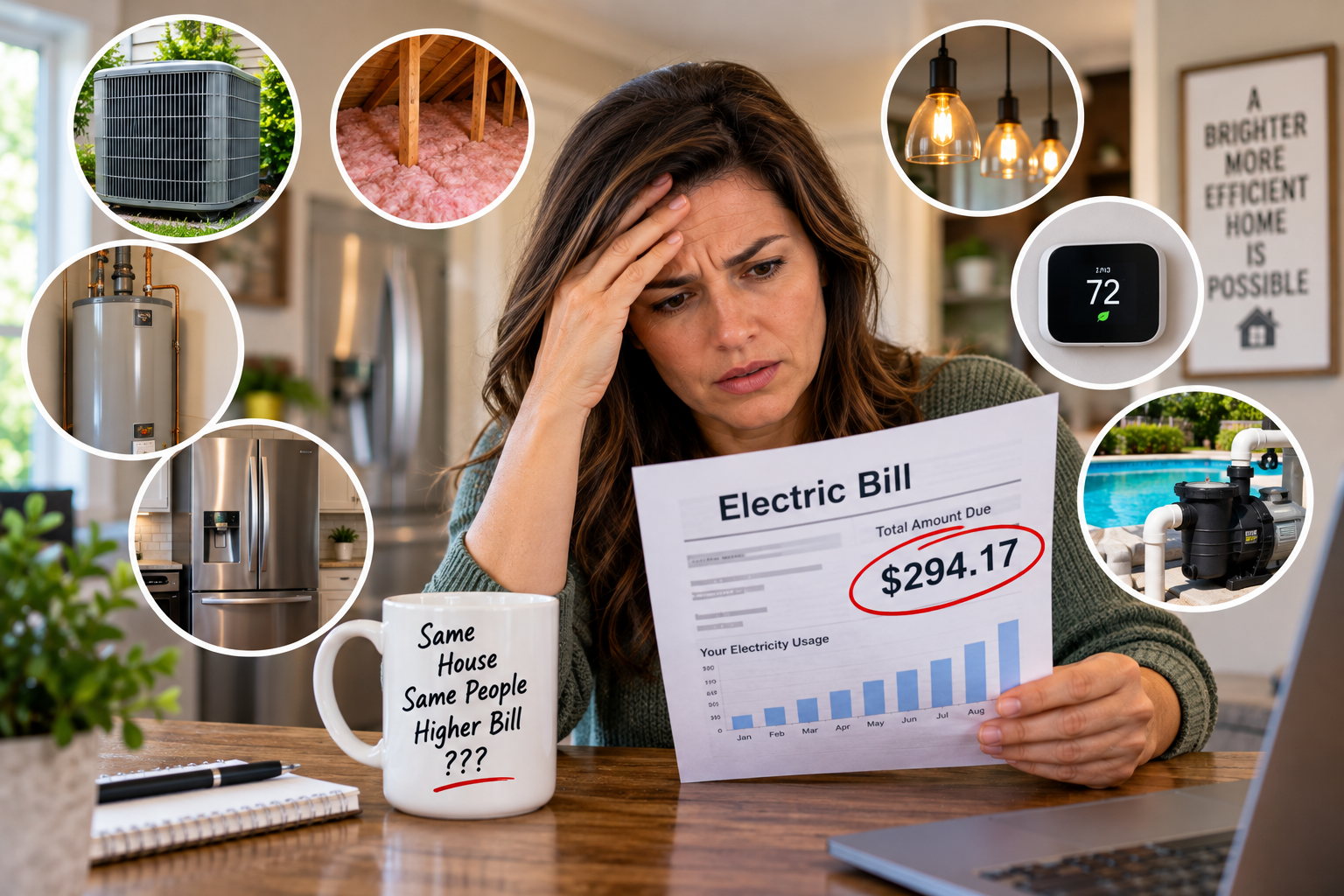
- Did you lower the thermostat?
- Did the AC run almost continuously?
- Did you have more people at home?
- Does the house feel less comfortable even though the system runs longer?
General remodeling · Renovation planning
| Project category | General remodeling |
|---|---|
| Problem type | Renovation planning |
| Trade required | General contracting |
| Urgency | Planned project |
| Safety risk | Low safety risk |
| DIY suitability | Pro recommended |
| Cost category | Major investment |
| Typical timeline | Design and permitting often 2–4 months before work starts |
| Contractor type | General contractor |
Repair option
Phase the work and fix the building envelope first.
Replacement option
Full renovation with permits, design, and a general contractor.
Common causes
- Space no longer fits how the household lives
- Resale preparation
- Deferred maintenance stacking up
Relevant tools:project cost estimatorcompare quoteshome improvement material prices
Published September 9, 2026Last updated September 9, 2026
Tools & materials you'll need
Affiliate links- AmazonThermostat settings access
As an Amazon Associate FixlyGuide earns from qualifying purchases — at no extra cost to you. Prices and availability are accurate as of publication and subject to change.
You open your electric bill.
Then you look at it again.
$187 last month.
$294 this month.
Same house.
Same family.
Same thermostat—or at least you think so.
Your first reaction might be:
"How in the world did we use THAT much electricity?"
And that's a reasonable question.
But before you blame the utility company, replace your windows, buy a new air conditioner, or start unplugging every phone charger in the house, there's something you should do first.
Look at your electricity usage—not just the dollar amount.
Because a higher electric bill and higher electricity consumption aren't necessarily the same thing.
Your house may be using more energy.
But your rate may also have changed.
The billing period may be different.
The weather may have been dramatically hotter or colder.
Or something in your home may be running far more than you realize.
So let's investigate this the way Fixly Guide believes homeowners should approach almost every home problem:
Diagnose first. Spend second.
First: Did Your Electric Bill Go Up—or Did Your Usage Go Up?
This is where I'd start.
Pull out your current bill and a previous one.
Don't only compare:
$225 vs. $310.
Look for electricity consumption, typically measured in:
kilowatt-hours (kWh)
Suppose last month you used:
1,200 kWh
and this month:
1,210 kWh.
Your usage barely changed.
If your bill increased significantly anyway, the explanation may involve things such as rates, fees, billing-period differences, plan changes or other billing factors rather than a dramatic new problem inside your house.
But suppose you went from:
1,200 kWh
to:
1,850 kWh.
Now we have a different question:
What changed?
That's the question this article will help you investigate.
1. Your HVAC System Is Working Much Harder
For many homes, heating and cooling are major energy users.
That makes your HVAC system one of the first places worth investigating when electricity consumption suddenly increases.
Think about the past month.
- Was it unusually hot?
- Unusually cold?
- Did you lower the thermostat?
- Did the AC run almost continuously?
- Did you have more people at home?
- Does the house feel less comfortable even though the system runs longer?
The important clue is often:
A change in behavior.
If your HVAC used to cycle normally but suddenly seems to run forever, something may deserve attention.
That doesn't automatically mean:
"You need a new HVAC system."
There can be many possible explanations.
Start by noticing what's different.
2. Your HVAC Filter Needs Attention
This is one of the easiest things homeowners can check.
Find the filter.
Look at it.
When was it last changed or serviced according to your system's requirements?
A dirty or inappropriate filter can affect airflow and system performance.
But here's another important point:
Don't automatically buy the most restrictive filter on the shelf because the packaging says it's better.
HVAC systems have airflow requirements.
Use a filter appropriate for your particular equipment and follow manufacturer or qualified professional guidance.
Write the replacement date on the filter or set a reminder.
It's a tiny maintenance habit that is easy to forget.
3. Something Is Wrong With the HVAC System
If the filter looks fine but the system's behavior has changed significantly, there may be another HVAC issue.
Possible problems vary widely depending on the system.
That's why this isn't the time to diagnose your air conditioner from a Facebook comment.
Instead, look for symptoms.
- Is airflow weaker?
- Are certain rooms suddenly uncomfortable?
- Does the outdoor equipment behave differently?
- Is the system short-cycling?
- Does it run far longer than before?
- Are there new sounds?
- Is the thermostat setting being reached?
- Has your electricity usage changed significantly compared with similar weather?
Those observations can be valuable to an HVAC technician.
Tell them what changed—not what you think needs replacing.
4. Your Thermostat Settings Changed More Than You Realized
This sounds obvious.
But it's worth checking.
A few degrees can affect how often your heating or cooling equipment operates, particularly during extreme weather.
And smart thermostats introduce another possibility:
Schedules.
Someone may have:
- Changed the temperature.
- Overridden an energy-saving schedule.
- Adjusted overnight settings.
- Changed away-from-home behavior.
- Disabled an eco setting.
- Or created a schedule you forgot existed.
Before calling a contractor, open your thermostat settings.
Check:
- Current setpoint.
- Schedule.
- Fan settings.
- Modes.
- Away settings.
- Recent changes.
You might find your answer there.
5. Your HVAC Fan Is Set to "ON"
Depending on your system, the thermostat may have fan settings such as:
AUTO
and
ON
With AUTO, the fan typically operates as needed with heating/cooling calls.
With ON, the fan may run continuously.
There can be reasons someone intentionally uses continuous fan operation, and systems differ.
But if your fan suddenly started operating much more than before:
Find out why.
Someone may simply have changed a setting.
6. Your Ductwork May Be Losing Conditioned Air
Your air conditioner can be doing its job...
while some of the conditioned air isn't getting where you want it.
Depending on the home, ductwork may run through:
- Attics.
- Crawlspaces.
- Garages.
- Other unconditioned areas.
Problems with duct connections, insulation, leakage or design can affect comfort and efficiency.
Possible clues include:
- One room suddenly harder to cool.
- Weak airflow from certain registers.
- Unexpected temperature differences.
- Visible accessible duct damage.
- HVAC running longer than expected.
But don't automatically assume every uncomfortable room means:
"Leaky ducts."
The system needs proper evaluation.
7. Your Attic May Be Working Against You
If your upstairs feels miserable every summer while the AC runs constantly, the attic deserves consideration.
Insulation levels and condition, air sealing, ventilation design, ductwork and other building-envelope factors can influence home comfort and energy performance.
But here's where homeowners can waste serious money:
Someone looks in the attic and says:
"You need more insulation."
Maybe.
But before spending thousands, ask:
- What's the actual problem we're trying to solve?
- Is existing insulation missing, displaced, compressed or otherwise inadequate?
- Are air leaks involved?
- Are ducts contributing?
- Are there moisture issues?
- What improvement should this work provide?
Don't buy a truckload of insulation simply because your electricity bill is high.
Diagnose the house as a system.
8. Your Home Has Air Leaks
A house isn't supposed to be perfectly airtight without regard to ventilation.
But uncontrolled air leakage can make heating and cooling more difficult.
Common areas homeowners may notice include:
- Exterior doors.
- Weatherstripping.
- Some window assemblies.
- Attic access points.
- Penetrations.
- Other gaps in the building envelope.
A draft doesn't automatically mean:
"Replace all the windows."
That's an expensive leap.
Sometimes the problem may involve a more localized condition.
Before approving a whole-house window replacement solely to reduce an electric bill, understand how much of the problem the windows are actually causing.
9. Your Water Heater Is Using More Electricity
Homeowners focus so heavily on HVAC that they forget another system:
Hot water.
If you have an electric water heater, changes in hot-water usage or equipment performance can affect electricity consumption.
Think about what changed.
- More people living in the house?
- Guests?
- Longer showers?
- More laundry?
- Different temperature setting?
- Equipment issue?
- Hot-water leak?
Again, don't randomly start adjusting or disassembling water-heater components.
But recognize that hot-water production is part of your home's energy picture.
10. You Have a Hot-Water Leak You Haven't Noticed
This is worth separating from ordinary water-heater use.
Imagine a leak somewhere on the hot-water side of the plumbing system.
You aren't only potentially wasting water.
Depending on the situation, the water heater may also be working to replace heated water that's being lost.
Possible clues could include:
- Unexpected water use.
- Water-heating equipment operating more than expected.
- Warm areas where they shouldn't be.
- Sounds of water when fixtures aren't being used.
- Other plumbing symptoms.
None of those automatically proves a hidden hot-water leak.
But if both your water use and electricity use unexpectedly increase around the same time, that's useful information to investigate.
11. An Old Refrigerator or Freezer Is Working Overtime
Your refrigerator doesn't get much attention.
It just sits there.
24 hours a day.
365 days a year.
The garage freezer?
Same thing.
If equipment isn't operating normally, electricity use can potentially increase.
Look for simple things first.
- Does the door seal properly?
- Is the door being left open?
- Is there excessive frost where that isn't normal?
- Is the refrigerator struggling to maintain temperature?
- Is a garage refrigerator operating in extreme conditions?
- Do you have an old second refrigerator running mostly to keep twelve drinks cold?
This doesn't mean:
"Throw away your refrigerator to save electricity."
It means remembering that appliances running around the clock deserve consideration.
12. Your Pool Pump May Be Running Longer Than Necessary
If you own a pool, don't overlook the pool equipment.
Pump schedules, equipment type, maintenance condition and operating requirements can have a meaningful impact on electricity consumption.
Check whether:
- The schedule changed.
- The pump is operating longer.
- Someone placed it in a manual mode.
- Equipment behavior changed.
- Other pool equipment has been added.
But don't simply slash operating time without understanding your pool's circulation and sanitation requirements.
The right schedule depends on the system and conditions.
13. You Added Something and Forgot About It
Sometimes there's nothing wrong with the house.
You changed how you're using it.
Think about the last few months.
Did you add:
- A second refrigerator?
- Freezer?
- Hot tub?
- Pool equipment?
- Portable AC?
- Electric heater?
- Workshop equipment?
- Dehumidifier?
- Aquarium equipment?
- Server/computer setup?
- EV charging?
- Additional occupants?
- Home office?
Any equipment that runs for many hours can add consumption.
Homeowners often say:
"Nothing changed."
Then ten minutes later:
"Well...we did put a freezer in the garage."
That's a change.
14. Space Heaters and Electric Resistance Heat Can Add Up
Small doesn't always mean low-energy.
Portable electric heaters can draw substantial power while operating.
One heater in an office may not seem dramatic.
But multiple heaters running for hours every day can change electricity consumption noticeably.
The same general principle applies to other forms of electric resistance heating.
If your winter electricity usage suddenly jumped:
Look at what is producing heat.
And use portable heaters according to manufacturer safety instructions. Avoid unsafe extension-cord setups or overloaded circuits.
15. The Problem Might Not Be Your House at All
This is why we started with the bill.
Before spending money on your home, investigate:
- Rate changes.
- Billing period.
- Estimated vs. actual readings where applicable.
- Utility-plan changes.
- Seasonal pricing structures where applicable.
- Fees.
- Weather.
- Changes in household usage.
Compare your kWh consumption.
If usage stayed relatively similar but your bill increased dramatically:
Don't start replacing your HVAC system to solve a billing problem.
Contact your utility provider if you don't understand the bill.
BONUS: What About "Phantom Power"?
You've probably heard:
"Unplug everything when you're not using it!"
Many electronic devices can consume some electricity while in standby.
Reducing unnecessary standby consumption can be worthwhile.
But keep perspective.
If your electric bill suddenly jumped $150, don't spend three weeks obsessing over a phone charger while ignoring an HVAC system running nearly nonstop.
Start with the biggest likely energy users.
Then work downward.
The Biggest Mistake: Buying New Windows First
This deserves its own section.
Homeowner:
"My electric bill is high."
Salesperson:
"You need new windows."
Quote:
$24,000
Could windows improve comfort or efficiency?
Potentially.
Could replacement make sense because the windows are damaged, deteriorated, performing poorly or otherwise due for replacement?
Absolutely.
But:
A high electric bill alone doesn't prove your windows are the problem.
Before spending that kind of money, understand what's actually driving your energy use.
Otherwise, you could spend $24,000...
and still have a high bill.
The Same Goes for a New HVAC System
Your AC runs a lot.
It's 12 years old.
Someone says:
"Replace it and your electric bill will drop."
Maybe a properly selected newer system could offer efficiency benefits.
But ask:
- What's wrong with my existing system?
- Is it operating correctly?
- Is the duct system performing properly?
- Is the house itself contributing to the problem?
- What energy reduction is realistically expected?
- How does replacement cost compare with the expected benefit?
Don't spend thousands based solely on:
"Newer is more efficient."
The economics matter too.
And Yes, the Same Applies to Solar
Solar can make sense for some homeowners.
But don't treat solar panels as the first diagnostic step for a high electric bill.
Understand:
- Your consumption.
- Utility rate structure.
- Roof condition.
- Solar exposure.
- System size.
- Financing.
- Ownership structure.
- Maintenance.
- Expected production.
- Payback assumptions.
- And other applicable details.
Solar changes how electricity is produced/purchased.
It doesn't magically fix an HVAC system wasting energy.
Your Bill Went Up: Here's What to Check First
Before calling anyone, do this.
Step 1 — Compare kWh
Current bill vs. previous bills.
Step 2 — Compare similar seasons
July vs. June may not tell the whole story.
Compare with previous hot or cold periods where useful.
Step 3 — Think about weather
Was it significantly hotter or colder?
Step 4 — Think about household changes
New equipment? Guests? Work-from-home? Pool? EV? Space heaters?
Step 5 — Check thermostat settings
Look for schedule changes.
Step 6 — Check appropriate HVAC maintenance items
Including the filter where applicable.
Step 7 — Observe HVAC behavior
Is it running differently?
Step 8 — Look at other major loads
Water heating. Pool equipment. Refrigeration. Heating equipment. Other significant appliances.
Step 9 — Look for home-comfort clues
Drafts. Hot rooms. Cold rooms. Weak airflow.
Step 10 — Get professional help when the problem requires diagnosis
Now you've collected useful information.
DIY Check vs. Call a Professional
Some investigation is perfectly reasonable for homeowners.
Things many homeowners can observe:
✔ Electric-bill kWh usage
✔ Thermostat settings
✔ Filter condition where safely accessible
✔ Appliance changes
✔ Pool schedules
✔ Doors/weatherstripping
✔ Obvious comfort differences
✔ Unusual equipment operation
✔ Changes in household behavior
But there are limits.
Call an HVAC Professional When...
Your heating/cooling system:
- Runs abnormally long.
- Doesn't maintain temperature.
- Short-cycles.
- Has dramatically changed airflow.
- Makes new concerning noises.
- Has recurring problems.
- Or otherwise appears to be operating incorrectly.
Don't open electrical compartments or handle refrigerant systems yourself.
Call an Electrician When...
You have electrical symptoms such as:
- Repeated breaker trips.
- Hot or scorched outlets.
- Burning odors.
- Sparking.
- Buzzing electrical equipment.
- Other concerning electrical behavior.
A high electric bill alone doesn't necessarily mean you need an electrician.
But a high bill plus electrical warning signs deserves appropriate attention.
Consider a Home Energy Assessment When...
You've addressed obvious equipment issues but still don't understand why the house performs poorly.
A qualified energy assessment may help evaluate areas such as:
- Air leakage.
- Insulation.
- Duct performance.
- Building envelope.
- Mechanical systems.
- Other energy-related conditions.
The quality and scope of assessments vary, so understand what will actually be tested before paying for one.
Before You Spend $10,000 Trying to Lower Your Electric Bill...
Ask:
Where is the energy actually going?
Don't immediately buy:
❌ New windows
❌ New HVAC
❌ More insulation
❌ Solar panels
❌ New appliances
❌ "Energy-saving" gadgets
until you understand the problem you're trying to solve.
That's one of the most important lessons on Fixly Guide:
Diagnose first. Spend second.
Create a Home Energy Baseline
Here's something homeowners rarely do.
Once a month, record:
- Electricity usage: ____ kWh
- Bill: $____
- Average thermostat setting: ____
- Major weather notes: ____
- Major household changes: ____
You don't have to do this forever.
But a year's worth of information can help you understand your home's normal pattern.
Then when something changes, you can actually see it.
The Fixly Guide High-Electric-Bill Test
If your bill suddenly jumps, ask these seven questions:
- Did my kWh usage actually increase?
- Did the electricity rate or billing period change?
- Was the weather significantly different?
- Did our household behavior change?
- Is the HVAC operating differently?
- Did we add any major electrical equipment?
- Are there other symptoms suggesting a home-system problem?
Those seven questions can save you from spending money in the wrong place.
A Realistic Example
Imagine this:
Your electric bill jumps from:
$190 → $315
You immediately assume:
"The AC is old. We need a new one."
But you investigate.
Your kWh usage increased substantially.
The weather was hotter.
Then you notice the AC runs almost continuously.
You check the filter.
It's overdue.
You replace it with an appropriate filter.
But the system still isn't performing normally.
Now you call an HVAC professional.
They diagnose the actual problem.
Notice what you didn't do:
You didn't automatically buy a new HVAC system.
You gathered evidence.
You handled appropriate basic maintenance.
Then you called the right professional.
That's smart homeownership.
Another Example
Your bill increases:
$210 → $285
You check electricity consumption.
It's nearly identical to the previous month.
Now what?
Before calling an electrician, HVAC technician and window company...
Investigate the bill.
Maybe:
- Rates changed.
- Billing days changed.
- Your electricity plan changed.
- Fees changed.
- Or another billing factor explains it.
Again:
Diagnosis before spending.
What Uses the Most Electricity in My House?
There isn't one universal answer for every home.
It depends on:
- Climate.
- Heating fuel.
- Home size.
- Equipment.
- Number of occupants.
- Appliances.
- Pool/spa ownership.
- EV charging.
- Efficiency.
- Lifestyle.
But heating, cooling and water heating can be major household energy uses, which is why they're logical places to investigate when consumption changes substantially.
Your actual utility data and equipment are more useful than a generic internet list.
Should You Buy a Home Energy Monitor?
Energy-monitoring devices can provide useful information for homeowners who want more detailed consumption data.
But don't feel like you need to buy another gadget just to start investigating.
Your utility bill may already provide:
- Monthly usage.
- Daily usage.
- Sometimes hourly or interval data.
Start there.
If your utility offers an online usage dashboard, explore it.
You may be surprised how much information is already available.
Final Thought
When an electric bill suddenly jumps, homeowners tend to do one of two things.
Blame the utility company.
Or:
Blame the house.
Sometimes it's one.
Sometimes it's the other.
Sometimes it's both.
But the smartest first question isn't:
"What should I replace?"
It's:
"What changed?"
Did your kWh usage increase?
Did the weather change?
Did your rate change?
Did the HVAC start running longer?
Did someone change the thermostat?
Did you add equipment?
Is the water heater behaving differently?
Is your house suddenly less comfortable?
Follow the clues.
Because spending $20,000 on new windows doesn't make sense if the real problem is your air conditioner.
Replacing an HVAC system doesn't make sense if your consumption didn't actually increase.
And obsessing over unplugging phone chargers doesn't make sense while three space heaters are running eight hours a day.
Find the biggest problem first.
Then decide what—if anything—needs to be repaired, improved or replaced.
That's how homeowners make smarter decisions.
Fixly Guide Bottom Line
If you remember only three things from this guide, make them these:
- Compare kWh—not just dollars.
- Look for what changed.
- Diagnose before spending.
Your electric bill isn't just a bill.
Sometimes it's another piece of information about how your house is performing.
And learning how to read those clues can help you become a much more informed homeowner.
Electric bill suddenly higher than normal? Save this guide before you start replacing things — and if the investigation points past DIY, find a vetted DFW pro who can diagnose the real cause.
More from Fixly Guide:
What should this project cost?
Enter your project details for a realistic cost range before you call anyone.
Service calls and common repairs run $150–$900; full system replacement typically $6,000–$12,000.
- Regional adjustment
- National average
- Labor share (typical)
- ~$1,935
- Quotes to collect
- 3 written estimates
Educational estimate based on national averages — not a binding quote. Always confirm with written local estimates.
Fixly Project Decision Box
- DIY difficulty
- Advanced
- Estimated time
- Homeowner checks 20–30 minutes
- Cost level
- Moderate
Main tools / materials
- Clean air filter
- Garden hose for condenser coils
- Shop vac for the condensate line
When to stop and call a pro
- Burning smell, smoke, or a tripping breaker
- Refrigerant lines iced over or hissing
- Any work inside the sealed refrigerant circuit (EPA-licensed only)
- Gas smell near a furnace — leave and call the utility
Need professional help?
Find an HVAC Pro Near YouRecommended for DIYers & woodworkers
Sponsored
The Top 20 Tools for Workshops of Any Budget
No stationary machines or power tools required — plus 3 fundamental tools that can't be bought at any price.
Get the free guide
Ted's Woodworking — The #1 Woodworking Resource
Detailed instructions, dimensioned drawings, materials & cutting lists, and 3D schematics for every skill level.
See the plansSponsored: links above are affiliate links. FixlyGuide may earn a commission on qualifying purchases — at no extra cost to you.
Frequently asked questions
Why did my electric bill suddenly increase?+
Possible reasons include increased electricity consumption, extreme weather, HVAC operation, water heating, new equipment, household changes, utility rates, billing-period differences or other factors. Compare kWh consumption first.
Can a bad HVAC system cause a high electric bill?+
HVAC performance problems can contribute to increased electricity use, but a high bill alone doesn't diagnose an HVAC failure. Look for changes in system operation and have concerning performance evaluated.
Can dirty HVAC filters increase electricity usage?+
A dirty or inappropriate filter can affect airflow and system performance. Follow the equipment manufacturer's recommendations for filter type and maintenance.
Can a water heater cause a high electric bill?+
An electric water heater can be a significant electrical load. Increased hot-water use, equipment issues or some hot-water leaks can potentially increase consumption.
Do old windows cause high electric bills?+
Windows can affect a home's thermal performance, but a high bill doesn't prove that window replacement is the best solution. Evaluate the whole home's energy performance before making an expensive replacement decision.
Should I replace my HVAC system because my electric bill is high?+
Not based on the bill alone. Determine whether usage actually increased and whether the HVAC system is operating improperly before deciding whether repair or replacement makes sense.
Does unplugging electronics really lower the electric bill?+
Reducing unnecessary standby consumption can help, but when investigating a large unexplained increase, start with major loads and significant changes before focusing exclusively on small devices.

Discussion
Loading comments…