- Wide shots that establish the whole room
- Tight shots of the actual damage
- Multiple angles — three or four per item
- The surrounding area, so nobody can claim you cropped something out
- Jobsite conditions: tools, materials, where the crew was working
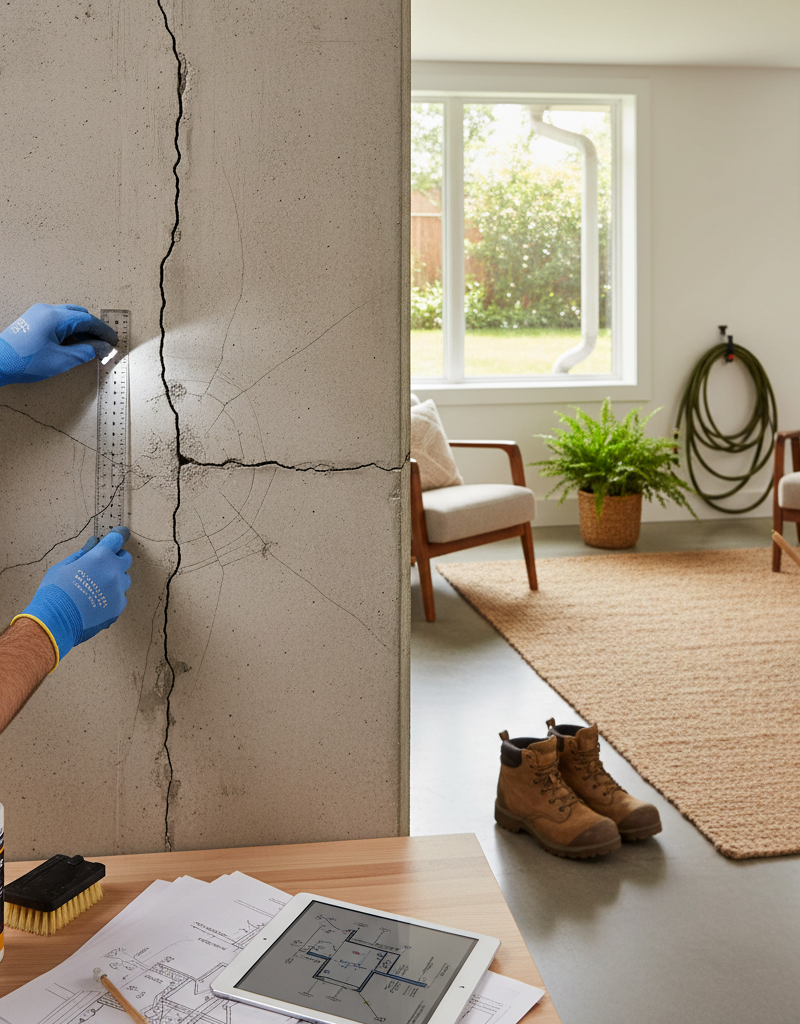
Concrete · Cracked or sunken concrete
| Project category | Concrete |
|---|---|
| Problem type | Cracked or sunken concrete |
| Trade required | Concrete |
| Urgency | Planned project |
| Safety risk | Moderate safety risk |
| DIY suitability | Pro recommended |
| Cost category | High cost |
| Typical timeline | Pour in a day, cure before use for several days |
| Contractor type | Concrete contractor |
Repair option
Slab lifting or crack repair when the concrete is otherwise sound.
Replacement option
Tear out and repour when the slab is spalled or broken through.
Common causes
- Soil washout under the slab
- Missing control joints
- Freeze-thaw and de-icing salts
Relevant tools:project cost estimatorhome improvement material prices
Published August 21, 2026Last updated August 21, 2026
Tools & materials you'll need
Affiliate links- AmazonSmartphone camera and video
As an Amazon Associate FixlyGuide earns from qualifying purchases — at no extra cost to you. Prices and availability are accurate as of publication and subject to change.
Quick Answer
If a contractor damages your home, responsibility usually depends on three things: what actually caused the damage, what your contract says, and what the evidence shows. Photograph everything before you clean up, find your "before" photos, notify the contractor the same day, and get any repair agreement in writing. Most damage disputes aren't won by arguing louder — they're won by the homeowner who documented the house before the crew ever showed up.
You Hired Someone to Improve Your House. Now Part of It Is Broken.
You walk in after a work day and something's wrong.
A water line got nicked. A hardwood plank is gouged where the fridge got dragged. A window pane is cracked. Somebody ran a skid steer across the yard and flattened two sprinkler heads. A roofer bent the gutter run on the back of the house.
Or it's worse than that.
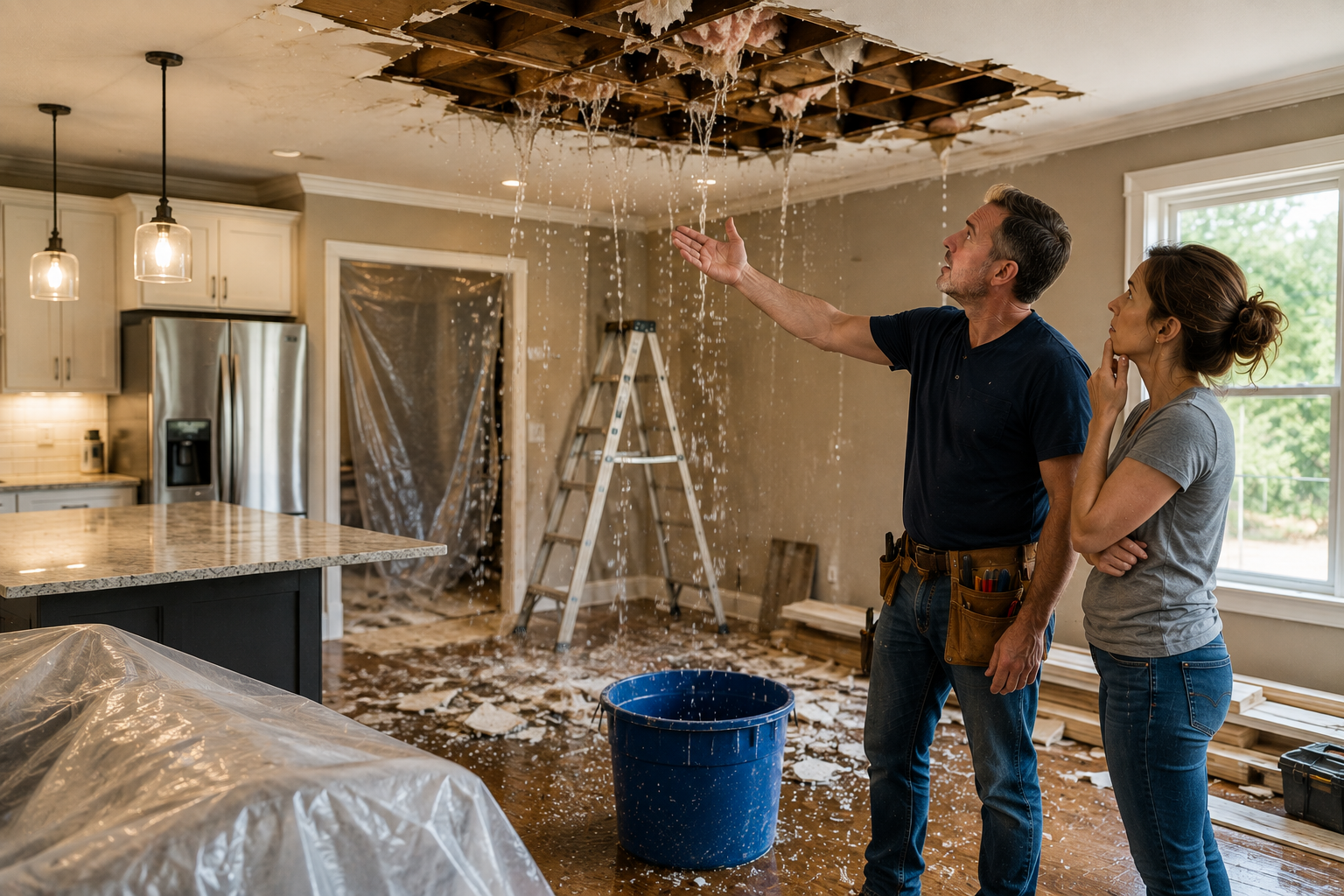
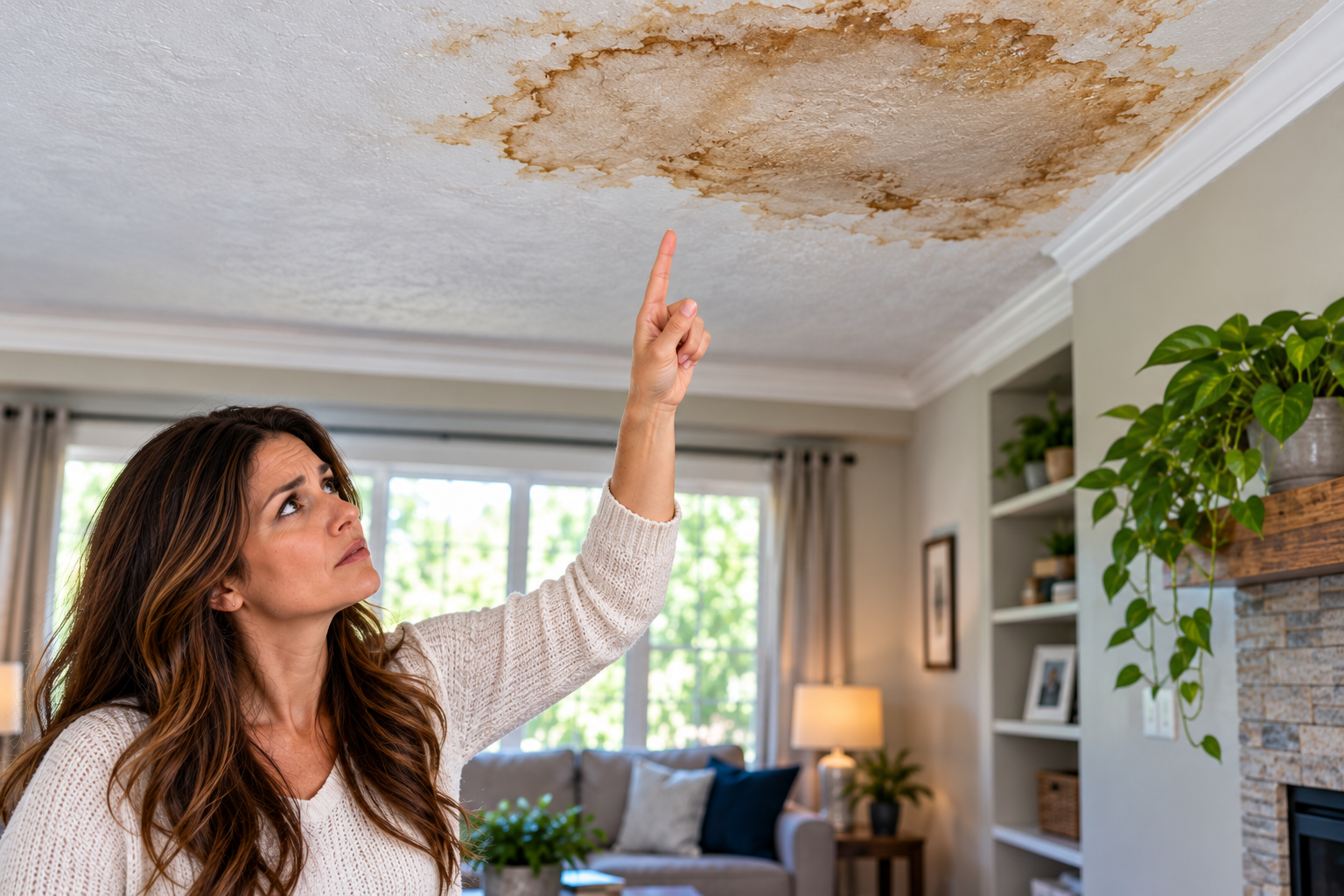
A supply line upstairs takes a screw. Nobody hears it. Water finds the path of least resistance, runs along a joist, and two days later you're standing in the kitchen looking at a brown ring spreading across the ceiling — the exact scene in the photo above, right down to the bucket.
And you're thinking one thing: who's paying for this?
Here's where a bad afternoon turns into a real fight. The contractor says the scratch was already there. You know it wasn't. Maybe a sub actually did it. Maybe insurance gets pulled in. Maybe there's a clause in the contract neither of you read closely at signing.
That $15,000 remodel you were excited about is now something else entirely.
So what do you do first? Not the thing most people do.
Don't open with anger. Open with evidence.
Accidents Don't Automatically Mean You Hired the Wrong Guy
I want to say this early because homeowners skip past it.
Construction is violent work. Crews are cutting, drilling, demoing, hauling sheet goods through hallways, working around live water and live wire, climbing, prying, lifting appliances, running equipment across soft ground, opening walls nobody has looked inside in forty years.
Things go wrong. Even with good people. Even with careful people.
A plumber can slip a torch. A roofer can drop a bundle. A delivery truck can spider a driveway. That doesn't tell you much about the company you hired.
What happens next tells you everything.
Compare these two:
"We scratched the floor moving the fridge. I already photographed it and I've got my flooring guy coming Thursday."
"Huh. That was probably already there."
Same accident. Completely different contractor.
Step 1: Photograph Everything Before You Touch Anything
Before you clean. Before you move furniture. Before you toss the wet drywall in a bag. Before anybody "starts on the repair."
Shoot it.
- Wide shots that establish the whole room
- Tight shots of the actual damage
- Multiple angles — three or four per item
- The surrounding area, so nobody can claim you cropped something out
- Jobsite conditions: tools, materials, where the crew was working
- Affected materials, trim, cabinets, contents
- Water lines, staining, debris fields
- Video anytime motion, dripping or sound matters
Obvious exception: if water is actively running, protect the house first. Stopping the leak beats building a perfect photo album. But grab thirty seconds of video on your way to the shutoff — that footage is worth more than an hour of arguing later.
Your phone is the single most useful tool you have in a damage dispute.
Step 2: Go Find Your "Before" Photos
Almost nobody thinks about this until the moment they need it.
Dig through:
- Your camera roll
- The real-estate listing photos from when you bought
- Your home inspection report
- Photos the contractor took during the estimate
- Insurance documentation
- Holiday and family pictures taken in that room
- Google Photos search by room or date
- Old videos
An unrelated birthday photo from eight months ago that happens to show clean, unmarked flooring in the background is real evidence. I've watched a Christmas-morning picture settle a $4,000 argument.
Which brings me to a rule I'd like every Fixly Guide reader to adopt.
Photograph your house before every major renovation. Not after. Before.
Walk the project area with your phone and shoot slow video. Walls. Floors. Doors and casings. Windows. Countertops. Driveway and walkway. Landscaping. Adjacent rooms the crew will walk through.
Five minutes. You'll probably never need it. The one time you do, it's worth thousands.
Step 3: Tell the Contractor the Day You Find It
Don't sit on it. Don't stockpile grievances and dump them at final payment — that's the worst possible moment, because now it looks like leverage instead of a legitimate concern.
Keep the first message plain:
"I noticed this damage after today's work. I don't believe it was there before. Can we look at it together and figure out what happened?"
Read what that does. It states the problem. It invites an inspection. It doesn't accuse anybody of anything.
A lot of the time you'll get: "Yeah, that was us. We'll take care of it." Done. Not every construction problem needs to become a dispute, and treating every one like a lawsuit guarantees more of them.
Step 4: Figure Out What Actually Caused It
This is where it gets genuinely complicated, and where most homeowner-contractor fights live.
Three different situations get lumped together and they shouldn't be:
| Situation | What happened | Typical responsibility |
|---|---|---|
| Pre-existing damage | The gouge, crack or stain was there before work started | Homeowner's — this is what before photos settle |
| Hidden condition | Rot, mold, bad wiring or old leaks uncovered by demo | Usually homeowner's cost; the contractor found it, didn't cause it |
| Construction damage | A screw through a supply line, a dropped tool, a cracked slab from equipment | The contractor's to make right |
Bathroom remodel, tile comes off, framing behind it is soaked and punky? That's a hidden condition. The contractor exposed it.
Screw through a PEX line that floods the ceiling below? That's construction damage. Different conversation entirely.
Demo vibration cracks tile in the next room because that tile was set over a bad substrate ten years ago? Now you're in the gray zone, and that's where an independent opinion earns its fee.
Hidden Damage Is Not Contractor Damage
Worth its own section because it causes so many unnecessary arguments.
You hire someone to replace siding. Siding comes off. Sheathing underneath is rotted to oatmeal. Your first instinct is "you pulled my siding off and now I have a giant problem."
They didn't create the rot. They uncovered it. It's been rotting since roughly the Obama administration.
Same deal with:
- Mold behind drywall
- Rotten or termite-eaten framing
- Galvanized or polybutylene plumbing
- Ungrounded or improperly spliced wiring
- Foundation cracking
- Failed shower waterproofing
What you should expect from a professional: they stop, photograph it, show you, and explain in plain language what has to happen next and what it costs — in writing, as a change order, before they proceed.
When the Contractor Clearly Did Cause It
Sometimes there's no ambiguity. They broke a window. Cracked the quartz. Backed a trailer into the garage door. Put a boot through the ceiling from the attic. Took out the neighbor's fence.
Your first question is not "who do I sue?"
It's: "How are you going to make this right?"
Give them the chance to propose something reasonable before you escalate. You'd be surprised how often that's the whole story.
Good Contractors Actually Want This Fixed
Run the math from their side.
A reputable company has a name, a review profile, a referral pipeline and a phone that needs to keep ringing next spring. If a crew member causes $800 of damage on a $20,000 job, converting that into a furious customer and a one-star review is a terrible business trade. It just is.
That's another reason to keep the first conversation calm and factual. You want the contractor solving the problem with you — not calling his lawyer and going quiet.
What If a Subcontractor Did It?
Extremely common, and it's where homeowners get spun in circles.
You hired a remodeling company. They hired the plumber, the electrician, the tile setter, the painter, the HVAC crew. One of those subs damages something, and you hear:
"That wasn't us. That was the plumber."
Your response:
"Understood. Under our contract, who's responsible for resolving it?"
You have a contractual relationship with the general contractor, not usually with their subs. Read your agreement and see how subcontractors and liability are addressed. Don't assume it's your job to personally chase down five different trade companies — you hired one company to manage them.
Insurance Matters Before the Accident, Not After
The usual exchange goes:
"Are you insured?" "Yep." "Great."
That's not verification. That's a conversation about the weather.
Before a significant project, understand what coverage the contractor carries and whether it fits the work. The one most relevant here is typically commercial general liability, which can respond to certain third-party property damage or bodily injury claims arising from business operations — subject to that policy's limits, exclusions and conditions.
That last part matters. "They have insurance" does not mean "everything is covered." Policies carry limits, deductibles, exclusions, notice requirements and conditions, and every incident gets evaluated on its own facts.
Ask for documentation before the first day of work
Depending on your state and the size of the job, that can include:
- Certificate of insurance (ask that it come directly from the agent, not as a forwarded PDF)
- Required state or municipal license
- Business registration
- Bond information where applicable
- Workers' compensation coverage where applicable
Then actually verify the pieces that matter. Nobody wants to learn the coverage situation is murky while water is coming through a light fixture.
When Should Insurance Get Involved?
Not every dinged baseboard needs a claim number.
If a crew scuffs a $150 interior door and offers to replace it Thursday, filing anything would be silly. But the calculus changes fast:
- $25,000 in water damage — different conversation
- Structural damage — different conversation
- Anyone seriously injured — very different conversation
Scale and nature drive the answer. For a significant loss, you're likely coordinating between the contractor, the relevant insurers and possibly independent professionals to establish cause, scope and cost.
Should You Call Your Own Homeowners Insurance?
Possibly — and don't guess either direction.
Whether your policy responds depends on the policy language, the cause of loss, the type of damage, the exclusions and the specific circumstances. Some policies address contractor-caused loss differently than sudden accidental discharge. Some carriers will pay and then pursue recovery from the contractor's insurer themselves, which can be the fastest path to getting your house dry.
If the damage is substantial, call your carrier and ask what your coverage and reporting obligations are. Ask before you assume.
Water Damage Rewrites the Priority List
Back to the punctured pipe.
Water is running. This is not the moment for a three-hour debate about financial responsibility.
In rough order:
- Kill the water at the shutoff if it's safe to do so
- Kill power to affected areas if water is anywhere near fixtures or panels
- Get people and pets clear
- Move belongings out of the path
- Call whoever needs to be called — plumber, mitigation company, contractor
- Start reasonable drying and mitigation
- Document conditions as you go
Water doesn't care whose fault it is. Every hour it sits, the number goes up and mold risk climbs. Sort out responsibility after the house is stable.
Don't Let a Small Accident Become a Huge Loss
Related, and important.
Some homeowners freeze: "The contractor caused it, I'm not touching a thing until they come look."
Bad instinct. You're generally expected to take reasonable steps to prevent further damage where it's safe to do so, and failing to can complicate both insurance and legal outcomes. Photograph it, then mitigate it. The dispute keeps. The drywall doesn't.
If They Offer to Repair It — Get Specific
"We'll fix it" is a sentence, not a plan.
Say they damaged hardwood. Before you accept, ask:
- Which boards are being replaced, exactly?
- Can you source a matching product, or is this a similar-but-not-identical species and grade?
- Who's doing the work — your crew or a flooring specialist?
- Does the repair require refinishing, and if so, how far does the refinish run? (Feathering into an existing finish rarely disappears; refinishing the full room often does.)
- What happens if the finished repair doesn't match?
- How long until it's done?
Then put it in an email. Nothing fancy:
"Confirming your company will replace the three damaged boards in the hallway and refinish the affected area at no cost to me, targeted for the week of the 14th."
Now everybody's memory matches.
"We'll Take Care of It Later" Is a Trap
Later has a way of becoming "I thought somebody already handled that" right around final invoice.
If the contractor acknowledges damage, get the resolution written down somewhere that survives: the punch list, a change order, an email thread, the project-management app, a signed addendum. You don't need a lawyer drafting your text messages. You need a record.
Don't Just Deduct It From the Next Payment
The instinct is understandable: they caused $2,000 of damage, so $2,000 comes off the next draw.
Careful. Unilaterally withholding contract payments can create a second dispute — this one about breach — and in some states it can affect lien exposure. Now you're fighting on two fronts over one scratch.
Better sequence:
- Document the damage
- Notify in writing
- Propose a written resolution — repair, credit, or a mutually agreed holdback
- Get professional or legal advice if the number is significant
Turn one disagreement into one disagreement.
Contractors: The Same Rule Applies to You
"We'll knock $500 off and call it square" is just as sloppy from the other direction. What if the repair costs $3,000? What if the homeowner cashes the credit and still expects the repair?
If a credit is replacing a repair, document three things: the dollar amount, exactly which damage it resolves, and that the homeowner accepts it in lieu of repair. Clarity now prevents a fight in November.
If the Contractor Denies It
This is where the documentation you built in Steps 1 and 2 does the work.
Assemble:
- Before photos and video
- After photos and video
- A dated project timeline of who was on site and when
- Text messages and emails
- Inspection reports
- Names of anyone who witnessed the condition
- The contract and all change orders
- Invoices and payment records
Then ask the contractor, straight: why do you believe your work didn't cause this? Not "you're lying." Ask for their version.
Sometimes they know something you don't. I've seen a homeowner absolutely certain a crew cracked a slab, only for the contractor to produce a photo from the estimate visit showing the same crack, same length, three weeks earlier.
When You Need an Independent Professional
Bring in a neutral expert when the stakes or the technical complexity justify it:
- Structural damage
- Roof or envelope damage
- Foundation movement
- Electrical faults
- Water intrusion inside assemblies
- Extensive flooring or finish damage
Depending on the issue, that's a licensed structural engineer, a certified home inspector, a public adjuster, or an IICRC-certified restoration firm. Their job is to answer four questions: what happened, what caused it, what repair is required, and what it should cost.
That converts "homeowner says X, contractor says Y" into "here's what the evidence shows." Insurers and courts both weight that far more heavily than either party's opinion.
The Neighbor Problem
Nobody plans for this one.
Your contractor damages the property next door. Concrete washout on their driveway. A limb torn off their tree. Fence sections knocked out. Tear-off debris on their car. A trencher through their sprinkler line.
Now there are three parties: you, your contractor, and a neighbor who is going to knock on your door, not the contractor's.
Don't stall. Notify your contractor the same day, document the damage yourself, and keep every conversation professional and factual. This is exactly the scenario general liability coverage exists for — and exactly why you verified it before the job started.
Damage to Personal Property
Crews work around furniture, TVs, artwork, appliances, cars and everything else you own.
Before work starts, ask directly: what needs to come out of the work area, and what will you protect in place?
Then apply the simplest rule in this entire guide: if it's valuable or irreplaceable, you move it yourself. Don't leave your grandmother's vase four feet from a demo zone and hope for the best. Contractors should take reasonable precautions. Homeowners should too.
Build a Pre-Construction Condition Report
Sounds formal. It's a phone video.
Walk the house before the first day. Narrate as you go:
"This is the hardwood at the kitchen transition — no marks." "Driveway, before construction. Existing crack here by the apron." "Siding on the north wall next to the work area." "Landscaping along the driveway."
Dated, time-stamped, narrated. Email a copy to yourself so there's a server-side timestamp too.
For a half-day faucet swap? Overkill. For a $75,000 renovation? I'd do it every time, and I'd send a copy to the contractor so both sides are working from the same record.
Pay Attention to the Access Route
Here's the thing homeowners miss: crews don't just damage the project area. They damage the path to it.
Hallways. Entry doors and thresholds. Stair treads and railings. Driveways. Lawns. Garage floors. Side yards and gates.
Before work starts, walk it and settle:
- Which door do workers use?
- Where do materials get staged?
- Where does the dumpster sit, and on what protection?
- Where do trucks park?
- How is flooring protected — ram board, masonite, and for how long?
- How is landscaping protected?
- Which bathroom, if any, can crews use?
Ten minutes of this conversation prevents most of the damage claims in this article.
The Dumpster Will Damage Your Driveway If You Let It
People never think about this until they're looking at two parallel gouges in the concrete.
Roll-off dumpsters, equipment trailers, material deliveries, concrete trucks, lifts and skid steers can all damage driveways, curbs, aprons, lawns, irrigation lines and sidewalks. A loaded roll-off is heavy enough to crack residential concrete, and drop-off is when it happens.
Ask where heavy equipment goes and how vulnerable surfaces get protected — plywood or timbers under dumpster wheels is standard practice and costs nothing.
The best property damage claim is the one that never happens.
Contractors: Document Existing Conditions Too
This guide isn't only for homeowners.
Before you start, photograph what's already wrong: scratched floors, cracked concrete, dented siding, stained ceilings, broken fixtures, existing water damage. Then walk the significant items with the homeowner so there are no surprises later.
Imagine finishing a job and hearing "your crew cracked my driveway." You open your phone, pull up a dated photo from day one showing that exact crack, and the conversation ends politely in about nine seconds.
Documentation protects both sides. It always has.
One of the Best Green Flags There Is
A contractor walks your property before work starts and says:
"I'd like to photograph existing conditions so neither of us has questions later."
Some homeowners get uneasy — why is this guy photographing my house?
I'd read it the opposite way. That's a company that has been through this before, understands risk, and is protecting both parties. It's one of the strongest signals of professionalism you'll get during the whole hiring process.
What If the Repair Doesn't Match?
Older homes make this hard.
Twenty-year-old hardwood in a discontinued width and stain. Brick from a plant that closed. Discontinued tile. Siding profiles nobody makes anymore. A countertop slab from a batch that's long gone. Weathered roofing next to brand-new shingles.
Now the argument shifts from "who's responsible" to "what counts as a reasonable repair?" Reasonable might mean replacing a larger contiguous area so the transition falls at a natural break, rather than dropping one bright new board in the middle of a faded floor.
That's a conversation to have explicitly, in writing, with a qualified professional's input if the number is large. Don't assume a small damaged area always has a small isolated fix.
The "Betterment" Wrinkle
One more nuance most homeowners have never heard of.
A contractor damages a 15-year-old component. The only practical repair is installing a brand-new one. You're now arguably better off than you were before the loss — and insurance and legal frameworks have concepts (depreciation, betterment) that address exactly that.
Sometimes it means a homeowner contributes toward the upgrade portion. Sometimes it doesn't apply at all. It depends on the policy, the state and the facts. For a significant loss, get real professional guidance rather than crowdsourcing it from a neighborhood Facebook group.
If the Contractor Simply Refuses
You've documented it. You notified them. You tried to resolve it. They're stonewalling.
Depending on the amount and your jurisdiction, the escalation ladder generally looks like:
- Formal written demand — dated letter, specific damage, specific remedy, specific deadline, sent with delivery confirmation
- Insurance notification — put the contractor's carrier on notice if you have the certificate
- Licensing board or state consumer-protection complaint where the trade is licensed
- Mediation — often faster and cheaper than anything below it
- Arbitration, if your contract requires it
- Small claims court, where the amount fits your state's limit
- Legal counsel for anything larger or more complex
Which rung you start on depends on your contract, your location, the dollar amount, your evidence and applicable law. Don't threaten five different lawsuits in your first text. Work up the ladder deliberately — it's more effective and it looks better if this ever lands in front of a judge or arbitrator.
Read the Dispute Section Before You Sign
The most-skipped page in every contract.
Yours may dictate exactly how a dispute has to be handled: mandatory mediation, binding arbitration, venue and jurisdiction, written notice-and-cure periods, attorney-fee provisions, limitations on damages.
Read it while you're happy and nobody's angry. Signing a binding arbitration clause is fine — signing one you never read is how homeowners lose options they didn't know they had.
What About Online Reviews?
The instinct is immediate: one star, right now, name and shame.
Maybe that's where this ends up. But if your actual goal is a repaired floor, leading with a review threat rarely gets you one — it usually gets you a defensive contractor and a longer timeline.
Post a factual review after the situation is resolved, or after it's clear it won't be. Describe what happened and how it was handled. That's genuinely useful to the next homeowner, and it's far more credible than a rage post written the same afternoon.
And contractors: threatening a customer over an honest review doesn't rebuild trust. It's also a bad look permanently archived on the internet.
What NOT to Do When Contractor Damage Happens
- Don't clean up, repair or discard anything before photographing it
- Don't wait weeks to report it
- Don't exaggerate the damage — it destroys your credibility on the parts that are real
- Don't jump straight to accusations of fraud
- Don't let active water or safety hazards sit while you argue
- Don't accept vague verbal promises on anything significant
- Don't withhold payment or fire the contractor without understanding your contract
- Don't post accusations publicly before you know what actually happened
Stay factual. Stay organized. Protect the house first.
The Fixly Guide Contractor Damage Checklist
Save this one.
Immediately
- Stop active damage if it's safe to do so
- Photograph and video everything before touching it
- Protect people, pets and belongings
- Notify the contractor the same day, in writing
Document
- Locate your before photos and video
- Save all texts, emails and voicemails
- Save the contract and every change order
- Record the date and time you discovered the damage
- Record the contractor's response verbatim
Resolution
- Establish the actual cause
- Define the specific repair required
- Get the repair agreement in writing, with a date
- Determine whether insurance is involved and who notifies whom
- Track the repair through completion and photograph the finished work
If there's a dispute
- Get an independent professional evaluation
- Re-read the contract, especially the dispute section
- Preserve every piece of evidence, including the damaged material itself
- Follow required notice and dispute-resolution procedures
- Get qualified professional or legal advice before the deadline passes
7 Questions to Ask Before Construction Starts
- What insurance does your company carry, and can your agent send the certificate directly?
- Who is responsible if your crew or a subcontractor damages something?
- How do you document existing property conditions before you start?
- How will floors, stairs and adjacent areas be protected?
- Where will workers, materials and deliveries enter the property?
- Where will the dumpster and heavy equipment sit, and how is that surface protected?
- Who do I call immediately if something goes wrong?
None of these are paranoid. They're the questions a good project manager asks, and a professional contractor will have crisp answers ready.
The One Question Worth Asking Every Bidder
If you only ask one thing from this entire guide, ask this:
"If something gets accidentally damaged during construction, how does your company normally handle it?"
You're not asking whether they have accidents. Everyone has accidents. You're asking whether they have a process.
An experienced contractor answers immediately and specifically — who to call, how it's documented, how repairs get scheduled, when insurance comes in. Somebody who's never thought about it gives you a shrug and "we're really careful."
You just learned a lot.
Contractors: This Is an Opportunity, Not an Attack
Contractors sometimes bristle at articles like this because it feels like the whole trade is being painted as dishonest. That's not what's happening here. Fixly Guide exists to help good contractors stand out from the ones giving everybody a bad name.
Two contractors bidding the same job:
Contractor A: "Don't worry about it. We never damage anything."
Contractor B: "We ram-board the floors, document existing conditions with photos on day one, carry general liability, and if my crew damages something you call me directly and I handle it."
Which one just won the job?
Professionalism isn't pretending mistakes never happen. It's having a process for when they do.
The Fixly Guide Rule
Accidents don't reveal bad contractors. How contractors handle accidents does.
A contractor can make a mistake and still be professional, honest, responsible and worth hiring again.
The red flag was never "something got damaged." The red flag is "nobody will take responsibility."
That's why homeowners should document their property before construction, verify who they're hiring, confirm appropriate insurance, keep agreements in writing and raise problems immediately.
And why contractors should do exactly the same thing.
Before Your Next Project
Take five minutes before the crew pulls up.
- Photograph and video the whole work area and the access route
- Save the contract somewhere you can find it in a hurry
- Make sure the scope is written and specific
- Verify license and insurance
- Know who your single point of contact is when something goes wrong
Then ask one simple question: "If your crew accidentally damages my property, what happens next?"
A professional will have an answer ready.
When you're ready to start your next project, Fixly Guide can help you find and compare local contractors — so you can ask better questions up front and hire the one whose answers hold up.
What should this project cost?
Enter your project details for a realistic cost range before you call anyone.
Outlet and switch work usually $150–$400; panel upgrades commonly $1,800–$4,200.
- Regional adjustment
- National average
- Labor share (typical)
- ~$709
- Quotes to collect
- 3 written estimates
Educational estimate based on national averages — not a binding quote. Always confirm with written local estimates.
Fixly Project Decision Box
- DIY difficulty
- Professional Recommended
- Estimated time
- Inspection 1–2 hours · repairs 1–3 days
- Cost level
- High
Main tools / materials
- Binoculars for a ground-level look
- Flashlight for attic checks
- Moisture meter
- Roofing cement (temporary patch only)
When to stop and call a pro
- Active leak near lights, fans, or any wiring
- Sagging, bulging, or water-filled ceiling
- Steep, wet, or two-story roof — do not climb it
- Storm or hail damage you plan to claim on insurance
Need professional help?
Free roof assessment first — no phone calls until you ask for them.
Get Local Roofing HelpDecide what your roof needs
Two minutes of questions turns "something is wrong up there" into a clear next step.
- Repair or replace your roof?Answer 10 questions about age, leaks, and damage to get a clear next step.Open
- Compare contractor quotesScore up to four bids on price, warranty, licensing, and timeline.Open
- Get local estimatesSend one request and compare written estimates from vetted pros.Open
Free, no signup required. Estimates are educational guidance, not a quote or an inspection.
Recommended for DIYers & woodworkers
Sponsored
The Top 20 Tools for Workshops of Any Budget
No stationary machines or power tools required — plus 3 fundamental tools that can't be bought at any price.
Get the free guide
Ted's Woodworking — The #1 Woodworking Resource
Detailed instructions, dimensioned drawings, materials & cutting lists, and 3D schematics for every skill level.
See the plansSponsored: links above are affiliate links. FixlyGuide may earn a commission on qualifying purchases — at no extra cost to you.
Frequently asked questions
Is a contractor responsible if they damage my house?+
Potential responsibility depends on how the damage occurred, what your contract says, who performed the work and applicable law. Damage caused by the crew during construction is generally the contractor’s to make right, while pre-existing damage and hidden conditions uncovered during demolition usually are not. Document the damage, notify the contractor promptly, and seek professional or legal advice for significant disputes.
What if a subcontractor caused the damage?+
You typically have a contractual relationship with the general contractor you hired, not with their subcontractors. Notify the contractor and ask who is responsible for resolving it under your agreement. Do not assume you need to chase each trade company yourself.
Should I contact the contractor's insurance company?+
For significant damage, the contractor’s general liability insurance may be part of the resolution. Start by notifying the contractor in writing and documenting the incident. If you already have their certificate of insurance, you can put the carrier on notice, and for large losses you may need to communicate with multiple insurers.
Should I call my homeowners insurance?+
If the damage is substantial or urgent, contact your carrier to understand your coverage and your reporting obligations. Whether a policy responds depends on the policy language, the cause of loss and the exclusions. Some carriers will pay to stabilize your home and then pursue recovery from the contractor’s insurer.
Can I withhold payment because a contractor damaged something?+
Be careful. Unilaterally withholding contract payments can create a separate breach-of-contract dispute and may affect lien exposure in some states. Document the damage, notify the contractor in writing, propose a written resolution such as a repair, credit or agreed holdback, and get professional advice if the amount is significant.
What if the contractor denies causing the damage?+
Assemble before and after photos, a timeline of who was on site, texts and emails, the contract and any inspection reports, then ask the contractor to explain why they believe their work did not cause it. For technically complex or high-dollar damage, an independent engineer, inspector or restoration professional can establish cause and repair scope.
How do I prove damage was not there before construction?+
Before photos and video are the strongest evidence. Check your camera roll, real-estate listing photos, your home inspection report, insurance documentation and even unrelated family photos taken in that room. Going forward, record a narrated walkthrough video of the work area and access route before any major project starts.

Discussion
Loading comments…