
- Special-order materials (cabinets, windows, doors, fixtures)
- Initial material purchases
- Scheduling and crew commitments
General remodeling · Renovation planning
| Project category | General remodeling |
|---|---|
| Problem type | Renovation planning |
| Trade required | General contracting |
| Urgency | Planned project |
| Safety risk | Low safety risk |
| DIY suitability | Pro recommended |
| Cost category | Major investment |
| Typical timeline | Design and permitting often 2–4 months before work starts |
| Contractor type | General contractor |
Repair option
Phase the work and fix the building envelope first.
Replacement option
Full renovation with permits, design, and a general contractor.
Common causes
- Space no longer fits how the household lives
- Resale preparation
- Deferred maintenance stacking up
Relevant tools:project cost estimatorcompare quoteshome improvement material prices
Published August 18, 2026Last updated August 18, 2026
Tools & materials you'll need
Affiliate links- AmazonPayment records and receipts folder
As an Amazon Associate FixlyGuide earns from qualifying purchases — at no extra cost to you. Prices and availability are accurate as of publication and subject to change.
Quick Answer
There is no universal "correct" contractor deposit. Some states cap down payments, and legitimate upfront costs vary wildly by project. Instead of arguing about 10% vs. 50%, ask what the deposit actually pays for, get every payment tied to a defined amount of completed work, keep a written change-order process, and never make final payment until the job is genuinely finished and inspected.
The $15,000 Question
The contractor slides a $30,000 remodeling contract across your kitchen table. Everything looks good. Then you reach the payment section:
50% deposit due at signing. That's $15,000 before construction begins.
Would you pay it?
Some homeowners would immediately say "absolutely not." Others think, "that's probably normal — they have to buy materials."
The better answer is: it depends, and the percentage alone doesn't tell you enough.
Contractors have legitimate reasons for requesting money before and during a project. Materials cost money. Special-order products may require deposits. Crews and subcontractors have to be scheduled. A contractor shouldn't be expected to finance an entire renovation for a homeowner.
At the same time, homeowners shouldn't hand over thousands of dollars without understanding where the money is going, what protection the contract provides, and what work must happen before the next payment becomes due.
Even government consumer-protection guidance emphasizes this distinction. The Federal Trade Commission recommends trying to limit the down payment, checking whether state law restricts deposits, and tying payments during construction to completion of defined portions of work.
So instead of asking "what percentage should I pay upfront?", ask the far better question:
How should money move through this project from signing to completion?
There Is No Universal "Correct" Contractor Deposit
You'll see plenty of advice online saying "never pay more than 10%," or "one-third upfront is standard," or "50% is normal."
Be careful with universal rules. Home-improvement laws and contracting practices vary by state, locality, trade and project type. The FTC advises consumers to check with state or local consumer agencies because some states restrict how much contractors can request as a down payment.
The project itself matters too:
| Project | Upfront cost reality |
|---|---|
| $4,000 interior painting job | Mostly labor and ordinary paint — little must be bought in advance |
| $40,000 kitchen remodel with $12,000 of custom cabinets | Cabinets must be ordered before demolition even starts |
Those two contractors have completely different legitimate cash-flow needs. That's why deposit percentage by itself isn't enough information to judge a contractor.
Why Legitimate Contractors Ask for Deposits
Depending on the project, a deposit may help cover:
- Special-order materials (cabinets, windows, doors, fixtures)
- Initial material purchases
- Equipment reservations
- Scheduling and crew commitments
- Mobilization expenses
It also demonstrates the homeowner is committed to moving forward. There's nothing inherently suspicious about a reasonable advance payment. Texas's Office of the Attorney General tells homeowners that in most circumstances they should expect a contractor to request partial payment in advance after appropriate precautions have been taken.
The problem isn't "contractor wants money before starting." The problem is when you can't get a clear answer to: what happens to my money after I give it to you?
Break Down the $15,000
Before deciding whether you're comfortable, ask what the money is paying for.
Suppose the contractor explains: "About $11,000 covers custom cabinets and materials that must be ordered immediately. Here's the cabinet proposal, here's the material schedule, and here's how the remaining payments correspond to construction milestones."
That's very different from: "That's just how we do it."
You don't need to interrogate a legitimate contractor. But when you're handing someone $15,000, asking how the payment structure works is entirely reasonable.
A Better Contractor Payment Schedule
Instead of focusing only on the deposit, look at the whole schedule. Here's an illustration for a hypothetical $30,000 project — not a universal formula:
| Milestone | Payment |
|---|---|
| Contract signing / initial materials | $5,000 |
| Materials delivered, project begins | $7,000 |
| Major rough work completed | $6,000 |
| Installation milestone completed | $6,000 |
| Substantial completion | $4,000 |
| Final walkthrough / completion requirements met | $2,000 |
The important feature is the structure: money follows clearly defined progress.
The FTC recommends making project payments contingent upon completion of defined amounts of work. Texas consumer guidance similarly says partial-payment schedules should identify what portion of the job has been completed when a payment becomes due, and homeowners should inspect the work before paying.
That's far more useful than obsessing over whether a deposit should be exactly 10%, 20% or 30%.
The one question every homeowner should ask
"Can you walk me through every payment from the initial deposit through final payment and explain what work or materials each payment corresponds to?"
Then listen. You're not looking for a magic percentage. You're looking for a payment structure that makes sense.
Red Flag #1: Paying the Entire Project Upfront
This is very different from paying a deposit. If someone wants 100% of a substantial project before doing the work, slow down.
Texas's Attorney General warns that scammers involved in door-to-door home-repair schemes may demand full payment upfront and then disappear without completing — or even starting — the work. Its guidance says not to pay in full until the job is complete and you've inspected it.
Partial advance payment can be completely legitimate. The entire project paid before meaningful work is a different animal.
Red Flag #2: The Payment Schedule Isn't in Writing
"Just give me $10,000 now and we'll figure out the rest later."
No. A substantial project deserves a written agreement that spells out:
- Total contract price
- Initial payment
- Subsequent payment amounts
- What triggers each payment
- Change-order procedure
- Materials and allowances
- Scope of work
- Start and completion expectations
- Final payment conditions
Texas consumer guidance recommends a written contract specifying what the contractor will do, when work begins, when it should be completed, and the costs of special orders and materials.
If the money isn't clear, don't assume the rest of the project will become clearer later.
Red Flag #3: "I Need More Money" Without Documentation
Construction projects change. A contractor opens a wall and finds rotten framing. The electrical system needs correction. A plumbing line isn't where anyone expected. You decide to upgrade the tile. Those situations can legitimately increase cost — but there should be a process.
When your contractor calls and says "we found another problem, I need $3,500," your next question is:
"Can you show me what's wrong and give me the change in writing?"
That's not distrust. That's project management.
Change Orders: Where Budgets Get Away From You
Understand change orders before construction begins, not when the first one arrives. A change order modifies the original agreement — additional work, removed work, different materials, upgraded fixtures, hidden damage, design changes, schedule changes.
Before signing the original contract, ask:
- How are change orders approved?
- Will I know the additional price before work proceeds?
- Can a change order affect the completion date?
- Who is authorized to approve one?
A casual "while you're here, can you also…" can become a very expensive sentence.
Red Flag #4: Payments Are Running Ahead of the Work
Don't let payments get dramatically ahead of progress without a clear reason.
If you've paid 90% of a $50,000 remodel and only about 55% of the work appears complete, that deserves a conversation. There may be legitimate reasons — expensive custom materials already purchased for your project — but you should understand them.
Texas consumer guidance specifically warns homeowners not to get too far ahead on payments, noting that paying too much upfront reduces the contractor's financial incentive to return and finish the job.
Red Flag #5: Pressure to Pay Immediately
There's a difference between:
- "Your cabinet order requires a deposit by Friday to keep the production date."
- "I need $10,000 tonight or this deal disappears."
Texas's Attorney General warns consumers about home-repair offers involving one-day-only deals, leftover materials, and pressure to sign immediately. A contractor may have real scheduling deadlines — but you should still have time to understand what you're signing and paying for.
Red Flag #6: A Blank or Incomplete Contract
Never sign one. Not "we'll fill in the materials later." Not "don't worry about that section." Not "I'll send you the completed copy afterward."
Texas's Attorney General specifically advises homeowners not to sign contracts containing blanks and to keep copies of everything they sign. If something isn't decided yet, the contract should explain how that decision and its cost will be handled.
Red Flag #7: No Clear Explanation of Final Payment
This is where homeowners give away their last piece of leverage. The project is "basically finished" — but cabinet doors need adjustment, paint needs touch-up, a fixture isn't installed, debris remains, a door doesn't close. And you've already paid 100%.
Consumer-protection agencies consistently advise homeowners not to make final payment until the project is completed satisfactorily. Texas guidance also warns against signing a certificate of completion until the work is finished, the site is cleaned, and you're satisfied.
Your contract should define completion clearly enough that both sides know when final payment becomes due.
Contractors Deserve Protection Too
Homeowner protection shouldn't turn into "never trust contractors." That's terrible advice.
Contractors take financial risks: customers who refuse legitimate final payments, expensive material orders, cancellations, schedule disruptions, change-order disputes, supplier bills, payroll and subcontractor payments.
A fair contract protects both sides. The homeowner shouldn't finance the contractor's entire business — and the contractor shouldn't finance the homeowner's entire renovation.
The Payment Schedule Should Tell a Story
When you read the payment section, you should be able to follow the project:
We sign
  ↓ materials are ordered
  ↓ construction begins
  ↓ major milestone completed → payment due
  ↓ installation progresses
  ↓ final work completed
  ↓ we inspect the project
Final payment is made
If instead the story is "we sign → I pay almost everything → I hope everything works out," ask more questions.
Special-Order Materials Change the Equation
Suppose you're ordering $18,000 of custom windows. The contractor can't return those to the supplier if you change your mind. The same goes for custom cabinets, doors, countertops, millwork and specialty fixtures.
If a large payment is required for special-order materials, ask for details and put the answers in writing:
- What is being ordered, and when?
- Is it refundable?
- Who owns the materials once purchased?
- Where will they be stored?
- What happens if the project is canceled?
Material deposits vs. project deposits
A payment may represent a project deposit, a specific material purchase, or a combination. That distinction matters if something goes wrong. For large material purchases, consider asking for the product description, manufacturer, quantity, order confirmation where appropriate, and expected delivery timing.
You're not trying to run the contractor's business. You're documenting your own project.
A Special Note for Texas Homeowners
The Texas Attorney General states that when a homestead improvement exceeds $5,000, contractors are required by law to deposit payments into a construction account at a financial institution. The agency advises homeowners to ask for written verification of the construction account, and says access to account records should be addressed in the written construction contract.
Texas homeowners should also understand lien exposure: the Attorney General warns that unpaid subcontractors or suppliers may create liens even when the homeowner paid the general contractor.
Those are exactly the details worth understanding before a large payment leaves your bank account.
Storm Damage Requires Extra Caution
After hurricanes, tornadoes and hailstorms, homeowners are stressed, roofs are damaged, water may be entering the house — and dozens of contractors suddenly appear in the neighborhood. Scammers know people want repairs quickly.
Texas has special protections involving certain emergency-remediation contractors. State consumer guidance notes that, subject to exceptions, these contractors cannot demand advance payment or payments disproportionate to work performed in covered disaster situations.
The broader lesson applies everywhere: a disaster is when you feel the most pressure to move fast — and when you may need to slow down the most.
This isn't just theoretical
In May 2026, the Texas Attorney General announced a lawsuit against a DFW-area roofing company, alleging it collected customer payments — including insurance proceeds — then delayed or failed to complete roofing projects and used misleading or high-pressure practices. Those are allegations in an active enforcement matter, not a final finding of liability, but the case illustrates why homeowners should keep control over contracts, payments and documentation.
The lesson isn't "don't trust roofers." It's: don't abandon normal financial precautions because your roof needs immediate attention. Good contractors benefit from that distinction too.
What About Paying Cash?
For a substantial project, you want a payment trail documenting what you paid, when, to whom, and for what. The FTC's contractor guidance advises consumers not to pay cash. Whatever method you use, keep invoices and receipts. A shoebox of handwritten notes isn't the payment system you want for a $50,000 renovation.
What About Contractor Financing?
Financing can make an expensive project possible, but don't let "can I afford the monthly payment?" become your only question. Understand the interest rate, fees, loan term, total amount financed, total repayment cost, prepayment provisions, whether the loan is secured by your home, and when funds are released to the contractor.
Texas consumer guidance advises homeowners to shop financing separately and evaluate interest, finance charges and total repayment costs rather than automatically accepting financing offered alongside the contract. A $40,000 renovation doesn't necessarily cost $40,000 once financing is involved.
The Fixly Guide Pre-Payment Checklist
Before making a substantial initial payment, make sure you can answer these.
Contractor
- Do I know the legal business name?
- Have I verified required licensing where applicable?
- Have I reviewed insurance documentation?
- Do I know who is managing the project?
Contract
- Is the scope written clearly?
- Are materials described?
- Are allowances identified?
- Are exclusions identified?
- Is the change-order process explained?
- Are warranty terms written?
Money
- Do I know what the deposit covers?
- Do I know every major payment milestone?
- Do I know what must happen before each payment?
- Do I know what triggers final payment?
- Will I receive documentation for payments?
Project
- Do I understand the expected start date and duration?
- Do I know who handles permits?
- Do I understand what happens if hidden damage is discovered?
If you can't answer several of those, don't panic — just ask.
10 Questions to Ask Before Handing Over a Deposit
- What exactly does my deposit pay for?
- Are any materials being ordered immediately?
- Are any of those materials custom or non-refundable?
- When is my next payment due?
- What work must be completed before that payment?
- How are change orders priced and approved?
- What could realistically increase the project cost?
- What amount remains unpaid until the end?
- What constitutes project completion?
- What documentation will I receive for every payment?
Those questions aren't hostile. They're professional.
Profit Isn't a Red Flag — Lack of Transparency Is
Good contractors shouldn't have to apologize for making money. They pay for insurance, payroll, vehicles, fuel, equipment, software, office staff, estimating, project management, training, warranty callbacks, taxes and licensing.
So don't assume every dollar above material and hourly labor cost is suspicious. Profit isn't a red flag. Lack of transparency can be.
"But this contractor has great reviews"
Excellent. Reviews matter — they just don't replace a contract. Neither does "my neighbor used him," "he's been doing this 25 years," or "he seems like a really good guy." Those are positive signals. Document the project anyway. A good contractor appreciates clearly established expectations, because written expectations protect them too.
When a Large Deposit Might Make Sense
A larger upfront payment may deserve consideration when there's a clear, documented reason — such as substantial custom materials that must be purchased early. The important words are clear, documented, reason.
Don't automatically reject a contractor because the initial payment is higher than something you read online. Ask why, then evaluate the answer against your contract, the project, the material requirements, local law and your comfort level.
When to be very cautious
Slow down considerably when several of these happen together:
- Large upfront payment
- Vague contract
- Pressure to sign immediately
- No clear material explanation
- No verifiable business information
- Unwillingness to discuss payment milestones
Consumer protection is usually about identifying patterns, not panicking over one detail.
Final Payment: "Almost Done" Isn't "Done"
When your contractor says "we're finished," walk the project. Check it against the contract and the agreed scope. Identify unfinished items. Ask about required inspections. Make sure the site is left in the condition your agreement requires. If something isn't right, document it.
Texas consumer guidance says homeowners shouldn't make full payment until the work is complete, inspected and satisfactory, and shouldn't sign completion papers until the project is actually finished and cleaned up.
Final payment should mean something.
So… Would You Pay 50% Upfront?
Back to the original question: would you hand a contractor $15,000 upfront on a $30,000 remodel?
Don't answer based on the percentage alone. First ask why $15,000?
If $12,000 of custom, documented, project-specific materials must be ordered immediately and everything else about the contractor and contract checks out, that's one situation. If the explanation is "that's just what I charge, I need the money today," that's another.
Same percentage. Completely different risk profile.
The Fixly Guide Rule
Don't ask only how much the contractor wants. Ask what has to happen before they receive it.
That changes the entire conversation. The homeowner gets accountability. The legitimate contractor gets clearly defined payment expectations. Both sides know what's supposed to happen next.
Before you hire: get the scope in writing, understand the payment schedule, verify credentials required for your project and location, ask what isn't included, and know how changes will be approved. A $30,000 remodeling project deserves more due diligence than a $30 online purchase.
Because the worst time to discover that you and your contractor understood the payment agreement differently is after you've already paid the money.
Questions to ask before you sign
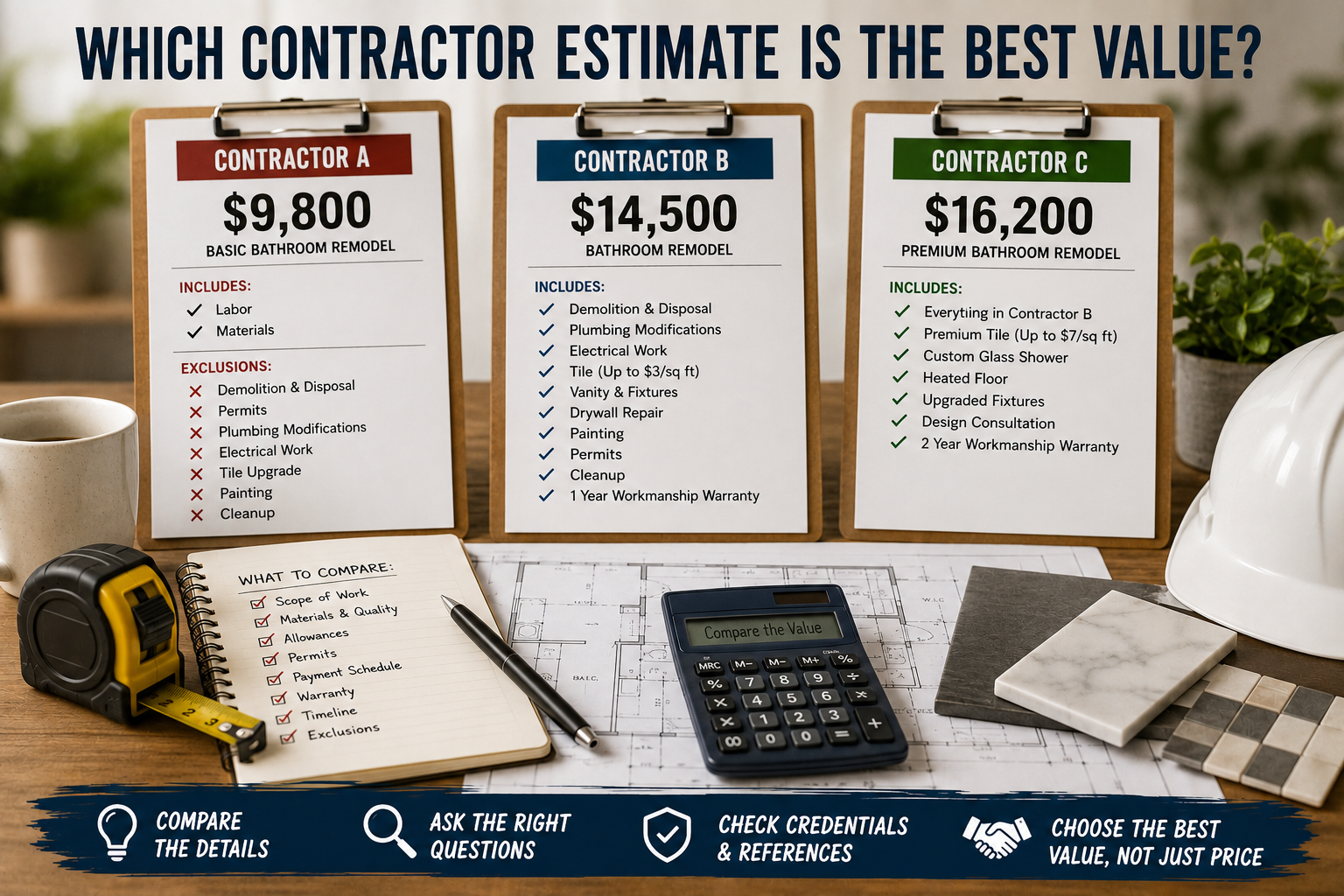
Ask every contractor the same questions and the cheapest bid stops looking cheapest. Check them off as you go — your progress is saved on this device.
Free, no signup. Bring this to every walkthrough so you compare bids on the same terms.
What should this project cost?
Enter your project details for a realistic cost range before you call anyone.
Scope drives everything — single-room work often $10,000–$40,000; whole-home much higher.
- Regional adjustment
- National average
- Labor share (typical)
- ~$21,825
- Quotes to collect
- 3 written estimates
Educational estimate based on national averages — not a binding quote. Always confirm with written local estimates.
Check these numbers against your project
National averages are a starting point. These tools narrow it to your scope and ZIP.
- Estimate this projectGet a cost range for your scope and ZIP before you call anyone.Open
- Get local estimatesSend one request and compare written estimates from vetted pros.Open
Free, no signup required. Estimates are educational guidance, not a quote or an inspection.
Recommended for DIYers & woodworkers
Sponsored
The Top 20 Tools for Workshops of Any Budget
No stationary machines or power tools required — plus 3 fundamental tools that can't be bought at any price.
Get the free guide
Ted's Woodworking — The #1 Woodworking Resource
Detailed instructions, dimensioned drawings, materials & cutting lists, and 3D schematics for every skill level.
See the plansSponsored: links above are affiliate links. FixlyGuide may earn a commission on qualifying purchases — at no extra cost to you.
Frequently asked questions
How much should you pay a contractor upfront?+
There is no single percentage appropriate for every project or jurisdiction. Deposit limits can be governed by state or local law, and legitimate upfront costs vary based on the project and materials. Focus on why the payment is required, how it is documented, and how the remaining payments correspond to project progress.
Is a 50% contractor deposit a red flag?+
Not automatically. It deserves explanation, especially on a large project. Evaluate what the money covers, applicable laws, the contract, special-order materials and the remaining payment schedule rather than judging the percentage in isolation.
Should I ever pay a contractor 100% upfront?+
For a substantial home-improvement project, consumer-protection agencies warn against paying the entire project price before the work is completed.
Should contractor payments be tied to milestones?+
That is generally a stronger structure. The FTC recommends making payments during the project contingent on defined amounts of completed work, and inspecting that work before each payment.
Should I make final payment before the punch list is complete?+
Your contract governs, but consumer guidance generally recommends withholding final payment until the project is completed satisfactorily and applicable inspections or completion requirements are addressed.
Should I pay a contractor in cash?+
The FTC advises against paying cash for home-improvement work. Use a payment method that documents what you paid, when you paid it, who received it and what it was for, and keep every invoice and receipt.
What is a construction account and why does it matter in Texas?+
The Texas Attorney General states that when a homestead improvement exceeds $5,000, contractors are required by law to deposit payments into a construction account at a financial institution. Homeowners can ask for written verification of that account and address access to records in the written contract.


Discussion
Loading comments…