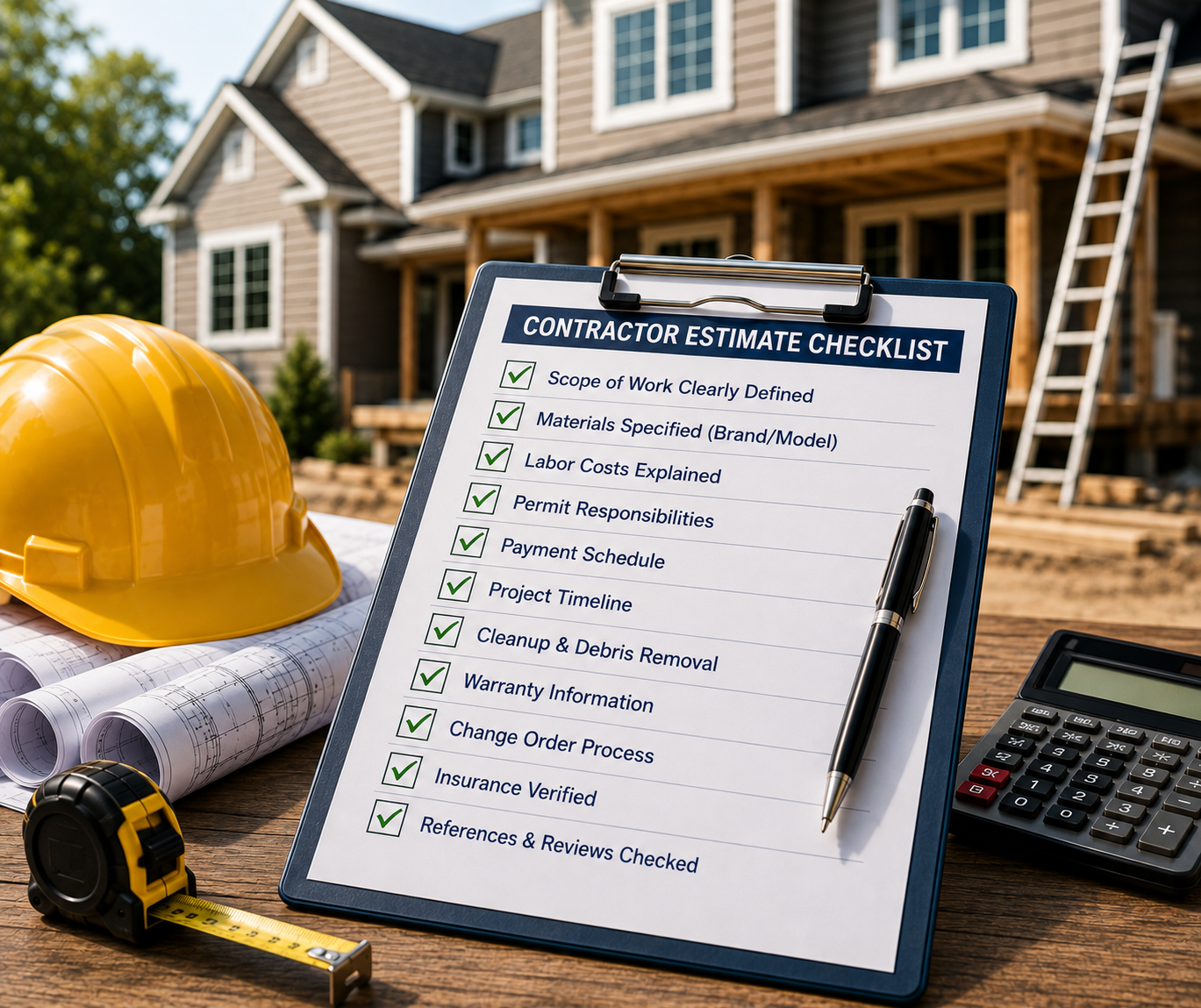
- Company name and contact information
- Contractor license number (where required)
- Detailed project description
- Materials being installed
- Product model numbers (when applicable)
General remodeling · Renovation planning
| Project category | General remodeling |
|---|---|
| Problem type | Renovation planning |
| Trade required | General contracting |
| Urgency | Planned project |
| Safety risk | Low safety risk |
| DIY suitability | Pro recommended |
| Cost category | Major investment |
| Typical timeline | Design and permitting often 2–4 months before work starts |
| Contractor type | General contractor |
Repair option
Phase the work and fix the building envelope first.
Replacement option
Full renovation with permits, design, and a general contractor.
Common causes
- Space no longer fits how the household lives
- Resale preparation
- Deferred maintenance stacking up
Relevant tools:project cost estimatorcompare quoteshome improvement material prices
Published August 3, 2026Last updated August 17, 2026
Tools & materials you'll need
Affiliate links- AmazonComparison scorecard
As an Amazon Associate FixlyGuide earns from qualifying purchases — at no extra cost to you. Prices and availability are accurate as of publication and subject to change.
Quick Answer
Before signing any contractor estimate, confirm the scope of work, exact materials (brand and model), labor breakdown, permit responsibility, cleanup and disposal, payment schedule, warranty terms, insurance, and the change-order process — in writing. Get at least three detailed written bids and compare value, not just the bottom-line price.
Why the Cheapest Bid Isn't Always the Best Deal
You finally received three contractor estimates for your home project.
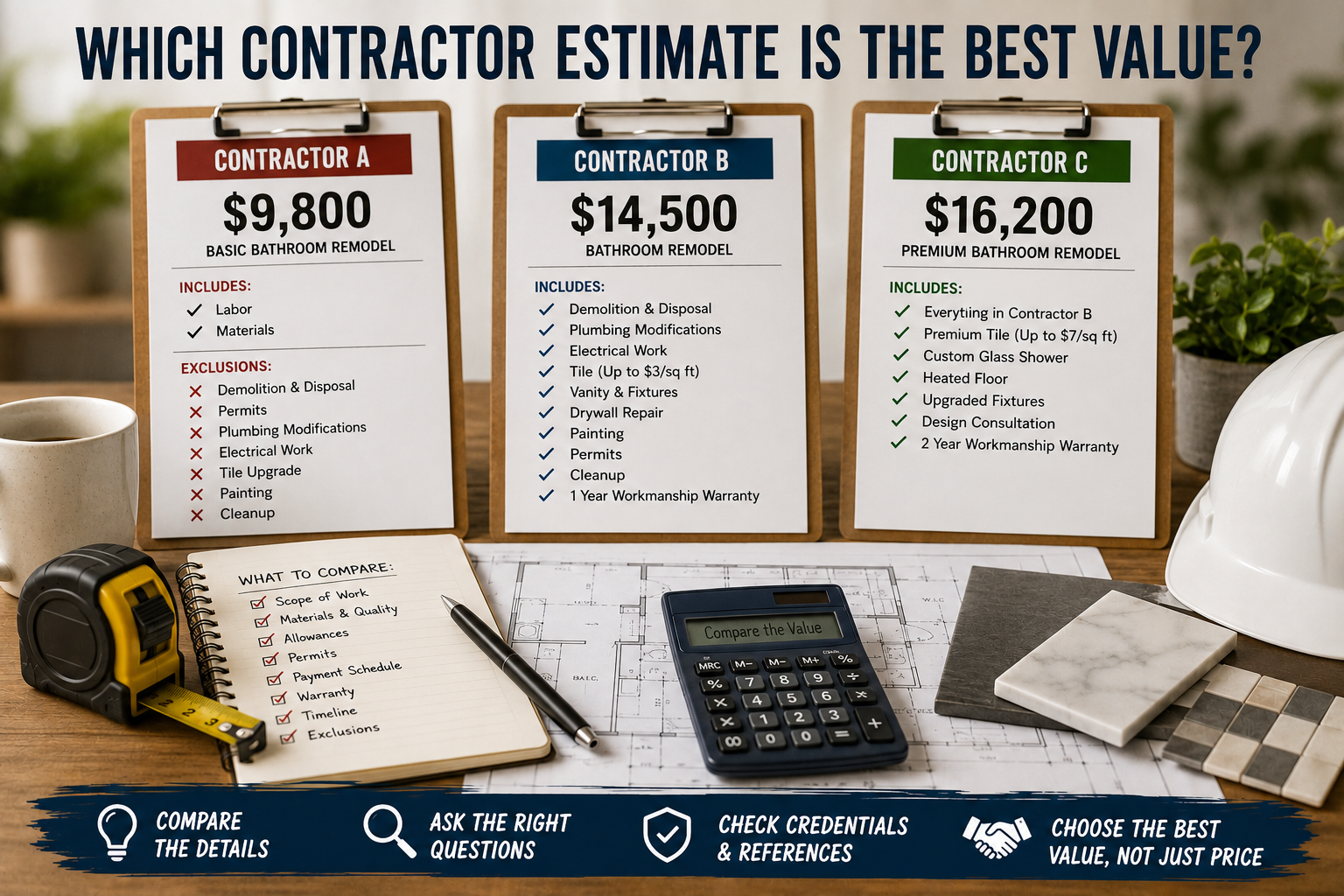
One quote is $8,200. Another is $11,700. The third comes in at $14,300.
Most homeowners immediately ask one question: "Why is one estimate thousands of dollars cheaper than the others?"
The truth is that the cheapest estimate isn't always the best deal. In fact, many expensive home improvement problems begin with an estimate that looked like a bargain.
A low bid may leave out demolition, permits, cleanup, disposal fees, warranty coverage, or even important materials. Those "extras" often appear later as change orders that dramatically increase the final price.
On the other hand, the highest estimate isn't automatically the best either. A premium price should come with better communication, higher-quality materials, stronger warranties, experienced crews, and a clearly defined scope of work.
The key isn't finding the cheapest contractor — it's finding the contractor who provides the best overall value.
This guide walks you through the 21 most important things to review before signing any contractor estimate, helping you avoid surprises, compare bids fairly, and hire with confidence.
Why Comparing Estimates Is So Important
Many homeowners compare only the total price. Professional contractors compare everything else first.
A detailed estimate tells you far more than the final dollar amount. It shows how organized the contractor is, whether they've carefully evaluated your project, and how likely they are to deliver what they promise.
A quality estimate should answer questions before you even think to ask them.
When estimates lack detail, misunderstandings become much more likely. That's when homeowners hear phrases like:
- "That wasn't included."
- "We'll need a change order."
- "That will cost extra."
- "We assumed you wanted the standard option."
These situations can often be avoided by reviewing estimates carefully before work begins.
What Every Contractor Estimate Should Include
Before comparing prices, verify that each estimate includes the same scope of work.
Every professional estimate should clearly identify:
- Company name and contact information
- Contractor license number (where required)
- Proof of insurance
- Detailed project description
- Materials being installed
- Product brands
- Product model numbers (when applicable)
- Labor costs
- Material costs
- Estimated project timeline
- Payment schedule
- Warranty information
- Cleanup procedures
- Debris disposal
- Permit responsibilities
- Change-order process
If any of these items are missing, ask for clarification before signing.
The 21-Point Contractor Estimate Checklist
1. Is the Scope of Work Clearly Defined?
The estimate should explain exactly what work will be completed.
Instead of saying "Replace roof," it should say something like:
"Remove existing shingles, inspect decking, replace damaged decking as needed, install synthetic underlayment, install architectural shingles, replace flashing around chimney and vents, install ridge vent, clean job site, and dispose of debris."
The more detailed the description, the fewer surprises you'll encounter later.
2. Are Materials Clearly Listed?
One estimate may simply say "Install vinyl siding." Another may specify:
- Brand
- Product line
- Thickness
- Color
- Warranty
- Trim package
- Moisture barrier
Those aren't equivalent estimates. Knowing exactly what products are being installed allows you to compare quality — not just price.
3. Does the Estimate Include Labor?
Some contractors bundle labor into one total price. Others separate it into categories such as:
- Demolition
- Installation
- Finish work
- Cleanup
A detailed labor breakdown helps you understand where your money is going and makes it easier to compare multiple bids.
4. Are Permits Included?
Many home improvement projects require permits. Ask:
- Who pulls the permit?
- Who pays permit fees?
- Are inspections included?
- Will the contractor schedule inspections?
Never assume permits are included unless the estimate clearly states it.
5. Is Cleanup Included?
A professional contractor should explain exactly what happens after the work is complete. The estimate should address:
- Debris removal
- Dumpster costs
- Daily cleanup
- Final cleanup
- Nail and fastener removal
- Material disposal
A clean job site is part of a professional installation — not an optional extra.
6. Does the Estimate Include a Payment Schedule?
Every professional estimate should clearly explain when payments are due. A typical payment schedule might look like this:
- Deposit when the contract is signed
- Progress payment after a specific milestone
- Final payment after the work is completed and inspected
Avoid contractors who demand the full payment before work begins. Payments should generally be tied to completed work, not calendar dates.
7. How Much Is the Deposit?
Deposit requirements vary by project, but they should be reasonable and clearly explained. The deposit often covers:
- Ordering materials
- Reserving your project on the schedule
- Initial labor costs
- Permit applications
Be cautious if a contractor asks for a very large upfront payment without explaining why. Always request a receipt for every payment you make.
8. Is There a Project Timeline?
Your estimate should answer questions such as:
- When will work begin?
- How many days will the project take?
- What could delay completion?
- How will weather affect the schedule?
- Will crews work every day?
A realistic timeline is usually more valuable than an unrealistic promise to finish quickly.
9. What Warranty Is Included?
Not all warranties provide the same level of protection. Ask whether the contractor offers a workmanship warranty, manufacturer warranty, labor warranty, and material warranty.
Also ask:
- How long is the warranty?
- What does it cover?
- What is excluded?
- Is the warranty transferable if you sell your home?
The answers can make a significant difference if problems arise after the project is complete.
10. Who Will Actually Perform the Work?
Some companies use their own employees. Others hire subcontractors. Ask:
- Will your own crew perform the work?
- Will subcontractors be used?
- Are they licensed and insured?
- Who supervises the project?
- Who is my primary point of contact?
Knowing who will be on your property helps avoid communication problems.
11. Is the Contractor Licensed?
Licensing requirements vary depending on your state and local regulations. If licensing is required where you live, verify that the contractor's license is active and in good standing.
Don't rely solely on what's printed on the estimate — take a few minutes to verify the information yourself if your jurisdiction provides an online lookup.
12. Is the Contractor Properly Insured?
Insurance protects both you and the contractor. Ask for proof of general liability insurance and workers' compensation coverage (if applicable).
Without proper insurance, homeowners may face unexpected financial risk if property damage or injuries occur during the project.
13. What Isn't Included?
This may be the single most important question you ask. Simply say:
"Can you tell me everything that's NOT included in this estimate?"
The answer often reveals items like drywall repair, painting, landscaping restoration, permit fees, dumpster rental, structural repairs, electrical upgrades, or plumbing modifications.
Knowing what's excluded helps you compare estimates fairly.
14. How Will Change Orders Be Handled?
Even well-planned projects sometimes uncover hidden issues such as water damage, rotten wood, mold, foundation movement, outdated wiring, or plumbing leaks.
Ask the contractor:
- How will additional work be approved?
- Will I receive written pricing first?
- Can work proceed without my authorization?
A reputable contractor should explain the change-order process before the project starts.
15. Who Purchases the Materials?
Some contractors supply everything. Others ask homeowners to purchase certain products such as light fixtures, flooring, cabinets, paint, or plumbing fixtures.
Clarify exactly who is responsible for purchasing each item so there are no surprises later.
16. How Responsive Is the Contractor?
The hiring process often predicts the construction process. Ask yourself:
- Did they return calls promptly?
- Did they arrive on time?
- Did they answer your questions?
- Did they explain things clearly?
- Did they listen to your concerns?
- Did they follow through on promises?
If communication is poor before you become a customer, it's unlikely to improve once the project begins.
17. Are References Available?
A reputable contractor should have satisfied customers willing to share their experiences. Ask for recent customer references, photos of completed projects, online reviews, and projects similar to yours.
When speaking with past customers, consider asking:
- Did the project finish on time?
- Did the final price match the estimate?
- Was the crew professional?
- Was the job site kept clean?
- Would you hire them again?
Patterns in customer feedback can reveal much more than a star rating alone.
18. Are Online Reviews Consistent?
Don't focus only on the overall rating — read the comments and look for recurring themes.
| Positive signs | Warning signs |
|---|---|
| Excellent communication | Poor communication |
| Honest pricing | Missed appointments |
| High-quality workmanship | Unexpected charges |
| Clean job sites | Delayed projects |
| Finished on schedule | Warranty problems |
| Professional crews | Incomplete work |
One negative review isn't necessarily a deal breaker, but repeated complaints about the same issue deserve attention.
19. Does the Contractor Carry the Right Certifications?
Depending on the type of project, manufacturers may certify contractors to install their products. Examples include roofing, siding, windows, HVAC systems, and flooring.
Manufacturer certifications can indicate additional training and may qualify homeowners for enhanced warranty coverage. Ask whether any certifications apply to your project and what benefits they provide.
20. Is Everything in Writing?
Never rely on verbal promises. Your contract should clearly include scope of work, materials, brand names, colors, quantities, labor, timeline, payment schedule, warranty, cleanup, and change-order procedures.
If it's important to you, it belongs in writing. Written agreements help protect both the homeowner and the contractor.
21. Trust Your Instincts
Sometimes everything looks good on paper, but something doesn't feel right. Pay attention if a contractor:
- Pressures you to sign immediately
- Avoids answering questions
- Changes pricing without explanation
- Speaks negatively about every competitor
- Refuses to provide documentation
- Seems disorganized or unprepared
Choosing a contractor is a business decision — but it's also about trust. If something feels off, it's okay to keep looking.
Hidden Costs That Surprise Homeowners
Even a detailed estimate can't predict every issue hidden behind walls or beneath flooring. Some of the most common unexpected expenses include:
- Water damage repairs
- Mold remediation
- Termite damage
- Structural framing repairs
- Outdated electrical systems
- Plumbing replacements
- Subfloor repairs
- Permit revisions
- Material price increases
- Additional labor due to unforeseen site conditions
For that reason, many remodeling professionals recommend setting aside 10–20% of your project budget as a contingency fund for unexpected conditions.
Contractor Red Flags Every Homeowner Should Know
One of the biggest mistakes homeowners make is ignoring early warning signs because the estimate is significantly cheaper than the competition.
Watch for these common red flags:
- Extremely low bids compared to other estimates
- Requests for full payment before work begins
- No written estimate or contract
- Refusal to provide proof of insurance
- No physical business address
- High-pressure sales tactics
- Vague or incomplete project descriptions
- Cash-only payment requests
- No warranty offered
- Unwillingness to answer questions
While none of these automatically mean a contractor is dishonest, several together should prompt you to slow down and investigate further.
Comparing Estimates the Right Way
A helpful way to compare bids is to score each contractor in several categories instead of looking only at the total price.
| Category | Contractor A | Contractor B | Contractor C |
|---|---|---|---|
| Price | /10 | /10 | /10 |
| Communication | /10 | /10 | /10 |
| Detail of estimate | /10 | /10 | /10 |
| Material quality | /10 | /10 | /10 |
| Warranty | /10 | /10 | /10 |
| Experience | /10 | /10 | /10 |
| Reviews | /10 | /10 | /10 |
| Timeline | /10 | /10 | /10 |
| Professionalism | /10 | /10 | /10 |
| Overall value |
This approach often reveals that the "middle" estimate offers the best combination of quality, service, and value.
Why the Cheapest Estimate Can Cost More
A contractor who significantly underbids competitors may need to recover those costs later by:
- Using lower-quality materials
- Cutting corners
- Rushing the work
- Hiring inexperienced labor
- Charging expensive change orders
- Skipping preparation work
- Offering little or no warranty support
Saving money upfront doesn't always mean spending less in the long run. The best estimate is usually the one that clearly explains what's included, uses quality materials, offers a solid warranty, and comes from a contractor with a proven reputation.
Questions to Ask Before You Sign
Before making your final decision, ask these questions:
- Is this your final price?
- Are there any possible additional costs?
- What could delay my project?
- How will you protect my property during construction?
- Who will supervise the job each day?
- How do you handle warranty issues?
- What happens if unexpected damage is found?
- How do I approve change orders?
- What happens if weather delays the project?
- What should I do to prepare before work begins?
These questions often uncover important details that aren't included in the written estimate.
Expert Tips Before You Sign
- Compare at least three detailed written estimates.
- Verify licensing, insurance, and certifications.
- Read recent customer reviews.
- Ask for local references.
- Confirm the exact materials being installed.
- Understand the payment schedule.
- Review warranty coverage.
- Clarify permit responsibilities.
- Know how change orders are approved.
- Make sure every promise is included in writing.
- Keep copies of all contracts, receipts, emails, and estimates.
A little extra preparation now can prevent major headaches later.
Contractor Estimate Comparison Checklist
Use this simple checklist when comparing contractors.
Contractor information
- Licensed (if required)
- Insured
- Local business address
- References provided
- Positive recent reviews
Estimate details
- Scope of work is detailed
- Materials listed by brand/model
- Labor clearly explained
- Timeline included
- Cleanup included
- Permit responsibility identified
- Warranty included
Financial review
- Reasonable deposit
- Payment schedule explained
- Change-order process documented
- No hidden fees identified
Final decision
- Questions answered clearly
- Communication has been professional
- Comfortable with contractor
- Everything is in writing before signing
Final Thoughts
Choosing the right contractor isn't about finding the lowest price — it's about finding the best value.
A well-written estimate should give you confidence by clearly explaining the work, the materials, the timeline, the payment schedule, and the protections you'll have throughout the project.
Take your time. Ask questions. Compare estimates carefully. Verify credentials. And don't be afraid to walk away if something doesn't feel right.
Whether you're replacing your roof, remodeling your kitchen, installing new siding, or building a deck, using a detailed contractor estimate checklist can help you avoid costly mistakes and hire with confidence.
Continue to Part 2
This checklist covers what to verify before you sign. Part 2 goes deeper into the money and paperwork traps that show up after the contract is signed — hidden costs, deposit and payment red flags, warranty fine print, change orders, and timeline risk.
Related Guides
Continue planning your project with these homeowner guides:
Questions to ask before you sign
Ask every contractor the same questions and the cheapest bid stops looking cheapest. Check them off as you go — your progress is saved on this device.
Free, no signup. Bring this to every walkthrough so you compare bids on the same terms.
What should this project cost?
Enter your project details for a realistic cost range before you call anyone.
Scope drives everything — single-room work often $10,000–$40,000; whole-home much higher.
- Regional adjustment
- National average
- Labor share (typical)
- ~$21,825
- Quotes to collect
- 3 written estimates
Educational estimate based on national averages — not a binding quote. Always confirm with written local estimates.
Check these numbers against your project
National averages are a starting point. These tools narrow it to your scope and ZIP.
- Estimate this projectGet a cost range for your scope and ZIP before you call anyone.Open
- Get local estimatesSend one request and compare written estimates from vetted pros.Open
Free, no signup required. Estimates are educational guidance, not a quote or an inspection.
Get the print-ready PDF of this guide
A clean, ad-free, printable version you can keep on your phone or pin to the workshop wall. Free with a FixlyGuide account.
- Print-optimized layout
- Tools, materials & every step included
- Saved to your account
Recommended for DIYers & woodworkers
Sponsored
The Top 20 Tools for Workshops of Any Budget
No stationary machines or power tools required — plus 3 fundamental tools that can't be bought at any price.
Get the free guide
Ted's Woodworking — The #1 Woodworking Resource
Detailed instructions, dimensioned drawings, materials & cutting lists, and 3D schematics for every skill level.
See the plansSponsored: links above are affiliate links. FixlyGuide may earn a commission on qualifying purchases — at no extra cost to you.
Frequently asked questions
Should I always get three estimates?+
Yes. For most projects, obtaining at least three written estimates helps you understand average market pricing, compare materials and workmanship, identify unusually low or high bids, learn about different installation methods, and evaluate each contractor’s communication and professionalism. If all three come in close, that is usually a good sign you are seeing realistic market value.
Why is one contractor estimate so much lower than the others?+
A significantly lower estimate is not always a bargain. The contractor may have missed part of the project, left out materials, specified lower-quality products, excluded permits or cleanup, underestimated labor, or planned to charge change orders later. Always ask why the price differs before making a decision.
Should I negotiate a contractor’s price?+
You can ask about ways to reduce costs, but avoid asking a contractor to simply beat another bid. Instead ask whether different material options would lower the price, whether part of the project can be simplified, whether there is a slower season with lower labor costs, or whether some upgrades can be postponed.
What should never be missing from a contractor estimate?+
Every estimate should include a detailed scope of work, material specifications, labor costs, a timeline, a payment schedule, warranty information, cleanup responsibilities, permit responsibilities, contractor contact information, and the change-order process. If any of these are missing, ask for clarification before signing.
How long is a contractor estimate good for?+
Many estimates are valid for 30 to 60 days, though the exact timeframe varies. Material prices for lumber, roofing, windows, and siding can change, so check whether the estimate lists an expiration date or a price guarantee.
Is it safe to pay a contractor in cash?+
Paying with cash is not automatically a red flag, but you should always receive a written contract, a detailed receipt, documentation of every payment, and a record of the remaining balance. Avoid making large cash payments without proper paperwork.
What happens if problems are found during the project?+
Unexpected issues such as rotten framing, water damage, mold, hidden plumbing leaks, electrical code violations, or foundation problems are common in remodeling work. Before work begins, ask how discoveries will be handled and insist that all additional work be priced and approved in writing before it starts.


Discussion
Loading comments…